 Add to Chrome
 Add to Firefox
 Add to Edge
AGIEval: A Human-Centric Benchmark for Evaluating Foundation Models
Apr 13, 2023
Evaluating the general abilities of foundation models to tackle human-level tasks is a vital aspect of their development and application in the pursuit of Artificial General Intelligence (AGI). Traditional benchmarks, which rely on artificial datasets, may not accurately represent human-level capabilities. In this paper, we introduce AGIEval, a novel benchmark specifically designed to assess foundation model in the context of human-centric standardized exams, such as college entrance exams, law school admission tests, math competitions, and lawyer qualification tests. We evaluate several state-of-the-art foundation models, including GPT-4, ChatGPT, and Text-Davinci-003, using this benchmark. Impressively, GPT-4 surpasses average human performance on SAT, LSAT, and math competitions, attaining a 95% accuracy rate on the SAT Math test and a 92.5% accuracy on the English test of the Chinese national college entrance exam. This demonstrates the extraordinary performance of contemporary foundation models. In contrast, we also find that GPT-4 is less proficient in tasks that require complex reasoning or specific domain knowledge. Our comprehensive analyses of model capabilities (understanding, knowledge, reasoning, and calculation) reveal these models' strengths and limitations, providing valuable insights into future directions for enhancing their general capabilities. By concentrating on tasks pertinent to human cognition and decision-making, our benchmark delivers a more meaningful and robust evaluation of foundation models' performance in real-world scenarios. The data, code, and all model outputs are released in https://github.com/microsoft/AGIEval.

RepoCoder: Repository-Level Code Completion Through Iterative Retrieval and Generation
Apr 03, 2023The task of repository-level code completion is to continue writing the unfinished code based on a broader context of the repository. While for automated code completion tools, it is difficult to utilize the useful information scattered in different files. We propose RepoCoder, a simple, generic, and effective framework to address the challenge. It streamlines the repository-level code completion process by incorporating a similarity-based retriever and a pre-trained code language model, which allows for the effective utilization of repository-level information for code completion and grants the ability to generate code at various levels of granularity. Furthermore, RepoCoder utilizes a novel iterative retrieval-generation paradigm that bridges the gap between retrieval context and the intended completion target. We also propose a new benchmark RepoEval, which consists of the latest and high-quality real-world repositories covering line, API invocation, and function body completion scenarios. We test the performance of RepoCoder by using various combinations of code retrievers and generators. Experimental results indicate that RepoCoder significantly improves the zero-shot code completion baseline by over 10% in all settings and consistently outperforms the vanilla retrieval-augmented code completion approach. Furthermore, we validate the effectiveness of RepoCoder through comprehensive analysis, providing valuable insights for future research.
AnnoLLM: Making Large Language Models to Be Better Crowdsourced Annotators
Mar 29, 2023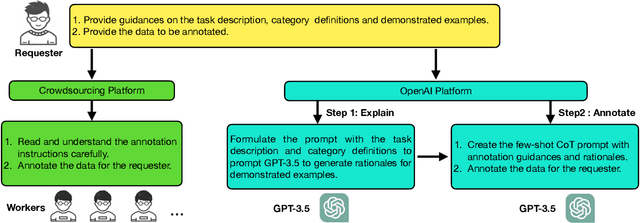
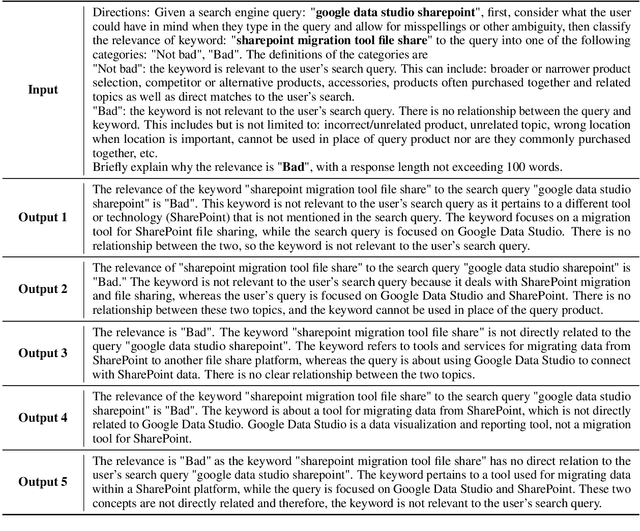
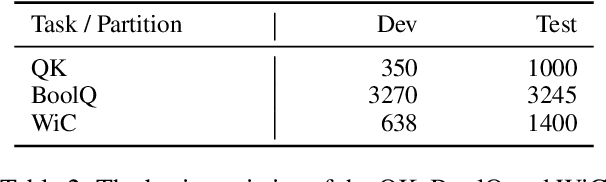
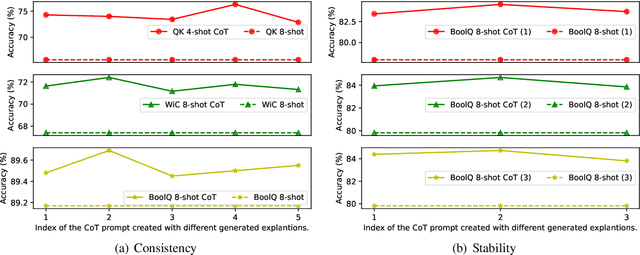
Many natural language processing (NLP) tasks rely on labeled data to train machine learning models to achieve high performance. However, data annotation can be a time-consuming and expensive process, especially when the task involves a large amount of data or requires specialized domains. Recently, GPT-3.5 series models have demonstrated remarkable few-shot and zero-shot ability across various NLP tasks. In this paper, we first claim that large language models (LLMs), such as GPT-3.5, can serve as an excellent crowdsourced annotator by providing them with sufficient guidance and demonstrated examples. To make LLMs to be better annotators, we propose a two-step approach, 'explain-then-annotate'. To be more precise, we begin by creating prompts for every demonstrated example, which we subsequently utilize to prompt a LLM to provide an explanation for why the specific ground truth answer/label was chosen for that particular example. Following this, we construct the few-shot chain-of-thought prompt with the self-generated explanation and employ it to annotate the unlabeled data. We conduct experiments on three tasks, including user input and keyword relevance assessment, BoolQ and WiC. The annotation results from GPT-3.5 surpasses those from crowdsourced annotation for user input and keyword relevance assessment. Additionally, for the other two tasks, GPT-3.5 achieves results that are comparable to those obtained through crowdsourced annotation.
Adaptive Budget Allocation for Parameter-Efficient Fine-Tuning
Mar 18, 2023Fine-tuning large pre-trained language models on downstream tasks has become an important paradigm in NLP. However, common practice fine-tunes all of the parameters in a pre-trained model, which becomes prohibitive when a large number of downstream tasks are present. Therefore, many fine-tuning methods are proposed to learn incremental updates of pre-trained weights in a parameter efficient way, e.g., low-rank increments. These methods often evenly distribute the budget of incremental updates across all pre-trained weight matrices, and overlook the varying importance of different weight parameters. As a consequence, the fine-tuning performance is suboptimal. To bridge this gap, we propose AdaLoRA, which adaptively allocates the parameter budget among weight matrices according to their importance score. In particular, AdaLoRA parameterizes the incremental updates in the form of singular value decomposition. Such a novel approach allows us to effectively prune the singular values of unimportant updates, which is essentially to reduce their parameter budget but circumvent intensive exact SVD computations. We conduct extensive experiments with several pre-trained models on natural language processing, question answering, and natural language generation to validate the effectiveness of AdaLoRA. Results demonstrate that AdaLoRA manifests notable improvement over baselines, especially in the low budget settings. Our code is publicly available at https://github.com/QingruZhang/AdaLoRA .
Meet in the Middle: A New Pre-training Paradigm
Mar 13, 2023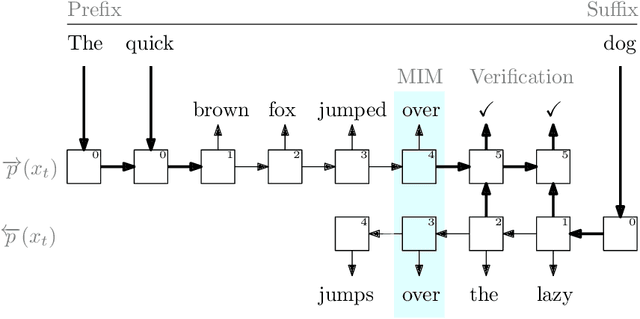
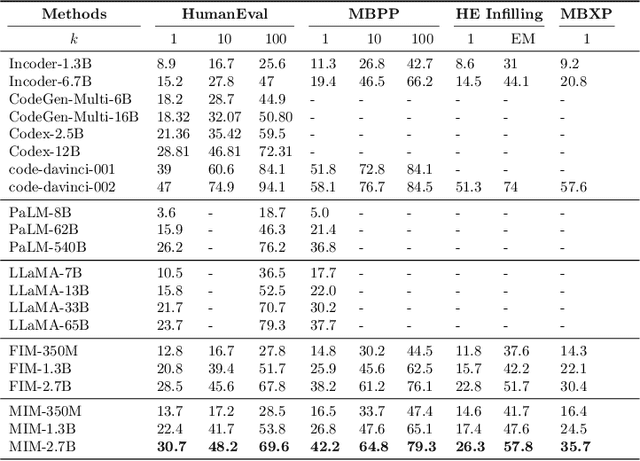
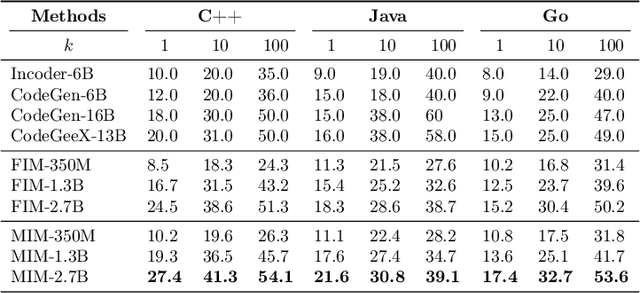
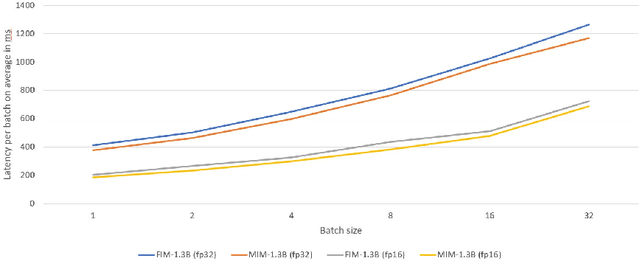
Most language models (LMs) are trained and applied in an autoregressive left-to-right fashion, assuming that the next token only depends on the preceding ones. However, this assumption ignores the potential benefits of using the full sequence information during training, and the possibility of having context from both sides during inference. In this paper, we propose a new pre-training paradigm with techniques that jointly improve the training data efficiency and the capabilities of the LMs in the infilling task. The first is a training objective that aligns the predictions of a left-to-right LM with those of a right-to-left LM, trained on the same data but in reverse order. The second is a bidirectional inference procedure that enables both LMs to meet in the middle. We show the effectiveness of our pre-training paradigm with extensive experiments on both programming and natural language models, outperforming strong baselines.
Check Your Facts and Try Again: Improving Large Language Models with External Knowledge and Automated Feedback
Mar 08, 2023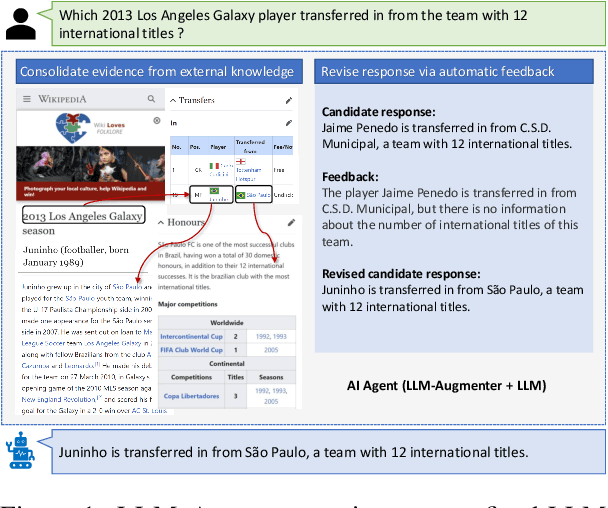

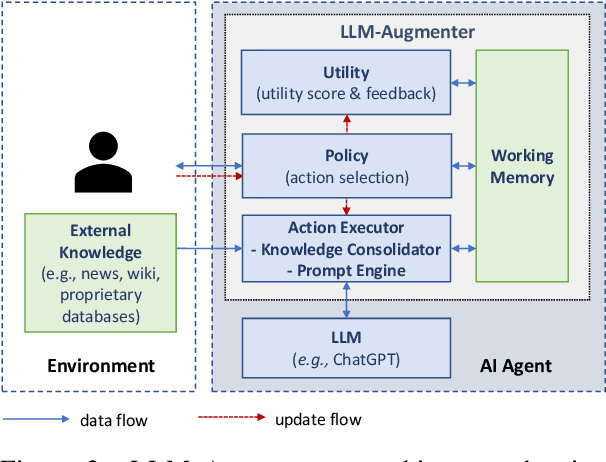

Large language models (LLMs), such as ChatGPT, are able to generate human-like, fluent responses for many downstream tasks, e.g., task-oriented dialog and question answering. However, applying LLMs to real-world, mission-critical applications remains challenging mainly due to their tendency to generate hallucinations and their inability to use external knowledge. This paper proposes a LLM-Augmenter system, which augments a black-box LLM with a set of plug-and-play modules. Our system makes the LLM generate responses grounded in external knowledge, e.g., stored in task-specific databases. It also iteratively revises LLM prompts to improve model responses using feedback generated by utility functions, e.g., the factuality score of a LLM-generated response. The effectiveness of LLM-Augmenter is empirically validated on two types of scenarios, task-oriented dialog and open-domain question answering. LLM-Augmenter significantly reduces ChatGPT's hallucinations without sacrificing the fluency and informativeness of its responses. We make the source code and models publicly available.
Synthetic Prompting: Generating Chain-of-Thought Demonstrations for Large Language Models
Feb 01, 2023Large language models can perform various reasoning tasks by using chain-of-thought prompting, which guides them to find answers through step-by-step demonstrations. However, the quality of the prompts depends on the demonstrations given to the models, and creating many of them by hand is costly. We introduce Synthetic prompting, a method that leverages a few handcrafted examples to prompt the model to generate more examples by itself, and selects effective demonstrations to elicit better reasoning. Our method alternates between a backward and forward process to generate new examples. The backward process generates a question that match a sampled reasoning chain, so that the question is solvable and clear. The forward process produces a more detailed reasoning chain for the question, improving the quality of the example. We evaluate our method on numerical, symbolic, and algorithmic reasoning tasks, and show that it outperforms existing prompting techniques.
GENIE: Large Scale Pre-training for Text Generation with Diffusion Model
Dec 22, 2022
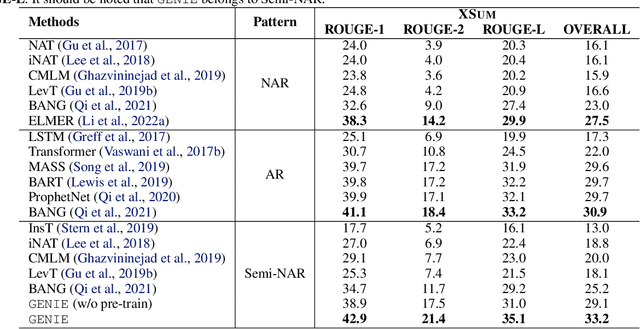
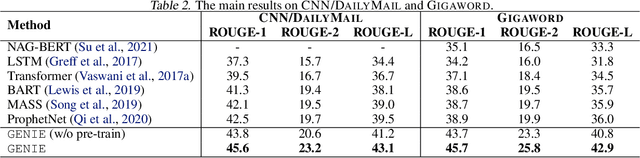
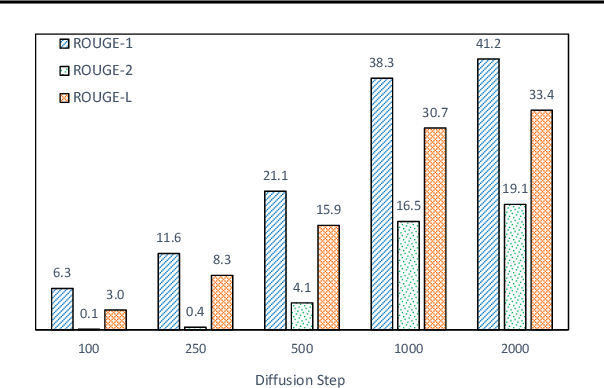
In this paper, we propose a large-scale language pre-training for text GENeration using dIffusion modEl, which is named GENIE. GENIE is a pre-training sequence-to-sequence text generation model which combines Transformer and diffusion. The diffusion model accepts the latent information from the encoder, which is used to guide the denoising of the current time step. After multiple such denoise iterations, the diffusion model can restore the Gaussian noise to the diverse output text which is controlled by the input text. Moreover, such architecture design also allows us to adopt large scale pre-training on the GENIE. We propose a novel pre-training method named continuous paragraph denoise based on the characteristics of the diffusion model. Extensive experiments on the XSum, CNN/DailyMail, and Gigaword benchmarks shows that GENIE can achieves comparable performance with various strong baselines, especially after pre-training, the generation quality of GENIE is greatly improved. We have also conduct a lot of experiments on the generation diversity and parameter impact of GENIE. The code for GENIE will be made publicly available.
Generation-Augmented Query Expansion For Code Retrieval
Dec 20, 2022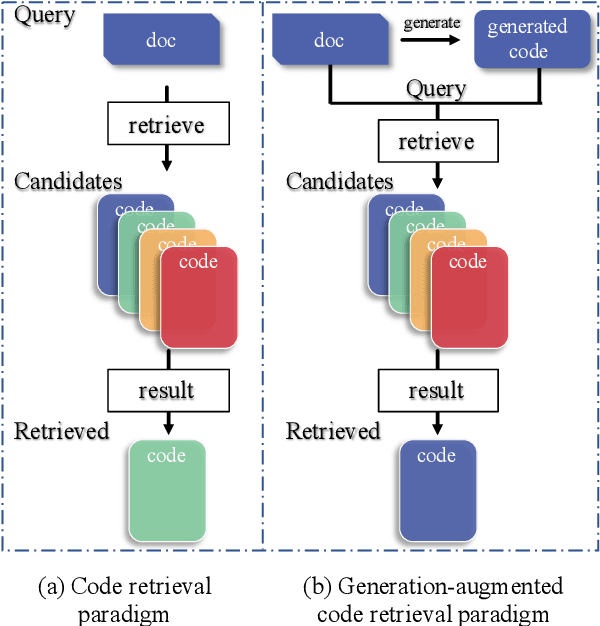
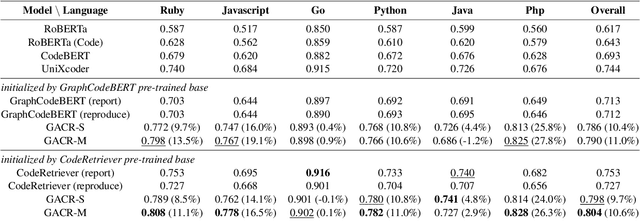

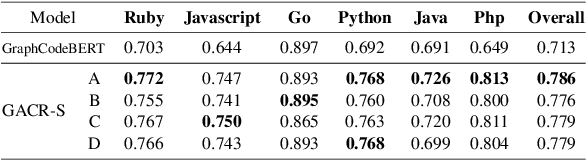
Pre-trained language models have achieved promising success in code retrieval tasks, where a natural language documentation query is given to find the most relevant existing code snippet. However, existing models focus only on optimizing the documentation code pairs by embedding them into latent space, without the association of external knowledge. In this paper, we propose a generation-augmented query expansion framework. Inspired by the human retrieval process - sketching an answer before searching, in this work, we utilize the powerful code generation model to benefit the code retrieval task. Specifically, we demonstrate that rather than merely retrieving the target code snippet according to the documentation query, it would be helpful to augment the documentation query with its generation counterpart - generated code snippets from the code generation model. To the best of our knowledge, this is the first attempt that leverages the code generation model to enhance the code retrieval task. We achieve new state-of-the-art results on the CodeSearchNet benchmark and surpass the baselines significantly.
HyperTuning: Toward Adapting Large Language Models without Back-propagation
Nov 22, 2022Fine-tuning large language models for different tasks can be costly and inefficient, and even methods that reduce the number of tuned parameters still require full gradient-based optimization. We propose HyperTuning, a novel approach to model adaptation that uses a hypermodel to generate task-specific parameters for a fixed downstream model. We demonstrate a simple setup for hypertuning with HyperT5, a T5-based hypermodel that produces soft prefixes or LoRA parameters for a frozen T5 model from few-shot examples. We train HyperT5 in two stages: first, hyperpretraining with a modified conditional language modeling objective that trains a hypermodel to generate parameters; second, multi-task fine-tuning (MTF) on a large number of diverse language tasks. We evaluate HyperT5 on P3, MetaICL and Super-NaturalInstructions datasets, and show that it can effectively generate parameters for unseen tasks. Moreover, we show that using hypermodel-generated parameters as initializations for further parameter-efficient fine-tuning improves performance. HyperTuning can thus be a flexible and efficient way to leverage large language models for diverse downstream applications.