 Add to Chrome
 Add to Firefox
 Add to Edge
Training Small LLMs as Spatial Multi-Agent Policies
Aug 02, 2026
Training LLM-based multi-agent systems with multi-agent reinforcement learning is rapidly gaining traction, and a parallel line of work argues that such systems should be judged by their behavior, not only their reward. We take up both threads in spatial cooperative games, where small frozen LLMs prompted with low-level actions fail outright, earning zero reward. Guided by the options/semi-MDP framework---and, because option execution is asynchronous across agents, its multi-agent extension in macro-action Dec-POMDPs---we equip each game with a library of symbolic \emph{options}: typed, state-feasible, short-horizon behaviors executed by a symbolic planner. Each library is drafted by a frontier coding model from the game's source code; the feasibility guards that filter each menu are then synthesized mechanically from cheap random-policy burn-in rollouts---a guard is adopted only if it explains repeated execution failures while hiding no logged success---so no guard is authored, selected, or reward-tuned by hand. Each agent's LLM acts as its policy over options, with a private per-agent LoRA adapter trained by a per-agent variant of multi-agent GRPO (PA-MAGRPO); this lifts frozen bases from zero reward to competent play across three games and four small backbones. Behavioral audits then reveal that reward and cooperation decouple: a rising reward curve may simply mean that one agent has learned to run the entire task alone while its partner idles---cooperation emerges only when the task makes it necessary. Reward alone is thus an unreliable readout of cooperation; behavioral evaluation must sit alongside it.

Data-Driven Evolution of Library and Information Science Research Methods (1990-2022): A Perspective Based on Fine-grained Method Entities
Jun 24, 2026Since the 1990s, advancements in big data and information technology have increasingly driven data-centric research in the field of Library and Information Science (LIS). To assess the influence of this data-driven research paradigm on the LIS discipline, this study conducts a fine-grained analysis to uncover the evolutionary trends of research methods within the domain. Using academic papers from LIS published between 1990 and 2022, four key categories of data-driven method entities are automatically extracted: algorithms and models, data resources, software and tools, and metrics. Based on these entities, the study examines the evolution of LIS research methods from three dimensions: the characteristics of research method entities over time, their evolution within different research topics, and the evolutionary features of research method entities across various research methods. The findings highlight data resources as a pivotal driver of methodological evolution in LIS, revealing a cyclical pattern of "emergence-stability/practical application" in the development of research methods within the field.
Research Method Usage across Academic Ages in Library and Information Science: An Empirical Study (1990-2023)
Jun 20, 2026Academic age critically shapes career development, influencing research behavior, output volume, and methodological choices. Analyzing method variation across academic ages offers a new theoretical lens on scholarly evolution and provides early-career researchers with practical guidance for method selection. A corpus of 26,677 articles published 1990-2023 in 14 authoritative Library and Information Science journals was compiled. The CogFT model automatically classified the research methods embedded in these articles, and Top2Vec generated the topic model. This process resulted in a comprehensive dataset linking research methods with topics. Author-name disambiguation enabled calculation of each scholar's academic age. Popularity and Shannon diversity indices for methods, together with topic diversity, were compared across academic age groups. Results reveal dynamic methodological trends: the share of theoretical approaches declined gradually, whereas experimental and bibliometric methods gained ground. Method popularity differs significantly among cohorts. Mid-career scholars exhibit the highest method diversity; late-career scholars the lowest.
JD-BP: A Joint-Decision Generative Framework for Auto-Bidding and Pricing
Apr 07, 2026Auto-bidding services optimize real-time bidding strategies for advertisers under key performance indicator (KPI) constraints such as target return on investment and budget. However, uncertainties such as model prediction errors and feedback latency can cause bidding strategies to deviate from ex-post optimality, leading to inefficient allocation. To address this issue, we propose JD-BP, a Joint generative Decision framework for Bidding and Pricing. Unlike prior methods, JD-BP jointly outputs a bid value and a pricing correction term that acts additively with the payment rule such as GSP. To mitigate adverse effects of historical constraint violations, we design a memory-less Return-to-Go that encourages future value maximizing of bidding actions while the cumulated bias is handled by the pricing correction. Moreover, a trajectory augmentation algorithm is proposed to generate joint bidding-pricing trajectories from a (possibly arbitrary) base bidding policy, enabling efficient plug-and-play deployment of our algorithm from existing RL/generative bidding models. Finally, we employ an Energy-Based Direct Preference Optimization method in conjunction with a cross-attention module to enhance the joint learning performance of bidding and pricing correction. Offline experiments on the AuctionNet dataset demonstrate that JD-BP achieves state-of-the-art performance. Online A/B tests at JD.com confirm its practical effectiveness, showing a 4.70% increase in ad revenue and a 6.48% improvement in target cost.
Boosting AI Reliability with an FSM-Driven Streaming Inference Pipeline: An Industrial Case
Mar 02, 2026The widespread adoption of AI in industry is often hampered by its limited robustness when faced with scenarios absent from training data, leading to prediction bias and vulnerabilities. To address this, we propose a novel streaming inference pipeline that enhances data-driven models by explicitly incorporating prior knowledge. This paper presents the work on an industrial AI application that automatically counts excavator workloads from surveillance videos. Our approach integrates an object detection model with a Finite State Machine (FSM), which encodes knowledge of operational scenarios to guide and correct the AI's predictions on streaming data. In experiments on a real-world dataset of over 7,000 images from 12 site videos, encompassing more than 300 excavator workloads, our method demonstrates superior performance and greater robustness compared to the original solution based on manual heuristic rules. We will release the code at https://github.com/thulab/video-streamling-inference-pipeline.
RepoCoder: Repository-Level Code Completion Through Iterative Retrieval and Generation
Apr 03, 2023The task of repository-level code completion is to continue writing the unfinished code based on a broader context of the repository. While for automated code completion tools, it is difficult to utilize the useful information scattered in different files. We propose RepoCoder, a simple, generic, and effective framework to address the challenge. It streamlines the repository-level code completion process by incorporating a similarity-based retriever and a pre-trained code language model, which allows for the effective utilization of repository-level information for code completion and grants the ability to generate code at various levels of granularity. Furthermore, RepoCoder utilizes a novel iterative retrieval-generation paradigm that bridges the gap between retrieval context and the intended completion target. We also propose a new benchmark RepoEval, which consists of the latest and high-quality real-world repositories covering line, API invocation, and function body completion scenarios. We test the performance of RepoCoder by using various combinations of code retrievers and generators. Experimental results indicate that RepoCoder significantly improves the zero-shot code completion baseline by over 10% in all settings and consistently outperforms the vanilla retrieval-augmented code completion approach. Furthermore, we validate the effectiveness of RepoCoder through comprehensive analysis, providing valuable insights for future research.
Exploring Distributional Shifts in Large Language Models for Code Analysis
Mar 16, 2023We systematically study the capacity of two large language models for code - CodeT5 and Codex - to generalize to out-of-domain data. In this study, we consider two fundamental applications - code summarization, and code generation. We split data into domains following its natural boundaries - by an organization, by a project, and by a module within the software project. This makes recognition of in-domain vs out-of-domain data at the time of deployment trivial. We establish that samples from each new domain present both models with a significant challenge of distribution shift. We study how well different established methods can adapt models to better generalize to new domains. Our experiments show that while multitask learning alone is a reasonable baseline, combining it with few-shot finetuning on examples retrieved from training data can achieve very strong performance. In fact, according to our experiments, this solution can outperform direct finetuning for very low-data scenarios. Finally, we consider variations of this approach to create a more broadly applicable method to adapt to multiple domains at once. We find that in the case of code generation, a model adapted to multiple domains simultaneously performs on par with those adapted to each domain individually.
Generation-Augmented Query Expansion For Code Retrieval
Dec 20, 2022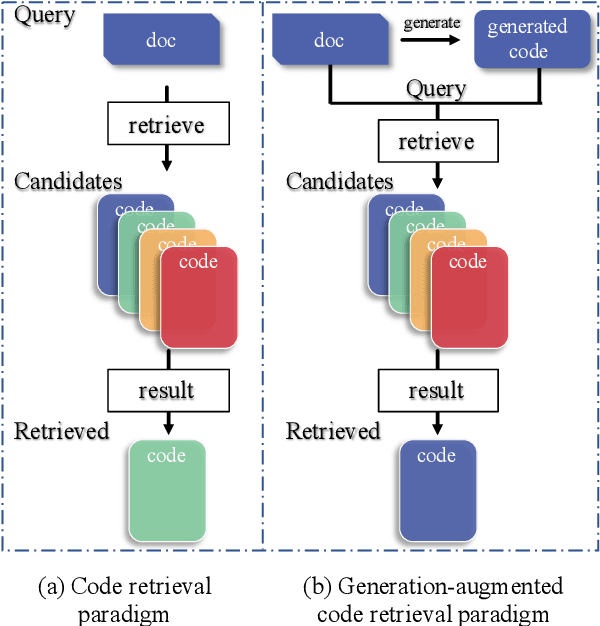
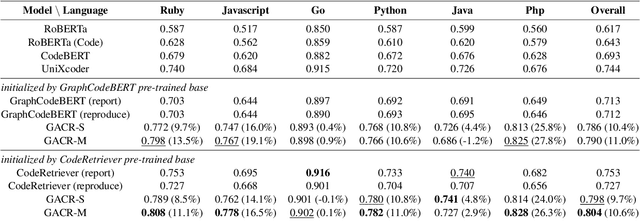

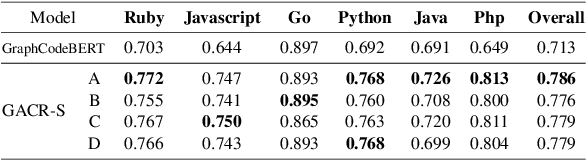
Pre-trained language models have achieved promising success in code retrieval tasks, where a natural language documentation query is given to find the most relevant existing code snippet. However, existing models focus only on optimizing the documentation code pairs by embedding them into latent space, without the association of external knowledge. In this paper, we propose a generation-augmented query expansion framework. Inspired by the human retrieval process - sketching an answer before searching, in this work, we utilize the powerful code generation model to benefit the code retrieval task. Specifically, we demonstrate that rather than merely retrieving the target code snippet according to the documentation query, it would be helpful to augment the documentation query with its generation counterpart - generated code snippets from the code generation model. To the best of our knowledge, this is the first attempt that leverages the code generation model to enhance the code retrieval task. We achieve new state-of-the-art results on the CodeSearchNet benchmark and surpass the baselines significantly.
HyperTuning: Toward Adapting Large Language Models without Back-propagation
Nov 22, 2022Fine-tuning large language models for different tasks can be costly and inefficient, and even methods that reduce the number of tuned parameters still require full gradient-based optimization. We propose HyperTuning, a novel approach to model adaptation that uses a hypermodel to generate task-specific parameters for a fixed downstream model. We demonstrate a simple setup for hypertuning with HyperT5, a T5-based hypermodel that produces soft prefixes or LoRA parameters for a frozen T5 model from few-shot examples. We train HyperT5 in two stages: first, hyperpretraining with a modified conditional language modeling objective that trains a hypermodel to generate parameters; second, multi-task fine-tuning (MTF) on a large number of diverse language tasks. We evaluate HyperT5 on P3, MetaICL and Super-NaturalInstructions datasets, and show that it can effectively generate parameters for unseen tasks. Moreover, we show that using hypermodel-generated parameters as initializations for further parameter-efficient fine-tuning improves performance. HyperTuning can thus be a flexible and efficient way to leverage large language models for diverse downstream applications.
AMD-DBSCAN: An Adaptive Multi-density DBSCAN for datasets of extremely variable density
Oct 15, 2022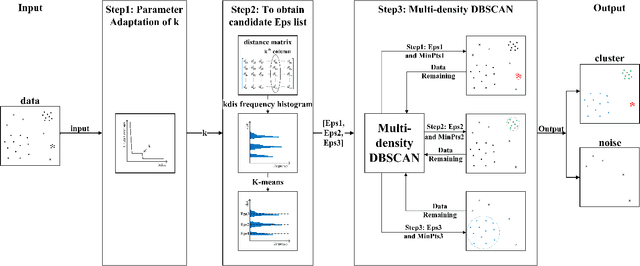
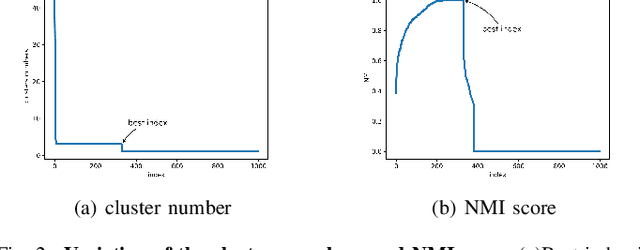
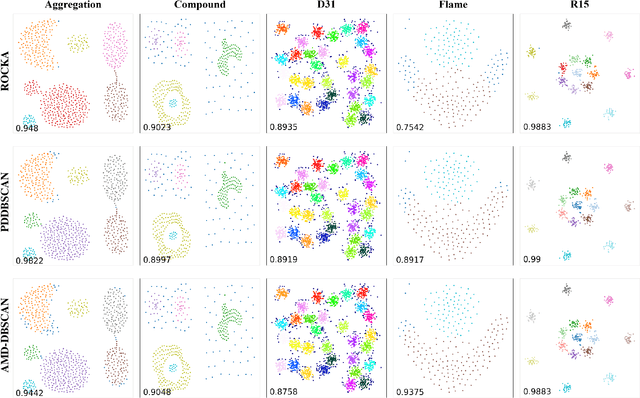
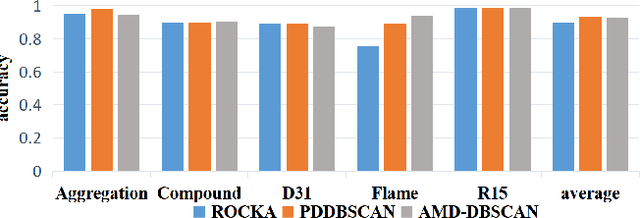
DBSCAN has been widely used in density-based clustering algorithms. However, with the increasing demand for Multi-density clustering, previous traditional DSBCAN can not have good clustering results on Multi-density datasets. In order to address this problem, an adaptive Multi-density DBSCAN algorithm (AMD-DBSCAN) is proposed in this paper. An improved parameter adaptation method is proposed in AMD-DBSCAN to search for multiple parameter pairs (i.e., Eps and MinPts), which are the key parameters to determine the clustering results and performance, therefore allowing the model to be applied to Multi-density datasets. Moreover, only one hyperparameter is required for AMD-DBSCAN to avoid the complicated repetitive initialization operations. Furthermore, the variance of the number of neighbors (VNN) is proposed to measure the difference in density between each cluster. The experimental results show that our AMD-DBSCAN reduces execution time by an average of 75% due to lower algorithm complexity compared with the traditional adaptive algorithm. In addition, AMD-DBSCAN improves accuracy by 24.7% on average over the state-of-the-art design on Multi-density datasets of extremely variable density, while having no performance loss in Single-density scenarios.