 Add to Chrome
 Add to Firefox
 Add to Edge
Latent Recurrent Transformer: Architecture Exploration, Training Strategies, and Scaling Behavior
May 26, 2026
We study Latent Recurrent Transformer (LRT), a lightweight augmentation of autoregressive transformers that reuses a high-level source-layer hidden state from the previous token as recurrent memory for the next token. Because this source state is already computed during ordinary decoding, LRT adds a cross-layer recurrent latent pathway across positions without inserting pause tokens or extra depth loops, and the standard attention mechanism and KV-cache interface are preserved. To pretrain this recurrence at scale without sequentially unrolling the transformer, we introduce interleaved parallel training: a single full-sequence initialization forward pass builds a shared buffer; then disjoint position subsets are refined in parallel and written back, so that all tokens receive recurrent-memory-aware supervision at roughly 2 times baseline compute. Across nanochat style backbones and a wide range of tokens-per-parameter budgets, LRT improves both language-modeling loss and in-context learning under matched effective compute while adding as little as 0.3% parameters.

Orchard: An Open-Source Agentic Modeling Framework
May 14, 2026Agentic modeling aims to transform LLMs into autonomous agents capable of solving complex tasks through planning, reasoning, tool use, and multi-turn interaction with environments. Despite major investment, open research remains constrained by infrastructure and training gaps. Many high-performing systems rely on proprietary codebases, models, or services, while most open-source frameworks focus on orchestration and evaluation rather than scalable agent training. We present Orchard, an open-source framework for scalable agentic modeling. At its core is Orchard Env, a lightweight environment service providing reusable primitives for sandbox lifecycle management across task domains, agent harnesses, and pipeline stages. On top of Orchard Env, we build three agentic modeling recipes. Orchard-SWE targets coding agents. We distill 107K trajectories from MiniMax-M2.5 and Qwen3.5-397B, introduce credit-assignment SFT to learn from productive segments of unresolved trajectories, and apply Balanced Adaptive Rollout for RL. Starting from Qwen3-30B-A3B-Thinking, Orchard-SWE achieves 64.3% on SWE-bench Verified after SFT and 67.5% after SFT+RL, setting a new state of the art among open-source models of comparable size. Orchard-GUI trains a 4B vision-language computer-use agent using only 0.4K distilled trajectories and 2.2K open-ended tasks. It achieves 74.1%, 67.0%, and 64.0% success rates on WebVoyager, Online-Mind2Web, and DeepShop, respectively, making it the strongest open-source model while remaining competitive with proprietary systems. Orchard-Claw targets personal assistant agents. Trained with only 0.2K synthetic tasks, it achieves 59.6% pass@3 on Claw-Eval and 73.9% when paired with a stronger ZeroClaw harness. Collectively, these results show that a lightweight, open, harness-agnostic environment layer enables reusable agentic data, training recipes, and evaluations across domains.
Reinforcement World Model Learning for LLM-based Agents
Feb 05, 2026Large language models (LLMs) have achieved strong performance in language-centric tasks. However, in agentic settings, LLMs often struggle to anticipate action consequences and adapt to environment dynamics, highlighting the need for world-modeling capabilities in LLM-based agents. We propose Reinforcement World Model Learning (RWML), a self-supervised method that learns action-conditioned world models for LLM-based agents on textual states using sim-to-real gap rewards. Our method aligns simulated next states produced by the model with realized next states observed from the environment, encouraging consistency between internal world simulations and actual environment dynamics in a pre-trained embedding space. Unlike next-state token prediction, which prioritizes token-level fidelity (i.e., reproducing exact wording) over semantic equivalence and can lead to model collapse, our method provides a more robust training signal and is empirically less susceptible to reward hacking than LLM-as-a-judge. We evaluate our method on ALFWorld and $τ^2$ Bench and observe significant gains over the base model, despite being entirely self-supervised. When combined with task-success rewards, our method outperforms direct task-success reward RL by 6.9 and 5.7 points on ALFWorld and $τ^2$ Bench respectively, while matching the performance of expert-data training.
RL from Teacher-Model Refinement: Gradual Imitation Learning for Machine Translation
Jul 29, 2025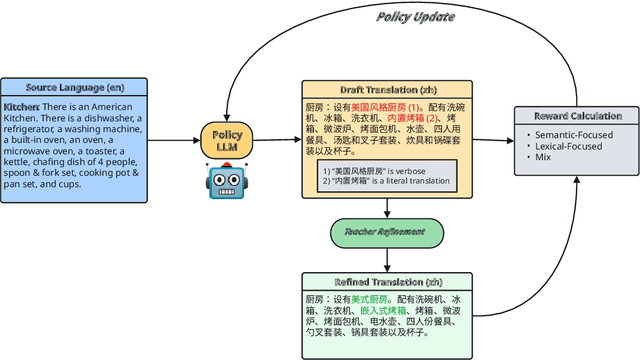
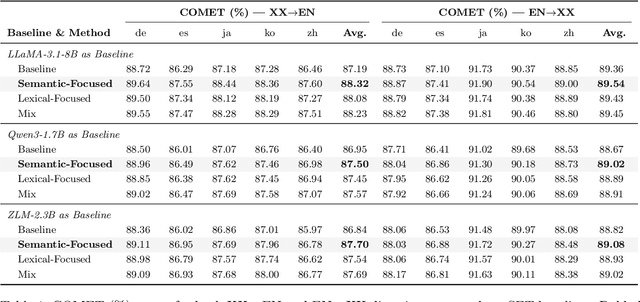
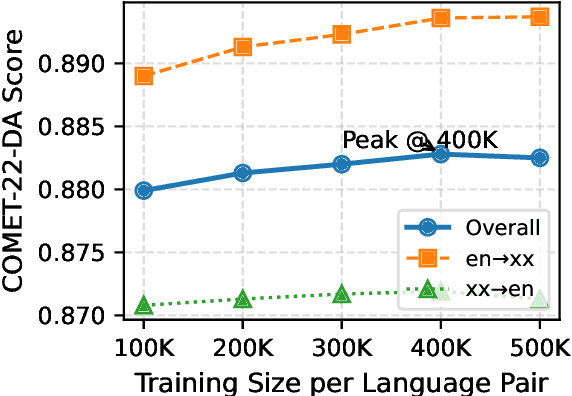
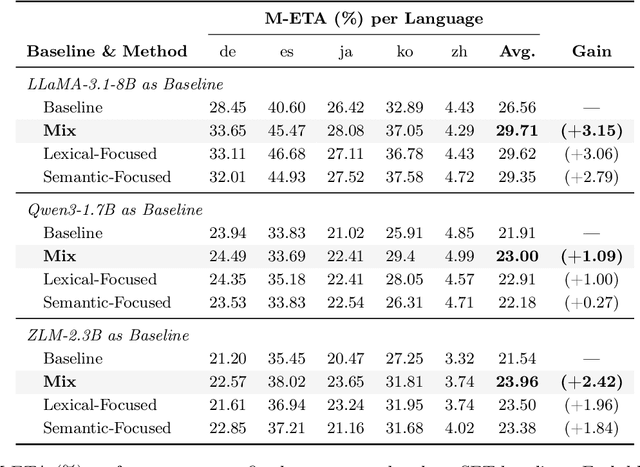
Preference-learning methods for machine translation (MT)--such as Direct Preference Optimization (DPO)--have achieved impressive gains but depend heavily on large, carefully curated triplet datasets and often struggle to generalize beyond their tuning domains. We propose Reinforcement Learning from Teacher-Model Refinement (RLfR), a novel framework that removes reliance on static triplets by leveraging continuous, high-quality feedback from an external teacher model (GPT-4o). RLfR frames each translation step as a micro-tutorial: the actor generates a hypothesis, the teacher refines it, and the actor is rewarded based on how closely it aligns with the teacher's refinement. Guided by two complementary signals--(i) negative edit distance, promoting lexical and structural fidelity, and (ii) COMET score, ensuring semantic adequacy--the actor progressively learns to emulate the teacher, mirroring a human learning process through incremental, iterative improvement. On the FLORES-200 benchmark (English to and from German, Spanish, Chinese, Korean, and Japanese), RLfR consistently outperforms both MT-SFT and preference-based baselines, significantly improving COMET (semantic adequacy) and M-ETA (entity preservation) scores.
Chain of Draft: Thinking Faster by Writing Less
Feb 25, 2025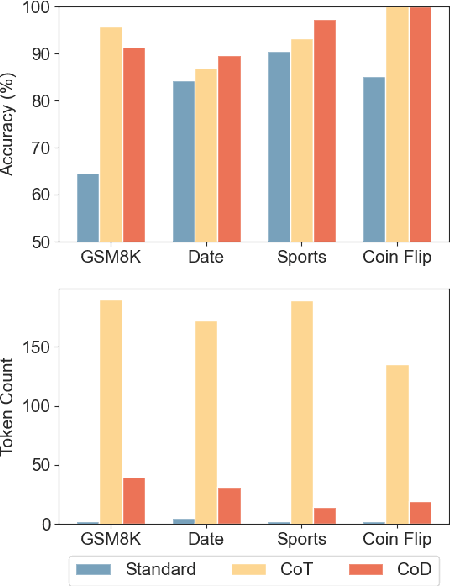
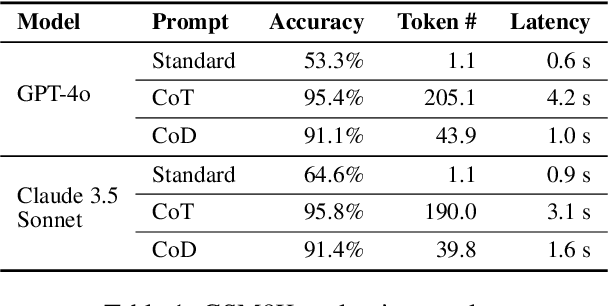
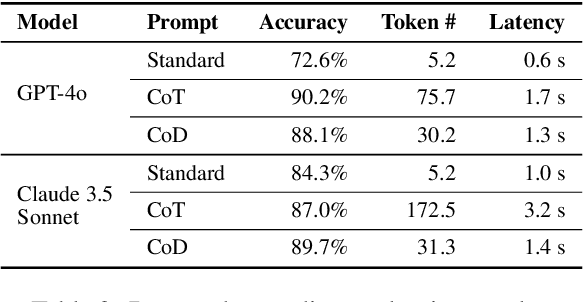
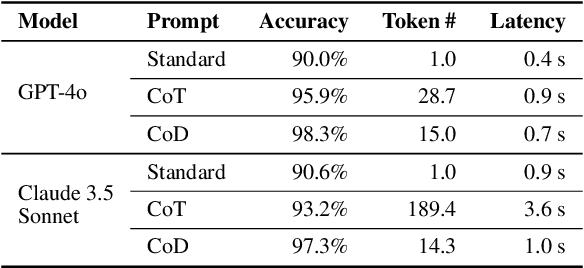
Large Language Models (LLMs) have demonstrated remarkable performance in solving complex reasoning tasks through mechanisms like Chain-of-Thought (CoT) prompting, which emphasizes verbose, step-by-step reasoning. However, humans typically employ a more efficient strategy: drafting concise intermediate thoughts that capture only essential information. In this work, we propose Chain of Draft (CoD), a novel paradigm inspired by human cognitive processes, where LLMs generate minimalistic yet informative intermediate reasoning outputs while solving tasks. By reducing verbosity and focusing on critical insights, CoD matches or surpasses CoT in accuracy while using as little as only 7.6% of the tokens, significantly reducing cost and latency across various reasoning tasks.
Switchable Decision: Dynamic Neural Generation Networks
May 07, 2024Auto-regressive generation models achieve competitive performance across many different NLP tasks such as summarization, question answering, and classifications. However, they are also known for being slow in inference, which makes them challenging to deploy in real-time applications. We propose a switchable decision to accelerate inference by dynamically assigning computation resources for each data instance. Automatically making decisions on where to skip and how to balance quality and computation cost with constrained optimization, our dynamic neural generation networks enforce the efficient inference path and determine the optimized trade-off. Experiments across question answering, summarization, and classification benchmarks show that our method benefits from less computation cost during inference while keeping the same accuracy. Extensive experiments and ablation studies demonstrate that our method can be general, effective, and beneficial for many NLP tasks.
LoftQ: LoRA-Fine-Tuning-Aware Quantization for Large Language Models
Oct 23, 2023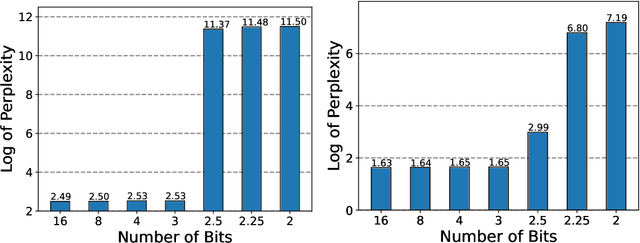
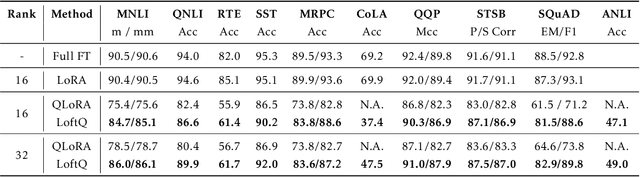
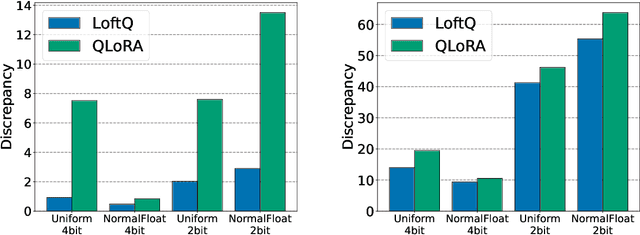
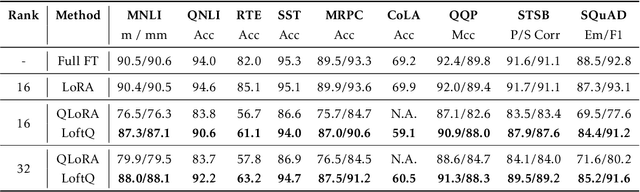
Quantization is an indispensable technique for serving Large Language Models (LLMs) and has recently found its way into LoRA fine-tuning. In this work we focus on the scenario where quantization and LoRA fine-tuning are applied together on a pre-trained model. In such cases it is common to observe a consistent gap in the performance on downstream tasks between full fine-tuning and quantization plus LoRA fine-tuning approach. In response, we propose LoftQ (LoRA-Fine-Tuning-aware Quantization), a novel quantization framework that simultaneously quantizes an LLM and finds a proper low-rank initialization for LoRA fine-tuning. Such an initialization alleviates the discrepancy between the quantized and full-precision model and significantly improves the generalization in downstream tasks. We evaluate our method on natural language understanding, question answering, summarization, and natural language generation tasks. Experiments show that our method is highly effective and outperforms existing quantization methods, especially in the challenging 2-bit and 2/4-bit mixed precision regimes. We will release our code.
Seeking Neural Nuggets: Knowledge Transfer in Large Language Models from a Parametric Perspective
Oct 17, 2023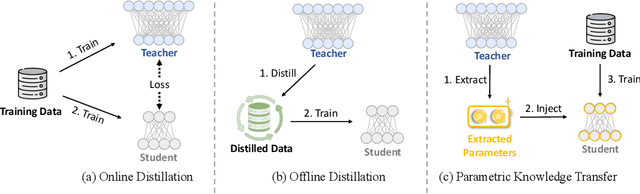
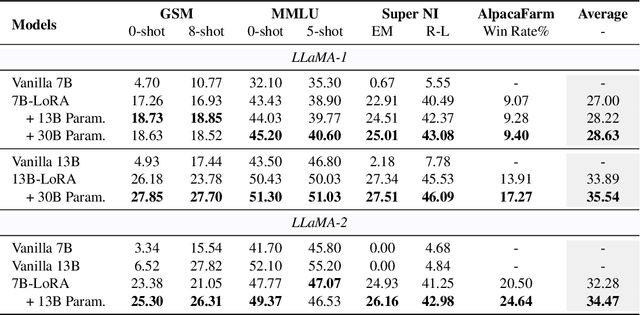
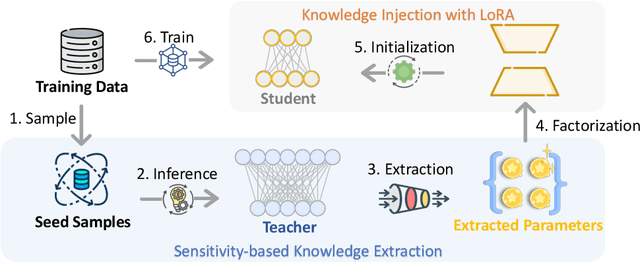
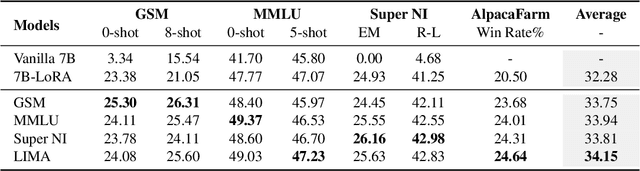
Large Language Models (LLMs) inherently encode a wealth of knowledge within their parameters through pre-training on extensive corpora. While prior research has delved into operations on these parameters to manipulate the underlying implicit knowledge (encompassing detection, editing, and merging), there remains an ambiguous understanding regarding their transferability across models with varying scales. In this paper, we seek to empirically investigate knowledge transfer from larger to smaller models through a parametric perspective. To achieve this, we employ sensitivity-based techniques to extract and align knowledge-specific parameters between different LLMs. Moreover, the LoRA module is used as the intermediary mechanism for injecting the extracted knowledge into smaller models. Evaluations across four benchmarks validate the efficacy of our proposed method. Our findings highlight the critical factors contributing to the process of parametric knowledge transfer, underscoring the transferability of model parameters across LLMs of different scales. We release code and data at \url{https://github.com/maszhongming/ParaKnowTransfer}.
Learning Stackable and Skippable LEGO Bricks for Efficient, Reconfigurable, and Variable-Resolution Diffusion Modeling
Oct 10, 2023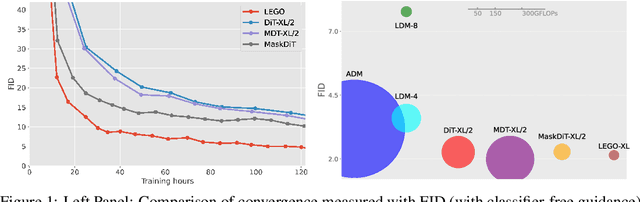

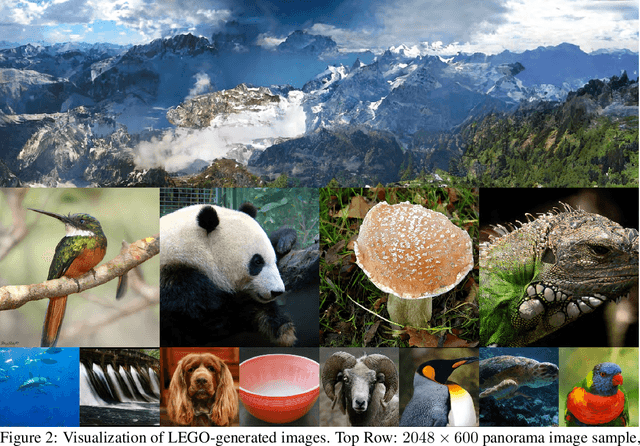
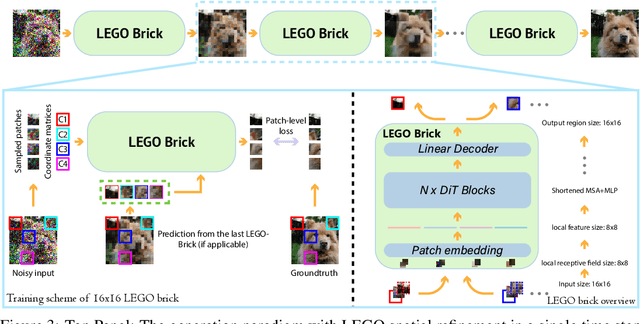
Diffusion models excel at generating photo-realistic images but come with significant computational costs in both training and sampling. While various techniques address these computational challenges, a less-explored issue is designing an efficient and adaptable network backbone for iterative refinement. Current options like U-Net and Vision Transformer often rely on resource-intensive deep networks and lack the flexibility needed for generating images at variable resolutions or with a smaller network than used in training. This study introduces LEGO bricks, which seamlessly integrate Local-feature Enrichment and Global-content Orchestration. These bricks can be stacked to create a test-time reconfigurable diffusion backbone, allowing selective skipping of bricks to reduce sampling costs and generate higher-resolution images than the training data. LEGO bricks enrich local regions with an MLP and transform them using a Transformer block while maintaining a consistent full-resolution image across all bricks. Experimental results demonstrate that LEGO bricks enhance training efficiency, expedite convergence, and facilitate variable-resolution image generation while maintaining strong generative performance. Moreover, LEGO significantly reduces sampling time compared to other methods, establishing it as a valuable enhancement for diffusion models.
DoLa: Decoding by Contrasting Layers Improves Factuality in Large Language Models
Sep 07, 2023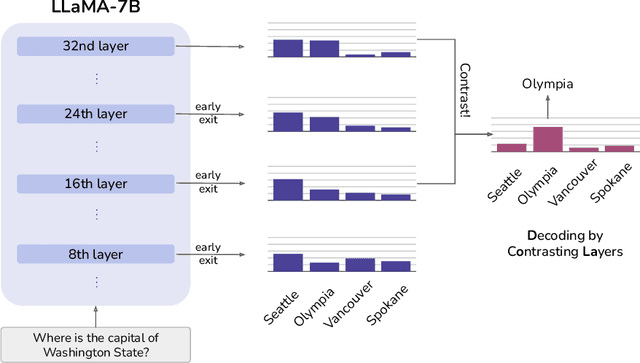
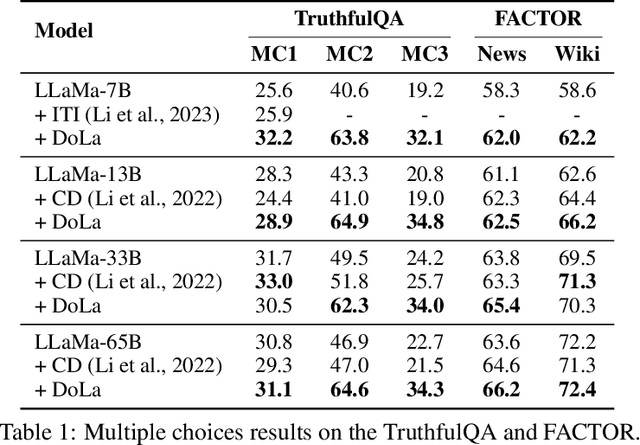
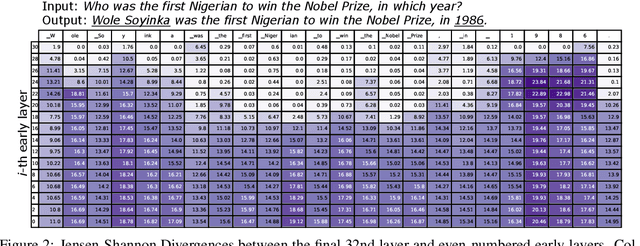
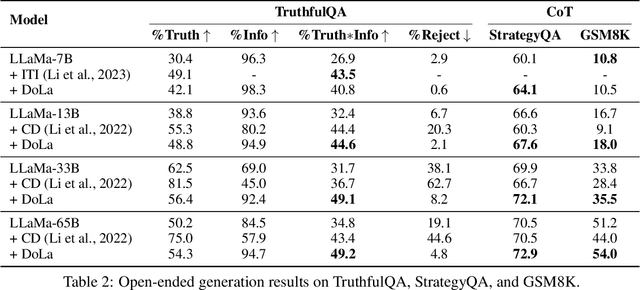
Despite their impressive capabilities, large language models (LLMs) are prone to hallucinations, i.e., generating content that deviates from facts seen during pretraining. We propose a simple decoding strategy for reducing hallucinations with pretrained LLMs that does not require conditioning on retrieved external knowledge nor additional fine-tuning. Our approach obtains the next-token distribution by contrasting the differences in logits obtained from projecting the later layers versus earlier layers to the vocabulary space, exploiting the fact that factual knowledge in an LLMs has generally been shown to be localized to particular transformer layers. We find that this Decoding by Contrasting Layers (DoLa) approach is able to better surface factual knowledge and reduce the generation of incorrect facts. DoLa consistently improves the truthfulness across multiple choices tasks and open-ended generation tasks, for example improving the performance of LLaMA family models on TruthfulQA by 12-17% absolute points, demonstrating its potential in making LLMs reliably generate truthful facts.