 Add to Chrome
 Add to Firefox
 Add to Edge
Frontis-MA1: Training an AI4AI Model towards Recursive Self-Improvement in Machine Learning Engineering
Jul 30, 2026
Recursive self-improvement (RSI) requires AI systems that improve the process of building AI (i.e., AI4AI); machine learning engineering (MLE) offers a concrete, executable testbed for studying this capability. We introduce OpenMLE, an open full-stack system for RSI research in MLE, spanning verifiable task environments with execution feedback (OpenMLE-Gym), operator learning (OpenMLE-RL), and long-horizon search (OpenMLE-Evo). On this stack we post-train Frontis-MA1 (35B) as a meta-evolution agent for MLE, aligning post-training and inference around four atomic program-evolution operators (Draft, Improve, Debug, Crossover): the same operators are trained via execution-grounded SFT and RL on data deduplicated against all evaluation benchmarks, then composed into long-horizon search, coupling learning and evolution in a single loop. On MLE-Bench Lite under a 12-hour per-task budget on one RTX 4090 capped at 12 GB VRAM, Frontis-MA1 (35B) improves Medal Average from 39.39% to 60.61% over its base model with OpenMLE-Evo, and reaches 71.21% with OpenMLE-Evo-Max (benchmark-independent experience priors and asynchronous search), exceeding GPT-5.5 + Codex and approaching GPT-5.6 Sol and the 2.8T Kimi K3. On held-out NatureBench Lite, both components transfer: with the framework fixed, swapping in the trained model raises Match-SOTA from 50% to 70%; with the model fixed, swapping in OpenMLE-Evo raises it from 20% to 50%. We release the model weights and the full OpenMLE stack to enable reproducible research on executable AI4AI toward RSI. Code: https://github.com/FrontisAI/OpenRSI

Frontier-Eng: Benchmarking Self-Evolving Agents on Real-World Engineering Tasks with Generative Optimization
Apr 14, 2026Current LLM agent benchmarks, which predominantly focus on binary pass/fail tasks such as code generation or search-based question answering, often neglect the value of real-world engineering that is often captured through the iterative optimization of feasible designs. To this end, we introduce Frontier-Eng, a human-verified benchmark for generative optimization -- an iterative propose-execute-evaluate loop in which an agent generates candidate artifacts, receives executable verifier feedback, and revises them under a fixed interaction budget -- spanning $47$ tasks across five broad engineering categories. Unlike previous suites, Frontier-Eng tasks are grounded in industrial-grade simulators and verifiers that provide continuous reward signals and enforce hard feasibility constraints under constrained budgets. We evaluate eight frontier language models using representative search frameworks, finding that while Claude 4.6 Opus achieves the most robust performance, the benchmark remains challenging for all models. Our analysis suggests a dual power-law decay in improvement frequency ($\sim$ 1/iteration) and magnitude ($\sim$ 1/improvement count). We further show that although width improves parallelism and diversity, depth remains crucial for hard-won improvements under a fixed budget. Frontier-Eng establishes a new standard for assessing the capacity of AI agents to integrate domain knowledge with executable feedback to solve complex, open-ended engineering problems.
CubeBench: Diagnosing Interactive, Long-Horizon Spatial Reasoning Under Partial Observations
Dec 30, 2025Large Language Model (LLM) agents, while proficient in the digital realm, face a significant gap in physical-world deployment due to the challenge of forming and maintaining a robust spatial mental model. We identify three core cognitive challenges hindering this transition: spatial reasoning, long-horizon state tracking via mental simulation, and active exploration under partial observation. To isolate and evaluate these faculties, we introduce CubeBench, a novel generative benchmark centered on the Rubik's Cube. CubeBench uses a three-tiered diagnostic framework that progressively assesses agent capabilities, from foundational state tracking with full symbolic information to active exploration with only partial visual data. Our experiments on leading LLMs reveal critical limitations, including a uniform 0.00% pass rate on all long-horizon tasks, exposing a fundamental failure in long-term planning. We also propose a diagnostic framework to isolate these cognitive bottlenecks by providing external solver tools. By analyzing the failure modes, we provide key insights to guide the development of more physically-grounded intelligent agents.
GLM-4.1V-Thinking: Towards Versatile Multimodal Reasoning with Scalable Reinforcement Learning
Jul 02, 2025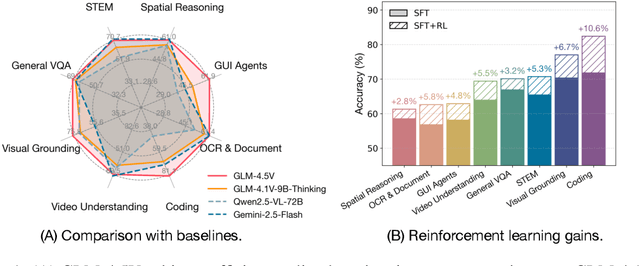
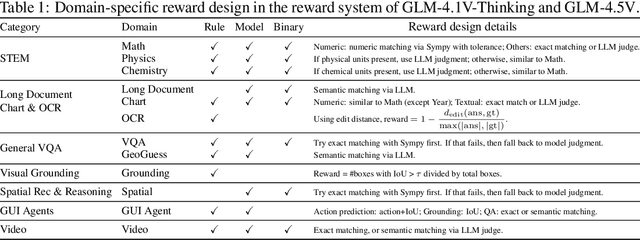
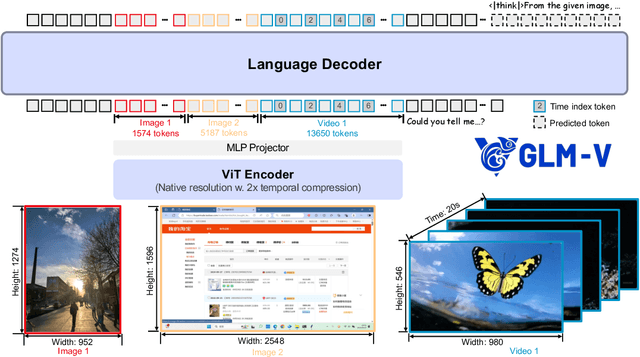
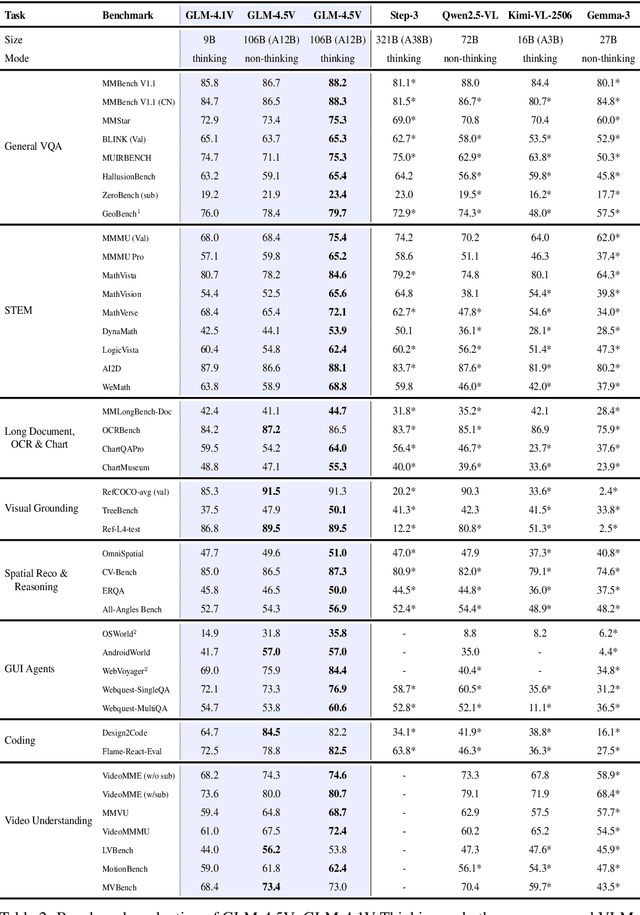
We present GLM-4.1V-Thinking, a vision-language model (VLM) designed to advance general-purpose multimodal understanding and reasoning. In this report, we share our key findings in the development of the reasoning-centric training framework. We first develop a capable vision foundation model with significant potential through large-scale pre-training, which arguably sets the upper bound for the final performance. We then propose Reinforcement Learning with Curriculum Sampling (RLCS) to unlock the full potential of the model, leading to comprehensive capability enhancement across a diverse range of tasks, including STEM problem solving, video understanding, content recognition, coding, grounding, GUI-based agents, and long document understanding. We open-source GLM-4.1V-9B-Thinking, which achieves state-of-the-art performance among models of comparable size. In a comprehensive evaluation across 28 public benchmarks, our model outperforms Qwen2.5-VL-7B on nearly all tasks and achieves comparable or even superior performance on 18 benchmarks relative to the significantly larger Qwen2.5-VL-72B. Notably, GLM-4.1V-9B-Thinking also demonstrates competitive or superior performance compared to closed-source models such as GPT-4o on challenging tasks including long document understanding and STEM reasoning, further underscoring its strong capabilities. Code, models and more information are released at https://github.com/THUDM/GLM-4.1V-Thinking.