 Add to Chrome
 Add to Firefox
 Add to Edge
MergeTok: Unified Continuous and Discrete Visual Tokenization via Token Merging
May 29, 2026
Most visual tokenizers for image generation are bifurcated into two families with complementary limitations: continuous VAEs offer high-fidelity reconstruction but suffer from dense, entangled latents that are poorly suited for semantic control, whereas discrete VQ-based models enable autoregressive generation yet struggle with gradient sparsity, unstable training, and codebook collapse. In this work, we introduce MergeTok, a unified tokenizer that jointly optimizes continuous (VAE) and discrete (VQ) tokenizers within a encoder-decoder architecture, leveraging token merging techniques as a semantic bridge. By clustering similar tokens during encoding, MergeTok establishes a structural prior that provides dual supervision signals: (i) it imposes merged-token semantic alignment in the VAE branch, regularizing its latent space toward disentangled, semantic-aware representations; (ii) it derives group-wise constraints, promoting intra-group diversity and inter-group exclusivity that stabilize VQ training. MergeTok shows competitive reconstruction and generation performance on ImageNet-256, with substantially lower rFID than strong VAE and VQ models under matched token budgets, while producing semantically-organized token representations compatible with both autoregressive and diffusion generators. This shows that a single architecture can endow visual tokenizers with robust semantic organization and generator-friendly discreteness.

RankE: End-to-End Post-Training for Discrete Text-to-Image Generation with Decoder Co-Evolution
May 20, 2026Discrete autoregressive (AR) text-to-image (T2I) models pair a VQ tokenizer with an AR policy, and current post-training pipelines optimize only the policy while keeping the VQ decoder frozen. Recent diffusion T2I work, exemplified by REPA-E, has shown that the VAE itself constitutes a key alignment bottleneck, yet no analogous investigation exists for discrete AR models. We show that policy-only optimization induces Latent Covariate Shift: as the policy evolves, the resulting token distribution diverges from the ground-truth distribution on which the decoder was trained, such that reward scores improve while decoded image quality degrades. To address this mismatch, we propose RankE, the first end-to-end post-training framework for discrete T2I generation. Rather than optimizing the policy against a fixed decoder, RankE co-evolves both components through alternating optimization: each module maximizes a ranking-based alignment objective while being regularized by a stability-preserving anchor suited to its parameter space. This co-evolution breaks the fidelity--alignment trade-off that plagues frozen-decoder approaches: on LlamaGen-XL (775M), standard RL improves CLIP but degrades FID, whereas RankE improves both simultaneously (FID 15.21, CLIP 33.76 on MS-COCO 30K). Consistent gains on Janus-Pro (1B) confirm that decoder co-evolution reliably converts reward optimization into pixel-space quality improvements.
CARE-Edit: Condition-Aware Routing of Experts for Contextual Image Editing
Mar 09, 2026Unified diffusion editors often rely on a fixed, shared backbone for diverse tasks, suffering from task interference and poor adaptation to heterogeneous demands (e.g., local vs global, semantic vs photometric). In particular, prevalent ControlNet and OmniControl variants combine multiple conditioning signals (e.g., text, mask, reference) via static concatenation or additive adapters which cannot dynamically prioritize or suppress conflicting modalities, thus resulting in artifacts like color bleeding across mask boundaries, identity or style drift, and unpredictable behavior under multi-condition inputs. To address this, we propose Condition-Aware Routing of Experts (CARE-Edit) that aligns model computation with specific editing competencies. At its core, a lightweight latent-attention router assigns encoded diffusion tokens to four specialized experts--Text, Mask, Reference, and Base--based on multi-modal conditions and diffusion timesteps: (i) a Mask Repaint module first refines coarse user-defined masks for precise spatial guidance; (ii) the router applies sparse top-K selection to dynamically allocate computation to the most relevant experts; (iii) a Latent Mixture module subsequently fuses expert outputs, coherently integrating semantic, spatial, and stylistic information to the base images. Experiments validate CARE-Edit's strong performance on contextual editing tasks, including erasure, replacement, text-driven edits, and style transfer. Empirical analysis further reveals task-specific behavior of specialized experts, showcasing the importance of dynamic, condition-aware processing to mitigate multi-condition conflicts.
Steady-State Behavior of Constant-Stepsize Stochastic Approximation: Gaussian Approximation and Tail Bounds
Feb 15, 2026Constant-stepsize stochastic approximation (SA) is widely used in learning for computational efficiency. For a fixed stepsize, the iterates typically admit a stationary distribution that is rarely tractable. Prior work shows that as the stepsize $α\downarrow 0$, the centered-and-scaled steady state converges weakly to a Gaussian random vector. However, for fixed $α$, this weak convergence offers no usable error bound for approximating the steady-state by its Gaussian limit. This paper provides explicit, non-asymptotic error bounds for fixed $α$. We first prove general-purpose theorems that bound the Wasserstein distance between the centered-scaled steady state and an appropriate Gaussian distribution, under regularity conditions for drift and moment conditions for noise. To ensure broad applicability, we cover both i.i.d. and Markovian noise models. We then instantiate these theorems for three representative SA settings: (1) stochastic gradient descent (SGD) for smooth strongly convex objectives, (2) linear SA, and (3) contractive nonlinear SA. We obtain dimension- and stepsize-dependent, explicit bounds in Wasserstein distance of order $α^{1/2}\log(1/α)$ for small $α$. Building on the Wasserstein approximation error, we further derive non-uniform Berry--Esseen-type tail bounds that compare the steady-state tail probability to Gaussian tails. We achieve an explicit error term that decays in both the deviation level and stepsize $α$. We adapt the same analysis for SGD beyond strongly convexity and study general convex objectives. We identify a non-Gaussian (Gibbs) limiting law under the correct scaling, which is validated numerically, and provide a corresponding pre-limit Wasserstein error bound.
Quantifying Normality: Convergence Rate to Gaussian Limit for Stochastic Approximation and Unadjusted OU Algorithm
Feb 14, 2026Stochastic approximation (SA) is a method for finding the root of an operator perturbed by noise. There is a rich literature establishing the asymptotic normality of rescaled SA iterates under fairly mild conditions. However, these asymptotic results do not quantify the accuracy of the Gaussian approximation in finite time. In this paper, we establish explicit non-asymptotic bounds on the Wasserstein distance between the distribution of the rescaled iterate at time k and the asymptotic Gaussian limit for various choices of step-sizes including constant and polynomially decaying. As an immediate consequence, we obtain tail bounds on the error of SA iterates at any time. We obtain the sharp rates by first studying the convergence rate of the discrete Ornstein-Uhlenbeck (O-U) process driven by general noise, whose stationary distribution is identical to the limiting Gaussian distribution of the rescaled SA iterates. We believe that this is of independent interest, given its connection to sampling literature. The analysis involves adapting Stein's method for Gaussian approximation to handle the matrix weighted sum of i.i.d. random variables. The desired finite-time bounds for SA are obtained by characterizing the error dynamics between the rescaled SA iterate and the discrete time O-U process and combining it with the convergence rate of the latter process.
Rep-MTL: Unleashing the Power of Representation-level Task Saliency for Multi-Task Learning
Jul 28, 2025Despite the promise of Multi-Task Learning in leveraging complementary knowledge across tasks, existing multi-task optimization (MTO) techniques remain fixated on resolving conflicts via optimizer-centric loss scaling and gradient manipulation strategies, yet fail to deliver consistent gains. In this paper, we argue that the shared representation space, where task interactions naturally occur, offers rich information and potential for operations complementary to existing optimizers, especially for facilitating the inter-task complementarity, which is rarely explored in MTO. This intuition leads to Rep-MTL, which exploits the representation-level task saliency to quantify interactions between task-specific optimization and shared representation learning. By steering these saliencies through entropy-based penalization and sample-wise cross-task alignment, Rep-MTL aims to mitigate negative transfer by maintaining the effective training of individual tasks instead pure conflict-solving, while explicitly promoting complementary information sharing. Experiments are conducted on four challenging MTL benchmarks covering both task-shift and domain-shift scenarios. The results show that Rep-MTL, even paired with the basic equal weighting policy, achieves competitive performance gains with favorable efficiency. Beyond standard performance metrics, Power Law exponent analysis demonstrates Rep-MTL's efficacy in balancing task-specific learning and cross-task sharing. The project page is available at HERE.
MergeVQ: A Unified Framework for Visual Generation and Representation with Disentangled Token Merging and Quantization
Apr 01, 2025Masked Image Modeling (MIM) with Vector Quantization (VQ) has achieved great success in both self-supervised pre-training and image generation. However, most existing methods struggle to address the trade-off in shared latent space for generation quality vs. representation learning and efficiency. To push the limits of this paradigm, we propose MergeVQ, which incorporates token merging techniques into VQ-based generative models to bridge the gap between image generation and visual representation learning in a unified architecture. During pre-training, MergeVQ decouples top-k semantics from latent space with the token merge module after self-attention blocks in the encoder for subsequent Look-up Free Quantization (LFQ) and global alignment and recovers their fine-grained details through cross-attention in the decoder for reconstruction. As for the second-stage generation, we introduce MergeAR, which performs KV Cache compression for efficient raster-order prediction. Extensive experiments on ImageNet verify that MergeVQ as an AR generative model achieves competitive performance in both visual representation learning and image generation tasks while maintaining favorable token efficiency and inference speed. The code and model will be available at https://apexgen-x.github.io/MergeVQ.
Prior-guided Hierarchical Harmonization Network for Efficient Image Dehazing
Mar 03, 2025Image dehazing is a crucial task that involves the enhancement of degraded images to recover their sharpness and textures. While vision Transformers have exhibited impressive results in diverse dehazing tasks, their quadratic complexity and lack of dehazing priors pose significant drawbacks for real-world applications. In this paper, guided by triple priors, Bright Channel Prior (BCP), Dark Channel Prior (DCP), and Histogram Equalization (HE), we propose a \textit{P}rior-\textit{g}uided Hierarchical \textit{H}armonization Network (PGH$^2$Net) for image dehazing. PGH$^2$Net is built upon the UNet-like architecture with an efficient encoder and decoder, consisting of two module types: (1) Prior aggregation module that injects B/DCP and selects diverse contexts with gating attention. (2) Feature harmonization modules that subtract low-frequency components from spatial and channel aspects and learn more informative feature distributions to equalize the feature maps.
Unveiling the Backbone-Optimizer Coupling Bias in Visual Representation Learning
Oct 08, 2024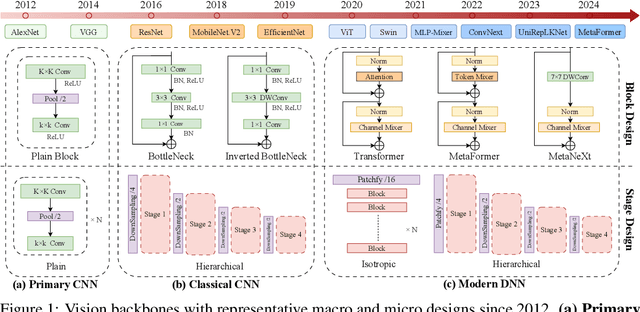
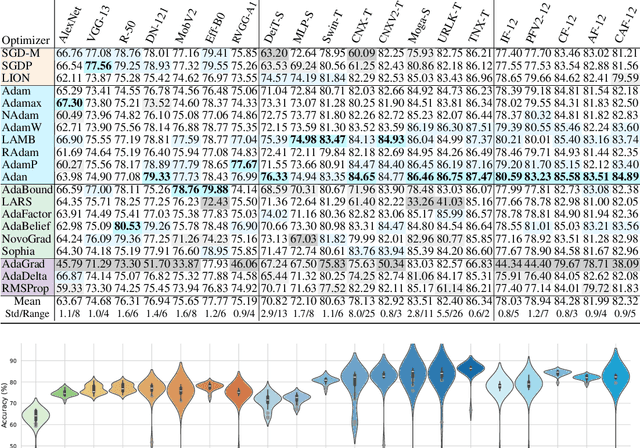
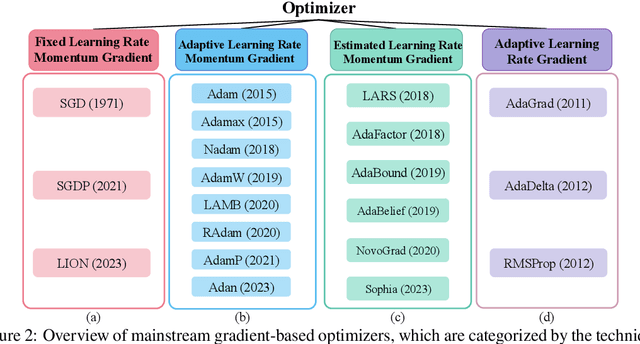
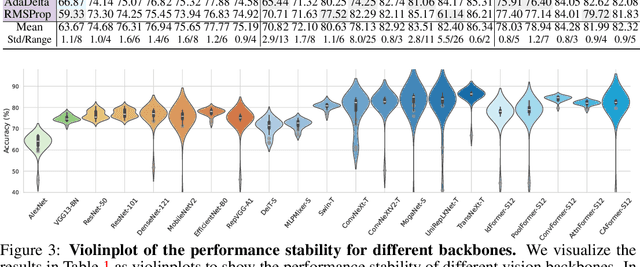
This paper delves into the interplay between vision backbones and optimizers, unvealing an inter-dependent phenomenon termed \textit{\textbf{b}ackbone-\textbf{o}ptimizer \textbf{c}oupling \textbf{b}ias} (BOCB). We observe that canonical CNNs, such as VGG and ResNet, exhibit a marked co-dependency with SGD families, while recent architectures like ViTs and ConvNeXt share a tight coupling with the adaptive learning rate ones. We further show that BOCB can be introduced by both optimizers and certain backbone designs and may significantly impact the pre-training and downstream fine-tuning of vision models. Through in-depth empirical analysis, we summarize takeaways on recommended optimizers and insights into robust vision backbone architectures. We hope this work can inspire the community to question long-held assumptions on backbones and optimizers, stimulate further explorations, and thereby contribute to more robust vision systems. The source code and models are publicly available at https://bocb-ai.github.io/.
A Survey on Mixup Augmentations and Beyond
Sep 08, 2024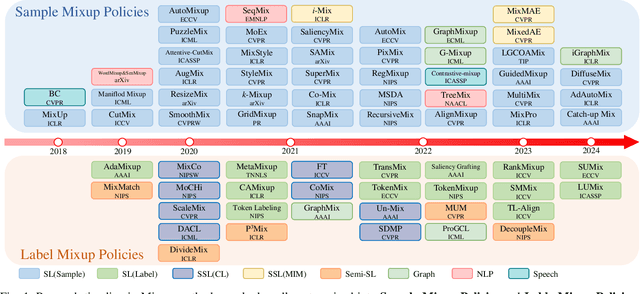

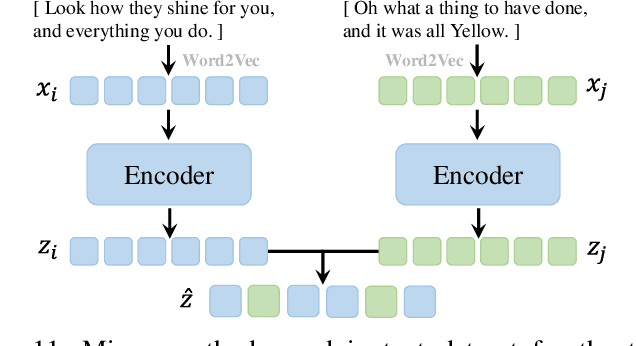
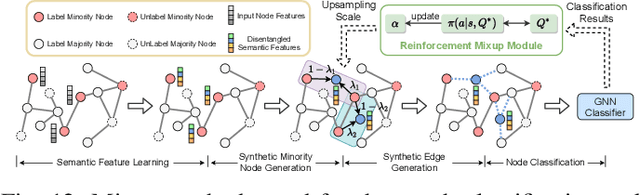
As Deep Neural Networks have achieved thrilling breakthroughs in the past decade, data augmentations have garnered increasing attention as regularization techniques when massive labeled data are unavailable. Among existing augmentations, Mixup and relevant data-mixing methods that convexly combine selected samples and the corresponding labels are widely adopted because they yield high performances by generating data-dependent virtual data while easily migrating to various domains. This survey presents a comprehensive review of foundational mixup methods and their applications. We first elaborate on the training pipeline with mixup augmentations as a unified framework containing modules. A reformulated framework could contain various mixup methods and give intuitive operational procedures. Then, we systematically investigate the applications of mixup augmentations on vision downstream tasks, various data modalities, and some analysis \& theorems of mixup. Meanwhile, we conclude the current status and limitations of mixup research and point out further work for effective and efficient mixup augmentations. This survey can provide researchers with the current state of the art in mixup methods and provide some insights and guidance roles in the mixup arena. An online project with this survey is available at \url{https://github.com/Westlake-AI/Awesome-Mixup}.