 Add to Chrome
 Add to Firefox
 Add to Edge
PhysMRV: Physical Memory Retrieval and Verification for Physics Plausibility Reasoning
Jul 11, 2026
Video-language models (VLMs) have achieved remarkable performance on video understanding and visual question answering, yet they remain unreliable in reasoning about physical plausibility, where understanding object interactions, causal dynamics, and fundamental physical principles is essential. This limitation is particularly evident on challenging physical reasoning benchmarks, revealing a persistent gap in physical commonsense reasoning. To address this challenge, we propose PhysMRV, a training-free physical memory and verification framework for physical plausibility reasoning. Unlike retrieval-augmented VLMs that retrieve semantically similar videos as additional context, PhysMRV transforms training videos into a Hierarchical Memory Bank of structured physical knowledge comprising three complementary levels: scene descriptions capturing visual context, physical-event graphs modeling object interactions and causal structure, and physics-rule summaries distilling reusable physical principles and cues. During inference, PhysMRV retrieves physically relevant memories and leverages their structured physical evidence to guide a frozen VLM in verifying physical plausibility, requiring neither fine-tuning nor parameter updates. We evaluate PhysMRV on three challenging physical reasoning benchmarks, ImplausiBench, IntPhys2, and GRASP Level 2, across multiple state-of-the-art VLMs. Experimental results demonstrate consistent improvements over direct prompting across diverse VLMs and evaluation benchmarks, showing that structured physical memories provide an effective and scalable means of enhancing physical plausibility reasoning without additional training.

TacReasoner: A Dynamic Tactile-Language Framework for Interactive Reasoning in Real-World Scenarios
Jul 06, 2026Among the five primary human senses, tactile is arguably the most fundamental to survival, as it enables the perception of physical contact and interaction in real-world environments. In this paper, we explore two key challenges of integrating tactile sensing into intelligent systems for multimodal reasoning: (i) insufficient modeling of dynamic tactile signals, which restricts reasoning over temporally evolving properties, and (ii) hallucination in tactile foundation models caused by the absence of explicit reasoning mechanisms, leading to unstable real-world inference. To address these challenges, we propose TacReasoner, a dynamic tactile-language framework for interactive reasoning in real-world scenarios. First, TacReasoner incorporates a Dynamic-aware Tactile Encoder to enhance the perception and representation of dynamic tactile signals. More importantly, we introduce TouchCoT-10k, the first tactile chain-of-thought dataset for structured reasoning over tactile inputs. Upon it, we establish DynTac-Bench to systematically evaluate dynamic tactile perception and real-world commonsense reasoning. Experimental results demonstrate that TacReasoner achieves competitive performance against state-of-the-art models across multiple datasets. Notably, despite using only 7B parameters, TacReasoner outperforms the 14B VTV-LLM model on most subtasks, highlighting its effectiveness and efficiency in tactile commonsense reasoning.
CoLT: Teaching Multi-Modal Models to Think with Chain of Latent Thoughts
Jun 30, 2026Chain-of-thought (CoT) reasoning has enabled multi-modal large language models (MLLMs) to tackle complex visual reasoning tasks by generating explicit intermediate reasoning steps in natural language. However, this text-based reasoning paradigm is inherently slow at inference time with even thousands of tokens and fundamentally constrained by the expressiveness of natural language. In this paper, we propose CoLT, (Chain of Latent Thoughts), a novel framework that teaches multi-modal models to reason through a chain of latent thought representations instead of verbose text tokens, which can perform thinking with as few as 3 steps. Naively forcing the model to think with latent states easily produces meaningless semantics and makes training unstable. To effectively regulate the latent reasoning process, we introduce a lightweight external decoder that provides step-level supervision for each latent reasoning step in two complementary directions: a forward mode that decodes latent thoughts into the textual reasoning of the next step, and a backward mode that aligns decoder hidden states with the model's latent thoughts given preceding textual context. We further incorporate internal supervision that encourages coherent step-by-step latent transitions. The decoder and internal supervision are removed during inference to maintain high efficiency of latent reasoning. Extensive experiments on eight benchmarks demonstrate that CoLT not only outperforms existing latent reasoning methods such as CODI and SIM-CoT, but also surpasses latent visual reasoning approaches that rely on auxiliary images with costly annotation requirements. Compared to text CoT methods, CoLT can notably reduce the inference time by 10.1$\times$ and text decoding time by 22.6$\times$. Code is released at https://github.com/hulianyuyy/CoLT.
TouchThinker: Scaling Tactile Commonsense Reasoning to the Open World with Large-scale Data and Action-aware Representation
Jun 10, 2026Touch is a key modality for embodied agents to understand the physical world. Although recent work has incorporated tactile signals into language systems for tactile commonsense reasoning, scaling such systems to realistic open-world settings remains challenging due to two key bottlenecks: (1) current tactile reasoning datasets remain limited in format and scale, providing insufficient supervision for reasoning from tactile observations to physical commonsense and hindering the learning of transferable tactile commonsense; (2) Tactile signals are inherently redundant and action-specific, yet existing methods often overlook these properties, resulting in inefficient representations with limited semantic expressiveness. To address these limitations, we propose TouchThinker, a tactile-language framework that scales tactile commonsense reasoning to the open world from both data and representation perspectives. First, we construct TouchThinker-1M, a million-scale, multi-source tactile reasoning dataset covering \textbf{415} objects, \textbf{8} scenarios, and \textbf{7} sensor types, providing a solid data foundation for open-world generalization. We further introduce TouchThinker-Bench, an open-world benchmark with more realistic and diverse tasks. Then, we propose action-aware modeling mechanism to improve tactile representation efficiency and enable efficient reasoning. Experimental results demonstrate that TouchThinker achieves competitive performance against state-of-the-art models across multiple datasets. Our code and dataset will be made available at: https://github.com/lvkailin0118/TouchThinker.
TVI-CoT: Text-Visual Interleaved Chain-of-Thought Reasoning for Multimodal Understanding
Jun 07, 2026Chain-of-thought (CoT) reasoning has proven effective for enhancing problem-solving in large language models. However, when applied to multimodal LLMs (MLLMs), existing CoT approaches suffer from a fundamental limitation: they perform reasoning entirely in text without accessing visual features during the reasoning process. After initial visual encoding, image information becomes inaccessible, forcing models to reason based solely on whatever was captured in the initial description, which forms a `vision-blind reasoning' paradigm that limits fine-grained visual extraction, error verification, and adaptive attention. We propose Text-Visual Interleaved Chain-of-Thought (TVI-CoT), a framework that enables explicit interleaving of textual reasoning and visual feature access through learnable control tokens <THINK>, <LOOK> and <ANSWER>. These tokens allow dynamic switching between reasoning and visual grounding, attending to relevant image regions conditioned on the evolving reasoning state. Experiments on eight benchmarks demonstrate state-of-the-art results among MLLM-based CoT methods and notable performance boost compared to the baseline: +6.1% on MMMU, +3.8% on MathVerse, +3.4% on MathVista, and +3.4% on ScienceQA. Code is available at https://github.com/hulianyuyy/TVI-CoT.
PhotoCraft: Agentic Reasoning with Hierarchical Self-Evolving Memory for Deep Image Search
Jun 02, 2026Deep Image Search requires multi-step reasoning over rich contextual cues, such as time, location, and event relations. However, most existing LLM-based agents are stateless and reactive, lacking persistent memory to maintain long-horizon context or transfer experience across tasks, which often leads to execution drift and experience isolation. To address these limitations, we propose PhotoCraft, a training-free, hierarchical memory system for photo-search agents. Inspired by human cognition, PhotoCraft equips MLLMs with working, episodic, and semantic memory, which are dynamically invoked during reasoning to preserve logical consistency and knowledge transferability throughout multi-step reasoning and answer generation. Extensive experiments on DISBench demonstrate that PhotoCraft consistently improves context-aware retrieval across diverse MLLM backbones, achieving gains of up to 18.5\% and effectively mitigating key bottlenecks in memoryless deep image search, offering a practical path toward reliable and generalizable multimodal search agents.
Reading Between the Pixels: An Inscriptive Jailbreak Attack on Text-to-Image Models
Apr 07, 2026Modern text-to-image (T2I) models can now render legible, paragraph-length text, enabling a fundamentally new class of misuse. We identify and formalize the inscriptive jailbreak, where an adversary coerces a T2I system into generating images containing harmful textual payloads (e.g., fraudulent documents) embedded within visually benign scenes. Unlike traditional depictive jailbreaks that elicit visually objectionable imagery, inscriptive attacks weaponize the text-rendering capability itself. Because existing jailbreak techniques are designed for coarse visual manipulation, they struggle to bypass multi-stage safety filters while maintaining character-level fidelity. To expose this vulnerability, we propose Etch, a black-box attack framework that decomposes the adversarial prompt into three functionally orthogonal layers: semantic camouflage, visual-spatial anchoring, and typographic encoding. This decomposition reduces joint optimization over the full prompt space to tractable sub-problems, which are iteratively refined through a zero-order loop. In this process, a vision-language model critiques each generated image, localizes failures to specific layers, and prescribes targeted revisions. Extensive evaluations across 7 models on the 2 benchmarks demonstrate that Etch achieves an average attack success rate of 65.57% (peaking at 91.00%), significantly outperforming existing baselines. Our results reveal a critical blind spot in current T2I safety alignments and underscore the urgent need for typography-aware defense multimodal mechanisms.
TennisExpert: Towards Expert-Level Analytical Sports Video Understanding
Mar 17, 2026Tennis is one of the most widely followed sports, generating extensive broadcast footage with strong potential for professional analysis, automated coaching, and real-time commentary. However, automatic tennis understanding remains underexplored due to two key challenges: (1) the lack of large-scale benchmarks with fine-grained annotations and expert-level commentary, and (2) the difficulty of building accurate yet efficient multimodal systems suitable for real-time deployment. To address these challenges, we introduce TennisVL, a large-scale tennis benchmark comprising over 200 professional matches (471.9 hours) and 40,000+ rally-level clips. Unlike existing commentary datasets that focus on descriptive play-by-play narration, TennisVL emphasizes expert analytical commentary capturing tactical reasoning, player decisions, and match momentum. Furthermore, we propose TennisExpert, a multimodal tennis understanding framework that integrates a video semantic parser with a memory-augmented model built on Qwen3-VL-8B. The parser extracts key match elements (e.g., scores, shot sequences, ball bounces, and player locations), while hierarchical memory modules capture both short- and long-term temporal context. Experiments show that TennisExpert consistently outperforms strong proprietary baselines, including GPT-5, Gemini, and Claude, and demonstrates improved ability to capture tactical context and match dynamics. Our dataset and code are publicly available at https://github.com/LZYAndy/TennisExpert.
HiMemVLN: Enhancing Reliability of Open-Source Zero-Shot Vision-and-Language Navigation with Hierarchical Memory System
Mar 16, 2026LLM-based agents have demonstrated impressive zero-shot performance in vision-language navigation (VLN) tasks. However, most zero-shot methods primarily rely on closed-source LLMs as navigators, which face challenges related to high token costs and potential data leakage risks. Recent efforts have attempted to address this by using open-source LLMs combined with a spatiotemporal CoT framework, but they still fall far short compared to closed-source models. In this work, we identify a critical issue, Navigation Amnesia, through a detailed analysis of the navigation process. This issue leads to navigation failures and amplifies the gap between open-source and closed-source methods. To address this, we propose HiMemVLN, which incorporates a Hierarchical Memory System into a multimodal large model to enhance visual perception recall and long-term localization, mitigating the amnesia issue and improving the agent's navigation performance. Extensive experiments in both simulated and real-world environments demonstrate that HiMemVLN achieves nearly twice the performance of the open-source state-of-the-art method. The code is available at https://github.com/lvkailin0118/HiMemVLN.
SSL-SSAW: Self-Supervised Learning with Sigmoid Self-Attention Weighting for Question-Based Sign Language Translation
Sep 17, 2025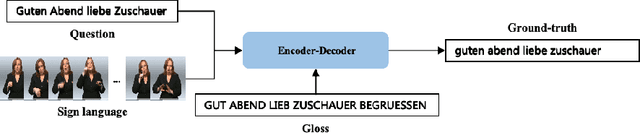
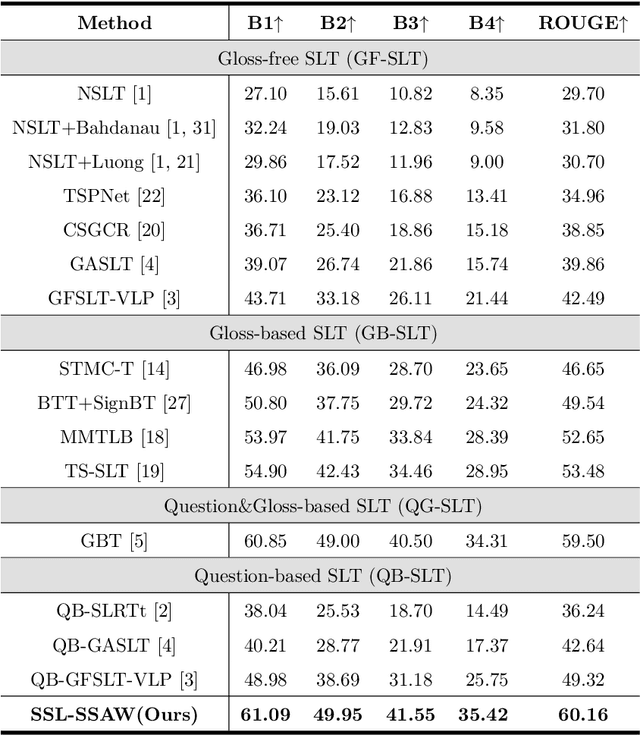
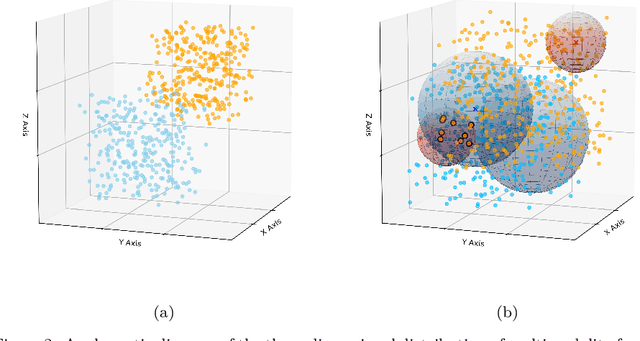
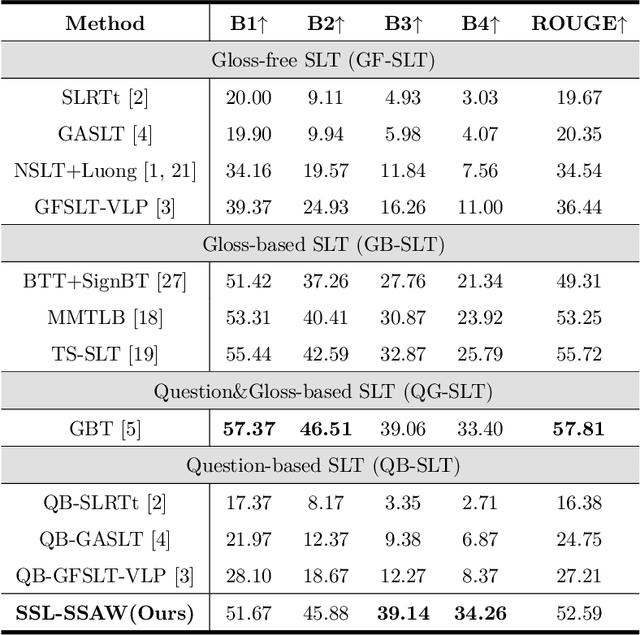
Sign Language Translation (SLT) bridges the communication gap between deaf people and hearing people, where dialogue provides crucial contextual cues to aid in translation. Building on this foundational concept, this paper proposes Question-based Sign Language Translation (QB-SLT), a novel task that explores the efficient integration of dialogue. Unlike gloss (sign language transcription) annotations, dialogue naturally occurs in communication and is easier to annotate. The key challenge lies in aligning multimodality features while leveraging the context of the question to improve translation. To address this issue, we propose a cross-modality Self-supervised Learning with Sigmoid Self-attention Weighting (SSL-SSAW) fusion method for sign language translation. Specifically, we employ contrastive learning to align multimodality features in QB-SLT, then introduce a Sigmoid Self-attention Weighting (SSAW) module for adaptive feature extraction from question and sign language sequences. Additionally, we leverage available question text through self-supervised learning to enhance representation and translation capabilities. We evaluated our approach on newly constructed CSL-Daily-QA and PHOENIX-2014T-QA datasets, where SSL-SSAW achieved SOTA performance. Notably, easily accessible question assistance can achieve or even surpass the performance of gloss assistance. Furthermore, visualization results demonstrate the effectiveness of incorporating dialogue in improving translation quality.