 Add to Chrome
 Add to Firefox
 Add to Edge
MolXPT: Wrapping Molecules with Text for Generative Pre-training
May 26, 2023

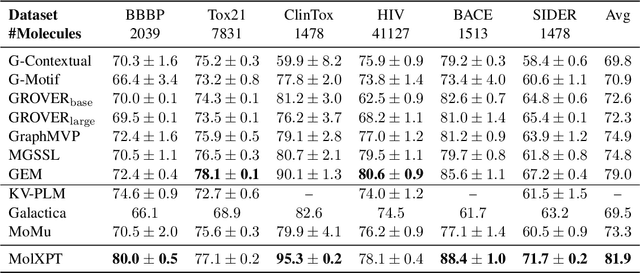
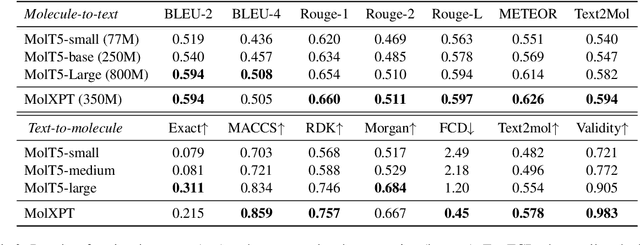
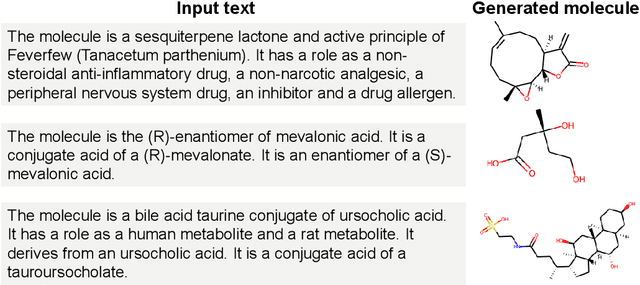
Generative pre-trained Transformer (GPT) has demonstrates its great success in natural language processing and related techniques have been adapted into molecular modeling. Considering that text is the most important record for scientific discovery, in this paper, we propose MolXPT, a unified language model of text and molecules pre-trained on SMILES (a sequence representation of molecules) wrapped by text. Briefly, we detect the molecule names in each sequence and replace them to the corresponding SMILES. In this way, the SMILES could leverage the information from surrounding text, and vice versa. The above wrapped sequences, text sequences from PubMed and SMILES sequences from PubChem are all fed into a language model for pre-training. Experimental results demonstrate that MolXPT outperforms strong baselines of molecular property prediction on MoleculeNet, performs comparably to the best model in text-molecule translation while using less than half of its parameters, and enables zero-shot molecular generation without finetuning.

NeuralStagger: accelerating physics-constrained neural PDE solver with spatial-temporal decomposition
Feb 20, 2023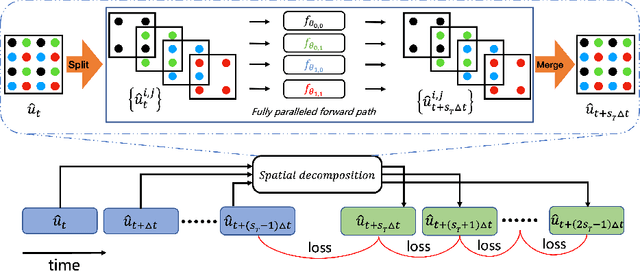
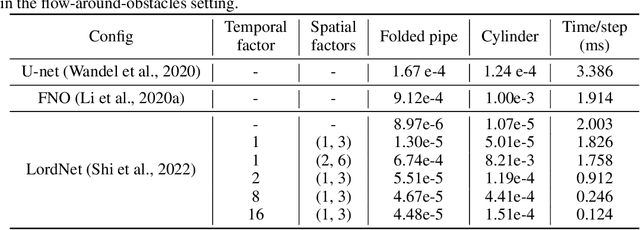

Neural networks have shown great potential in accelerating the solution of partial differential equations (PDEs). Recently, there has been a growing interest in introducing physics constraints into training neural PDE solvers to reduce the use of costly data and improve the generalization ability. However, these physics constraints, based on certain finite dimensional approximations over the function space, must resolve the smallest scaled physics to ensure the accuracy and stability of the simulation, resulting in high computational costs from large input, output, and neural networks. This paper proposes a general acceleration methodology called NeuralStagger by spatially and temporally decomposing the original learning tasks into several coarser-resolution subtasks. We define a coarse-resolution neural solver for each subtask, which requires fewer computational resources, and jointly train them with the vanilla physics-constrained loss by simply arranging their outputs to reconstruct the original solution. Due to the perfect parallelism between them, the solution is achieved as fast as a coarse-resolution neural solver. In addition, the trained solvers bring the flexibility of simulating with multiple levels of resolution. We demonstrate the successful application of NeuralStagger on 2D and 3D fluid dynamics simulations, which leads to an additional $10\sim100\times$ speed-up. Moreover, the experiment also shows that the learned model could be well used for optimal control.
Monte Carlo Neural Operator for Learning PDEs via Probabilistic Representation
Feb 10, 2023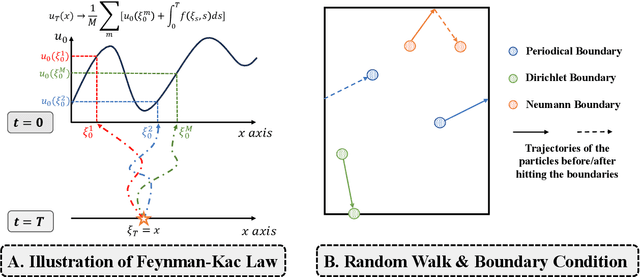
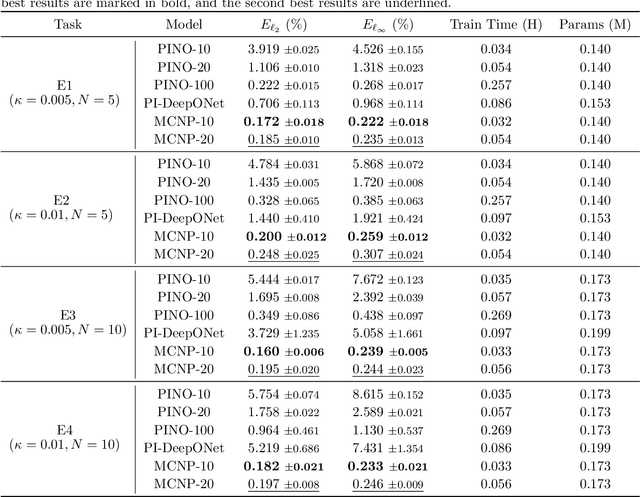
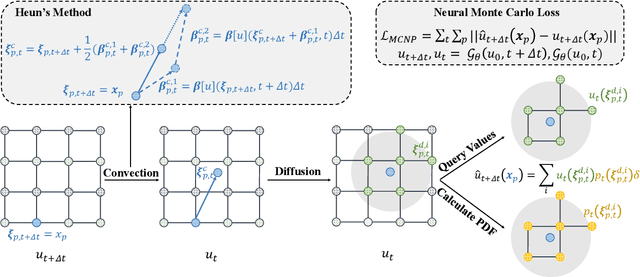
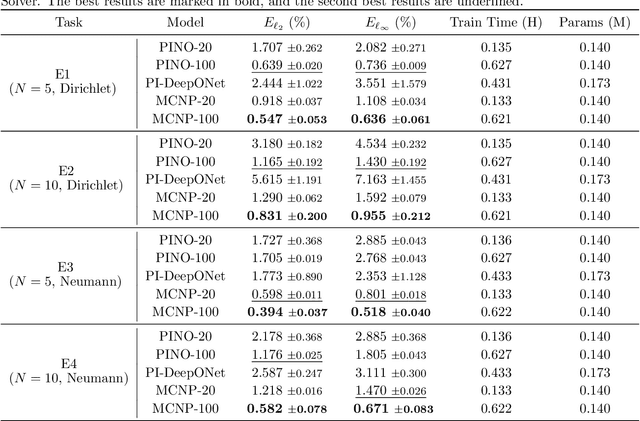
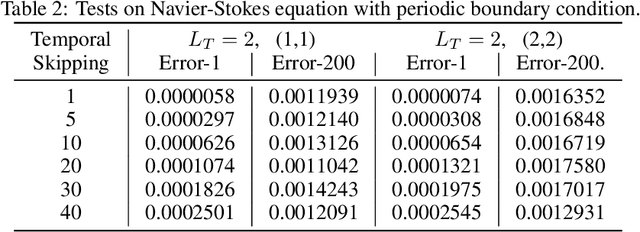
Neural operators, which use deep neural networks to approximate the solution mappings of partial differential equation (PDE) systems, are emerging as a new paradigm for PDE simulation. The neural operators could be trained in supervised or unsupervised ways, i.e., by using the generated data or the PDE information. The unsupervised training approach is essential when data generation is costly or the data is less qualified (e.g., insufficient and noisy). However, its performance and efficiency have plenty of room for improvement. To this end, we design a new loss function based on the Feynman-Kac formula and call the developed neural operator Monte-Carlo Neural Operator (MCNO), which can allow larger temporal steps and efficiently handle fractional diffusion operators. Our analyses show that MCNO has advantages in handling complex spatial conditions and larger temporal steps compared with other unsupervised methods. Furthermore, MCNO is more robust with the perturbation raised by the numerical scheme and operator approximation. Numerical experiments on the diffusion equation and Navier-Stokes equation show significant accuracy improvement compared with other unsupervised baselines, especially for the vibrated initial condition and long-time simulation settings.
De Novo Molecular Generation via Connection-aware Motif Mining
Feb 02, 2023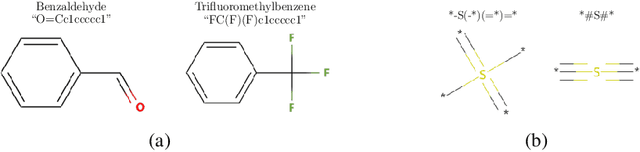
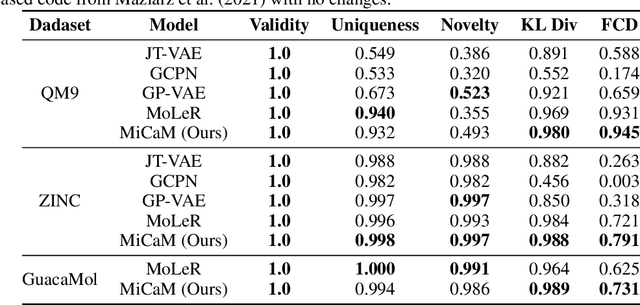
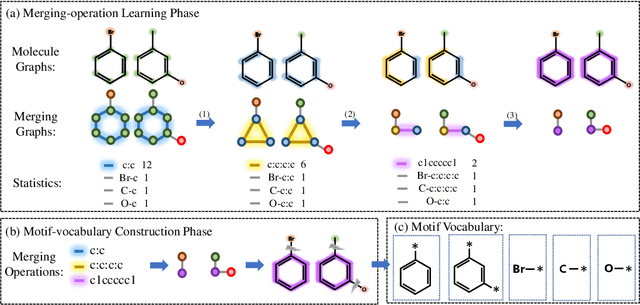
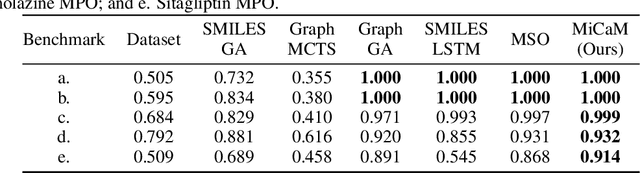
De novo molecular generation is an essential task for science discovery. Recently, fragment-based deep generative models have attracted much research attention due to their flexibility in generating novel molecules based on existing molecule fragments. However, the motif vocabulary, i.e., the collection of frequent fragments, is usually built upon heuristic rules, which brings difficulties to capturing common substructures from large amounts of molecules. In this work, we propose a new method, MiCaM, to generate molecules based on mined connection-aware motifs. Specifically, it leverages a data-driven algorithm to automatically discover motifs from a molecule library by iteratively merging subgraphs based on their frequency. The obtained motif vocabulary consists of not only molecular motifs (i.e., the frequent fragments), but also their connection information, indicating how the motifs are connected with each other. Based on the mined connection-aware motifs, MiCaM builds a connection-aware generator, which simultaneously picks up motifs and determines how they are connected. We test our method on distribution-learning benchmarks (i.e., generating novel molecules to resemble the distribution of a given training set) and goal-directed benchmarks (i.e., generating molecules with target properties), and achieve significant improvements over previous fragment-based baselines. Furthermore, we demonstrate that our method can effectively mine domain-specific motifs for different tasks.
Retrosynthetic Planning with Dual Value Networks
Jan 31, 2023Retrosynthesis, which aims to find a route to synthesize a target molecule from commercially available starting materials, is a critical task in drug discovery and materials design. Recently, the combination of ML-based single-step reaction predictors with multi-step planners has led to promising results. However, the single-step predictors are mostly trained offline to optimize the single-step accuracy, without considering complete routes. Here, we leverage reinforcement learning (RL) to improve the single-step predictor, by using a tree-shaped MDP to optimize complete routes while retaining single-step accuracy. Desirable routes should be both synthesizable and of low cost. We propose an online training algorithm, called Planning with Dual Value Networks (PDVN), in which two value networks predict the synthesizability and cost of molecules, respectively. To maintain the single-step accuracy, we design a two-branch network structure for the single-step predictor. On the widely-used USPTO dataset, our PDVN algorithm improves the search success rate of existing multi-step planners (e.g., increasing the success rate from 85.79% to 98.95% for Retro*, and reducing the number of model calls by half while solving 99.47% molecules for RetroGraph). Furthermore, PDVN finds shorter synthesis routes (e.g., reducing the average route length from 5.76 to 4.83 for Retro*, and from 5.63 to 4.78 for RetroGraph).
Regeneration Learning: A Learning Paradigm for Data Generation
Jan 21, 2023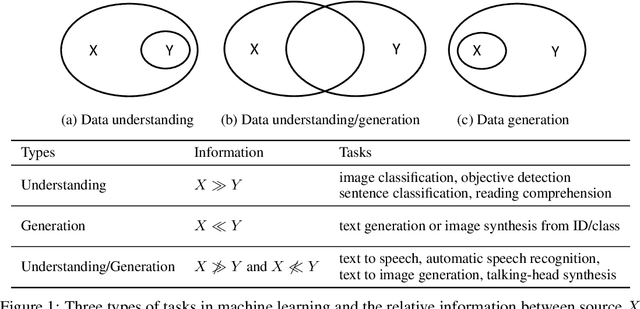


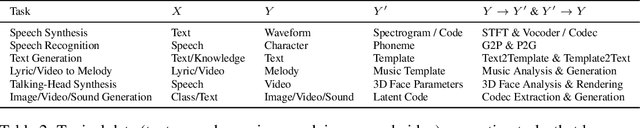
Machine learning methods for conditional data generation usually build a mapping from source conditional data X to target data Y. The target Y (e.g., text, speech, music, image, video) is usually high-dimensional and complex, and contains information that does not exist in source data, which hinders effective and efficient learning on the source-target mapping. In this paper, we present a learning paradigm called regeneration learning for data generation, which first generates Y' (an abstraction/representation of Y) from X and then generates Y from Y'. During training, Y' is obtained from Y through either handcrafted rules or self-supervised learning and is used to learn X-->Y' and Y'-->Y. Regeneration learning extends the concept of representation learning to data generation tasks, and can be regarded as a counterpart of traditional representation learning, since 1) regeneration learning handles the abstraction (Y') of the target data Y for data generation while traditional representation learning handles the abstraction (X') of source data X for data understanding; 2) both the processes of Y'-->Y in regeneration learning and X-->X' in representation learning can be learned in a self-supervised way (e.g., pre-training); 3) both the mappings from X to Y' in regeneration learning and from X' to Y in representation learning are simpler than the direct mapping from X to Y. We show that regeneration learning can be a widely-used paradigm for data generation (e.g., text generation, speech recognition, speech synthesis, music composition, image generation, and video generation) and can provide valuable insights into developing data generation methods.
An Adaptive Deep RL Method for Non-Stationary Environments with Piecewise Stable Context
Dec 24, 2022One of the key challenges in deploying RL to real-world applications is to adapt to variations of unknown environment contexts, such as changing terrains in robotic tasks and fluctuated bandwidth in congestion control. Existing works on adaptation to unknown environment contexts either assume the contexts are the same for the whole episode or assume the context variables are Markovian. However, in many real-world applications, the environment context usually stays stable for a stochastic period and then changes in an abrupt and unpredictable manner within an episode, resulting in a segment structure, which existing works fail to address. To leverage the segment structure of piecewise stable context in real-world applications, in this paper, we propose a \textit{\textbf{Se}gmented \textbf{C}ontext \textbf{B}elief \textbf{A}ugmented \textbf{D}eep~(SeCBAD)} RL method. Our method can jointly infer the belief distribution over latent context with the posterior over segment length and perform more accurate belief context inference with observed data within the current context segment. The inferred belief context can be leveraged to augment the state, leading to a policy that can adapt to abrupt variations in context. We demonstrate empirically that SeCBAD can infer context segment length accurately and outperform existing methods on a toy grid world environment and Mujuco tasks with piecewise-stable context.
SoftCorrect: Error Correction with Soft Detection for Automatic Speech Recognition
Dec 02, 2022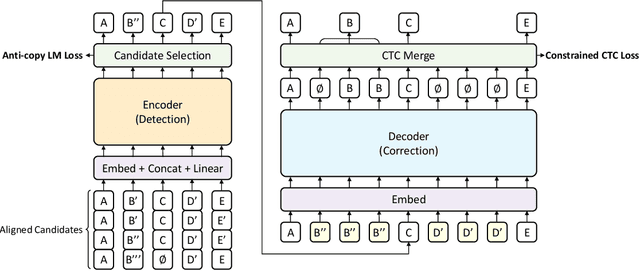
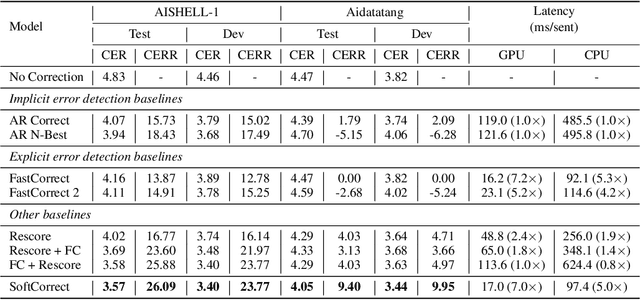
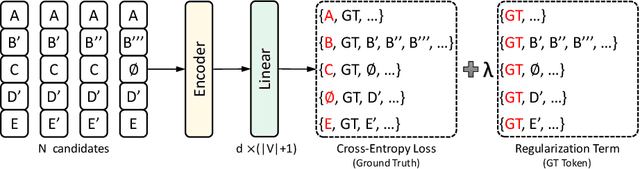
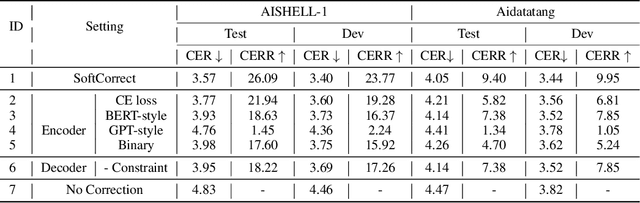
Error correction in automatic speech recognition (ASR) aims to correct those incorrect words in sentences generated by ASR models. Since recent ASR models usually have low word error rate (WER), to avoid affecting originally correct tokens, error correction models should only modify incorrect words, and therefore detecting incorrect words is important for error correction. Previous works on error correction either implicitly detect error words through target-source attention or CTC (connectionist temporal classification) loss, or explicitly locate specific deletion/substitution/insertion errors. However, implicit error detection does not provide clear signal about which tokens are incorrect and explicit error detection suffers from low detection accuracy. In this paper, we propose SoftCorrect with a soft error detection mechanism to avoid the limitations of both explicit and implicit error detection. Specifically, we first detect whether a token is correct or not through a probability produced by a dedicatedly designed language model, and then design a constrained CTC loss that only duplicates the detected incorrect tokens to let the decoder focus on the correction of error tokens. Compared with implicit error detection with CTC loss, SoftCorrect provides explicit signal about which words are incorrect and thus does not need to duplicate every token but only incorrect tokens; compared with explicit error detection, SoftCorrect does not detect specific deletion/substitution/insertion errors but just leaves it to CTC loss. Experiments on AISHELL-1 and Aidatatang datasets show that SoftCorrect achieves 26.1% and 9.4% CER reduction respectively, outperforming previous works by a large margin, while still enjoying fast speed of parallel generation.
An ensemble of VisNet, Transformer-M, and pretraining models for molecular property prediction in OGB Large-Scale Challenge @ NeurIPS 2022
Nov 23, 2022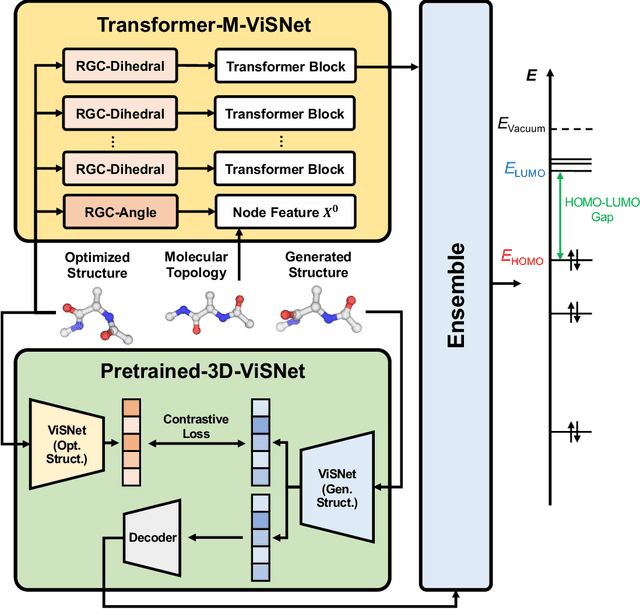
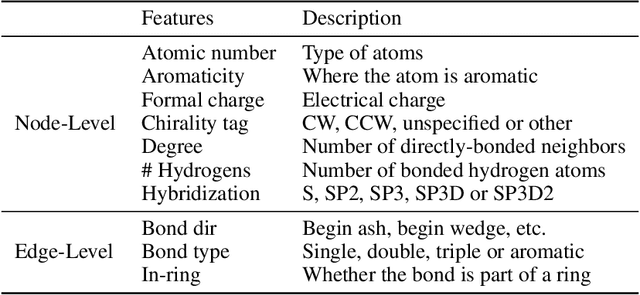
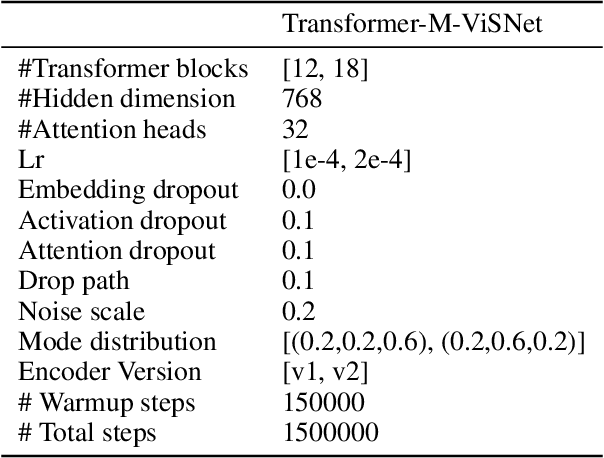
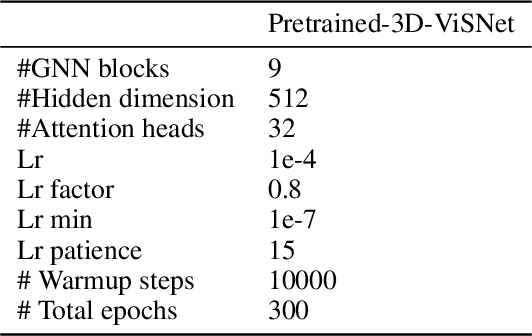
In the technical report, we provide our solution for OGB-LSC 2022 Graph Regression Task. The target of this task is to predict the quantum chemical property, HOMO-LUMO gap for a given molecule on PCQM4Mv2 dataset. In the competition, we designed two kinds of models: Transformer-M-ViSNet which is an geometry-enhanced graph neural network for fully connected molecular graphs and Pretrained-3D-ViSNet which is a pretrained ViSNet by distilling geomeotric information from optimized structures. With an ensemble of 22 models, ViSNet Team achieved the MAE of 0.0723 eV on the test-challenge set, dramatically reducing the error by 39.75% compared with the best method in the last year competition.
Incorporating Pre-training Paradigm for Antibody Sequence-Structure Co-design
Nov 17, 2022Antibodies are versatile proteins that can bind to pathogens and provide effective protection for human body. Recently, deep learning-based computational antibody design has attracted popular attention since it automatically mines the antibody patterns from data that could be complementary to human experiences. However, the computational methods heavily rely on high-quality antibody structure data, which is quite limited. Besides, the complementarity-determining region (CDR), which is the key component of an antibody that determines the specificity and binding affinity, is highly variable and hard to predict. Therefore, the data limitation issue further raises the difficulty of CDR generation for antibodies. Fortunately, there exists a large amount of sequence data of antibodies that can help model the CDR and alleviate the reliance on structure data. By witnessing the success of pre-training models for protein modeling, in this paper, we develop the antibody pre-training language model and incorporate it into the (antigen-specific) antibody design model in a systemic way. Specifically, we first pre-train an antibody language model based on the sequence data, then propose a one-shot way for sequence and structure generation of CDR to avoid the heavy cost and error propagation from an autoregressive manner, and finally leverage the pre-trained antibody model for the antigen-specific antibody generation model with some carefully designed modules. Through various experiments, we show that our method achieves superior performances over previous baselines on different tasks, such as sequence and structure generation and antigen-binding CDR-H3 design.