 Add to Chrome
 Add to Firefox
 Add to Edge
Seedance 2.0: Advancing Video Generation for World Complexity
Apr 15, 2026
Seedance 2.0 is a new native multi-modal audio-video generation model, officially released in China in early February 2026. Compared with its predecessors, Seedance 1.0 and 1.5 Pro, Seedance 2.0 adopts a unified, highly efficient, and large-scale architecture for multi-modal audio-video joint generation. This allows it to support four input modalities: text, image, audio, and video, by integrating one of the most comprehensive suites of multi-modal content reference and editing capabilities available in the industry to date. It delivers substantial, well-rounded improvements across all key sub-dimensions of video and audio generation. In both expert evaluations and public user tests, the model has demonstrated performance on par with the leading levels in the field. Seedance 2.0 supports direct generation of audio-video content with durations ranging from 4 to 15 seconds, with native output resolutions of 480p and 720p. For multi-modal inputs as reference, its current open platform supports up to 3 video clips, 9 images, and 3 audio clips. In addition, we provide Seedance 2.0 Fast version, an accelerated variant of Seedance 2.0 designed to boost generation speed for low-latency scenarios. Seedance 2.0 has delivered significant improvements to its foundational generation capabilities and multi-modal generation performance, bringing an enhanced creative experience for end users.

Seedance 1.5 pro: A Native Audio-Visual Joint Generation Foundation Model
Dec 23, 2025Recent strides in video generation have paved the way for unified audio-visual generation. In this work, we present Seedance 1.5 pro, a foundational model engineered specifically for native, joint audio-video generation. Leveraging a dual-branch Diffusion Transformer architecture, the model integrates a cross-modal joint module with a specialized multi-stage data pipeline, achieving exceptional audio-visual synchronization and superior generation quality. To ensure practical utility, we implement meticulous post-training optimizations, including Supervised Fine-Tuning (SFT) on high-quality datasets and Reinforcement Learning from Human Feedback (RLHF) with multi-dimensional reward models. Furthermore, we introduce an acceleration framework that boosts inference speed by over 10X. Seedance 1.5 pro distinguishes itself through precise multilingual and dialect lip-syncing, dynamic cinematic camera control, and enhanced narrative coherence, positioning it as a robust engine for professional-grade content creation. Seedance 1.5 pro is now accessible on Volcano Engine at https://console.volcengine.com/ark/region:ark+cn-beijing/experience/vision?type=GenVideo.
Virtual Width Networks
Nov 17, 2025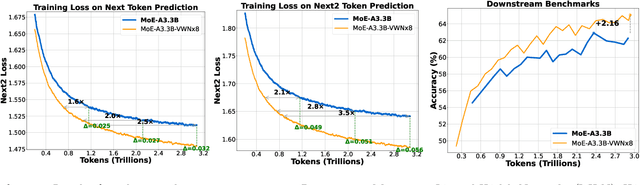
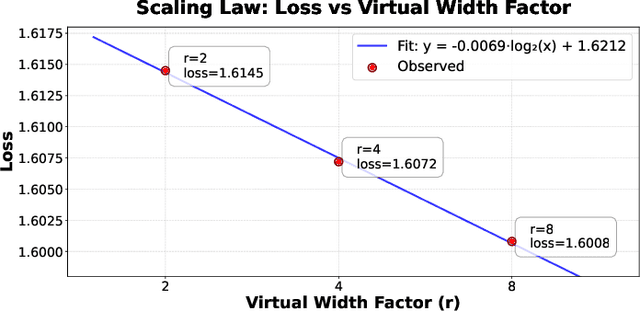
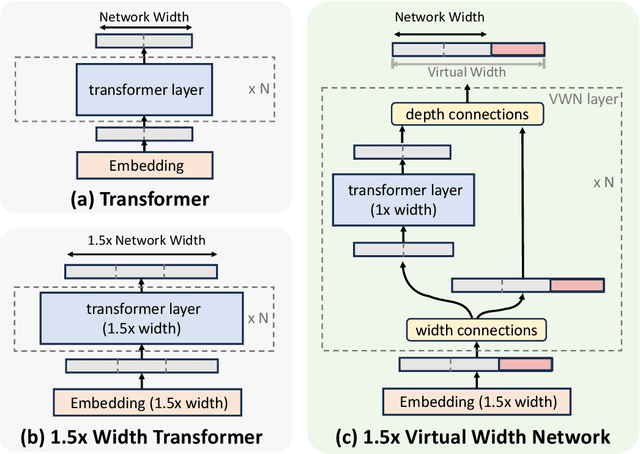
We introduce Virtual Width Networks (VWN), a framework that delivers the benefits of wider representations without incurring the quadratic cost of increasing the hidden size. VWN decouples representational width from backbone width, expanding the embedding space while keeping backbone compute nearly constant. In our large-scale experiment, an 8-times expansion accelerates optimization by over 2 times for next-token and 3 times for next-2-token prediction. The advantage amplifies over training as both the loss gap grows and the convergence-speedup ratio increases, showing that VWN is not only token-efficient but also increasingly effective with scale. Moreover, we identify an approximately log-linear scaling relation between virtual width and loss reduction, offering an initial empirical basis and motivation for exploring virtual-width scaling as a new dimension of large-model efficiency.
EFIM: Efficient Serving of LLMs for Infilling Tasks with Improved KV Cache Reuse
May 29, 2025Large language models (LLMs) are often used for infilling tasks, which involve predicting or generating missing information in a given text. These tasks typically require multiple interactions with similar context. To reduce the computation of repeated historical tokens, cross-request key-value (KV) cache reuse, a technique that stores and reuses intermediate computations, has become a crucial method in multi-round interactive services. However, in infilling tasks, the KV cache reuse is often hindered by the structure of the prompt format, which typically consists of a prefix and suffix relative to the insertion point. Specifically, the KV cache of the prefix or suffix part is frequently invalidated as the other part (suffix or prefix) is incrementally generated. To address the issue, we propose EFIM, a transformed prompt format of FIM to unleash the performance potential of KV cache reuse. Although the transformed prompt can solve the inefficiency, it exposes subtoken generation problems in current LLMs, where they have difficulty generating partial words accurately. Therefore, we introduce a fragment tokenization training method which splits text into multiple fragments before tokenization during data processing. Experiments on two representative LLMs show that LLM serving with EFIM can lower the latency by 52% and improve the throughput by 98% while maintaining the original infilling capability. EFIM's source code is publicly available at https://github.com/gty111/EFIM.
Kimi-Audio Technical Report
Apr 25, 2025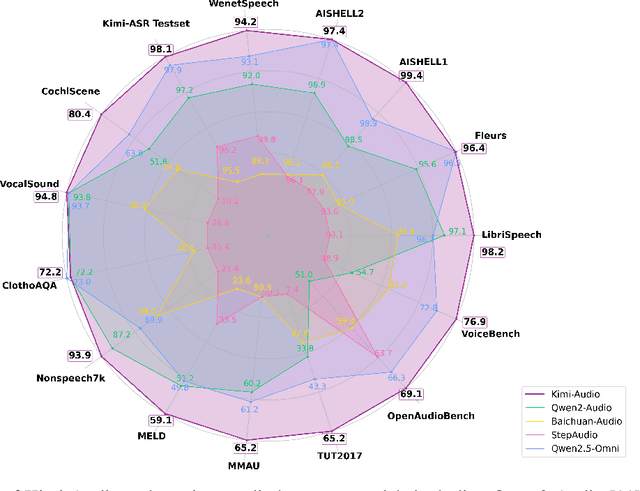
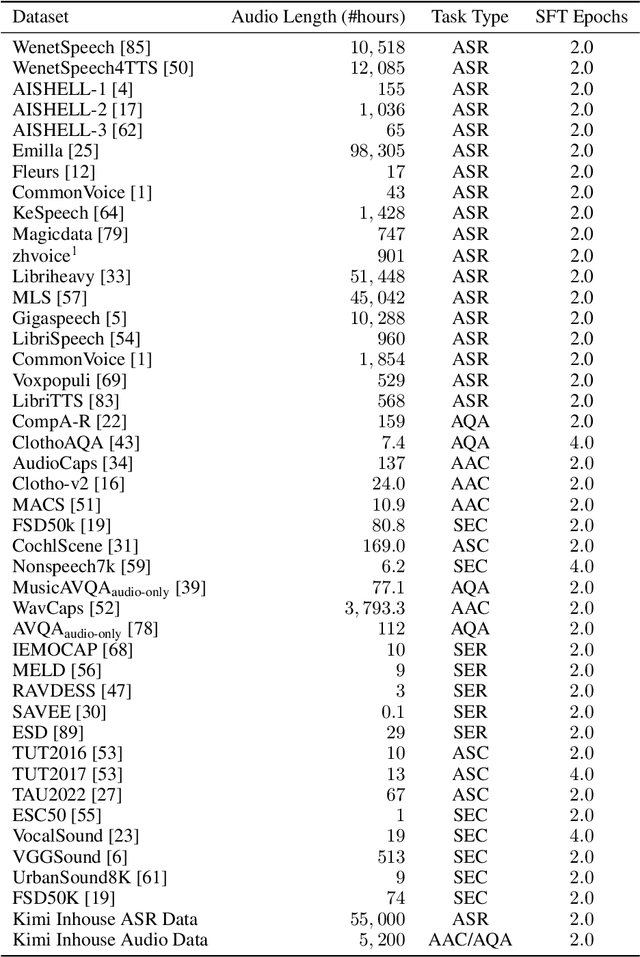
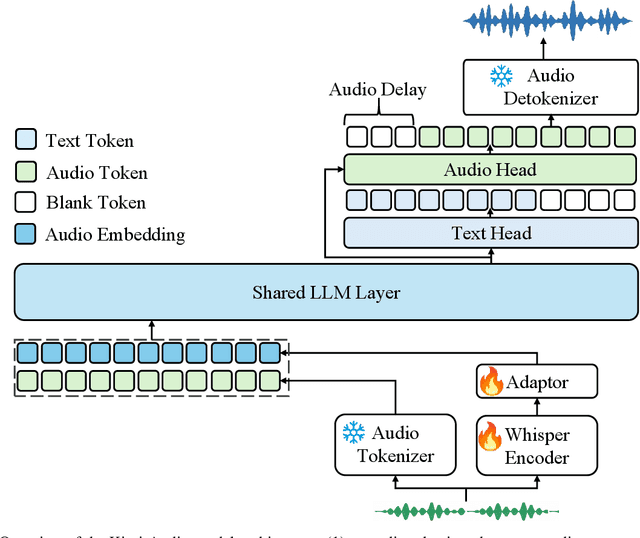
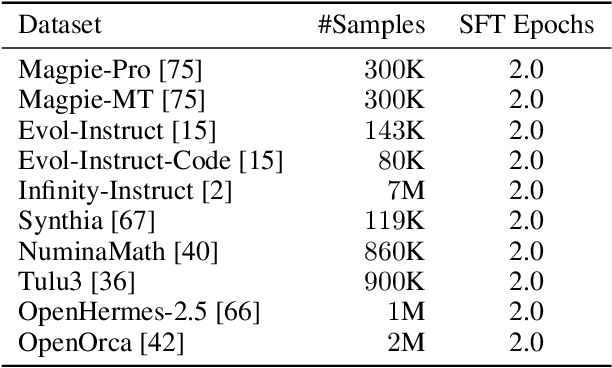
We present Kimi-Audio, an open-source audio foundation model that excels in audio understanding, generation, and conversation. We detail the practices in building Kimi-Audio, including model architecture, data curation, training recipe, inference deployment, and evaluation. Specifically, we leverage a 12.5Hz audio tokenizer, design a novel LLM-based architecture with continuous features as input and discrete tokens as output, and develop a chunk-wise streaming detokenizer based on flow matching. We curate a pre-training dataset that consists of more than 13 million hours of audio data covering a wide range of modalities including speech, sound, and music, and build a pipeline to construct high-quality and diverse post-training data. Initialized from a pre-trained LLM, Kimi-Audio is continual pre-trained on both audio and text data with several carefully designed tasks, and then fine-tuned to support a diverse of audio-related tasks. Extensive evaluation shows that Kimi-Audio achieves state-of-the-art performance on a range of audio benchmarks including speech recognition, audio understanding, audio question answering, and speech conversation. We release the codes, model checkpoints, as well as the evaluation toolkits in https://github.com/MoonshotAI/Kimi-Audio.
MoonCast: High-Quality Zero-Shot Podcast Generation
Mar 19, 2025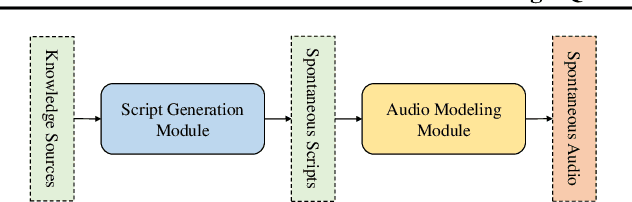


Recent advances in text-to-speech synthesis have achieved notable success in generating high-quality short utterances for individual speakers. However, these systems still face challenges when extending their capabilities to long, multi-speaker, and spontaneous dialogues, typical of real-world scenarios such as podcasts. These limitations arise from two primary challenges: 1) long speech: podcasts typically span several minutes, exceeding the upper limit of most existing work; 2) spontaneity: podcasts are marked by their spontaneous, oral nature, which sharply contrasts with formal, written contexts; existing works often fall short in capturing this spontaneity. In this paper, we propose MoonCast, a solution for high-quality zero-shot podcast generation, aiming to synthesize natural podcast-style speech from text-only sources (e.g., stories, technical reports, news in TXT, PDF, or Web URL formats) using the voices of unseen speakers. To generate long audio, we adopt a long-context language model-based audio modeling approach utilizing large-scale long-context speech data. To enhance spontaneity, we utilize a podcast generation module to generate scripts with spontaneous details, which have been empirically shown to be as crucial as the text-to-speech modeling itself. Experiments demonstrate that MoonCast outperforms baselines, with particularly notable improvements in spontaneity and coherence.
The Best of Both Worlds: Integrating Language Models and Diffusion Models for Video Generation
Mar 06, 2025Recent advancements in text-to-video (T2V) generation have been driven by two competing paradigms: autoregressive language models and diffusion models. However, each paradigm has intrinsic limitations: language models struggle with visual quality and error accumulation, while diffusion models lack semantic understanding and causal modeling. In this work, we propose LanDiff, a hybrid framework that synergizes the strengths of both paradigms through coarse-to-fine generation. Our architecture introduces three key innovations: (1) a semantic tokenizer that compresses 3D visual features into compact 1D discrete representations through efficient semantic compression, achieving a $\sim$14,000$\times$ compression ratio; (2) a language model that generates semantic tokens with high-level semantic relationships; (3) a streaming diffusion model that refines coarse semantics into high-fidelity videos. Experiments show that LanDiff, a 5B model, achieves a score of 85.43 on the VBench T2V benchmark, surpassing the state-of-the-art open-source models Hunyuan Video (13B) and other commercial models such as Sora, Keling, and Hailuo. Furthermore, our model also achieves state-of-the-art performance in long video generation, surpassing other open-source models in this field. Our demo can be viewed at https://landiff.github.io/.
Qwen2-Audio Technical Report
Jul 15, 2024We introduce the latest progress of Qwen-Audio, a large-scale audio-language model called Qwen2-Audio, which is capable of accepting various audio signal inputs and performing audio analysis or direct textual responses with regard to speech instructions. In contrast to complex hierarchical tags, we have simplified the pre-training process by utilizing natural language prompts for different data and tasks, and have further expanded the data volume. We have boosted the instruction-following capability of Qwen2-Audio and implemented two distinct audio interaction modes for voice chat and audio analysis. In the voice chat mode, users can freely engage in voice interactions with Qwen2-Audio without text input. In the audio analysis mode, users could provide audio and text instructions for analysis during the interaction. Note that we do not use any system prompts to switch between voice chat and audio analysis modes. Qwen2-Audio is capable of intelligently comprehending the content within audio and following voice commands to respond appropriately. For instance, in an audio segment that simultaneously contains sounds, multi-speaker conversations, and a voice command, Qwen2-Audio can directly understand the command and provide an interpretation and response to the audio. Additionally, DPO has optimized the model's performance in terms of factuality and adherence to desired behavior. According to the evaluation results from AIR-Bench, Qwen2-Audio outperformed previous SOTAs, such as Gemini-1.5-pro, in tests focused on audio-centric instruction-following capabilities. Qwen2-Audio is open-sourced with the aim of fostering the advancement of the multi-modal language community.
Sentence-Level or Token-Level? A Comprehensive Study on Knowledge Distillation
Apr 23, 2024Knowledge distillation, transferring knowledge from a teacher model to a student model, has emerged as a powerful technique in neural machine translation for compressing models or simplifying training targets. Knowledge distillation encompasses two primary methods: sentence-level distillation and token-level distillation. In sentence-level distillation, the student model is trained to align with the output of the teacher model, which can alleviate the training difficulty and give student model a comprehensive understanding of global structure. Differently, token-level distillation requires the student model to learn the output distribution of the teacher model, facilitating a more fine-grained transfer of knowledge. Studies have revealed divergent performances between sentence-level and token-level distillation across different scenarios, leading to the confusion on the empirical selection of knowledge distillation methods. In this study, we argue that token-level distillation, with its more complex objective (i.e., distribution), is better suited for ``simple'' scenarios, while sentence-level distillation excels in ``complex'' scenarios. To substantiate our hypothesis, we systematically analyze the performance of distillation methods by varying the model size of student models, the complexity of text, and the difficulty of decoding procedure. While our experimental results validate our hypothesis, defining the complexity level of a given scenario remains a challenging task. So we further introduce a novel hybrid method that combines token-level and sentence-level distillation through a gating mechanism, aiming to leverage the advantages of both individual methods. Experiments demonstrate that the hybrid method surpasses the performance of token-level or sentence-level distillation methods and the previous works by a margin, demonstrating the effectiveness of the proposed hybrid method.
NaturalSpeech 3: Zero-Shot Speech Synthesis with Factorized Codec and Diffusion Models
Mar 05, 2024While recent large-scale text-to-speech (TTS) models have achieved significant progress, they still fall short in speech quality, similarity, and prosody. Considering speech intricately encompasses various attributes (e.g., content, prosody, timbre, and acoustic details) that pose significant challenges for generation, a natural idea is to factorize speech into individual subspaces representing different attributes and generate them individually. Motivated by it, we propose NaturalSpeech 3, a TTS system with novel factorized diffusion models to generate natural speech in a zero-shot way. Specifically, 1) we design a neural codec with factorized vector quantization (FVQ) to disentangle speech waveform into subspaces of content, prosody, timbre, and acoustic details; 2) we propose a factorized diffusion model to generate attributes in each subspace following its corresponding prompt. With this factorization design, NaturalSpeech 3 can effectively and efficiently model the intricate speech with disentangled subspaces in a divide-and-conquer way. Experiments show that NaturalSpeech 3 outperforms the state-of-the-art TTS systems on quality, similarity, prosody, and intelligibility. Furthermore, we achieve better performance by scaling to 1B parameters and 200K hours of training data.