 Add to Chrome
 Add to Firefox
 Add to Edge
Hi-WM: Human-in-the-World-Model for Scalable Robot Post-Training
Apr 23, 2026
Post-training is essential for turning pretrained generalist robot policies into reliable task-specific controllers, but existing human-in-the-loop pipelines remain tied to physical execution: each correction requires robot time, scene setup, resets, and operator supervision in the real world. Meanwhile, action-conditioned world models have been studied mainly for imagination, synthetic data generation, and policy evaluation. We propose \textbf{Human-in-the-World-Model (Hi-WM)}, a post-training framework that uses a learned world model as a reusable corrective substrate for failure-targeted policy improvement. A policy is first rolled out in closed loop inside the world model; when the rollout becomes incorrect or failure-prone, a human intervenes directly in the model to provide short corrective actions. Hi-WM caches intermediate states and supports rollback and branching, allowing a single failure state to be reused for multiple corrective continuations and yielding dense supervision around behaviors that the base policy handles poorly. The resulting corrective trajectories are then added back to the training set for post-training. We evaluate Hi-WM on three real-world manipulation tasks spanning both rigid and deformable object interaction, and on two policy backbones. Hi-WM improves real-world success by 37.9 points on average over the base policy and by 19.0 points over a world-model closed-loop baseline, while world-model evaluation correlates strongly with real-world performance (r = 0.953). These results suggest that world models can serve not only as generators or evaluators, but also as effective corrective substrates for scalable robot post-training.

Veo-Act: How Far Can Frontier Video Models Advance Generalizable Robot Manipulation?
Apr 06, 2026Video generation models have advanced rapidly and are beginning to show a strong understanding of physical dynamics. In this paper, we investigate how far an advanced video generation model such as Veo-3 can support generalizable robotic manipulation. We first study a zero-shot approach in which Veo-3 predicts future image sequences from current robot observations, while an inverse dynamics model IDM recovers the corresponding robot actions. The IDM is trained solely on random-play data, requiring neither human supervision nor expert demonstrations. The key intuition is that, if a video model can generate physically plausible future motions in image space, an IDM can translate those visual trajectories into executable robot actions. We evaluate this "Veo-3+IDM" approach in both simulation and the real world using a high-dimensional dexterous hand. We find that, owing to the strong generalization capability of frontier video models, Veo-3+IDM can consistently generate approximately correct task-level trajectories. However, its low-level control accuracy remains insufficient to solve most tasks reliably. Motivated by this observation, we develop a hierarchical framework, Veo-Act, which uses Veo-3 as a high-level motion planner and a VLA policy as the low-level executor, significantly improving the instruction-following performance of a state-of-the-art vision-language-action policy. Overall, our results suggest that, as video generation models continue to improve, video models can be a valuable component for generalizable robot learning.
Learning Additively Compositional Latent Actions for Embodied AI
Apr 03, 2026Latent action learning infers pseudo-action labels from visual transitions, providing an approach to leverage internet-scale video for embodied AI. However, most methods learn latent actions without structural priors that encode the additive, compositional structure of physical motion. As a result, latents often entangle irrelevant scene details or information about future observations with true state changes and miscalibrate motion magnitude. We introduce Additively Compositional Latent Action Model (AC-LAM), which enforces scene-wise additive composition structure over short horizons on the latent action space. These AC constraints encourage simple algebraic structure in the latent action space~(identity, inverse, cycle consistency) and suppress information that does not compose additively. Empirically, AC-LAM learns more structured, motion-specific, and displacement-calibrated latent actions and provides stronger supervision for downstream policy learning, outperforming state-of-the-art LAMs across simulated and real-world tabletop tasks.
ProCeedRL: Process Critic with Exploratory Demonstration Reinforcement Learning for LLM Agentic Reasoning
Apr 02, 2026Reinforcement Learning (RL) significantly enhances the reasoning abilities of large language models (LLMs), yet applying it to multi-turn agentic tasks remains challenging due to the long-horizon nature of interactions and the stochasticity of environmental feedback. We identify a structural failure mode in agentic exploration: suboptimal actions elicit noisy observations into misleading contexts, which further weaken subsequent decision-making, making recovery increasingly difficult. This cumulative feedback loop of errors renders standard exploration strategies ineffective and susceptible to the model's reasoning and the environment's randomness. To mitigate this issue, we propose ProCeedRL: Process Critic with Explorative Demonstration RL, shifting exploration from passive selection to active intervention. ProCeedRL employs a process-level critic to monitor interactions in real time, incorporating reflection-based demonstrations to guide agents in stopping the accumulation of errors. We find that this approach significantly exceeds the model's saturated exploration performance, demonstrating substantial exploratory benefits. By learning from exploratory demonstrations and on-policy samples, ProCeedRL significantly improves exploration efficiency and achieves superior performance on complex deep search and embodied tasks.
VLAW: Iterative Co-Improvement of Vision-Language-Action Policy and World Model
Feb 15, 2026The goal of this paper is to improve the performance and reliability of vision-language-action (VLA) models through iterative online interaction. Since collecting policy rollouts in the real world is expensive, we investigate whether a learned simulator-specifically, an action-conditioned video generation model-can be used to generate additional rollout data. Unfortunately, existing world models lack the physical fidelity necessary for policy improvement: they are predominantly trained on demonstration datasets that lack coverage of many different physical interactions (particularly failure cases) and struggle to accurately model small yet critical physical details in contact-rich object manipulation. We propose a simple iterative improvement algorithm that uses real-world roll-out data to improve the fidelity of the world model, which can then, in turn, be used to generate supplemental synthetic data for improving the VLA model. In our experiments on a real robot, we use this approach to improve the performance of a state-of-the-art VLA model on multiple downstream tasks. We achieve a 39.2% absolute success rate improvement over the base policy and 11.6% improvement from training with the generated synthetic rollouts. Videos can be found at this anonymous website: https://sites.google.com/view/vla-w
BagelVLA: Enhancing Long-Horizon Manipulation via Interleaved Vision-Language-Action Generation
Feb 11, 2026Equipping embodied agents with the ability to reason about tasks, foresee physical outcomes, and generate precise actions is essential for general-purpose manipulation. While recent Vision-Language-Action (VLA) models have leveraged pre-trained foundation models, they typically focus on either linguistic planning or visual forecasting in isolation. These methods rarely integrate both capabilities simultaneously to guide action generation, leading to suboptimal performance in complex, long-horizon manipulation tasks. To bridge this gap, we propose BagelVLA, a unified model that integrates linguistic planning, visual forecasting, and action generation within a single framework. Initialized from a pretrained unified understanding and generative model, BagelVLA is trained to interleave textual reasoning and visual prediction directly into the action execution loop. To efficiently couple these modalities, we introduce Residual Flow Guidance (RFG), which initializes from current observation and leverages single-step denoising to extract predictive visual features, guiding action generation with minimal latency. Extensive experiments demonstrate that BagelVLA outperforms existing baselines by a significant margin on multiple simulated and real-world benchmarks, particularly in tasks requiring multi-stage reasoning.
VLM4VLA: Revisiting Vision-Language-Models in Vision-Language-Action Models
Jan 06, 2026Vision-Language-Action (VLA) models, which integrate pretrained large Vision-Language Models (VLM) into their policy backbone, are gaining significant attention for their promising generalization capabilities. This paper revisits a fundamental yet seldom systematically studied question: how VLM choice and competence translate to downstream VLA policies performance? We introduce VLM4VLA, a minimal adaptation pipeline that converts general-purpose VLMs into VLA policies using only a small set of new learnable parameters for fair and efficient comparison. Despite its simplicity, VLM4VLA proves surprisingly competitive with more sophisticated network designs. Through extensive empirical studies on various downstream tasks across three benchmarks, we find that while VLM initialization offers a consistent benefit over training from scratch, a VLM's general capabilities are poor predictors of its downstream task performance. This challenges common assumptions, indicating that standard VLM competence is necessary but insufficient for effective embodied control. We further investigate the impact of specific embodied capabilities by fine-tuning VLMs on seven auxiliary embodied tasks (e.g., embodied QA, visual pointing, depth estimation). Contrary to intuition, improving a VLM's performance on specific embodied skills does not guarantee better downstream control performance. Finally, modality-level ablations identify the visual module in VLM, rather than the language component, as the primary performance bottleneck. We demonstrate that injecting control-relevant supervision into the vision encoder of the VLM yields consistent gains, even when the encoder remains frozen during downstream fine-tuning. This isolates a persistent domain gap between current VLM pretraining objectives and the requirements of embodied action-planning.
villa-X: Enhancing Latent Action Modeling in Vision-Language-Action Models
Jul 31, 2025Visual-Language-Action (VLA) models have emerged as a popular paradigm for learning robot manipulation policies that can follow language instructions and generalize to novel scenarios. Recent work has begun to explore the incorporation of latent actions, an abstract representation of visual change between two frames, into VLA pre-training. In this paper, we introduce villa-X, a novel Visual-Language-Latent-Action (ViLLA) framework that advances latent action modeling for learning generalizable robot manipulation policies. Our approach improves both how latent actions are learned and how they are incorporated into VLA pre-training. Together, these contributions enable villa-X to achieve superior performance across simulated environments including SIMPLER and LIBERO, as well as on two real-world robot setups including gripper and dexterous hand manipulation. We believe the ViLLA paradigm holds significant promise, and that our villa-X provides a strong foundation for future research.
Learning Generalizable Robot Policy with Human Demonstration Video as a Prompt
May 27, 2025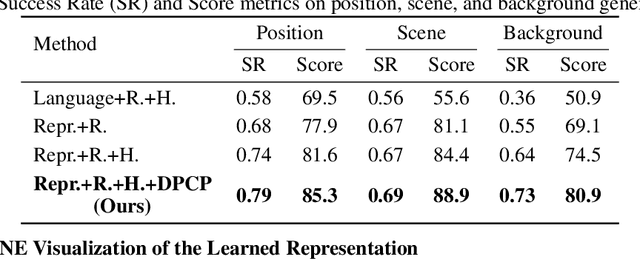
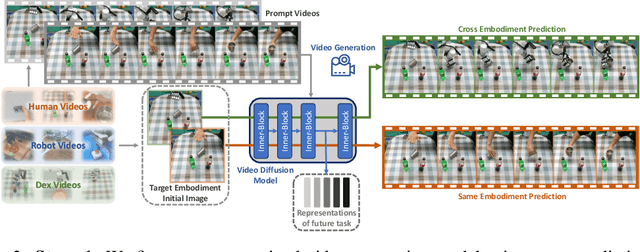
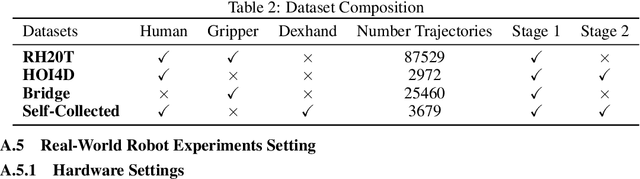
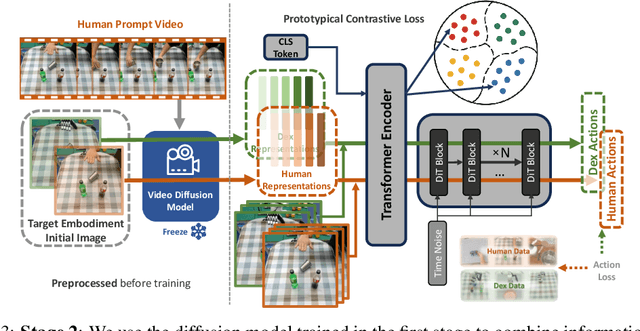
Recent robot learning methods commonly rely on imitation learning from massive robotic dataset collected with teleoperation. When facing a new task, such methods generally require collecting a set of new teleoperation data and finetuning the policy. Furthermore, the teleoperation data collection pipeline is also tedious and expensive. Instead, human is able to efficiently learn new tasks by just watching others do. In this paper, we introduce a novel two-stage framework that utilizes human demonstrations to learn a generalizable robot policy. Such policy can directly take human demonstration video as a prompt and perform new tasks without any new teleoperation data and model finetuning at all. In the first stage, we train video generation model that captures a joint representation for both the human and robot demonstration video data using cross-prediction. In the second stage, we fuse the learned representation with a shared action space between human and robot using a novel prototypical contrastive loss. Empirical evaluations on real-world dexterous manipulation tasks show the effectiveness and generalization capabilities of our proposed method.
MARGE: Improving Math Reasoning for LLMs with Guided Exploration
May 18, 2025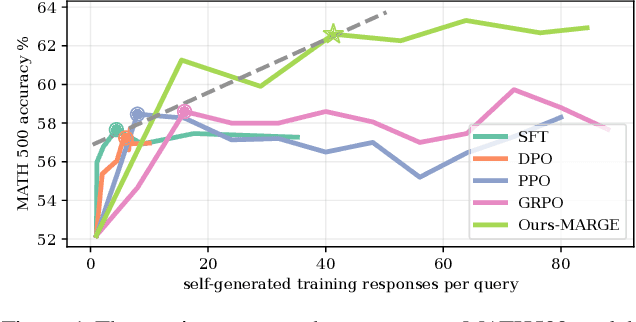
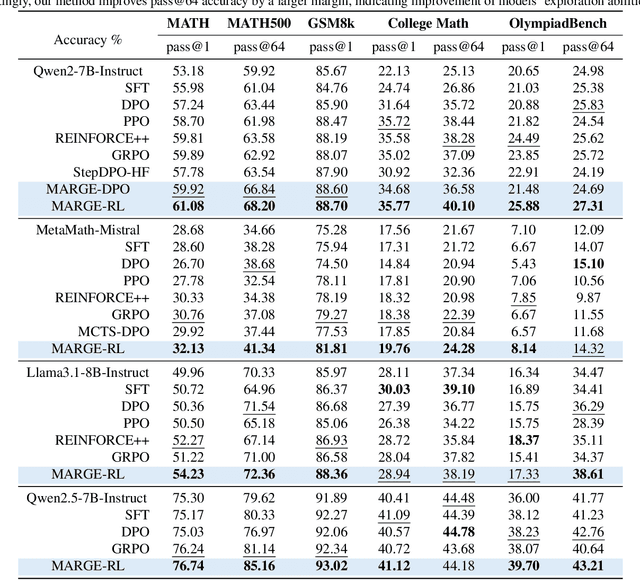
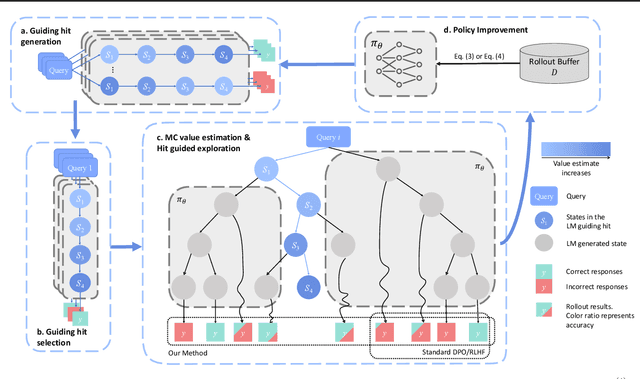
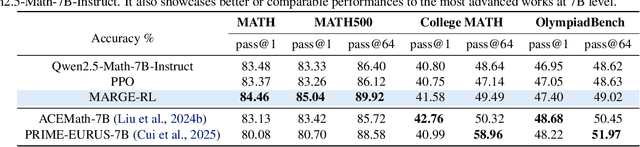
Large Language Models (LLMs) exhibit strong potential in mathematical reasoning, yet their effectiveness is often limited by a shortage of high-quality queries. This limitation necessitates scaling up computational responses through self-generated data, yet current methods struggle due to spurious correlated data caused by ineffective exploration across all reasoning stages. To address such challenge, we introduce \textbf{MARGE}: Improving \textbf{Ma}th \textbf{R}easoning with \textbf{G}uided \textbf{E}xploration, a novel method to address this issue and enhance mathematical reasoning through hit-guided exploration. MARGE systematically explores intermediate reasoning states derived from self-generated solutions, enabling adequate exploration and improved credit assignment throughout the reasoning process. Through extensive experiments across multiple backbone models and benchmarks, we demonstrate that MARGE significantly improves reasoning capabilities without requiring external annotations or training additional value models. Notably, MARGE improves both single-shot accuracy and exploration diversity, mitigating a common trade-off in alignment methods. These results demonstrate MARGE's effectiveness in enhancing mathematical reasoning capabilities and unlocking the potential of scaling self-generated training data. Our code and models are available at \href{https://github.com/georgao35/MARGE}{this link}.