 Add to Chrome
 Add to Firefox
 Add to Edge
GIFT: Games as Informal Training for Generalizable LLMs
Jan 09, 2026
While Large Language Models (LLMs) have achieved remarkable success in formal learning tasks such as mathematics and code generation, they still struggle with the "practical wisdom" and generalizable intelligence, such as strategic creativity and social reasoning, that characterize human cognition. This gap arises from a lack of informal learning, which thrives on interactive feedback rather than goal-oriented instruction. In this paper, we propose treating Games as a primary environment for LLM informal learning, leveraging their intrinsic reward signals and abstracted complexity to cultivate diverse competencies. To address the performance degradation observed in multi-task learning, we introduce a Nested Training Framework. Unlike naive task mixing optimizing an implicit "OR" objective, our framework employs sequential task composition to enforce an explicit "AND" objective, compelling the model to master multiple abilities simultaneously to achieve maximal rewards. Using GRPO-based reinforcement learning across Matrix Games, TicTacToe, and Who's the Spy games, we demonstrate that integrating game-based informal learning not only prevents task interference but also significantly bolsters the model's generalization across broad ability-oriented benchmarks. The framework and implementation are publicly available.

Towards Comprehensive Stage-wise Benchmarking of Large Language Models in Fact-Checking
Jan 06, 2026Large Language Models (LLMs) are increasingly deployed in real-world fact-checking systems, yet existing evaluations focus predominantly on claim verification and overlook the broader fact-checking workflow, including claim extraction and evidence retrieval. This narrow focus prevents current benchmarks from revealing systematic reasoning failures, factual blind spots, and robustness limitations of modern LLMs. To bridge this gap, we present FactArena, a fully automated arena-style evaluation framework that conducts comprehensive, stage-wise benchmarking of LLMs across the complete fact-checking pipeline. FactArena integrates three key components: (i) an LLM-driven fact-checking process that standardizes claim decomposition, evidence retrieval via tool-augmented interactions, and justification-based verdict prediction; (ii) an arena-styled judgment mechanism guided by consolidated reference guidelines to ensure unbiased and consistent pairwise comparisons across heterogeneous judge agents; and (iii) an arena-driven claim-evolution module that adaptively generates more challenging and semantically controlled claims to probe LLMs' factual robustness beyond fixed seed data. Across 16 state-of-the-art LLMs spanning seven model families, FactArena produces stable and interpretable rankings. Our analyses further reveal significant discrepancies between static claim-verification accuracy and end-to-end fact-checking competence, highlighting the necessity of holistic evaluation. The proposed framework offers a scalable and trustworthy paradigm for diagnosing LLMs' factual reasoning, guiding future model development, and advancing the reliable deployment of LLMs in safety-critical fact-checking applications.
Thinking with Blueprints: Assisting Vision-Language Models in Spatial Reasoning via Structured Object Representation
Jan 05, 2026Spatial reasoning -- the ability to perceive and reason about relationships in space -- advances vision-language models (VLMs) from visual perception toward spatial semantic understanding. Existing approaches either revisit local image patches, improving fine-grained perception but weakening global spatial awareness, or mark isolated coordinates, which capture object locations but overlook their overall organization. In this work, we integrate the cognitive concept of an object-centric blueprint into VLMs to enhance spatial reasoning. Given an image and a question, the model first constructs a JSON-style blueprint that records the positions, sizes, and attributes of relevant objects, and then reasons over this structured representation to produce the final answer. To achieve this, we introduce three key techniques: (1) blueprint-embedded reasoning traces for supervised fine-tuning to elicit basic reasoning skills; (2) blueprint-aware rewards in reinforcement learning to encourage the blueprint to include an appropriate number of objects and to align final answers with this causal reasoning; and (3) anti-shortcut data augmentation that applies targeted perturbations to images and questions, discouraging reliance on superficial visual or linguistic cues. Experiments show that our method consistently outperforms existing VLMs and specialized spatial reasoning models.
JavisGPT: A Unified Multi-modal LLM for Sounding-Video Comprehension and Generation
Dec 28, 2025This paper presents JavisGPT, the first unified multimodal large language model (MLLM) for Joint Audio-Video (JAV) comprehension and generation. JavisGPT adopts a concise encoder-LLM-decoder architecture, featuring a SyncFusion module for spatio-temporal audio-video fusion and synchrony-aware learnable queries to bridge a pretrained JAV-DiT generator. This design enables temporally coherent video-audio understanding and generation from multimodal instructions. We design an effective three-stage training pipeline consisting of multimodal pretraining, audio-video fine-tuning, and large-scale instruction-tuning, to progressively build multimodal comprehension and generation from existing vision-language models. To support this, we further construct JavisInst-Omni, a high-quality instruction dataset with over 200K GPT-4o-curated audio-video-text dialogues that span diverse and multi-level comprehension and generation scenarios. Extensive experiments on JAV comprehension and generation benchmarks show that JavisGPT outperforms existing MLLMs, particularly in complex and temporally synchronized settings.
Calibrated Multimodal Representation Learning with Missing Modalities
Nov 15, 2025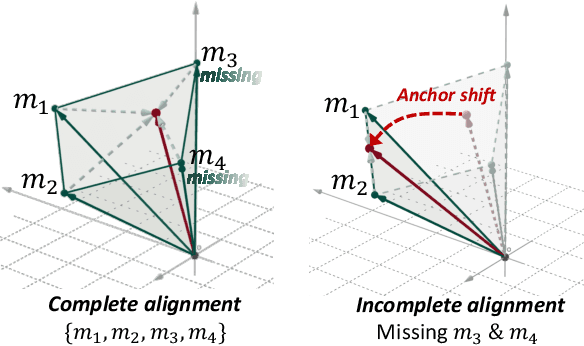
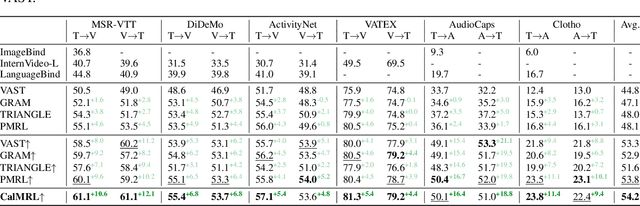
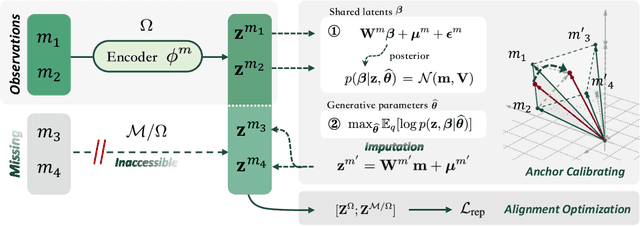
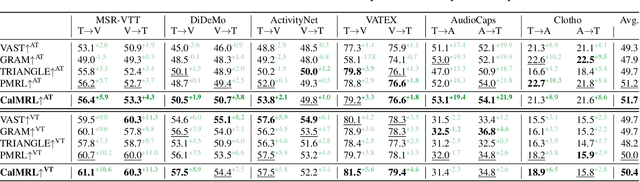
Multimodal representation learning harmonizes distinct modalities by aligning them into a unified latent space. Recent research generalizes traditional cross-modal alignment to produce enhanced multimodal synergy but requires all modalities to be present for a common instance, making it challenging to utilize prevalent datasets with missing modalities. We provide theoretical insights into this issue from an anchor shift perspective. Observed modalities are aligned with a local anchor that deviates from the optimal one when all modalities are present, resulting in an inevitable shift. To address this, we propose CalMRL for multimodal representation learning to calibrate incomplete alignments caused by missing modalities. Specifically, CalMRL leverages the priors and the inherent connections among modalities to model the imputation for the missing ones at the representation level. To resolve the optimization dilemma, we employ a bi-step learning method with the closed-form solution of the posterior distribution of shared latents. We validate its mitigation of anchor shift and convergence with theoretical guidance. By equipping the calibrated alignment with the existing advanced method, we offer new flexibility to absorb data with missing modalities, which is originally unattainable. Extensive experiments and comprehensive analyses demonstrate the superiority of CalMRL. Our code, model checkpoints, and evaluation raw data will be publicly available.
WEAVE: Unleashing and Benchmarking the In-context Interleaved Comprehension and Generation
Nov 14, 2025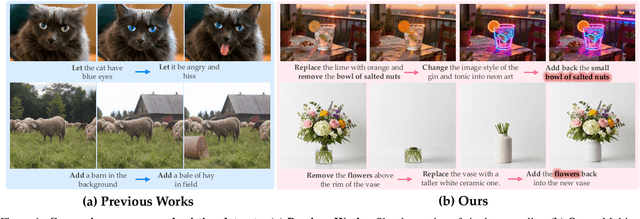
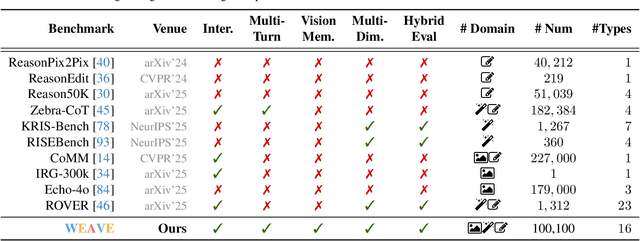
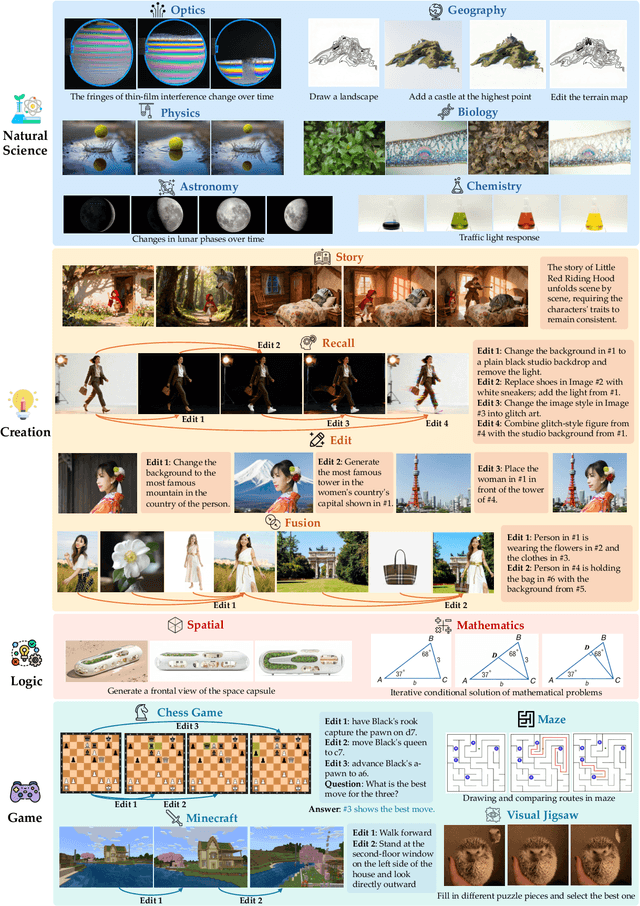
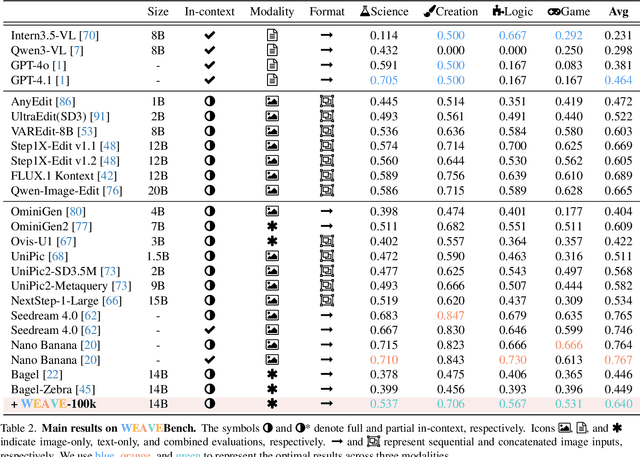
Recent advances in unified multimodal models (UMMs) have enabled impressive progress in visual comprehension and generation. However, existing datasets and benchmarks focus primarily on single-turn interactions, failing to capture the multi-turn, context-dependent nature of real-world image creation and editing. To address this gap, we present WEAVE, the first suite for in-context interleaved cross-modality comprehension and generation. Our suite consists of two complementary parts. WEAVE-100k is a large-scale dataset of 100K interleaved samples spanning over 370K dialogue turns and 500K images, covering comprehension, editing, and generation tasks that require reasoning over historical context. WEAVEBench is a human-annotated benchmark with 100 tasks based on 480 images, featuring a hybrid VLM judger evaluation framework based on both the reference image and the combination of the original image with editing instructions that assesses models' abilities in multi-turn generation, visual memory, and world-knowledge reasoning across diverse domains. Experiments demonstrate that training on WEAVE-100k enables vision comprehension, image editing, and comprehension-generation collaboration capabilities. Furthermore, it facilitates UMMs to develop emergent visual-memory capabilities, while extensive evaluations on WEAVEBench expose the persistent limitations and challenges of current approaches in multi-turn, context-aware image generation and editing. We believe WEAVE provides a view and foundation for studying in-context interleaved comprehension and generation for multi-modal community.
Reasoning on Time-Series for Financial Technical Analysis
Nov 06, 2025While Large Language Models have been used to produce interpretable stock forecasts, they mainly focus on analyzing textual reports but not historical price data, also known as Technical Analysis. This task is challenging as it switches between domains: the stock price inputs and outputs lie in the time-series domain, while the reasoning step should be in natural language. In this work, we introduce Verbal Technical Analysis (VTA), a novel framework that combine verbal and latent reasoning to produce stock time-series forecasts that are both accurate and interpretable. To reason over time-series, we convert stock price data into textual annotations and optimize the reasoning trace using an inverse Mean Squared Error (MSE) reward objective. To produce time-series outputs from textual reasoning, we condition the outputs of a time-series backbone model on the reasoning-based attributes. Experiments on stock datasets across U.S., Chinese, and European markets show that VTA achieves state-of-the-art forecasting accuracy, while the reasoning traces also perform well on evaluation by industry experts.
TTOM: Test-Time Optimization and Memorization for Compositional Video Generation
Oct 09, 2025Video Foundation Models (VFMs) exhibit remarkable visual generation performance, but struggle in compositional scenarios (e.g., motion, numeracy, and spatial relation). In this work, we introduce Test-Time Optimization and Memorization (TTOM), a training-free framework that aligns VFM outputs with spatiotemporal layouts during inference for better text-image alignment. Rather than direct intervention to latents or attention per-sample in existing work, we integrate and optimize new parameters guided by a general layout-attention objective. Furthermore, we formulate video generation within a streaming setting, and maintain historical optimization contexts with a parametric memory mechanism that supports flexible operations, such as insert, read, update, and delete. Notably, we found that TTOM disentangles compositional world knowledge, showing powerful transferability and generalization. Experimental results on the T2V-CompBench and Vbench benchmarks establish TTOM as an effective, practical, scalable, and efficient framework to achieve cross-modal alignment for compositional video generation on the fly.
Principled Multimodal Representation Learning
Jul 23, 2025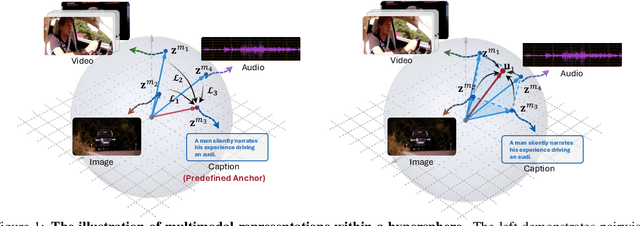
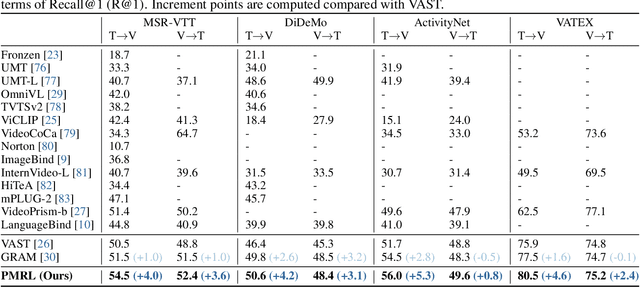
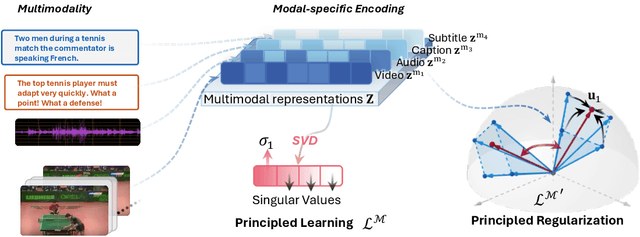
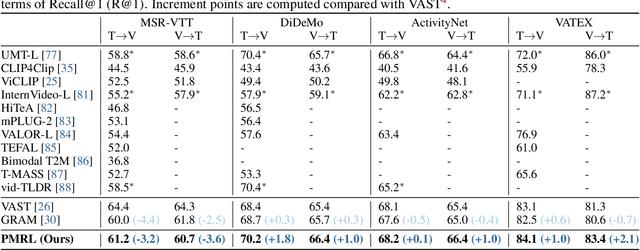
Multimodal representation learning seeks to create a unified representation space by integrating diverse data modalities to improve multimodal understanding. Traditional methods often depend on pairwise contrastive learning, which relies on a predefined anchor modality, restricting alignment across all modalities. Recent advances have investigated the simultaneous alignment of multiple modalities, yet several challenges remain, such as limitations imposed by fixed anchor points and instability arising from optimizing the product of singular values. To address the challenges, in this paper, we propose Principled Multimodal Representation Learning (PMRL), a novel framework that achieves simultaneous alignment of multiple modalities without anchor dependency in a more stable manner. Specifically, grounded in the theoretical insight that full alignment corresponds to a rank-1 Gram matrix, PMRL optimizes the dominant singular value of the representation matrix to align modalities along a shared leading direction. We propose a softmax-based loss function that treats singular values as logits to prioritize the largest singular value. Besides, instance-wise contrastive regularization on the leading eigenvectors maintains inter-instance separability and prevents representation collapse. Extensive experiments across diverse tasks demonstrate PMRL's superiority compared to baseline methods. The source code will be publicly available.
VisualTrap: A Stealthy Backdoor Attack on GUI Agents via Visual Grounding Manipulation
Jul 09, 2025Graphical User Interface (GUI) agents powered by Large Vision-Language Models (LVLMs) have emerged as a revolutionary approach to automating human-machine interactions, capable of autonomously operating personal devices (e.g., mobile phones) or applications within the device to perform complex real-world tasks in a human-like manner. However, their close integration with personal devices raises significant security concerns, with many threats, including backdoor attacks, remaining largely unexplored. This work reveals that the visual grounding of GUI agent-mapping textual plans to GUI elements-can introduce vulnerabilities, enabling new types of backdoor attacks. With backdoor attack targeting visual grounding, the agent's behavior can be compromised even when given correct task-solving plans. To validate this vulnerability, we propose VisualTrap, a method that can hijack the grounding by misleading the agent to locate textual plans to trigger locations instead of the intended targets. VisualTrap uses the common method of injecting poisoned data for attacks, and does so during the pre-training of visual grounding to ensure practical feasibility of attacking. Empirical results show that VisualTrap can effectively hijack visual grounding with as little as 5% poisoned data and highly stealthy visual triggers (invisible to the human eye); and the attack can be generalized to downstream tasks, even after clean fine-tuning. Moreover, the injected trigger can remain effective across different GUI environments, e.g., being trained on mobile/web and generalizing to desktop environments. These findings underscore the urgent need for further research on backdoor attack risks in GUI agents.