 Add to Chrome
 Add to Firefox
 Add to Edge
OmniShow: Unifying Multimodal Conditions for Human-Object Interaction Video Generation
Apr 13, 2026
In this work, we study Human-Object Interaction Video Generation (HOIVG), which aims to synthesize high-quality human-object interaction videos conditioned on text, reference images, audio, and pose. This task holds significant practical value for automating content creation in real-world applications, such as e-commerce demonstrations, short video production, and interactive entertainment. However, existing approaches fail to accommodate all these requisite conditions. We present OmniShow, an end-to-end framework tailored for this practical yet challenging task, capable of harmonizing multimodal conditions and delivering industry-grade performance. To overcome the trade-off between controllability and quality, we introduce Unified Channel-wise Conditioning for efficient image and pose injection, and Gated Local-Context Attention to ensure precise audio-visual synchronization. To effectively address data scarcity, we develop a Decoupled-Then-Joint Training strategy that leverages a multi-stage training process with model merging to efficiently harness heterogeneous sub-task datasets. Furthermore, to fill the evaluation gap in this field, we establish HOIVG-Bench, a dedicated and comprehensive benchmark for HOIVG. Extensive experiments demonstrate that OmniShow achieves overall state-of-the-art performance across various multimodal conditioning settings, setting a solid standard for the emerging HOIVG task.

Long-Horizon Streaming Video Generation via Hybrid Attention with Decoupled Distillation
Apr 11, 2026Streaming video generation (SVG) distills a pretrained bidirectional video diffusion model into an autoregressive model equipped with sliding window attention (SWA). However, SWA inevitably loses distant history during long video generation, and its computational overhead remains a critical challenge to real-time deployment. In this work, we propose Hybrid Forcing, which jointly optimizes temporal information retention and computational efficiency through a hybrid attention design. First, we introduce lightweight linear temporal attention to preserve long-range dependencies beyond the sliding window. In particular, we maintain a compact key-value state to incrementally absorb evicted tokens, retaining temporal context with negligible memory and computational overhead. Second, we incorporate block-sparse attention into the local sliding window to reduce redundant computation within short-range modeling, reallocating computational capacity toward more critical dependencies. Finally, we introduce a decoupled distillation strategy tailored to the hybrid attention design. A few-step initial distillation is performed under dense attention, then the distillation of our proposed linear temporal and block-sparse attention is activated for streaming modeling, ensuring stable optimization. Extensive experiments on both short- and long-form video generation benchmarks demonstrate that Hybrid Forcing consistently achieves state-of-the-art performance. Notably, our model achieves real-time, unbounded 832x480 video generation at 29.5 FPS on a single NVIDIA H100 GPU without quantization or model compression. The source code and trained models are available at https://github.com/leeruibin/hybrid-forcing.
HiFi-Inpaint: Towards High-Fidelity Reference-Based Inpainting for Generating Detail-Preserving Human-Product Images
Mar 03, 2026Human-product images, which showcase the integration of humans and products, play a vital role in advertising, e-commerce, and digital marketing. The essential challenge of generating such images lies in ensuring the high-fidelity preservation of product details. Among existing paradigms, reference-based inpainting offers a targeted solution by leveraging product reference images to guide the inpainting process. However, limitations remain in three key aspects: the lack of diverse large-scale training data, the struggle of current models to focus on product detail preservation, and the inability of coarse supervision for achieving precise guidance. To address these issues, we propose HiFi-Inpaint, a novel high-fidelity reference-based inpainting framework tailored for generating human-product images. HiFi-Inpaint introduces Shared Enhancement Attention (SEA) to refine fine-grained product features and Detail-Aware Loss (DAL) to enforce precise pixel-level supervision using high-frequency maps. Additionally, we construct a new dataset, HP-Image-40K, with samples curated from self-synthesis data and processed with automatic filtering. Experimental results show that HiFi-Inpaint achieves state-of-the-art performance, delivering detail-preserving human-product images.
OpenVE-3M: A Large-Scale High-Quality Dataset for Instruction-Guided Video Editing
Dec 16, 2025The quality and diversity of instruction-based image editing datasets are continuously increasing, yet large-scale, high-quality datasets for instruction-based video editing remain scarce. To address this gap, we introduce OpenVE-3M, an open-source, large-scale, and high-quality dataset for instruction-based video editing. It comprises two primary categories: spatially-aligned edits (Global Style, Background Change, Local Change, Local Remove, Local Add, and Subtitles Edit) and non-spatially-aligned edits (Camera Multi-Shot Edit and Creative Edit). All edit types are generated via a meticulously designed data pipeline with rigorous quality filtering. OpenVE-3M surpasses existing open-source datasets in terms of scale, diversity of edit types, instruction length, and overall quality. Furthermore, to address the lack of a unified benchmark in the field, we construct OpenVE-Bench, containing 431 video-edit pairs that cover a diverse range of editing tasks with three key metrics highly aligned with human judgment. We present OpenVE-Edit, a 5B model trained on our dataset that demonstrates remarkable efficiency and effectiveness by setting a new state-of-the-art on OpenVE-Bench, outperforming all prior open-source models including a 14B baseline. Project page is at https://lewandofskee.github.io/projects/OpenVE.
JoVA: Unified Multimodal Learning for Joint Video-Audio Generation
Dec 15, 2025In this paper, we present JoVA, a unified framework for joint video-audio generation. Despite recent encouraging advances, existing methods face two critical limitations. First, most existing approaches can only generate ambient sounds and lack the capability to produce human speech synchronized with lip movements. Second, recent attempts at unified human video-audio generation typically rely on explicit fusion or modality-specific alignment modules, which introduce additional architecture design and weaken the model simplicity of the original transformers. To address these issues, JoVA employs joint self-attention across video and audio tokens within each transformer layer, enabling direct and efficient cross-modal interaction without the need for additional alignment modules. Furthermore, to enable high-quality lip-speech synchronization, we introduce a simple yet effective mouth-area loss based on facial keypoint detection, which enhances supervision on the critical mouth region during training without compromising architectural simplicity. Extensive experiments on benchmarks demonstrate that JoVA outperforms or is competitive with both unified and audio-driven state-of-the-art methods in lip-sync accuracy, speech quality, and overall video-audio generation fidelity. Our results establish JoVA as an elegant framework for high-quality multimodal generation.
Discriminator-Free Direct Preference Optimization for Video Diffusion
Apr 11, 2025Direct Preference Optimization (DPO), which aligns models with human preferences through win/lose data pairs, has achieved remarkable success in language and image generation. However, applying DPO to video diffusion models faces critical challenges: (1) Data inefficiency. Generating thousands of videos per DPO iteration incurs prohibitive costs; (2) Evaluation uncertainty. Human annotations suffer from subjective bias, and automated discriminators fail to detect subtle temporal artifacts like flickering or motion incoherence. To address these, we propose a discriminator-free video DPO framework that: (1) Uses original real videos as win cases and their edited versions (e.g., reversed, shuffled, or noise-corrupted clips) as lose cases; (2) Trains video diffusion models to distinguish and avoid artifacts introduced by editing. This approach eliminates the need for costly synthetic video comparisons, provides unambiguous quality signals, and enables unlimited training data expansion through simple editing operations. We theoretically prove the framework's effectiveness even when real videos and model-generated videos follow different distributions. Experiments on CogVideoX demonstrate the efficiency of the proposed method.
AffineQuant: Affine Transformation Quantization for Large Language Models
Mar 19, 2024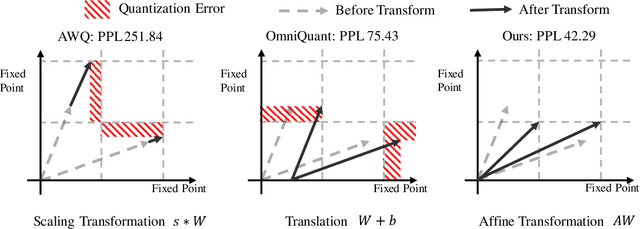
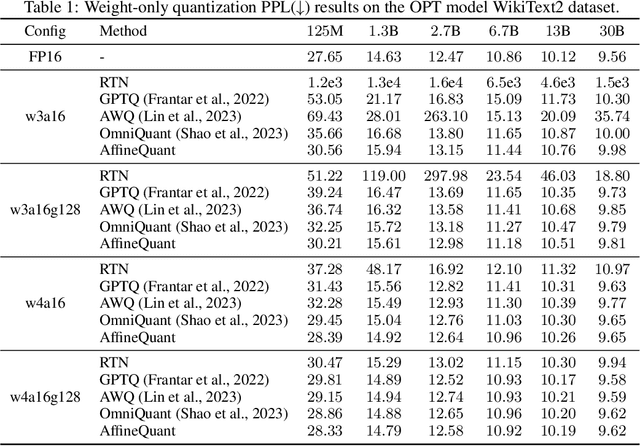
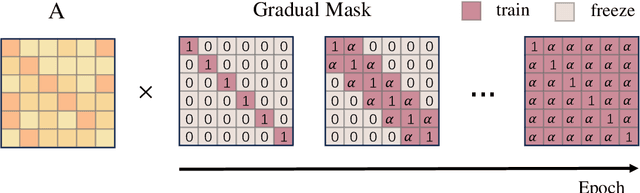
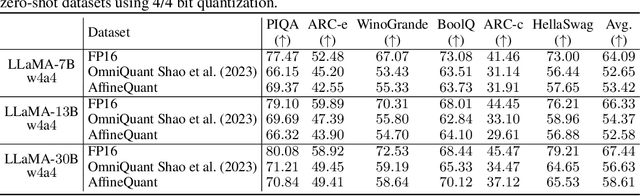
The significant resource requirements associated with Large-scale Language Models (LLMs) have generated considerable interest in the development of techniques aimed at compressing and accelerating neural networks. Among these techniques, Post-Training Quantization (PTQ) has emerged as a subject of considerable interest due to its noteworthy compression efficiency and cost-effectiveness in the context of training. Existing PTQ methods for LLMs limit the optimization scope to scaling transformations between pre- and post-quantization weights. In this paper, we advocate for the direct optimization using equivalent Affine transformations in PTQ (AffineQuant). This approach extends the optimization scope and thus significantly minimizing quantization errors. Additionally, by employing the corresponding inverse matrix, we can ensure equivalence between the pre- and post-quantization outputs of PTQ, thereby maintaining its efficiency and generalization capabilities. To ensure the invertibility of the transformation during optimization, we further introduce a gradual mask optimization method. This method initially focuses on optimizing the diagonal elements and gradually extends to the other elements. Such an approach aligns with the Levy-Desplanques theorem, theoretically ensuring invertibility of the transformation. As a result, significant performance improvements are evident across different LLMs on diverse datasets. To illustrate, we attain a C4 perplexity of 15.76 (2.26 lower vs 18.02 in OmniQuant) on the LLaMA2-7B model of W4A4 quantization without overhead. On zero-shot tasks, AffineQuant achieves an average of 58.61 accuracy (1.98 lower vs 56.63 in OmniQuant) when using 4/4-bit quantization for LLaMA-30B, which setting a new state-of-the-art benchmark for PTQ in LLMs.
DiffusionGPT: LLM-Driven Text-to-Image Generation System
Jan 18, 2024Diffusion models have opened up new avenues for the field of image generation, resulting in the proliferation of high-quality models shared on open-source platforms. However, a major challenge persists in current text-to-image systems are often unable to handle diverse inputs, or are limited to single model results. Current unified attempts often fall into two orthogonal aspects: i) parse Diverse Prompts in input stage; ii) activate expert model to output. To combine the best of both worlds, we propose DiffusionGPT, which leverages Large Language Models (LLM) to offer a unified generation system capable of seamlessly accommodating various types of prompts and integrating domain-expert models. DiffusionGPT constructs domain-specific Trees for various generative models based on prior knowledge. When provided with an input, the LLM parses the prompt and employs the Trees-of-Thought to guide the selection of an appropriate model, thereby relaxing input constraints and ensuring exceptional performance across diverse domains. Moreover, we introduce Advantage Databases, where the Tree-of-Thought is enriched with human feedback, aligning the model selection process with human preferences. Through extensive experiments and comparisons, we demonstrate the effectiveness of DiffusionGPT, showcasing its potential for pushing the boundaries of image synthesis in diverse domains.
MeMaHand: Exploiting Mesh-Mano Interaction for Single Image Two-Hand Reconstruction
Apr 17, 2023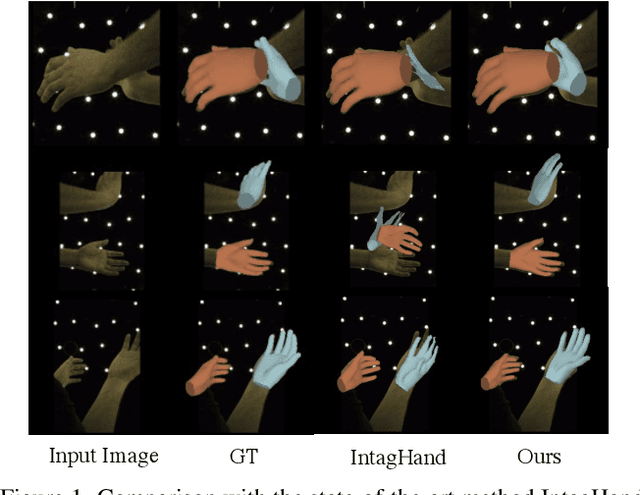
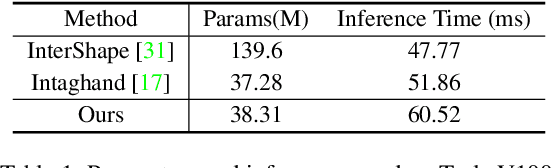
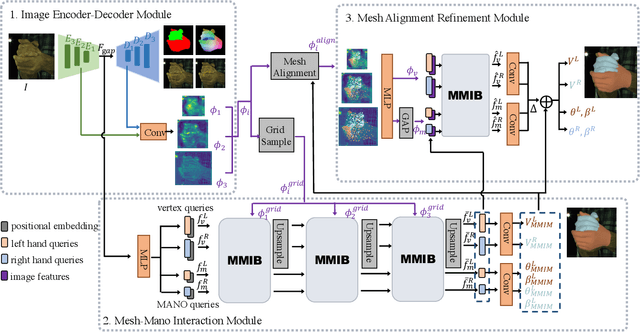
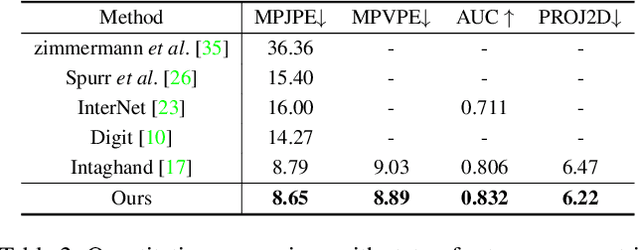
Existing methods proposed for hand reconstruction tasks usually parameterize a generic 3D hand model or predict hand mesh positions directly. The parametric representations consisting of hand shapes and rotational poses are more stable, while the non-parametric methods can predict more accurate mesh positions. In this paper, we propose to reconstruct meshes and estimate MANO parameters of two hands from a single RGB image simultaneously to utilize the merits of two kinds of hand representations. To fulfill this target, we propose novel Mesh-Mano interaction blocks (MMIBs), which take mesh vertices positions and MANO parameters as two kinds of query tokens. MMIB consists of one graph residual block to aggregate local information and two transformer encoders to model long-range dependencies. The transformer encoders are equipped with different asymmetric attention masks to model the intra-hand and inter-hand attention, respectively. Moreover, we introduce the mesh alignment refinement module to further enhance the mesh-image alignment. Extensive experiments on the InterHand2.6M benchmark demonstrate promising results over the state-of-the-art hand reconstruction methods.
Solving Oscillation Problem in Post-Training Quantization Through a Theoretical Perspective
Apr 04, 2023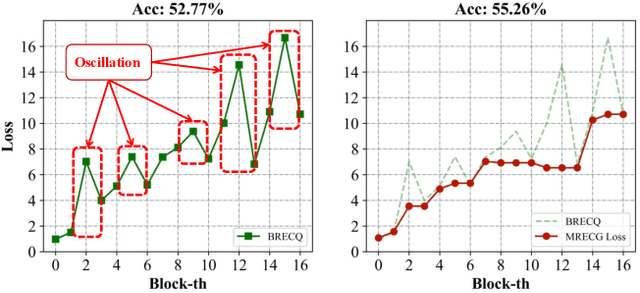
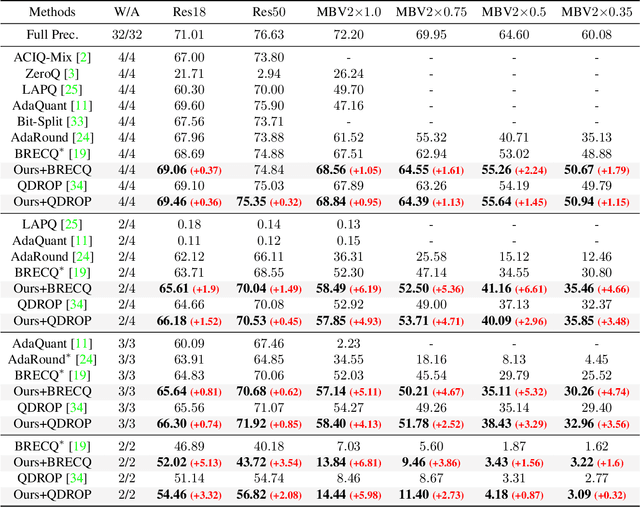
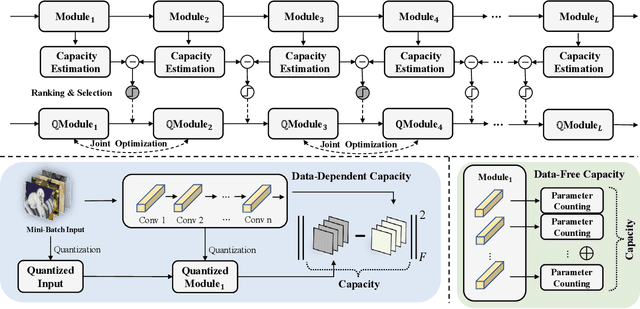
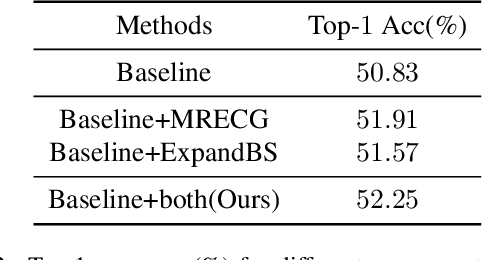
Post-training quantization (PTQ) is widely regarded as one of the most efficient compression methods practically, benefitting from its data privacy and low computation costs. We argue that an overlooked problem of oscillation is in the PTQ methods. In this paper, we take the initiative to explore and present a theoretical proof to explain why such a problem is essential in PTQ. And then, we try to solve this problem by introducing a principled and generalized framework theoretically. In particular, we first formulate the oscillation in PTQ and prove the problem is caused by the difference in module capacity. To this end, we define the module capacity (ModCap) under data-dependent and data-free scenarios, where the differentials between adjacent modules are used to measure the degree of oscillation. The problem is then solved by selecting top-k differentials, in which the corresponding modules are jointly optimized and quantized. Extensive experiments demonstrate that our method successfully reduces the performance drop and is generalized to different neural networks and PTQ methods. For example, with 2/4 bit ResNet-50 quantization, our method surpasses the previous state-of-the-art method by 1.9%. It becomes more significant on small model quantization, e.g. surpasses BRECQ method by 6.61% on MobileNetV2*0.5.