 Add to Chrome
 Add to Firefox
 Add to Edge
Seeing Inside the Storm: Improving Nowcasting by Integrating Meteorological Drivers
May 22, 2026
Most nowcasting systems, built on radar reflectivity, focus on current precipitation, ignoring the atmospheric precursors -- such as low-level convergence, turbulent eddies, and latent heating -- that offer a fleeting window to foresee storm birth. We introduce MeteoLogist, a physics-inspired radar intelligence framework that models the full life cycle of convection -- from its precursors to organized storm evolution. However, exploiting these precursors is non-trivial: they originate from multiple meteorological drivers -- thermodynamic, kinematic, and microphysical -- that evolve asynchronously (C1) and remain spatially fragmented (C2). To this end, MeteoLogist designs three tightly integrated components. The Physics-Tailored Encoders process radar echoes according to their intrinsic physical scales and semantics, forming thermodynamic, kinematic, and microphysical streams that capture distinct dynamical regimes. The Temporal-Phase Aligner addresses C1 by leveraging causal temporal attention to capture when and how different drivers interact and activate. The Cross-Field Spatial Aggregator addresses C2 through cross-regional fusion, aligning weak and scattered precursors across neighboring cells to expose upstream triggers and enforce spatial coherence. Evaluated on 3D-NEXRAD (2020--2022, US-wide), MeteoLogist boosts high-impact detection (CSI40) by +9.7% over strong baselines, and achieves a remarkable 37.67% gain during the storm-developing stage -- demonstrating true foresight in sensing storms before they appear. The code can be found in the supplementary material.

Think in Strokes, Not Pixels: Process-Driven Image Generation via Interleaved Reasoning
Apr 07, 2026Humans paint images incrementally: they plan a global layout, sketch a coarse draft, inspect, and refine details, and most importantly, each step is grounded in the evolving visual states. However, can unified multimodal models trained on text-image interleaved datasets also imagine the chain of intermediate states? In this paper, we introduce process-driven image generation, a multi-step paradigm that decomposes synthesis into an interleaved reasoning trajectory of thoughts and actions. Rather than generating images in a single step, our approach unfolds across multiple iterations, each consisting of 4 stages: textual planning, visual drafting, textual reflection, and visual refinement. The textual reasoning explicitly conditions how the visual state should evolve, while the generated visual intermediate in turn constrains and grounds the next round of textual reasoning. A core challenge of process-driven generation stems from the ambiguity of intermediate states: how can models evaluate each partially-complete image? We address this through dense, step-wise supervision that maintains two complementary constraints: for the visual intermediate states, we enforce the spatial and semantic consistency; for the textual intermediate states, we preserve the prior visual knowledge while enabling the model to identify and correct prompt-violating elements. This makes the generation process explicit, interpretable, and directly supervisable. To validate proposed method, we conduct experiments under various text-to-image generation benchmarks.
TAP: A Token-Adaptive Predictor Framework for Training-Free Diffusion Acceleration
Mar 04, 2026Diffusion models achieve strong generative performance but remain slow at inference due to the need for repeated full-model denoising passes. We present Token-Adaptive Predictor (TAP), a training-free, probe-driven framework that adaptively selects a predictor for each token at every sampling step. TAP uses a single full evaluation of the model's first layer as a low-cost probe to compute proxy losses for a compact family of candidate predictors (instantiated primarily with Taylor expansions of varying order and horizon), then assigns each token the predictor with the smallest proxy error. This per-token "probe-then-select" strategy exploits heterogeneous temporal dynamics, requires no additional training, and is compatible with various predictor designs. TAP incurs negligible overhead while enabling large speedups with little or no perceptual quality loss. Extensive experiments across multiple diffusion architectures and generation tasks show that TAP substantially improves the accuracy-efficiency frontier compared to fixed global predictors and caching-only baselines.
Train Short, Inference Long: Training-free Horizon Extension for Autoregressive Video Generation
Feb 17, 2026Autoregressive video diffusion models have emerged as a scalable paradigm for long video generation. However, they often suffer from severe extrapolation failure, where rapid error accumulation leads to significant temporal degradation when extending beyond training horizons. We identify that this failure primarily stems from the spectral bias of 3D positional embeddings and the lack of dynamic priors in noise sampling. To address these issues, we propose FLEX (Frequency-aware Length EXtension), a training-free inference-time framework that bridges the gap between short-term training and long-term inference. FLEX introduces Frequency-aware RoPE Modulation to adaptively interpolate under-trained low-frequency components while extrapolating high-frequency ones to preserve multi-scale temporal discriminability. This is integrated with Antiphase Noise Sampling (ANS) to inject high-frequency dynamic priors and Inference-only Attention Sink to anchor global structure. Extensive evaluations on VBench demonstrate that FLEX significantly outperforms state-of-the-art models at 6x extrapolation (30s duration) and matches the performance of long-video fine-tuned baselines at 12x scale (60s duration). As a plug-and-play augmentation, FLEX seamlessly integrates into existing inference pipelines for horizon extension. It effectively pushes the generation limits of models such as LongLive, supporting consistent and dynamic video synthesis at a 4-minute scale. Project page is available at https://ga-lee.github.io/FLEX_demo.
LLM4Fluid: Large Language Models as Generalizable Neural Solvers for Fluid Dynamics
Jan 29, 2026Deep learning has emerged as a promising paradigm for spatio-temporal modeling of fluid dynamics. However, existing approaches often suffer from limited generalization to unseen flow conditions and typically require retraining when applied to new scenarios. In this paper, we present LLM4Fluid, a spatio-temporal prediction framework that leverages Large Language Models (LLMs) as generalizable neural solvers for fluid dynamics. The framework first compresses high-dimensional flow fields into a compact latent space via reduced-order modeling enhanced with a physics-informed disentanglement mechanism, effectively mitigating spatial feature entanglement while preserving essential flow structures. A pretrained LLM then serves as a temporal processor, autoregressively predicting the dynamics of physical sequences with time series prompts. To bridge the modality gap between prompts and physical sequences, which can otherwise degrade prediction accuracy, we propose a dedicated modality alignment strategy that resolves representational mismatch and stabilizes long-term prediction. Extensive experiments across diverse flow scenarios demonstrate that LLM4Fluid functions as a robust and generalizable neural solver without retraining, achieving state-of-the-art accuracy while exhibiting powerful zero-shot and in-context learning capabilities. Code and datasets are publicly available at https://github.com/qisongxiao/LLM4Fluid.
FlowAct-R1: Towards Interactive Humanoid Video Generation
Jan 15, 2026Interactive humanoid video generation aims to synthesize lifelike visual agents that can engage with humans through continuous and responsive video. Despite recent advances in video synthesis, existing methods often grapple with the trade-off between high-fidelity synthesis and real-time interaction requirements. In this paper, we propose FlowAct-R1, a framework specifically designed for real-time interactive humanoid video generation. Built upon a MMDiT architecture, FlowAct-R1 enables the streaming synthesis of video with arbitrary durations while maintaining low-latency responsiveness. We introduce a chunkwise diffusion forcing strategy, complemented by a novel self-forcing variant, to alleviate error accumulation and ensure long-term temporal consistency during continuous interaction. By leveraging efficient distillation and system-level optimizations, our framework achieves a stable 25fps at 480p resolution with a time-to-first-frame (TTFF) of only around 1.5 seconds. The proposed method provides holistic and fine-grained full-body control, enabling the agent to transition naturally between diverse behavioral states in interactive scenarios. Experimental results demonstrate that FlowAct-R1 achieves exceptional behavioral vividness and perceptual realism, while maintaining robust generalization across diverse character styles.
PhyGDPO: Physics-Aware Groupwise Direct Preference Optimization for Physically Consistent Text-to-Video Generation
Dec 31, 2025Recent advances in text-to-video (T2V) generation have achieved good visual quality, yet synthesizing videos that faithfully follow physical laws remains an open challenge. Existing methods mainly based on graphics or prompt extension struggle to generalize beyond simple simulated environments or learn implicit physical reasoning. The scarcity of training data with rich physics interactions and phenomena is also a problem. In this paper, we first introduce a Physics-Augmented video data construction Pipeline, PhyAugPipe, that leverages a vision-language model (VLM) with chain-of-thought reasoning to collect a large-scale training dataset, PhyVidGen-135K. Then we formulate a principled Physics-aware Groupwise Direct Preference Optimization, PhyGDPO, framework that builds upon the groupwise Plackett-Luce probabilistic model to capture holistic preferences beyond pairwise comparisons. In PhyGDPO, we design a Physics-Guided Rewarding (PGR) scheme that embeds VLM-based physics rewards to steer optimization toward physical consistency. We also propose a LoRA-Switch Reference (LoRA-SR) scheme that eliminates memory-heavy reference duplication for efficient training. Experiments show that our method significantly outperforms state-of-the-art open-source methods on PhyGenBench and VideoPhy2. Please check our project page at https://caiyuanhao1998.github.io/project/PhyGDPO for more video results. Our code, models, and data will be released at https://github.com/caiyuanhao1998/Open-PhyGDPO
Exploring MLLM-Diffusion Information Transfer with MetaCanvas
Dec 12, 2025Multimodal learning has rapidly advanced visual understanding, largely via multimodal large language models (MLLMs) that use powerful LLMs as cognitive cores. In visual generation, however, these powerful core models are typically reduced to global text encoders for diffusion models, leaving most of their reasoning and planning ability unused. This creates a gap: current multimodal LLMs can parse complex layouts, attributes, and knowledge-intensive scenes, yet struggle to generate images or videos with equally precise and structured control. We propose MetaCanvas, a lightweight framework that lets MLLMs reason and plan directly in spatial and spatiotemporal latent spaces and interface tightly with diffusion generators. We empirically implement MetaCanvas on three different diffusion backbones and evaluate it across six tasks, including text-to-image generation, text/image-to-video generation, image/video editing, and in-context video generation, each requiring precise layouts, robust attribute binding, and reasoning-intensive control. MetaCanvas consistently outperforms global-conditioning baselines, suggesting that treating MLLMs as latent-space planners is a promising direction for narrowing the gap between multimodal understanding and generation.
Prompt-A-Video: Prompt Your Video Diffusion Model via Preference-Aligned LLM
Dec 19, 2024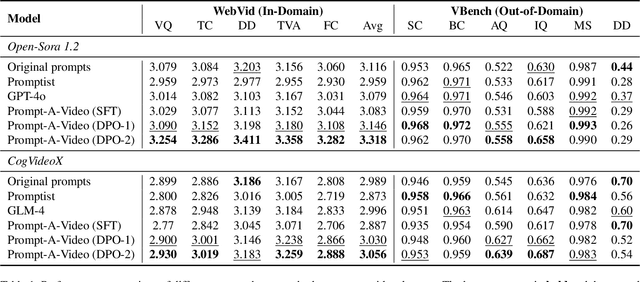
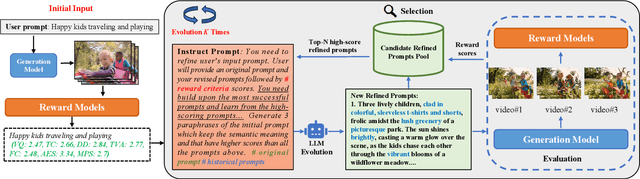
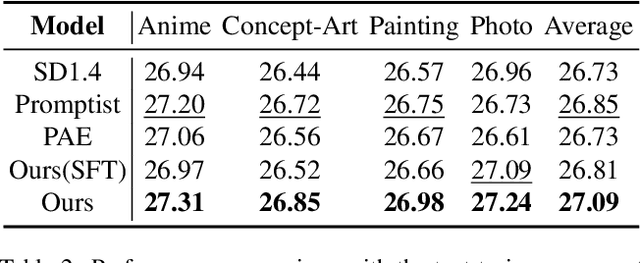
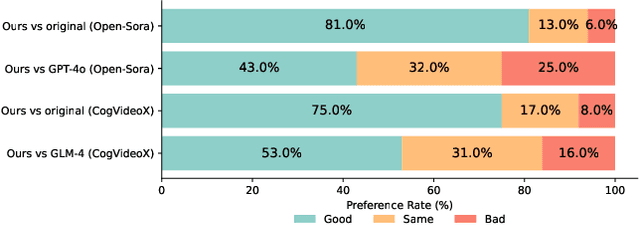
Text-to-video models have made remarkable advancements through optimization on high-quality text-video pairs, where the textual prompts play a pivotal role in determining quality of output videos. However, achieving the desired output often entails multiple revisions and iterative inference to refine user-provided prompts. Current automatic methods for refining prompts encounter challenges such as Modality-Inconsistency, Cost-Discrepancy, and Model-Unaware when applied to text-to-video diffusion models. To address these problem, we introduce an LLM-based prompt adaptation framework, termed as Prompt-A-Video, which excels in crafting Video-Centric, Labor-Free and Preference-Aligned prompts tailored to specific video diffusion model. Our approach involves a meticulously crafted two-stage optimization and alignment system. Initially, we conduct a reward-guided prompt evolution pipeline to automatically create optimal prompts pool and leverage them for supervised fine-tuning (SFT) of the LLM. Then multi-dimensional rewards are employed to generate pairwise data for the SFT model, followed by the direct preference optimization (DPO) algorithm to further facilitate preference alignment. Through extensive experimentation and comparative analyses, we validate the effectiveness of Prompt-A-Video across diverse generation models, highlighting its potential to push the boundaries of video generation.
OnlineVPO: Align Video Diffusion Model with Online Video-Centric Preference Optimization
Dec 19, 2024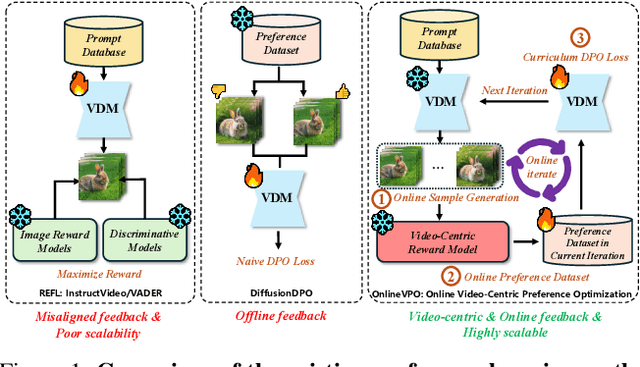


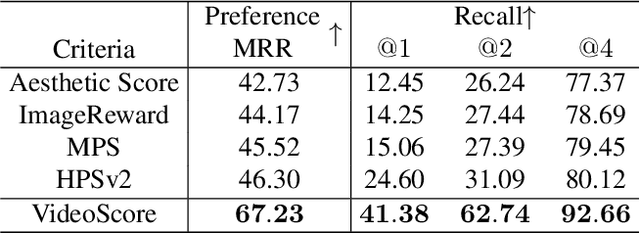
In recent years, the field of text-to-video (T2V) generation has made significant strides. Despite this progress, there is still a gap between theoretical advancements and practical application, amplified by issues like degraded image quality and flickering artifacts. Recent advancements in enhancing the video diffusion model (VDM) through feedback learning have shown promising results. However, these methods still exhibit notable limitations, such as misaligned feedback and inferior scalability. To tackle these issues, we introduce OnlineVPO, a more efficient preference learning approach tailored specifically for video diffusion models. Our method features two novel designs, firstly, instead of directly using image-based reward feedback, we leverage the video quality assessment (VQA) model trained on synthetic data as the reward model to provide distribution and modality-aligned feedback on the video diffusion model. Additionally, we introduce an online DPO algorithm to address the off-policy optimization and scalability issue in existing video preference learning frameworks. By employing the video reward model to offer concise video feedback on the fly, OnlineVPO offers effective and efficient preference guidance. Extensive experiments on the open-source video-diffusion model demonstrate OnlineVPO as a simple yet effective and more importantly scalable preference learning algorithm for video diffusion models, offering valuable insights for future advancements in this domain.