 Add to Chrome
 Add to Firefox
 Add to Edge
Mapping the City Through the Lens of Language Models
Aug 04, 2026
Language models often complete an underspecified reference to a city with unstated assumptions about urban size, form, infrastructure, environment, and function. We measure those assumptions without naming places. Ten open-weight checkpoints rate anonymized profiles derived from real morphological urban centres across 40 audited indicators and seven domains. The design combines constrained probability-based ratings, prespecified reliability screens, lineage-aware aggregation, multiple population weightings, an independent replication sample, and whole-profile validation. The clearest shared tendency favours urban profiles with larger developed area, faster recent growth, greater mapped infrastructure and non-residential capacity, and less sparse form. Most eligible directions recur in the replication data, and direct ratings of complete profiles show moderate agreement with the indicator-wise construction. Geographic differences shrink after accounting for city scale and development, while reliably measured paired tasks indicate that typicality and desirability are often closely aligned. The framework makes an otherwise vague notion of what models regard as an ordinary city empirically traceable. The resulting evidence delineates a shared yet model-dependent portrait of the city through the lens of language models.

ISO: An RLVR-Native Optimization Stack
Jul 21, 2026Reinforcement learning with verifiable rewards (RLVR) is rapidly advancing the reasoning capabilities of language models, yet the optimization layer that converts reward feedback into weight-space updates remains poorly understood. Building on our prior analysis (Zhu et al., 2025), we study this missing layer through the singular structure of model weights and identify spectral inheritance: RLVR can reuse the base model's weight spectra while acquiring new behavior through changes in the associated input and output singular frames. We operationalize spectral inheritance as Isospectral Optimization (ISO), an RLVR-native, fixed-spectrum optimization framework with complementary offline and online instantiations. Offline, ISO-Merger combines the frame changes of shared-base specialists into a single fixed-spectrum model, requiring no post-merge data, rollouts, gradient updates, or on-policy distillation (OPD). It recovers complementary specialist capabilities and achieves the strongest aggregate performance among the compared data-free merging methods. Online, ISO-Optimizer applies a chosen base optimizer, including AdamW and Muon, to the frame variables while keeping the base spectra fixed. Across reasoning and coding tasks ranging from 1.5B to 8B parameters, ISO-Optimizer improves accuracy in the reported runs and reaches matched scores with substantially fewer training steps. On Qwen3-8B-Base, AdamW reaches an aggregate accuracy of 0.495 after 270 training steps. ISO-AdamW reaches the same accuracy after only 100 training steps and improves further to 0.509 after 210 training steps. Together, ISO offers a concrete answer to RLVR's missing optimization layer: rather than inheriting pre-training optimization wholesale, design post-training around the structure of reward-driven adaptation: inherit the spectrum, optimize the frames.
Learning from the Self-future: On-policy Self-distillation for dLLMs
Jun 16, 2026On-policy self-distillation (OPSD) has proven effective for post-training large language models (LLMs), yet its application to diffusion LLMs (dLLMs) remains unexplored. Existing OPSD methods are inherently autoregressive-centric. They inject privileged information via left-to-right prefix conditioning with token-level divergence supervision, a design that fundamentally conflicts with the arbitraryorder generation of dLLMs. We introduce d-OPSD, the first OPSD framework tailored for dLLMs. Our approach makes two core contributions. First, we reframe self-teacher construction by using self-generated answers as suffix conditioning, enabling the student model to learn from "self future-experience" rather than privileged prefixes. Second, we shift supervision from token-level to step-level, aligning training with the iterative denoising process of dLLMs. Experiments across four reasoning benchmarks show that d-OPSD consistently outperforms RLVR and SFT baselines with superior sample efficiency, requiring only around 10% of the optimization steps by RLVR and opening a promising pathway for dLLM posttraining. The code is available at https://github.com/xingzhejun/d-OPSD.
No Hidden Prompts Needed! You Can Game AI Peer Review with Presentation-Only Revisions
Jun 11, 2026As AI-generated reviews move from experimental tools into peer-review infrastructure, most robustness concerns have focused on explicit attacks such as hidden instructions and prompt injection. We study a harder and more policy-relevant failure mode: no hidden text, no prompt injection, and no changes to methods, experiments, figures, equations, proofs, or numerical results. The attacker modifies only presentation-level content, such as the abstract, contribution framing, related work, discussion, and narrative structure. We introduce adversarial repackaging: a closed-loop attack that uses AI-reviewer feedback to search for presentation-level revisions while keeping the scientific evidence fixed. Across three mainstream AI reviewers, adversarial repackaging achieves a 75.1% attack success rate and a mean score gain of +1.21/10. The effect is not explained by ordinary prose polishing. We also reveal that strategies that change how the reviewer interprets the paper, such as related-work repositioning and analytical discussion expansion, substantially outperform surface edits such as local polishing, table formatting, and algorithm boxes. Our analysis reveals two deeper structural failure modes. First, AI reviewers are easier to impress than to convince: highlighting strengths reliably increases perceived merit, while attempts to dissolve weaknesses frequently backfire. Second, AI reviewers can confuse the appearance of addressing a limitation with actually resolving it, allowing unchanged evidence to be reinterpreted as stronger scientific contribution. These results show that the deployment risk is not only malicious hidden instructions, but the emergence of paper presentation itself as an optimization surface. We release a contamination-free rolling benchmark and attack framework for testing whether AI reviewers remain anchored to scientific content under presentation-only edits.
Large language models perceive cities through a culturally uneven baseline
Apr 21, 2026Large language models (LLMs) are increasingly used to describe, evaluate and interpret places, yet it remains unclear whether they do so from a culturally neutral standpoint. Here we test urban perception in frontier LLMs using a balanced global street-view sample and prompts that either remain neutral or invoke different regional cultural standpoints. Across open-ended descriptions and structured place judgments, the neutral condition proved not to be neutral in practice. Prompts associated with Europe and Northern America remained systematically closer to the baseline than many non-Western prompts, indicating that model perception is organized around a culturally uneven reference frame rather than a universal one. Cultural prompting also shifted affective evaluation, producing sentiment-based ingroup preference for some prompted identities. Comparisons with regional human text-image benchmarks showed that culturally proximate prompting could improve alignment with human descriptions, but it did not recover human levels of semantic diversity and often preserved an affectively elevated style. The same asymmetry reappeared in structured judgments of safety, beauty, wealth, liveliness, boredom and depression, where model outputs were interpretable but only partly reproduced human group differences. These findings suggest that LLMs do not simply perceive cities from nowhere: they do so through a culturally uneven baseline that shapes what appears ordinary, familiar and positively valued.
MEMO: Memory-Augmented Model Context Optimization for Robust Multi-Turn Multi-Agent LLM Games
Mar 09, 2026Multi-turn, multi-agent LLM game evaluations often exhibit substantial run-to-run variance. In long-horizon interactions, small early deviations compound across turns and are amplified by multi-agent coupling. This biases win rate estimates and makes rankings unreliable across repeated tournaments. Prompt choice worsens this further by producing different effective policies. We address both instability and underperformance with MEMO (Memory-augmented MOdel context optimization), a self-play framework that optimizes inference-time context by coupling retention and exploration. Retention maintains a persistent memory bank that stores structured insights from self-play trajectories and injects them as priors during later play. Exploration runs tournament-style prompt evolution with uncertainty-aware selection via TrueSkill, and uses prioritized replay to revisit rare and decisive states. Across five text-based games, MEMO raises mean win rate from 25.1% to 49.5% for GPT-4o-mini and from 20.9% to 44.3% for Qwen-2.5-7B-Instruct, using $2,000$ self-play games per task. Run-to-run variance also drops, giving more stable rankings across prompt variations. These results suggest that multi-agent LLM game performance and robustness have substantial room for improvement through context optimization. MEMO achieves the largest gains in negotiation and imperfect-information games, while RL remains more effective in perfect-information settings.
UrbanAlign: Post-hoc Semantic Calibration for VLM-Human Preference Alignment
Feb 23, 2026Aligning vision-language model (VLM) outputs with human preferences in domain-specific tasks typically requires fine-tuning or reinforcement learning, both of which demand labelled data and GPU compute. We show that for subjective perception tasks, this alignment can be achieved without any model training: VLMs are already strong concept extractors but poor decision calibrators, and the gap can be closed externally. We propose a training-free post-hoc concept-bottleneck pipeline consisting of three tightly coupled stages: concept mining, multi-agent structured scoring, and geometric calibration, unified by an end-to-end dimension optimization loop. Interpretable evaluation dimensions are mined from a handful of human annotations; an Observer-Debater-Judge chain extracts robust continuous concept scores from a frozen VLM; and locally-weighted ridge regression on a hybrid visual-semantic manifold calibrates these scores against human ratings. Applied to urban perception as UrbanAlign, the framework achieves 72.2% accuracy ($κ=0.45$) on Place Pulse 2.0 across six categories, outperforming the best supervised baseline by +15.1 pp and uncalibrated VLM scoring by +16.3 pp, with full dimension-level interpretability and zero model-weight modification.
The Path Not Taken: RLVR Provably Learns Off the Principals
Nov 11, 2025Reinforcement Learning with Verifiable Rewards (RLVR) reliably improves the reasoning performance of large language models, yet it appears to modify only a small fraction of parameters. We revisit this paradox and show that sparsity is a surface artifact of a model-conditioned optimization bias: for a fixed pretrained model, updates consistently localize to preferred parameter regions, highly consistent across runs and largely invariant to datasets and RL recipes. We mechanistically explain these dynamics with a Three-Gate Theory: Gate I (KL Anchor) imposes a KL-constrained update; Gate II (Model Geometry) steers the step off principal directions into low-curvature, spectrum-preserving subspaces; and Gate III (Precision) hides micro-updates in non-preferred regions, making the off-principal bias appear as sparsity. We then validate this theory and, for the first time, provide a parameter-level characterization of RLVR's learning dynamics: RLVR learns off principal directions in weight space, achieving gains via minimal spectral drift, reduced principal-subspace rotation, and off-principal update alignment. In contrast, SFT targets principal weights, distorts the spectrum, and even lags RLVR. Together, these results provide the first parameter-space account of RLVR's training dynamics, revealing clear regularities in how parameters evolve. Crucially, we show that RL operates in a distinct optimization regime from SFT, so directly adapting SFT-era parameter-efficient fine-tuning (PEFT) methods can be flawed, as evidenced by our case studies on advanced sparse fine-tuning and LoRA variants. We hope this work charts a path toward a white-box understanding of RLVR and the design of geometry-aware, RLVR-native learning algorithms, rather than repurposed SFT-era heuristics.
Discriminator-Free Direct Preference Optimization for Video Diffusion
Apr 11, 2025Direct Preference Optimization (DPO), which aligns models with human preferences through win/lose data pairs, has achieved remarkable success in language and image generation. However, applying DPO to video diffusion models faces critical challenges: (1) Data inefficiency. Generating thousands of videos per DPO iteration incurs prohibitive costs; (2) Evaluation uncertainty. Human annotations suffer from subjective bias, and automated discriminators fail to detect subtle temporal artifacts like flickering or motion incoherence. To address these, we propose a discriminator-free video DPO framework that: (1) Uses original real videos as win cases and their edited versions (e.g., reversed, shuffled, or noise-corrupted clips) as lose cases; (2) Trains video diffusion models to distinguish and avoid artifacts introduced by editing. This approach eliminates the need for costly synthetic video comparisons, provides unambiguous quality signals, and enables unlimited training data expansion through simple editing operations. We theoretically prove the framework's effectiveness even when real videos and model-generated videos follow different distributions. Experiments on CogVideoX demonstrate the efficiency of the proposed method.
HOFAR: High-Order Augmentation of Flow Autoregressive Transformers
Mar 11, 2025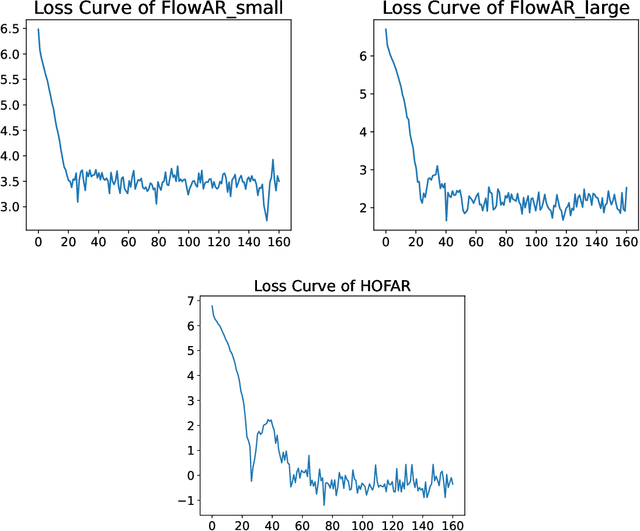

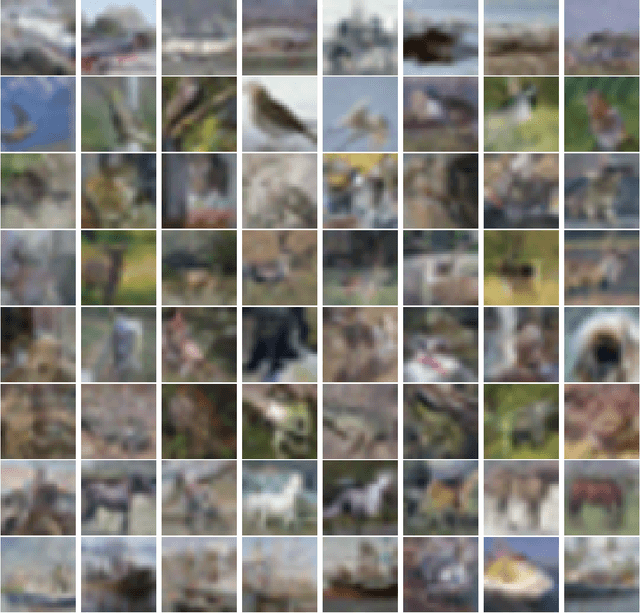
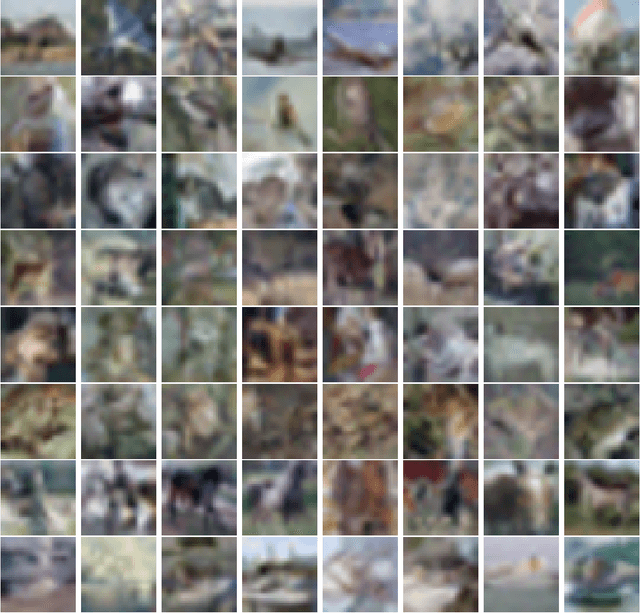
Flow Matching and Transformer architectures have demonstrated remarkable performance in image generation tasks, with recent work FlowAR [Ren et al., 2024] synergistically integrating both paradigms to advance synthesis fidelity. However, current FlowAR implementations remain constrained by first-order trajectory modeling during the generation process. This paper introduces a novel framework that systematically enhances flow autoregressive transformers through high-order supervision. We provide theoretical analysis and empirical evaluation showing that our High-Order FlowAR (HOFAR) demonstrates measurable improvements in generation quality compared to baseline models. The proposed approach advances the understanding of flow-based autoregressive modeling by introducing a systematic framework for analyzing trajectory dynamics through high-order expansion.