 Add to Chrome
 Add to Firefox
 Add to Edge
Unlocking Decoding-time Controllability: Gradient-Free Multi-Objective Alignment with Contrastive Prompts
Aug 09, 2024
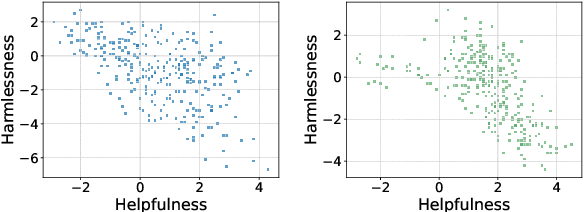
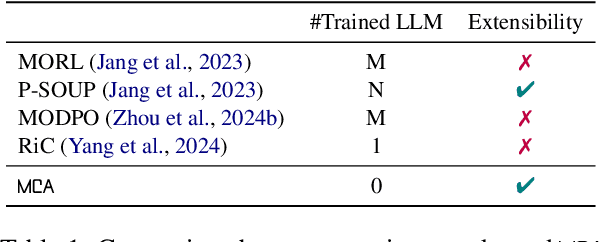
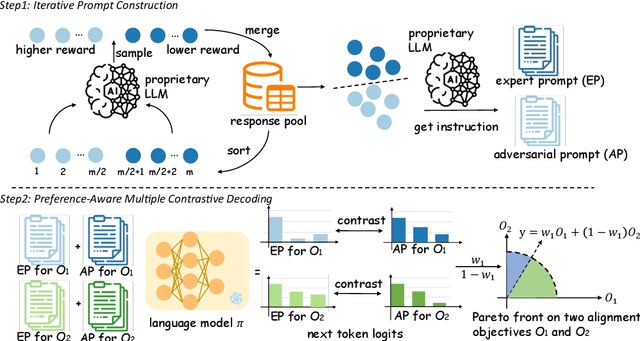
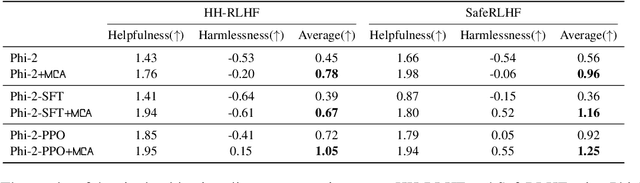
The task of multi-objective alignment aims at balancing and controlling the different alignment objectives (e.g., helpfulness, harmlessness and honesty) of large language models to meet the personalized requirements of different users. However, previous methods tend to train multiple models to deal with various user preferences, with the number of trained models growing linearly with the number of alignment objectives and the number of different preferences. Meanwhile, existing methods are generally poor in extensibility and require significant re-training for each new alignment objective considered. Considering the limitation of previous approaches, we propose MCA (Multi-objective Contrastive Alignemnt), which constructs an expert prompt and an adversarial prompt for each objective to contrast at the decoding time and balances the objectives through combining the contrast. Our approach is verified to be superior to previous methods in obtaining a well-distributed Pareto front among different alignment objectives.

Towards Effective and Efficient Continual Pre-training of Large Language Models
Jul 26, 2024

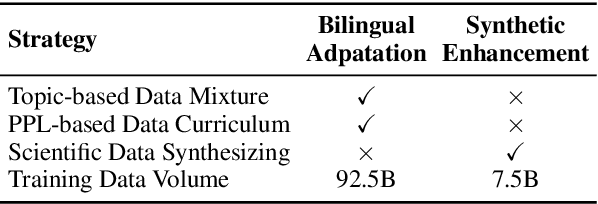

Continual pre-training (CPT) has been an important approach for adapting language models to specific domains or tasks. To make the CPT approach more traceable, this paper presents a technical report for continually pre-training Llama-3 (8B), which significantly enhances the Chinese language ability and scientific reasoning ability of the backbone model. To enhance the new abilities while retaining the original abilities, we design specific data mixture and curriculum strategies by utilizing existing datasets and synthesizing high-quality datasets. Specifically, we synthesize multidisciplinary scientific question and answer (QA) pairs based on related web pages, and subsequently incorporate these synthetic data to improve the scientific reasoning ability of Llama-3. We refer to the model after CPT as Llama-3-SynE (Synthetic data Enhanced Llama-3). We also present the tuning experiments with a relatively small model -- TinyLlama, and employ the derived findings to train the backbone model. Extensive experiments on a number of evaluation benchmarks show that our approach can largely improve the performance of the backbone models, including both the general abilities (+8.81 on C-Eval and +6.31 on CMMLU) and the scientific reasoning abilities (+12.00 on MATH and +4.13 on SciEval), without hurting the original capacities. Our model, data, and codes are available at https://github.com/RUC-GSAI/Llama-3-SynE.
Graph-Structured Speculative Decoding
Jul 23, 2024


Speculative decoding has emerged as a promising technique to accelerate the inference of Large Language Models (LLMs) by employing a small language model to draft a hypothesis sequence, which is then validated by the LLM. The effectiveness of this approach heavily relies on the balance between performance and efficiency of the draft model. In our research, we focus on enhancing the proportion of draft tokens that are accepted to the final output by generating multiple hypotheses instead of just one. This allows the LLM more options to choose from and select the longest sequence that meets its standards. Our analysis reveals that hypotheses produced by the draft model share many common token sequences, suggesting a potential for optimizing computation. Leveraging this observation, we introduce an innovative approach utilizing a directed acyclic graph (DAG) to manage the drafted hypotheses. This structure enables us to efficiently predict and merge recurring token sequences, vastly reducing the computational demands of the draft model. We term this approach Graph-structured Speculative Decoding (GSD). We apply GSD across a range of LLMs, including a 70-billion parameter LLaMA-2 model, and observe a remarkable speedup of 1.73$\times$ to 1.96$\times$, significantly surpassing standard speculative decoding.
Exploiting Pre-trained Models for Drug Target Affinity Prediction with Nearest Neighbors
Jul 21, 2024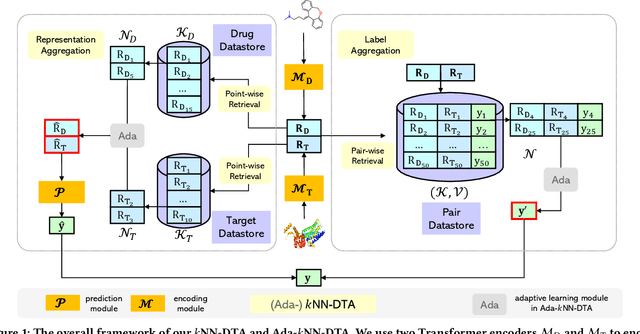
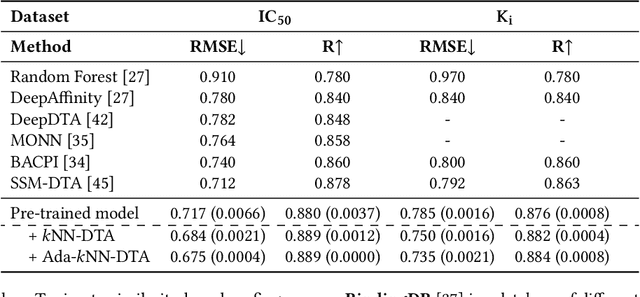
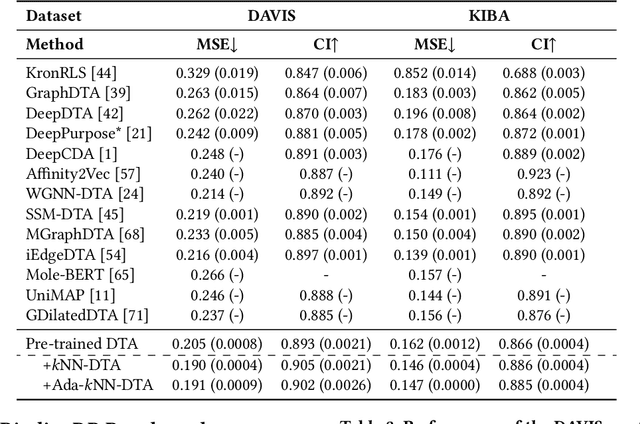
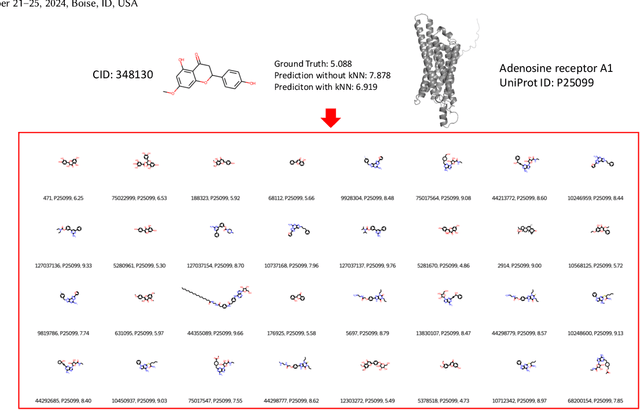
Drug-Target binding Affinity (DTA) prediction is essential for drug discovery. Despite the application of deep learning methods to DTA prediction, the achieved accuracy remain suboptimal. In this work, inspired by the recent success of retrieval methods, we propose $k$NN-DTA, a non-parametric embedding-based retrieval method adopted on a pre-trained DTA prediction model, which can extend the power of the DTA model with no or negligible cost. Different from existing methods, we introduce two neighbor aggregation ways from both embedding space and label space that are integrated into a unified framework. Specifically, we propose a \emph{label aggregation} with \emph{pair-wise retrieval} and a \emph{representation aggregation} with \emph{point-wise retrieval} of the nearest neighbors. This method executes in the inference phase and can efficiently boost the DTA prediction performance with no training cost. In addition, we propose an extension, Ada-$k$NN-DTA, an instance-wise and adaptive aggregation with lightweight learning. Results on four benchmark datasets show that $k$NN-DTA brings significant improvements, outperforming previous state-of-the-art (SOTA) results, e.g, on BindingDB IC$_{50}$ and $K_i$ testbeds, $k$NN-DTA obtains new records of RMSE $\bf{0.684}$ and $\bf{0.750}$. The extended Ada-$k$NN-DTA further improves the performance to be $\bf{0.675}$ and $\bf{0.735}$ RMSE. These results strongly prove the effectiveness of our method. Results in other settings and comprehensive studies/analyses also show the great potential of our $k$NN-DTA approach.
Mixture-of-Modules: Reinventing Transformers as Dynamic Assemblies of Modules
Jul 09, 2024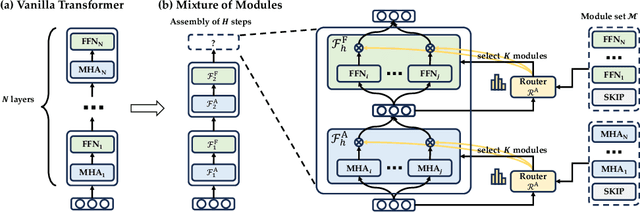
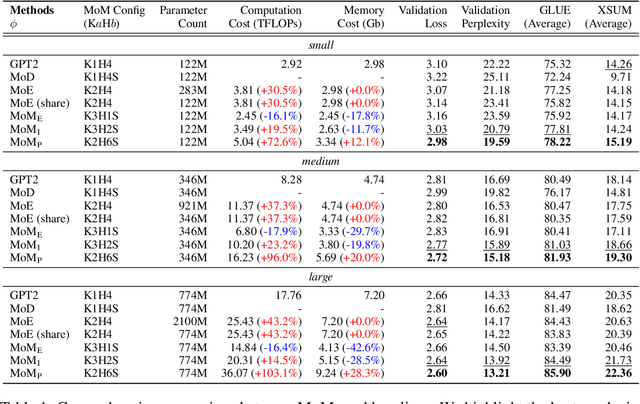
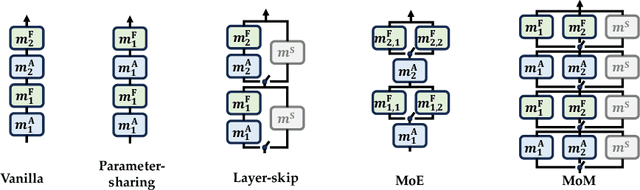

Is it always necessary to compute tokens from shallow to deep layers in Transformers? The continued success of vanilla Transformers and their variants suggests an undoubted "yes". In this work, however, we attempt to break the depth-ordered convention by proposing a novel architecture dubbed mixture-of-modules (MoM), which is motivated by an intuition that any layer, regardless of its position, can be used to compute a token as long as it possesses the needed processing capabilities. The construction of MoM starts from a finite set of modules defined by multi-head attention and feed-forward networks, each distinguished by its unique parameterization. Two routers then iteratively select attention modules and feed-forward modules from the set to process a token. The selection dynamically expands the computation graph in the forward pass of the token, culminating in an assembly of modules. We show that MoM provides not only a unified framework for Transformers and their numerous variants but also a flexible and learnable approach for reducing redundancy in Transformer parameterization. We pre-train various MoMs using OpenWebText. Empirical results demonstrate that MoMs, of different parameter counts, consistently outperform vanilla transformers on both GLUE and XSUM benchmarks. More interestingly, with a fixed parameter budget, MoM-large enables an over 38% increase in depth for computation graphs compared to GPT-2-large, resulting in absolute gains of 1.4 on GLUE and 1 on XSUM. On the other hand, MoM-large also enables an over 60% reduction in depth while involving more modules per layer, yielding a 16% reduction in TFLOPs and a 43% decrease in memory usage compared to GPT-2-large, while maintaining comparable performance.
Mobile-Bench: An Evaluation Benchmark for LLM-based Mobile Agents
Jul 01, 2024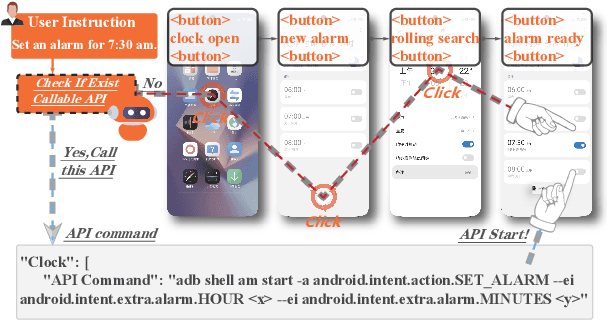
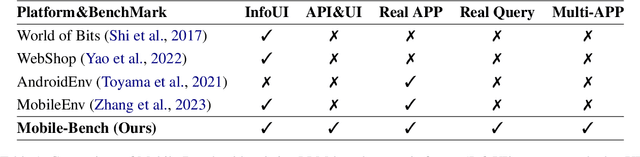
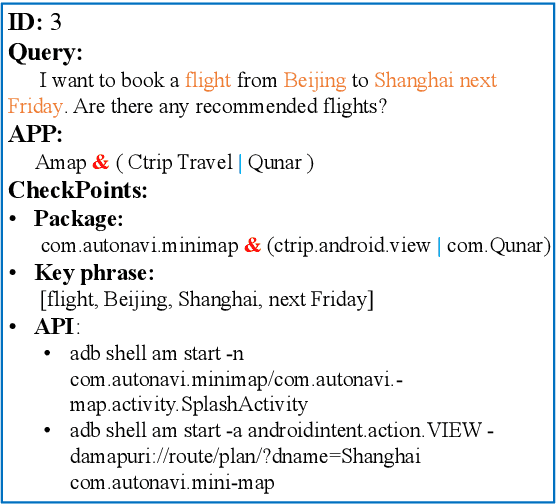
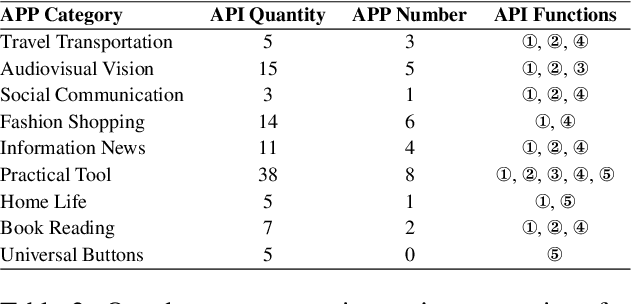
With the remarkable advancements of large language models (LLMs), LLM-based agents have become a research hotspot in human-computer interaction. However, there is a scarcity of benchmarks available for LLM-based mobile agents. Benchmarking these agents generally faces three main challenges: (1) The inefficiency of UI-only operations imposes limitations to task evaluation. (2) Specific instructions within a singular application lack adequacy for assessing the multi-dimensional reasoning and decision-making capacities of LLM mobile agents. (3) Current evaluation metrics are insufficient to accurately assess the process of sequential actions. To this end, we propose Mobile-Bench, a novel benchmark for evaluating the capabilities of LLM-based mobile agents. First, we expand conventional UI operations by incorporating 103 collected APIs to accelerate the efficiency of task completion. Subsequently, we collect evaluation data by combining real user queries with augmentation from LLMs. To better evaluate different levels of planning capabilities for mobile agents, our data is categorized into three distinct groups: SAST, SAMT, and MAMT, reflecting varying levels of task complexity. Mobile-Bench comprises 832 data entries, with more than 200 tasks specifically designed to evaluate multi-APP collaboration scenarios. Furthermore, we introduce a more accurate evaluation metric, named CheckPoint, to assess whether LLM-based mobile agents reach essential points during their planning and reasoning steps.
YuLan: An Open-source Large Language Model
Jun 28, 2024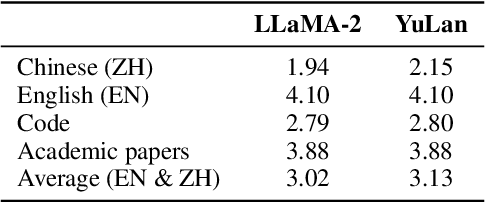

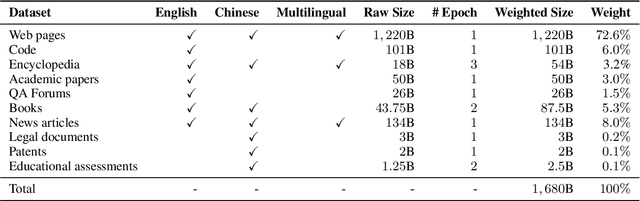

Large language models (LLMs) have become the foundation of many applications, leveraging their extensive capabilities in processing and understanding natural language. While many open-source LLMs have been released with technical reports, the lack of training details hinders further research and development. This paper presents the development of YuLan, a series of open-source LLMs with $12$ billion parameters. The base model of YuLan is pre-trained on approximately $1.7$T tokens derived from a diverse corpus, including massive English, Chinese, and multilingual texts. We design a three-stage pre-training method to enhance YuLan's overall capabilities. Subsequent phases of training incorporate instruction-tuning and human alignment, employing a substantial volume of high-quality synthesized data. To facilitate the learning of complex and long-tail knowledge, we devise a curriculum-learning framework throughout across these stages, which helps LLMs learn knowledge in an easy-to-hard manner. YuLan's training is finished on Jan, 2024 and has achieved performance on par with state-of-the-art LLMs across various English and Chinese benchmarks. This paper outlines a comprehensive technical roadmap for developing LLMs from scratch. Our model and codes are available at https://github.com/RUC-GSAI/YuLan-Chat.
Mixture of In-Context Experts Enhance LLMs' Long Context Awareness
Jun 28, 2024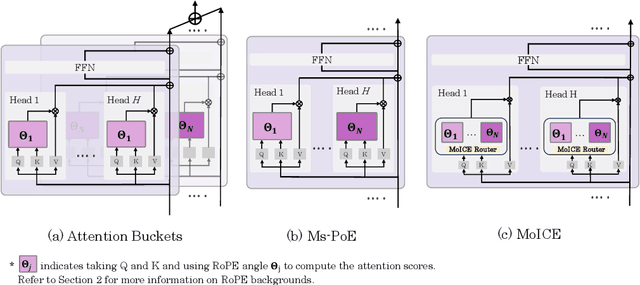


Many studies have revealed that large language models (LLMs) exhibit uneven awareness of different contextual positions.Their limited context awareness can lead to overlooking critical information and subsequent task failures. While several approaches have been proposed to enhance LLMs' context awareness, achieving both effectiveness and efficiency remains challenging.In this paper, for LLMs utilizing RoPE as position embeddings, we introduce a novel method called ``Mixture of In-Context Experts'' (MoICE) to address this challenge. MoICE comprises two key components: a router integrated into each attention head within LLMs and a lightweight router-only training optimization strategy: (1) MoICE views each RoPE angle as an `in-context' expert, demonstrated to be capable of directing the attention of a head to specific contextual positions. Consequently, each attention head flexibly processes tokens using multiple RoPE angles dynamically selected by the router to attend to the needed positions. This approach mitigates the risk of overlooking essential contextual information. (2) The router-only training strategy entails freezing LLM parameters and exclusively updating routers for only a few steps. When applied to open-source LLMs including Llama and Mistral, MoICE surpasses prior methods across multiple tasks on long context understanding and generation, all while maintaining commendable inference efficiency.
From the Least to the Most: Building a Plug-and-Play Visual Reasoner via Data Synthesis
Jun 28, 2024We explore multi-step reasoning in vision-language models (VLMs). The problem is challenging, as reasoning data consisting of multiple steps of visual and language processing are barely available. To overcome the challenge, we first introduce a least-to-most visual reasoning paradigm, which interleaves steps of decomposing a question into sub-questions and invoking external tools for resolving sub-questions. Based on the paradigm, we further propose a novel data synthesis approach that can automatically create questions and multi-step reasoning paths for an image in a bottom-up manner. Our approach divides the complex synthesis task into a few simple sub-tasks, and (almost entirely) relies on open-sourced models to accomplish the sub-tasks. Therefore, the entire synthesis process is reproducible and cost-efficient, and the synthesized data is quality guaranteed. With the approach, we construct $50$k visual reasoning examples. Then, we develop a visual reasoner through supervised fine-tuning, which is capable of generally enhancing the reasoning abilities of a wide range of existing VLMs in a plug-and-play fashion. Extensive experiments indicate that the visual reasoner can consistently and significantly improve four VLMs on four VQA benchmarks. Our code and dataset are available at https://github.com/steven-ccq/VisualReasoner.
3D-MolT5: Towards Unified 3D Molecule-Text Modeling with 3D Molecular Tokenization
Jun 09, 2024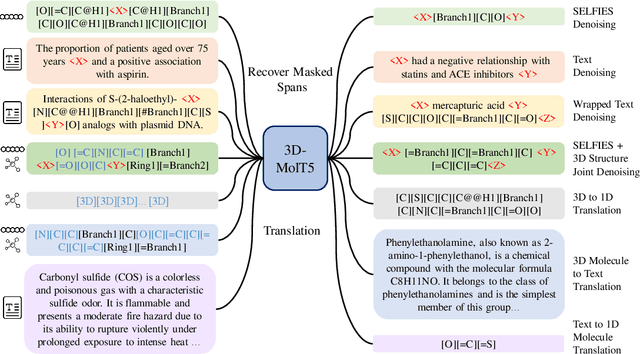

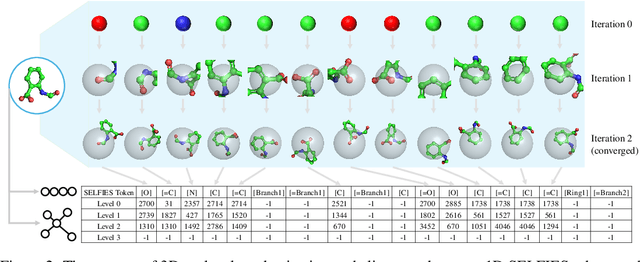

The integration of molecule and language has garnered increasing attention in molecular science. Recent advancements in Language Models (LMs) have demonstrated potential for the comprehensive modeling of molecule and language. However, existing works exhibit notable limitations. Most existing works overlook the modeling of 3D information, which is crucial for understanding molecular structures and also functions. While some attempts have been made to leverage external structure encoding modules to inject the 3D molecular information into LMs, there exist obvious difficulties that hinder the integration of molecular structure and language text, such as modality alignment and separate tuning. To bridge this gap, we propose 3D-MolT5, a unified framework designed to model both 1D molecular sequence and 3D molecular structure. The key innovation lies in our methodology for mapping fine-grained 3D substructure representations (based on 3D molecular fingerprints) to a specialized 3D token vocabulary for 3D-MolT5. This 3D structure token vocabulary enables the seamless combination of 1D sequence and 3D structure representations in a tokenized format, allowing 3D-MolT5 to encode molecular sequence (SELFIES), molecular structure, and text sequences within a unified architecture. Alongside, we further introduce 1D and 3D joint pre-training to enhance the model's comprehension of these diverse modalities in a joint representation space and better generalize to various tasks for our foundation model. Through instruction tuning on multiple downstream datasets, our proposed 3D-MolT5 shows superior performance than existing methods in molecular property prediction, molecule captioning, and text-based molecule generation tasks. Our code will be available on GitHub soon.