 Add to Chrome
 Add to Firefox
 Add to Edge
See Less, See Right: Bi-directional Perceptual Shaping For Multimodal Reasoning
Dec 26, 2025
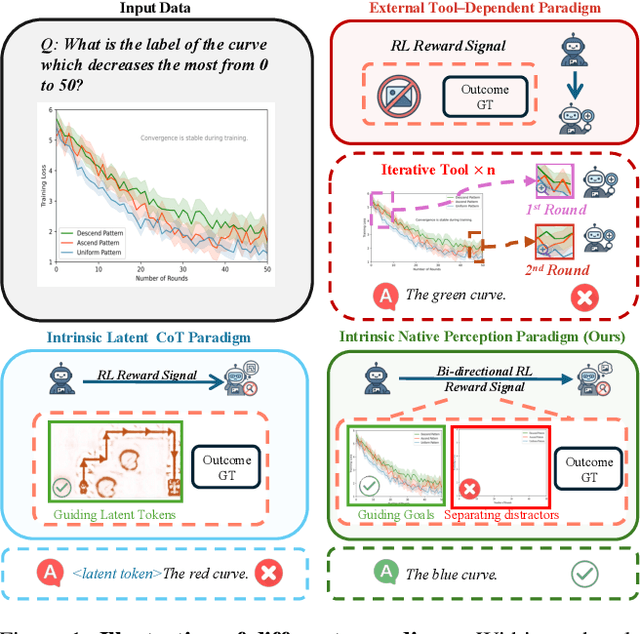
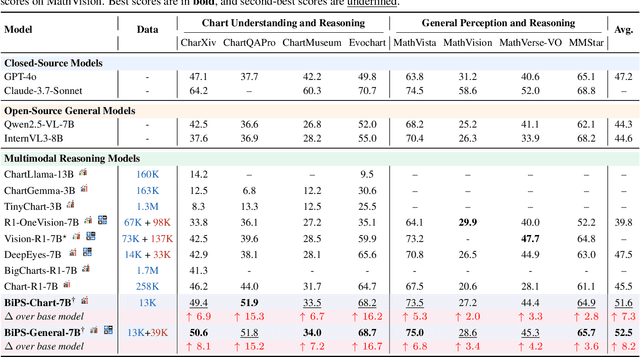
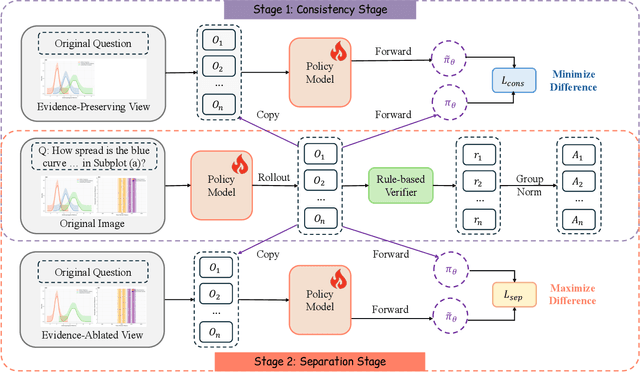
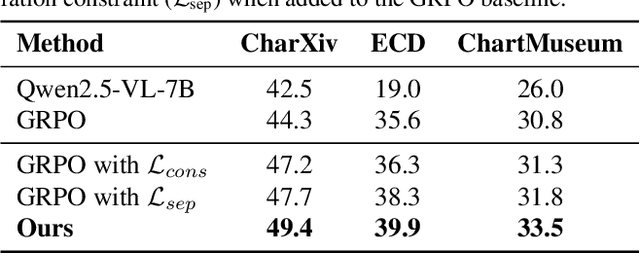
Large vision-language models (VLMs) often benefit from intermediate visual cues, either injected via external tools or generated as latent visual tokens during reasoning, but these mechanisms still overlook fine-grained visual evidence (e.g., polylines in charts), generalize poorly across domains, and incur high inference-time cost. In this paper, we propose Bi-directional Perceptual Shaping (BiPS), which transforms question-conditioned masked views into bidirectional where-to-look signals that shape perception during training. BiPS first applies a KL-consistency constraint between the original image and an evidence-preserving view that keeps only question-relevant regions, encouraging coarse but complete coverage of supporting pixels. It then applies a KL-separation constraint between the original and an evidence-ablated view where critical pixels are masked so the image no longer supports the original answer, discouraging text-only shortcuts (i.e., answering from text alone) and enforcing fine-grained visual reliance. Across eight benchmarks, BiPS boosts Qwen2.5-VL-7B by 8.2% on average and shows strong out-of-domain generalization to unseen datasets and image types.

C2LLM Technical Report: A New Frontier in Code Retrieval via Adaptive Cross-Attention Pooling
Dec 24, 2025We present C2LLM - Contrastive Code Large Language Models, a family of code embedding models in both 0.5B and 7B sizes. Building upon Qwen-2.5-Coder backbones, C2LLM adopts a Pooling by Multihead Attention (PMA) module for generating sequence embedding from token embeddings, effectively 1) utilizing the LLM's causal representations acquired during pretraining, while also 2) being able to aggregate information from all tokens in the sequence, breaking the information bottleneck in EOS-based sequence embeddings, and 3) supporting flexible adaptation of embedding dimension, serving as an alternative to MRL. Trained on three million publicly available data, C2LLM models set new records on MTEB-Code among models of similar sizes, with C2LLM-7B ranking 1st on the overall leaderboard.
Seedance 1.5 pro: A Native Audio-Visual Joint Generation Foundation Model
Dec 23, 2025Recent strides in video generation have paved the way for unified audio-visual generation. In this work, we present Seedance 1.5 pro, a foundational model engineered specifically for native, joint audio-video generation. Leveraging a dual-branch Diffusion Transformer architecture, the model integrates a cross-modal joint module with a specialized multi-stage data pipeline, achieving exceptional audio-visual synchronization and superior generation quality. To ensure practical utility, we implement meticulous post-training optimizations, including Supervised Fine-Tuning (SFT) on high-quality datasets and Reinforcement Learning from Human Feedback (RLHF) with multi-dimensional reward models. Furthermore, we introduce an acceleration framework that boosts inference speed by over 10X. Seedance 1.5 pro distinguishes itself through precise multilingual and dialect lip-syncing, dynamic cinematic camera control, and enhanced narrative coherence, positioning it as a robust engine for professional-grade content creation. Seedance 1.5 pro is now accessible on Volcano Engine at https://console.volcengine.com/ark/region:ark+cn-beijing/experience/vision?type=GenVideo.
Learning-Assisted Multi-Operator Variable Neighborhood Search for Urban Cable Routing
Dec 22, 2025Urban underground cable construction is essential for enhancing the reliability of city power grids, yet its high construction costs make planning a worthwhile optimization task. In urban environments, road layouts tightly constrain cable routing. This, on the one hand, renders relation-only models (i.e., those without explicit routes) used in prior work overly simplistic, and on the other hand, dramatically enlarges the combinatorial search space, thereby imposing much higher demands on algorithm design. In this study, we formulate urban cable routing as a connectivity-path co-optimization problem and propose a learning-assisted multi-operator variable neighborhood search (L-MVNS) algorithm. The framework first introduces an auxiliary task to generate high-quality feasible initial solutions. A hybrid genetic search (HGS) and A* serve as the connectivity optimizer and the route-planning optimizer, respectively. Building on these, a multi-operator variable neighborhood search (MVNS) iteratively co-optimizes inter-substation connectivity and detailed routes via three complementary destruction operators, a modified A* repair operator, and an adaptive neighborhood-sizing mechanism. A multi-agent deep reinforcement learning module is further embedded to prioritize promising neighborhoods. We also construct a standardized and scalable benchmark suite for evaluation. Across these cases, comprehensive experiments demonstrate effectiveness and stability: relative to representative approaches, MVNS and L-MVNS reduce total construction cost by approximately 30-50%, with L-MVNS delivering additional gains on larger instances and consistently higher stability.
AmPLe: Supporting Vision-Language Models via Adaptive-Debiased Ensemble Multi-Prompt Learning
Dec 20, 2025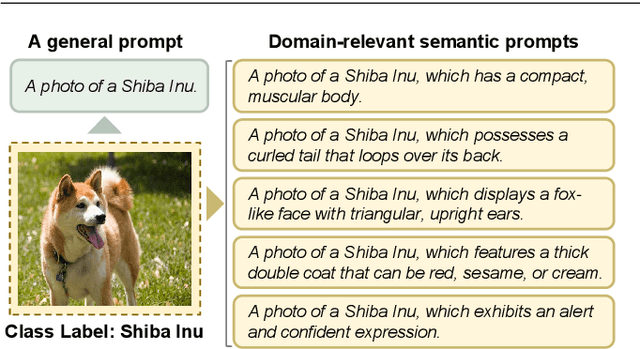
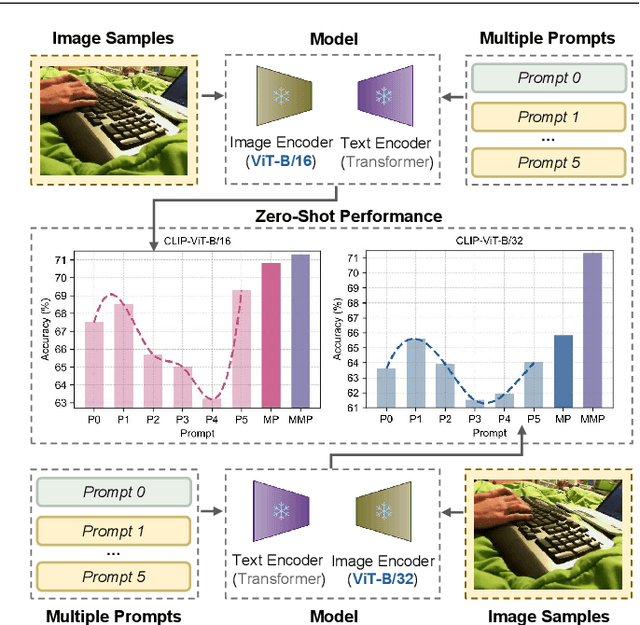
Multi-prompt learning methods have emerged as an effective approach for facilitating the rapid adaptation of vision-language models to downstream tasks with limited resources. Existing multi-prompt learning methods primarily focus on utilizing various meticulously designed prompts within a single foundation vision-language model to achieve superior performance. However, the overlooked model-prompt matching bias hinders the development of multi-prompt learning, i.e., the same prompt can convey different semantics across distinct vision-language models, such as CLIP-ViT-B/16 and CLIP-ViT-B/32, resulting in inconsistent predictions of identical prompt. To mitigate the impact of this bias on downstream tasks, we explore an ensemble learning approach to sufficiently aggregate the benefits of diverse predictions. Additionally, we further disclose the presence of sample-prompt matching bias, which originates from the prompt-irrelevant semantics encapsulated in the input samples. Thus, directly utilizing all information from the input samples for generating weights of ensemble learning can lead to suboptimal performance. In response, we extract prompt-relevant semantics from input samples by leveraging the guidance of the information theory-based analysis, adaptively calculating debiased ensemble weights. Overall, we propose Adaptive-Debiased Ensemble MultiPrompt Learning, abbreviated as AmPLe, to mitigate the two types of bias simultaneously. Extensive experiments on three representative tasks, i.e., generalization to novel classes, new target datasets, and unseen domain shifts, show that AmPLe can widely outperform existing methods. Theoretical validation from a causal perspective further supports the effectiveness of AmPLe.
Conversational Time Series Foundation Models: Towards Explainable and Effective Forecasting
Dec 17, 2025The proliferation of time series foundation models has created a landscape where no single method achieves consistent superiority, framing the central challenge not as finding the best model, but as orchestrating an optimal ensemble with interpretability. While Large Language Models (LLMs) offer powerful reasoning capabilities, their direct application to time series forecasting has proven ineffective. We address this gap by repositioning the LLM as an intelligent judge that evaluates, explains, and strategically coordinates an ensemble of foundation models. To overcome the LLM's inherent lack of domain-specific knowledge on time series, we introduce an R1-style finetuning process, guided by SHAP-based faithfulness scores, which teaches the model to interpret ensemble weights as meaningful causal statements about temporal dynamics. The trained agent then engages in iterative, multi-turn conversations to perform forward-looking assessments, provide causally-grounded explanations for its weighting decisions, and adaptively refine the optimization strategy. Validated on the GIFT-Eval benchmark on 23 datasets across 97 settings, our approach significantly outperforms leading time series foundation models on both CRPS and MASE metrics, establishing new state-of-the-art results.
GDKVM: Echocardiography Video Segmentation via Spatiotemporal Key-Value Memory with Gated Delta Rule
Dec 11, 2025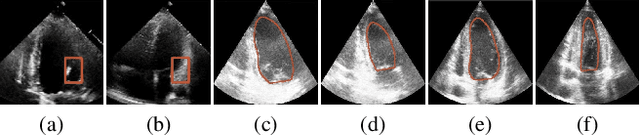
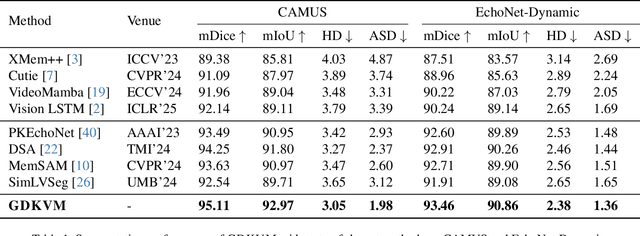
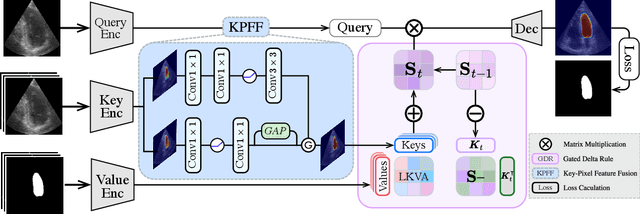
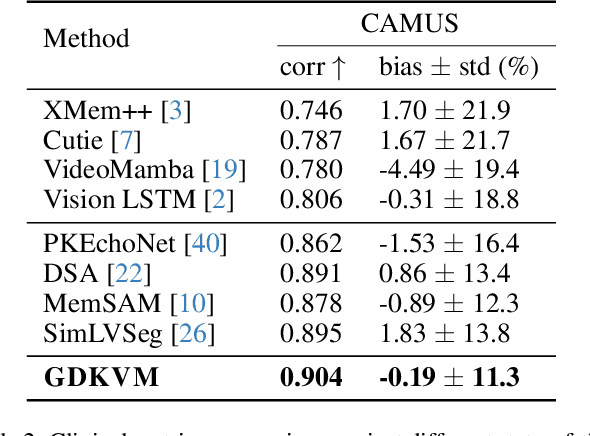
Accurate segmentation of cardiac chambers in echocardiography sequences is crucial for the quantitative analysis of cardiac function, aiding in clinical diagnosis and treatment. The imaging noise, artifacts, and the deformation and motion of the heart pose challenges to segmentation algorithms. While existing methods based on convolutional neural networks, Transformers, and space-time memory networks have improved segmentation accuracy, they often struggle with the trade-off between capturing long-range spatiotemporal dependencies and maintaining computational efficiency with fine-grained feature representation. In this paper, we introduce GDKVM, a novel architecture for echocardiography video segmentation. The model employs Linear Key-Value Association (LKVA) to effectively model inter-frame correlations, and introduces Gated Delta Rule (GDR) to efficiently store intermediate memory states. Key-Pixel Feature Fusion (KPFF) module is designed to integrate local and global features at multiple scales, enhancing robustness against boundary blurring and noise interference. We validated GDKVM on two mainstream echocardiography video datasets (CAMUS and EchoNet-Dynamic) and compared it with various state-of-the-art methods. Experimental results show that GDKVM outperforms existing approaches in terms of segmentation accuracy and robustness, while ensuring real-time performance. Code is available at https://github.com/wangrui2025/GDKVM.
Wasserstein-Aligned Hyperbolic Multi-View Clustering
Dec 10, 2025Multi-view clustering (MVC) aims to uncover the latent structure of multi-view data by learning view-common and view-specific information. Although recent studies have explored hyperbolic representations for better tackling the representation gap between different views, they focus primarily on instance-level alignment and neglect global semantic consistency, rendering them vulnerable to view-specific information (\textit{e.g.}, noise and cross-view discrepancies). To this end, this paper proposes a novel Wasserstein-Aligned Hyperbolic (WAH) framework for multi-view clustering. Specifically, our method exploits a view-specific hyperbolic encoder for each view to embed features into the Lorentz manifold for hierarchical semantic modeling. Whereafter, a global semantic loss based on the hyperbolic sliced-Wasserstein distance is introduced to align manifold distributions across views. This is followed by soft cluster assignments to encourage cross-view semantic consistency. Extensive experiments on multiple benchmarking datasets show that our method can achieve SOTA clustering performance.
SIT-Graph: State Integrated Tool Graph for Multi-Turn Agents
Dec 08, 2025Despite impressive advances in agent systems, multi-turn tool-use scenarios remain challenging. It is mainly because intent is clarified progressively and the environment evolves with each tool call. While reusing past experience is natural, current LLM agents either treat entire trajectories or pre-defined subtasks as indivisible units, or solely exploit tool-to-tool dependencies, hindering adaptation as states and information evolve across turns. In this paper, we propose a State Integrated Tool Graph (SIT-Graph), which enhances multi-turn tool use by exploiting partially overlapping experience. Inspired by human decision-making that integrates episodic and procedural memory, SIT-Graph captures both compact state representations (episodic-like fragments) and tool-to-tool dependencies (procedural-like routines) from historical trajectories. Specifically, we first build a tool graph from accumulated tool-use sequences, and then augment each edge with a compact state summary of the dialog and tool history that may shape the next action. At inference time, SIT-Graph enables a human-like balance between episodic recall and procedural execution: when the next decision requires recalling prior context, the agent retrieves the state summaries stored on relevant edges and uses them to guide its next action; when the step is routine, it follows high-confidence tool dependencies without explicit recall. Experiments across multiple stateful multi-turn tool-use benchmarks show that SIT-Graph consistently outperforms strong memory- and graph-based baselines, delivering more robust tool selection and more effective experience transfer.
Fourier-KAN-Mamba: A Novel State-Space Equation Approach for Time-Series Anomaly Detection
Nov 19, 2025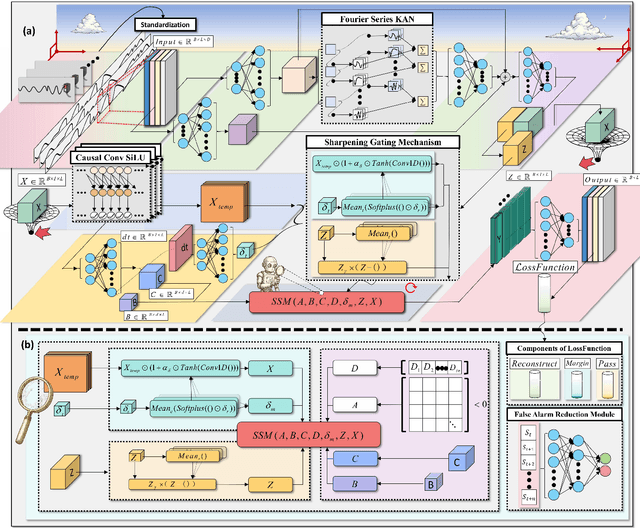
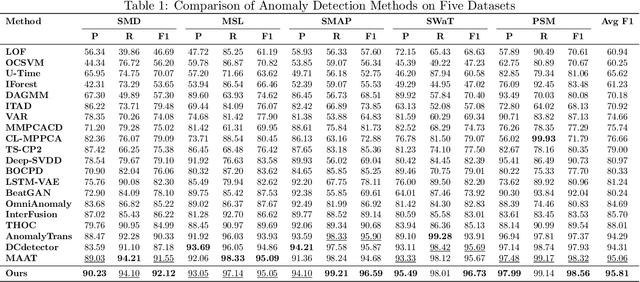
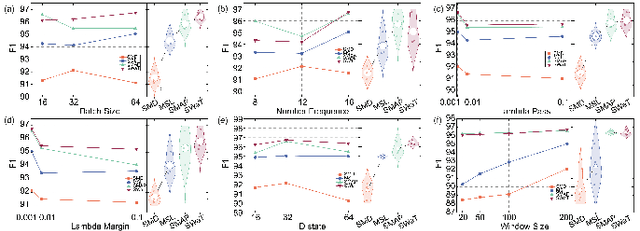

Time-series anomaly detection plays a critical role in numerous real-world applications, including industrial monitoring and fault diagnosis. Recently, Mamba-based state-space models have shown remarkable efficiency in long-sequence modeling. However, directly applying Mamba to anomaly detection tasks still faces challenges in capturing complex temporal patterns and nonlinear dynamics. In this paper, we propose Fourier-KAN-Mamba, a novel hybrid architecture that integrates Fourier layer, Kolmogorov-Arnold Networks (KAN), and Mamba selective state-space model. The Fourier layer extracts multi-scale frequency features, KAN enhances nonlinear representation capability, and a temporal gating control mechanism further improves the model's ability to distinguish normal and anomalous patterns. Extensive experiments on MSL, SMAP, and SWaT datasets demonstrate that our method significantly outperforms existing state-of-the-art approaches. Keywords: time-series anomaly detection, state-space model, Mamba, Fourier transform, Kolmogorov-Arnold Network