 Add to Chrome
 Add to Firefox
 Add to Edge
OmniVerifier-M1: Multimodal Meta-Verifier with Explicit Structured Recalibration
May 27, 2026
Visual outcomes are increasingly central to multimodal large language models, making reliable and fine-grained verification essential for scaling generalist foundation models. In this work, we investigate multimodal meta-verification, which leverages verifier-generated rationales rather than decision-only signals, and explore how to effectively incorporate meta-verification feedback into multimodal verifier training. We identify two key findings. First, symbolic verifier outputs (e.g., bounding boxes) outperform textual explanations as meta-verification rationales, enabling efficient rule-based reinforcement learning rewards while avoiding reliance on model-based rewards from auxiliary judge models. Second, decoupling reinforcement learning objectives for binary judgment and meta-verification substantially outperforms joint reward optimization, due to intrinsic differences in output structure and learning dynamics. Based on these insights, we train OmniVerifier-M1, a generalist visual verifier leveraging symbolic meta-verification and decoupled reinforcement learning. OmniVerifier-M1 provides robust verification and fine-grained error localization, and further enables M1-TTS, a verifier-driven agentic generation system achieving dynamic region-level self-correction. This approach paves the way for more reliable, interpretable, and fine-grained multimodal verification, supporting safer and more controllable foundation model deployment.

YOCO++: Enhancing YOCO with KV Residual Connections for Efficient LLM Inference
Apr 15, 2026Cross-layer key-value (KV) compression has been found to be effective in efficient inference of large language models (LLMs). Although they reduce the memory consumption of the KV cache, such methods usually introduce non-negligible performance degradation. In this work, we aim to enhance the performance of YOCO, a cross-layer KV compression method that shares the KVs of the middle layer with the top-half layers. We propose YOCO++, an enhanced YOCO that incorporates a weighted residual connection between the KVs of each bottom-half layer and the bottom layer. Compared to YOCO, YOCO++ increases model capacity while maintaining the same training and inference efficiency. Our experiments show that YOCO++ achieves state-of-the-art performance among the cross-layer KV compression methods at a 50% KV cache compression rate, outperforming the standard Transformer.
From Narrow to Panoramic Vision: Attention-Guided Cold-Start Reshapes Multimodal Reasoning
Mar 04, 2026The cold-start initialization stage plays a pivotal role in training Multimodal Large Reasoning Models (MLRMs), yet its mechanisms remain insufficiently understood. To analyze this stage, we introduce the Visual Attention Score (VAS), an attention-based metric that quantifies how much a model attends to visual tokens. We find that reasoning performance is strongly correlated with VAS (r=0.9616): models with higher VAS achieve substantially stronger multimodal reasoning. Surprisingly, multimodal cold-start fails to elevate VAS, resulting in attention distributions close to the base model, whereas text-only cold-start leads to a clear increase. We term this counter-intuitive phenomenon Lazy Attention Localization. To validate its causal role, we design training-free interventions that directly modulate attention allocation during inference, performance gains of 1$-$2% without any retraining. Building on these insights, we further propose Attention-Guided Visual Anchoring and Reflection (AVAR), a comprehensive cold-start framework that integrates visual-anchored data synthesis, attention-guided objectives, and visual-anchored reward shaping. Applied to Qwen2.5-VL-7B, AVAR achieves an average gain of 7.0% across 7 multimodal reasoning benchmarks. Ablation studies further confirm that each component of AVAR contributes step-wise to the overall gains. The code, data, and models are available at https://github.com/lrlbbzl/Qwen-AVAR.
SpiralFormer: Looped Transformers Can Learn Hierarchical Dependencies via Multi-Resolution Recursion
Feb 12, 2026Recursive (looped) Transformers decouple computational depth from parameter depth by repeatedly applying shared layers, providing an explicit architectural primitive for iterative refinement and latent reasoning. However, early looped Transformers often underperform non-recursive baselines of equal compute. While recent literature has introduced more effective recursion mechanisms to mitigate this gap, existing architectures still operate at a fixed, full-token resolution, neglecting the potential efficiency of computing over compressed latent representations. In this paper, we propose SpiralFormer, a looped Transformer that executes recurrence under a multi-resolution recursion schedule. We provide probing evidence that multi-resolution recursion enables the model to learn hierarchical dependencies by inducing iteration-wise functional specialization across different scales. Empirically, SpiralFormer achieves better parameter and compute efficiency than both looped and non-looped baselines across model scales from 160M to 1.4B, establishing sequence resolution as a potential axis for scaling recursive architectures.
VideoZoomer: Reinforcement-Learned Temporal Focusing for Long Video Reasoning
Dec 26, 2025Multimodal Large Language Models (MLLMs) have achieved remarkable progress in vision-language tasks yet remain limited in long video understanding due to the limited context window. Consequently, prevailing approaches tend to rely on uniform frame sampling or static pre-selection, which might overlook critical evidence and unable to correct its initial selection error during its reasoning process. To overcome these limitations, we propose VideoZoomer, a novel agentic framework that enables MLLMs to dynamically control their visual focus during reasoning. Starting from a coarse low-frame-rate overview, VideoZoomer invokes a temporal zoom tool to obtain high-frame-rate clips at autonomously chosen moments, thereby progressively gathering fine-grained evidence in a multi-turn interactive manner. Accordingly, we adopt a two-stage training strategy: a cold-start supervised fine-tuning phase on a curated dataset of distilled exemplar and reflection trajectories, followed by reinforcement learning to further refine the agentic policy. Extensive experiments demonstrate that our 7B model delivers diverse and complex reasoning patterns, yielding strong performance across a broad set of long video understanding and reasoning benchmarks. These emergent capabilities allow it to consistently surpass existing open-source models and even rival proprietary systems on challenging tasks, while achieving superior efficiency under reduced frame budgets.
See Less, See Right: Bi-directional Perceptual Shaping For Multimodal Reasoning
Dec 26, 2025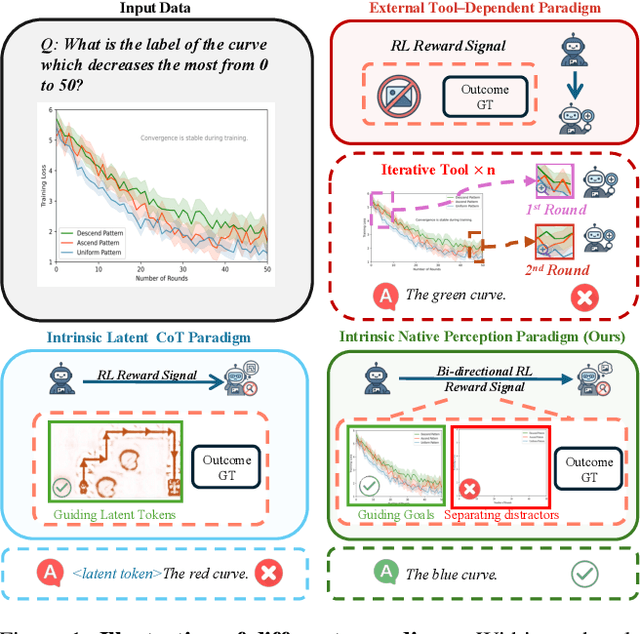
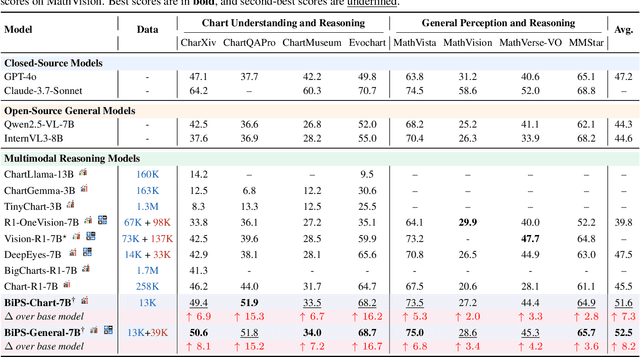
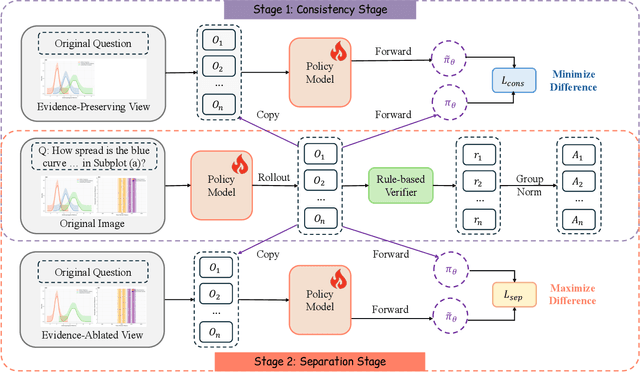
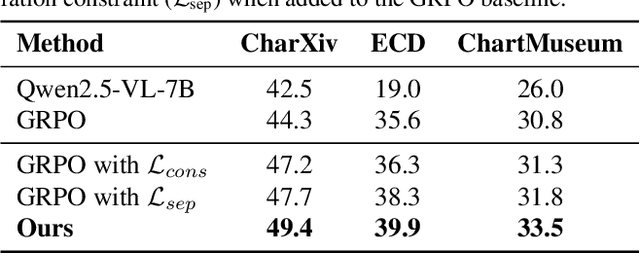
Large vision-language models (VLMs) often benefit from intermediate visual cues, either injected via external tools or generated as latent visual tokens during reasoning, but these mechanisms still overlook fine-grained visual evidence (e.g., polylines in charts), generalize poorly across domains, and incur high inference-time cost. In this paper, we propose Bi-directional Perceptual Shaping (BiPS), which transforms question-conditioned masked views into bidirectional where-to-look signals that shape perception during training. BiPS first applies a KL-consistency constraint between the original image and an evidence-preserving view that keeps only question-relevant regions, encouraging coarse but complete coverage of supporting pixels. It then applies a KL-separation constraint between the original and an evidence-ablated view where critical pixels are masked so the image no longer supports the original answer, discouraging text-only shortcuts (i.e., answering from text alone) and enforcing fine-grained visual reliance. Across eight benchmarks, BiPS boosts Qwen2.5-VL-7B by 8.2% on average and shows strong out-of-domain generalization to unseen datasets and image types.
OpenAI GPT-5 System Card
Dec 19, 2025This is the system card published alongside the OpenAI GPT-5 launch, August 2025. GPT-5 is a unified system with a smart and fast model that answers most questions, a deeper reasoning model for harder problems, and a real-time router that quickly decides which model to use based on conversation type, complexity, tool needs, and explicit intent (for example, if you say 'think hard about this' in the prompt). The router is continuously trained on real signals, including when users switch models, preference rates for responses, and measured correctness, improving over time. Once usage limits are reached, a mini version of each model handles remaining queries. This system card focuses primarily on gpt-5-thinking and gpt-5-main, while evaluations for other models are available in the appendix. The GPT-5 system not only outperforms previous models on benchmarks and answers questions more quickly, but -- more importantly -- is more useful for real-world queries. We've made significant advances in reducing hallucinations, improving instruction following, and minimizing sycophancy, and have leveled up GPT-5's performance in three of ChatGPT's most common uses: writing, coding, and health. All of the GPT-5 models additionally feature safe-completions, our latest approach to safety training to prevent disallowed content. Similarly to ChatGPT agent, we have decided to treat gpt-5-thinking as High capability in the Biological and Chemical domain under our Preparedness Framework, activating the associated safeguards. While we do not have definitive evidence that this model could meaningfully help a novice to create severe biological harm -- our defined threshold for High capability -- we have chosen to take a precautionary approach.
MeSH: Memory-as-State-Highways for Recursive Transformers
Oct 09, 2025Recursive transformers reuse parameters and iterate over hidden states multiple times, decoupling compute depth from parameter depth. However, under matched compute, recursive models with fewer parameters often lag behind non-recursive counterparts. By probing hidden states, we trace this performance gap to two primary bottlenecks: undifferentiated computation, where the core is forced to adopt a similar computational pattern at every iteration, and information overload, where long-lived and transient information must coexist in a single hidden state. To address the issues, we introduce a Memory-as-State-Highways (MeSH) scheme, which externalizes state management into an explicit memory buffer and employs lightweight routers to dynamically diversify computation across iterations. Probing visualizations confirm that MeSH successfully resolves the pathologies by inducing functional specialization across iterations. On the Pythia suite (160M-1.4B), MeSH-enhanced recursive transformers consistently improve over recursive baselines and outperforms its larger non-recursive counterpart at the 1.4B scale, improving average downstream accuracy by +1.06% with 33% fewer non-embedding parameters. Our analysis establishes MeSH as a scalable and principled architecture for building stronger recursive models.
PeRL: Permutation-Enhanced Reinforcement Learning for Interleaved Vision-Language Reasoning
Jun 17, 2025Inspired by the impressive reasoning capabilities demonstrated by reinforcement learning approaches like DeepSeek-R1, recent emerging research has begun exploring the use of reinforcement learning (RL) to enhance vision-language models (VLMs) for multimodal reasoning tasks. However, most existing multimodal reinforcement learning approaches remain limited to spatial reasoning within single-image contexts, yet still struggle to generalize to more complex and real-world scenarios involving multi-image positional reasoning, where understanding the relationships across images is crucial. To address this challenge, we propose a general reinforcement learning approach PeRL tailored for interleaved multimodal tasks, and a multi-stage strategy designed to enhance the exploration-exploitation trade-off, thereby improving learning efficiency and task performance. Specifically, we introduce permutation of image sequences to simulate varied positional relationships to explore more spatial and positional diversity. Furthermore, we design a rollout filtering mechanism for resampling to focus on trajectories that contribute most to learning optimal behaviors to exploit learned policies effectively. We evaluate our model on 5 widely-used multi-image benchmarks and 3 single-image benchmarks. Our experiments confirm that PeRL trained model consistently surpasses R1-related and interleaved VLM baselines by a large margin, achieving state-of-the-art performance on multi-image benchmarks, while preserving comparable performance on single-image tasks.
UQABench: Evaluating User Embedding for Prompting LLMs in Personalized Question Answering
Feb 26, 2025Large language models (LLMs) achieve remarkable success in natural language processing (NLP). In practical scenarios like recommendations, as users increasingly seek personalized experiences, it becomes crucial to incorporate user interaction history into the context of LLMs to enhance personalization. However, from a practical utility perspective, user interactions' extensive length and noise present challenges when used directly as text prompts. A promising solution is to compress and distill interactions into compact embeddings, serving as soft prompts to assist LLMs in generating personalized responses. Although this approach brings efficiency, a critical concern emerges: Can user embeddings adequately capture valuable information and prompt LLMs? To address this concern, we propose \name, a benchmark designed to evaluate the effectiveness of user embeddings in prompting LLMs for personalization. We establish a fair and standardized evaluation process, encompassing pre-training, fine-tuning, and evaluation stages. To thoroughly evaluate user embeddings, we design three dimensions of tasks: sequence understanding, action prediction, and interest perception. These evaluation tasks cover the industry's demands in traditional recommendation tasks, such as improving prediction accuracy, and its aspirations for LLM-based methods, such as accurately understanding user interests and enhancing the user experience. We conduct extensive experiments on various state-of-the-art methods for modeling user embeddings. Additionally, we reveal the scaling laws of leveraging user embeddings to prompt LLMs. The benchmark is available online.