 Add to Chrome
 Add to Firefox
 Add to Edge
Trustworthy Protein-Ligand Binding Affinity Prediction via Reliability-Aware Multi-Engine Fusion
Jul 20, 2026
Accurate protein-ligand binding affinity prediction is central to computational drug discovery, yet modern docking engines frequently disagree without indicating which prediction to trust. Consensus scoring and ensemble methods improve mean accuracy but treat all predictions identically without interpretable confidence measures or uncertainty decomposition, ignoring the chemical context of each protein-ligand pair. To address this limitation, we introduce RELIABLE-BA (RELIABiLity-aware Evidential fusion for Binding Affinity), an evidential framework for multi-engine binding affinity prediction. Our model comprises three steps: (1) modeling each engine as an evidential expert via Normal-Inverse-Gamma distributions, (2) scaling epistemic uncertainty through learned reliability from molecular context while preserving each expert's predictive mean, and (3) fusing experts through closed-form aggregation that captures both individual uncertainty and inter-engine disagreement. Experiments on the PDBBind and BDB2020+ benchmarks demonstrate competitive point prediction with substantially improved uncertainty calibration, and additional validation on the SARS-CoV-2 Mpro dataset and 5HT2A receptor demonstrates applicability to clinically relevant drug targets. Crucially, these uncertainty estimates enable reliable filtering of protein-ligand pairs, reducing prediction error by up to 25% when retaining only high-confidence pairs. To our knowledge, RELIABLE-BA is the first multi-engine binding affinity prediction framework to combine evidential fusion with context-dependent reliability, offering a principled path toward trustworthy AI-guided drug discovery. Our code is publicly available at https://github.com/yongchand/RELIABLE-BA.

Speaking Numbers to LLMs: Multi-Wavelet Number Embeddings for Time Series Forecasting
Jun 25, 2026Large language models (LLMs) are attractive for context-aware time series forecasting because they can integrate heterogeneous textual signals, yet their discrete, language-oriented tokenization and embedding interfaces are misaligned with continuous numerical values, often harming numerical ordering and forecasting reliability. We propose TempoWave, a plug-and-play temporal wavelet digit interface that maps each scalar observation into digit-wise embeddings constructed from multi-wavelet, multi-scale coefficients. By directly overriding standard token representations, TempoWave seamlessly exposes both fine-grained local fluctuations and macro global structures in a transformer-compatible form, ensuring that precise numerical formatting, distinct digit identity, and robustness to common normalization operations are maintained throughout the LLM pipeline. Experiments across five context-enriched forecasting benchmarks demonstrate that TempoWave consistently improves LLM-based forecasters over standard numeric tokenization and alternative embedding interfaces, achieving a new state-of-the-art. These results highlight the numeric interface as a key bottleneck and suggest that principled multi-resolution embeddings can better couple LLMs' contextual reasoning with precise forecasting. Our code is available at https://github.com/DC-research/TempoWAVE and our model can be accessed at https://huggingface.co/Melady/TempoWAVE.
Adaptive Collaboration with Humans: Metacognitive Policy Optimization for Multi-Agent LLMs with Continual Learning
Mar 09, 2026While scaling individual Large Language Models (LLMs) has delivered remarkable progress, the next frontier lies in scaling collaboration through multi-agent systems (MAS). However, purely autonomous MAS remain ''closed-world'' systems, constrained by the static knowledge horizon of pre-trained models. This limitation makes them brittle on tasks requiring knowledge beyond training data, often leading to collective failure under novel challenges. To address this, we propose the Human-In-the-Loop Multi-Agent Collaboration (HILA) framework, a principled paradigm for human--agent collaboration. HILA trains agents to learn a metacognitive policy that governs when to solve problems autonomously and when to defer to a human expert. To operationalize this policy, we introduce Dual-Loop Policy Optimization, which disentangles immediate decision-making from long-term capability growth. The inner loop applies Group Relative Policy Optimization (GRPO) with a cost-aware reward to optimize deferral decisions, while the outer loop implements continual learning, transforming expert feedback into high-quality supervised signals that strengthen the agent's reasoning ability. Experiments on challenging mathematical and problem-solving benchmarks show that HILA, equipped with Dual-Loop Policy Optimization, consistently outperforms advanced MAS, establishing a principled foundation for collaborative and continually improving agentic systems.
TemporalBench: A Benchmark for Evaluating LLM-Based Agents on Contextual and Event-Informed Time Series Tasks
Feb 05, 2026It is unclear whether strong forecasting performance reflects genuine temporal understanding or the ability to reason under contextual and event-driven conditions. We introduce TemporalBench, a multi-domain benchmark designed to evaluate temporal reasoning behavior under progressively richer informational settings. TemporalBench adopts a four-tier task taxonomy that examines historical structure interpretation, context-free forecasting, contextual temporal reasoning, and event-conditioned prediction across four real-world domains: retail, healthcare, energy, and physical systems. By controlling access to future targets and contextual information, the benchmark enables a diagnostic analysis of whether models can correctly interpret temporal patterns, align them with external context, and adapt predictions when conditions change. Extensive baseline experiments show that strong numerical forecasting accuracy does not reliably translate into robust contextual or event-aware temporal reasoning; instead, existing agent frameworks exhibit fragmented strengths and systematic failure modes that remain largely hidden under forecasting-only benchmarks. The TemporalBench dataset is publicly available at https://huggingface.co/datasets/Melady/TemporalBench, and we additionally provide a public leaderboard at https://huggingface.co/spaces/Melady/TemporalBench_Leaderboard.
Conversational Time Series Foundation Models: Towards Explainable and Effective Forecasting
Dec 17, 2025The proliferation of time series foundation models has created a landscape where no single method achieves consistent superiority, framing the central challenge not as finding the best model, but as orchestrating an optimal ensemble with interpretability. While Large Language Models (LLMs) offer powerful reasoning capabilities, their direct application to time series forecasting has proven ineffective. We address this gap by repositioning the LLM as an intelligent judge that evaluates, explains, and strategically coordinates an ensemble of foundation models. To overcome the LLM's inherent lack of domain-specific knowledge on time series, we introduce an R1-style finetuning process, guided by SHAP-based faithfulness scores, which teaches the model to interpret ensemble weights as meaningful causal statements about temporal dynamics. The trained agent then engages in iterative, multi-turn conversations to perform forward-looking assessments, provide causally-grounded explanations for its weighting decisions, and adaptively refine the optimization strategy. Validated on the GIFT-Eval benchmark on 23 datasets across 97 settings, our approach significantly outperforms leading time series foundation models on both CRPS and MASE metrics, establishing new state-of-the-art results.
Foundation Models for Demand Forecasting via Dual-Strategy Ensembling
Jul 29, 2025Accurate demand forecasting is critical for supply chain optimization, yet remains difficult in practice due to hierarchical complexity, domain shifts, and evolving external factors. While recent foundation models offer strong potential for time series forecasting, they often suffer from architectural rigidity and limited robustness under distributional change. In this paper, we propose a unified ensemble framework that enhances the performance of foundation models for sales forecasting in real-world supply chains. Our method combines two complementary strategies: (1) Hierarchical Ensemble (HE), which partitions training and inference by semantic levels (e.g., store, category, department) to capture localized patterns; and (2) Architectural Ensemble (AE), which integrates predictions from diverse model backbones to mitigate bias and improve stability. We conduct extensive experiments on the M5 benchmark and three external sales datasets, covering both in-domain and zero-shot forecasting. Results show that our approach consistently outperforms strong baselines, improves accuracy across hierarchical levels, and provides a simple yet effective mechanism for boosting generalization in complex forecasting environments.
Creating a Cooperative AI Policymaking Platform through Open Source Collaboration
Dec 09, 2024

Advances in artificial intelligence (AI) present significant risks and opportunities, requiring improved governance to mitigate societal harms and promote equitable benefits. Current incentive structures and regulatory delays may hinder responsible AI development and deployment, particularly in light of the transformative potential of large language models (LLMs). To address these challenges, we propose developing the following three contributions: (1) a large multimodal text and economic-timeseries foundation model that integrates economic and natural language policy data for enhanced forecasting and decision-making, (2) algorithmic mechanisms for eliciting diverse and representative perspectives, enabling the creation of data-driven public policy recommendations, and (3) an AI-driven web platform for supporting transparent, inclusive, and data-driven policymaking.
Active Sequential Posterior Estimation for Sample-Efficient Simulation-Based Inference
Dec 07, 2024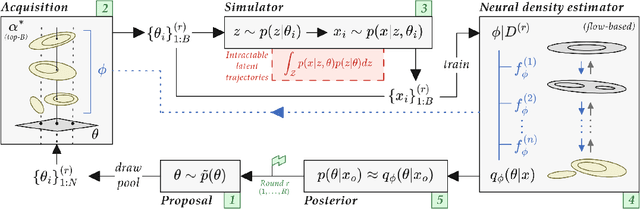
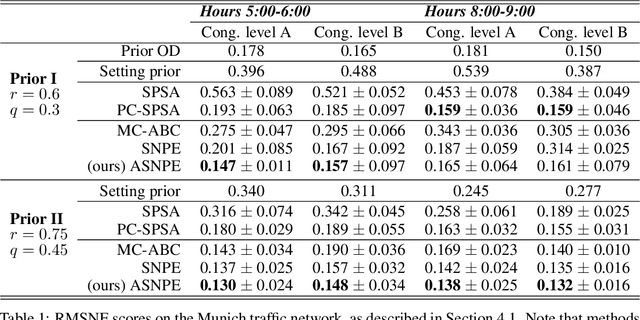
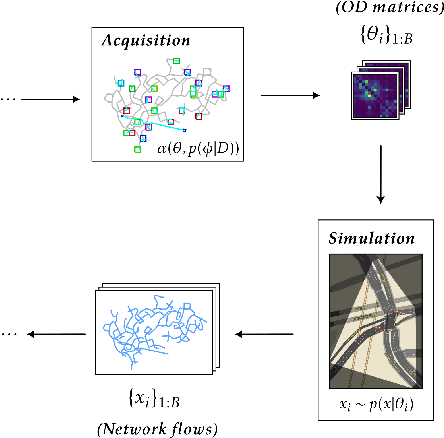

Computer simulations have long presented the exciting possibility of scientific insight into complex real-world processes. Despite the power of modern computing, however, it remains challenging to systematically perform inference under simulation models. This has led to the rise of simulation-based inference (SBI), a class of machine learning-enabled techniques for approaching inverse problems with stochastic simulators. Many such methods, however, require large numbers of simulation samples and face difficulty scaling to high-dimensional settings, often making inference prohibitive under resource-intensive simulators. To mitigate these drawbacks, we introduce active sequential neural posterior estimation (ASNPE). ASNPE brings an active learning scheme into the inference loop to estimate the utility of simulation parameter candidates to the underlying probabilistic model. The proposed acquisition scheme is easily integrated into existing posterior estimation pipelines, allowing for improved sample efficiency with low computational overhead. We further demonstrate the effectiveness of the proposed method in the travel demand calibration setting, a high-dimensional inverse problem commonly requiring computationally expensive traffic simulators. Our method outperforms well-tuned benchmarks and state-of-the-art posterior estimation methods on a large-scale real-world traffic network, as well as demonstrates a performance advantage over non-active counterparts on a suite of SBI benchmark environments.
Beyond Forecasting: Compositional Time Series Reasoning for End-to-End Task Execution
Oct 08, 2024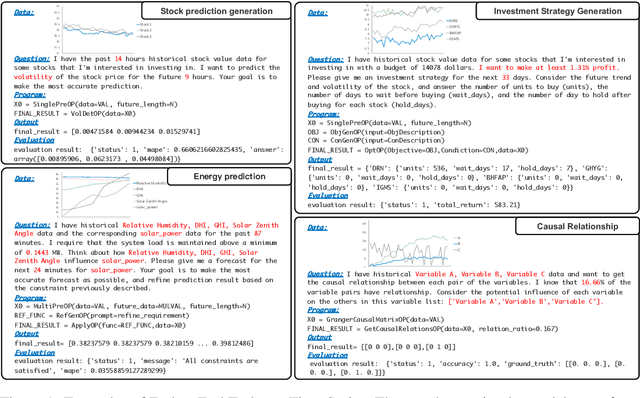

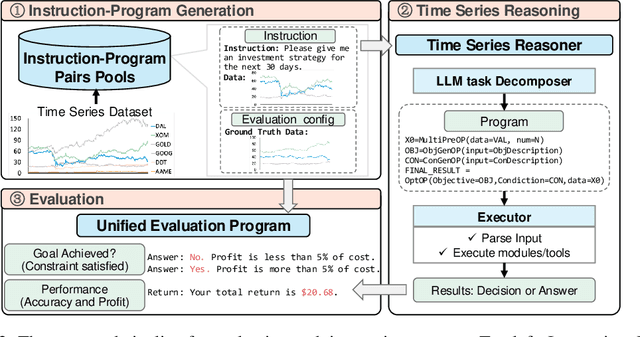
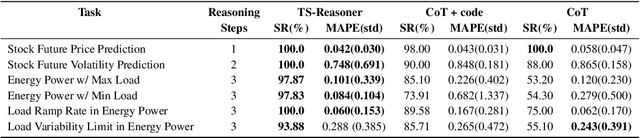
In recent decades, there has been substantial advances in time series models and benchmarks across various individual tasks, such as time series forecasting, classification, and anomaly detection. Meanwhile, compositional reasoning in time series is prevalent in real-world applications (e.g., decision-making and compositional question answering) and is in great demand. Unlike simple tasks that primarily focus on predictive accuracy, compositional reasoning emphasizes the synthesis of diverse information from both time series data and various domain knowledge, making it distinct and extremely more challenging. In this paper, we introduce Compositional Time Series Reasoning, a new task of handling intricate multistep reasoning tasks from time series data. Specifically, this new task focuses on various question instances requiring structural and compositional reasoning abilities on time series data, such as decision-making and compositional question answering. As an initial attempt to tackle this novel task, we developed TS-Reasoner, a program-aided approach that utilizes large language model (LLM) to decompose a complex task into steps of programs that leverage existing time series models and numerical subroutines. Unlike existing reasoning work which only calls off-the-shelf modules, TS-Reasoner allows for the creation of custom modules and provides greater flexibility to incorporate domain knowledge as well as user-specified constraints. We demonstrate the effectiveness of our method through a comprehensive set of experiments. These promising results indicate potential opportunities in the new task of time series reasoning and highlight the need for further research.
TimeDiT: General-purpose Diffusion Transformers for Time Series Foundation Model
Sep 03, 2024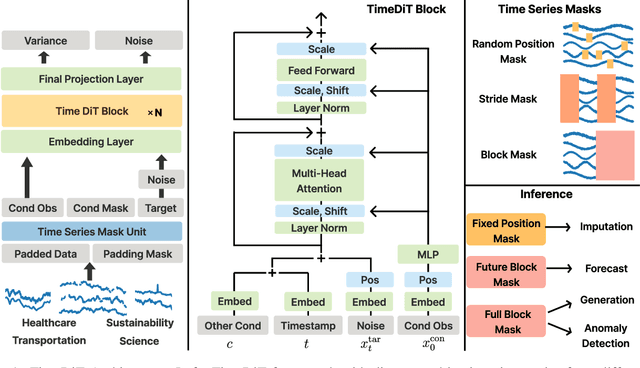
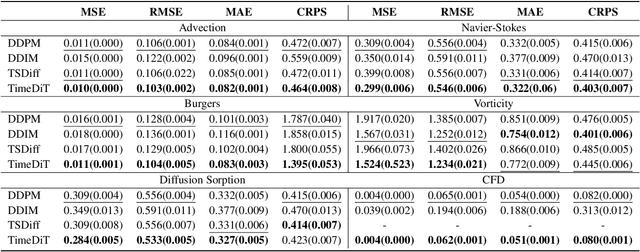
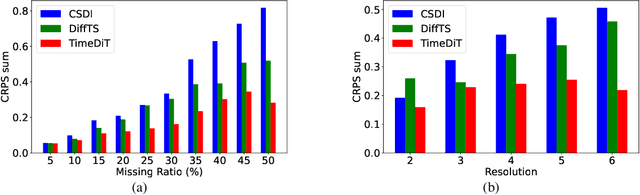
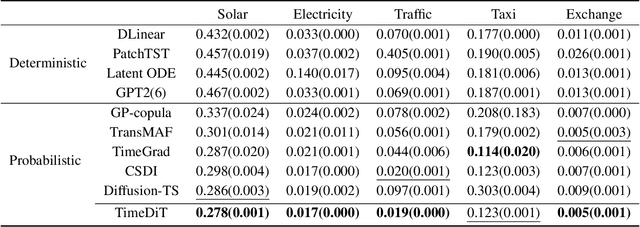
With recent advances in building foundation models for texts and video data, there is a surge of interest in foundation models for time series. A family of models have been developed, utilizing a temporal auto-regressive generative Transformer architecture, whose effectiveness has been proven in Large Language Models. While the empirical results are promising, almost all existing time series foundation models have only been tested on well-curated ``benchmark'' datasets very similar to texts. However, real-world time series exhibit unique challenges, such as variable channel sizes across domains, missing values, and varying signal sampling intervals due to the multi-resolution nature of real-world data. Additionally, the uni-directional nature of temporally auto-regressive decoding limits the incorporation of domain knowledge, such as physical laws expressed as partial differential equations (PDEs). To address these challenges, we introduce the Time Diffusion Transformer (TimeDiT), a general foundation model for time series that employs a denoising diffusion paradigm instead of temporal auto-regressive generation. TimeDiT leverages the Transformer architecture to capture temporal dependencies and employs diffusion processes to generate high-quality candidate samples without imposing stringent assumptions on the target distribution via novel masking schemes and a channel alignment strategy. Furthermore, we propose a finetuning-free model editing strategy that allows the seamless integration of external knowledge during the sampling process without updating any model parameters. Extensive experiments conducted on a varity of tasks such as forecasting, imputation, and anomaly detection, demonstrate the effectiveness of TimeDiT.