 Add to Chrome
 Add to Firefox
 Add to Edge
PD-SOVNet: A Physics-Driven Second-Order Vibration Operator Network for Estimating Wheel Polygonal Roughness from Axle-Box Vibrations
Apr 08, 2026
Quantitative estimation of wheel polygonal roughness from axle-box vibration signals is a challenging yet practically relevant problem for rail-vehicle condition monitoring. Existing studies have largely focused on detection, identification, or severity classification, while continuous regression of multi-order roughness spectra remains less explored, especially under real operational data and unseen-wheel conditions. To address this problem, this paper presents PD-SOVNet, a physics-guided gray-box framework that combines shared second-order vibration kernels, a $4\times4$ MIMO coupling module, an adaptive physical correction branch, and a Mamba-based temporal branch for estimating the 1st--40th-order wheel roughness spectrum from axle-box vibrations. The proposed design embeds modal-response priors into the model while retaining data-driven flexibility for sample-dependent correction and residual temporal dynamics. Experiments on three real-world datasets, including operational data and real fault data, show that the proposed method provides competitive prediction accuracy and relatively stable cross-wheel performance under the current data protocol, with its most noticeable advantage observed on the more challenging Dataset III. Noise injection experiments further indicate that the Mamba temporal branch helps mitigate performance degradation under perturbed inputs. These results suggest that structured physical priors can be beneficial for stabilizing roughness regression in practical rail-vehicle monitoring scenarios, although further validation under broader operating conditions and stricter comparison protocols is still needed.

BoundAD: Boundary-Aware Negative Generation for Time Series Anomaly Detection
Mar 18, 2026Contrastive learning methods for time series anomaly detection (TSAD) heavily depend on the quality of negative sample construction. However, existing strategies based on random perturbations or pseudo-anomaly injection often struggle to simultaneously preserve temporal semantic consistency and provide effective decision-boundary supervision. Most existing methods rely on prior anomaly injection, while overlooking the potential of generating hard negatives near the data manifold boundary directly from normal samples themselves. To address this issue, we propose a reconstruction-driven boundary negative generation framework that automatically constructs hard negatives through the reconstruction process of normal samples. Specifically, the method first employs a reconstruction network to capture normal temporal patterns, and then introduces a reinforcement learning strategy to adaptively adjust the optimization update magnitude according to the current reconstruction state. In this way, boundary-shifted samples close to the normal data manifold can be induced along the reconstruction trajectory and further used for subsequent contrastive representation learning. Unlike existing methods that depend on explicit anomaly injection, the proposed framework does not require predefined anomaly patterns, but instead mines more challenging boundary negatives from the model's own learning dynamics. Experimental results show that the proposed method effectively improves anomaly representation learning and achieves competitive detection performance on the current dataset.
Fourier-KAN-Mamba: A Novel State-Space Equation Approach for Time-Series Anomaly Detection
Nov 19, 2025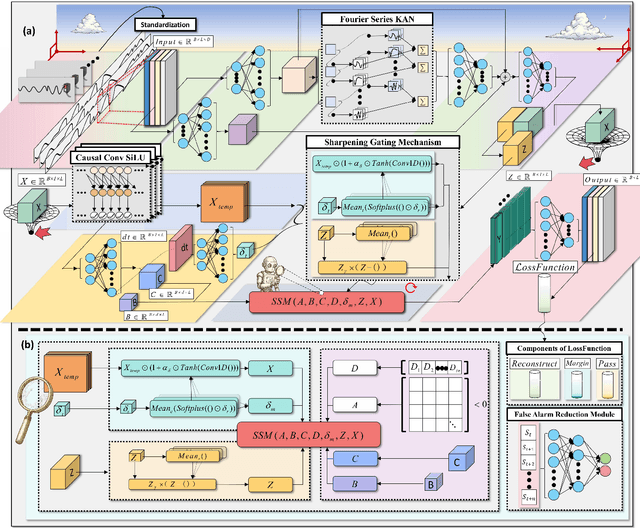
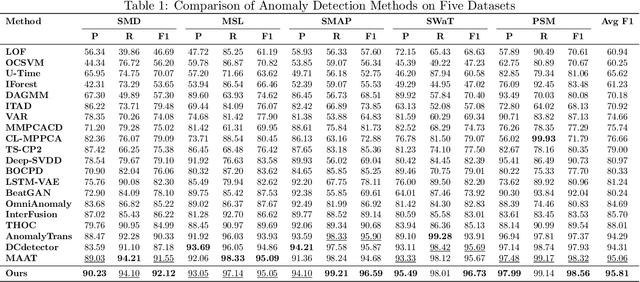
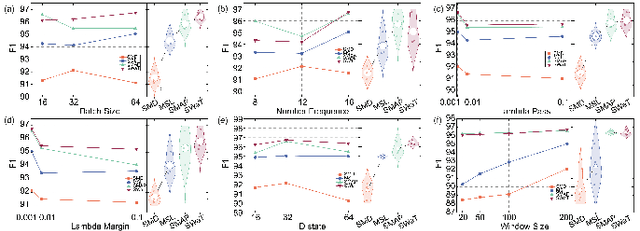

Time-series anomaly detection plays a critical role in numerous real-world applications, including industrial monitoring and fault diagnosis. Recently, Mamba-based state-space models have shown remarkable efficiency in long-sequence modeling. However, directly applying Mamba to anomaly detection tasks still faces challenges in capturing complex temporal patterns and nonlinear dynamics. In this paper, we propose Fourier-KAN-Mamba, a novel hybrid architecture that integrates Fourier layer, Kolmogorov-Arnold Networks (KAN), and Mamba selective state-space model. The Fourier layer extracts multi-scale frequency features, KAN enhances nonlinear representation capability, and a temporal gating control mechanism further improves the model's ability to distinguish normal and anomalous patterns. Extensive experiments on MSL, SMAP, and SWaT datasets demonstrate that our method significantly outperforms existing state-of-the-art approaches. Keywords: time-series anomaly detection, state-space model, Mamba, Fourier transform, Kolmogorov-Arnold Network
Fast-Slow Co-advancing Optimizer: Toward Harmonious Adversarial Training of GAN
Apr 21, 2025
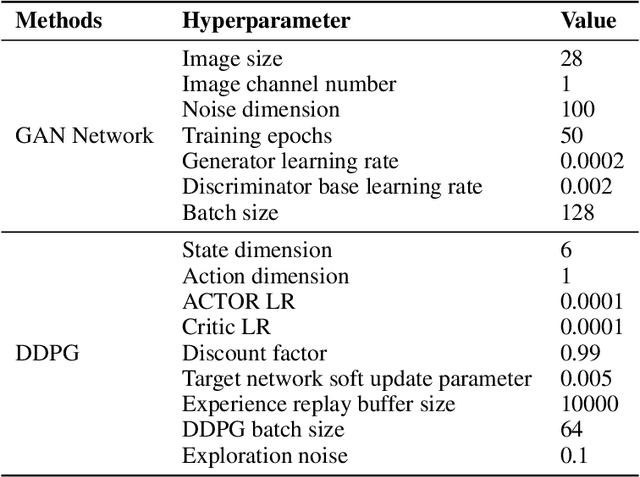
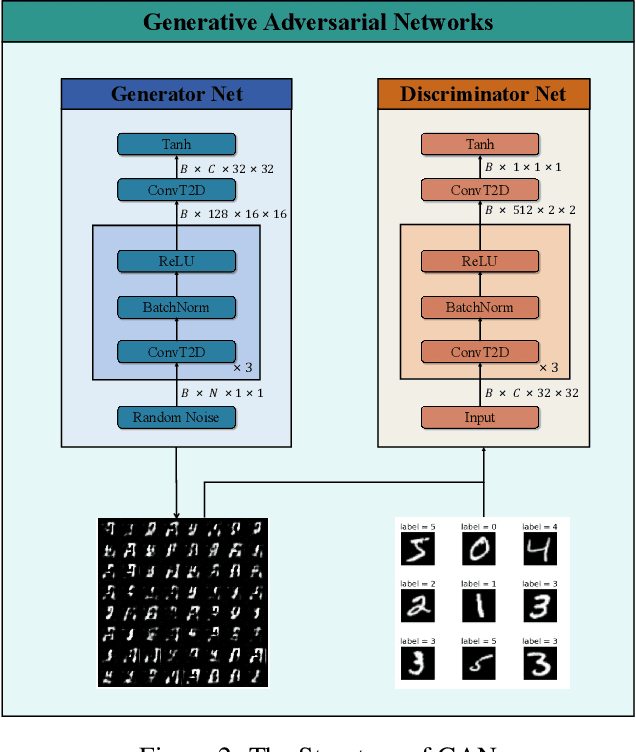
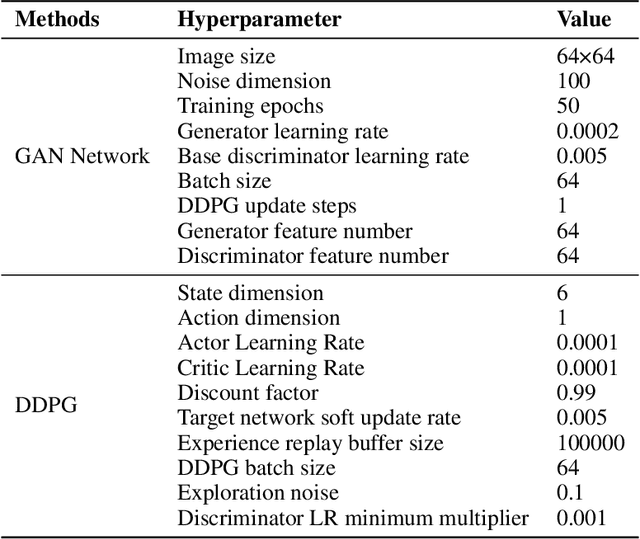
Up to now, the training processes of typical Generative Adversarial Networks (GANs) are still particularly sensitive to data properties and hyperparameters, which may lead to severe oscillations, difficulties in convergence, or even failures to converge, especially when the overall variances of the training sets are large. These phenomena are often attributed to the training characteristics of such networks. Aiming at the problem, this paper develops a new intelligent optimizer, Fast-Slow Co-advancing Optimizer (FSCO), which employs reinforcement learning in the training process of GANs to make training easier. Specifically, this paper allows the training step size to be controlled by an agent to improve training stability, and makes the training process more intelligent with variable learning rates, making GANs less sensitive to step size. Experiments have been conducted on three benchmark datasets to verify the effectiveness of the developed FSCO.