 Add to Chrome
 Add to Firefox
 Add to Edge
See Less, See Right: Bi-directional Perceptual Shaping For Multimodal Reasoning
Dec 26, 2025
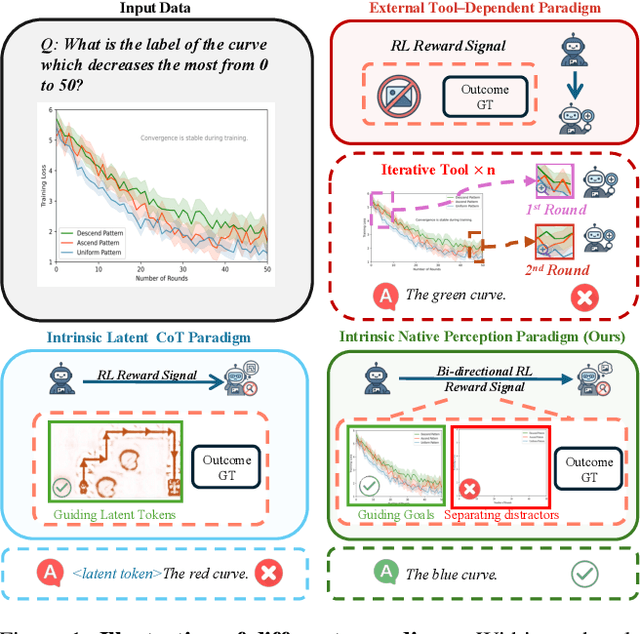
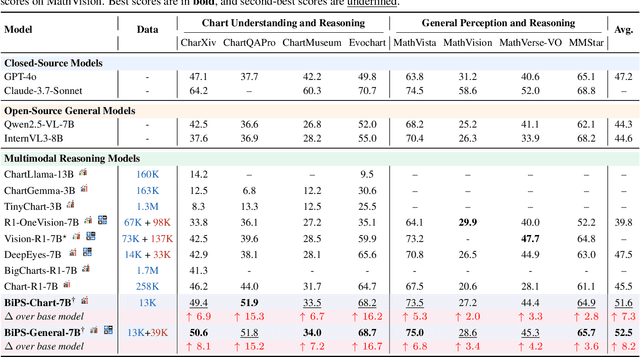
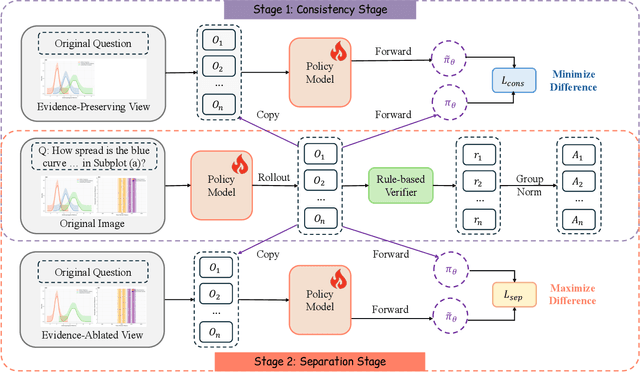
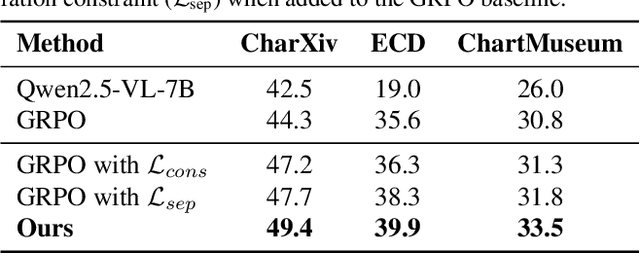
Large vision-language models (VLMs) often benefit from intermediate visual cues, either injected via external tools or generated as latent visual tokens during reasoning, but these mechanisms still overlook fine-grained visual evidence (e.g., polylines in charts), generalize poorly across domains, and incur high inference-time cost. In this paper, we propose Bi-directional Perceptual Shaping (BiPS), which transforms question-conditioned masked views into bidirectional where-to-look signals that shape perception during training. BiPS first applies a KL-consistency constraint between the original image and an evidence-preserving view that keeps only question-relevant regions, encouraging coarse but complete coverage of supporting pixels. It then applies a KL-separation constraint between the original and an evidence-ablated view where critical pixels are masked so the image no longer supports the original answer, discouraging text-only shortcuts (i.e., answering from text alone) and enforcing fine-grained visual reliance. Across eight benchmarks, BiPS boosts Qwen2.5-VL-7B by 8.2% on average and shows strong out-of-domain generalization to unseen datasets and image types.

PeRL: Permutation-Enhanced Reinforcement Learning for Interleaved Vision-Language Reasoning
Jun 17, 2025Inspired by the impressive reasoning capabilities demonstrated by reinforcement learning approaches like DeepSeek-R1, recent emerging research has begun exploring the use of reinforcement learning (RL) to enhance vision-language models (VLMs) for multimodal reasoning tasks. However, most existing multimodal reinforcement learning approaches remain limited to spatial reasoning within single-image contexts, yet still struggle to generalize to more complex and real-world scenarios involving multi-image positional reasoning, where understanding the relationships across images is crucial. To address this challenge, we propose a general reinforcement learning approach PeRL tailored for interleaved multimodal tasks, and a multi-stage strategy designed to enhance the exploration-exploitation trade-off, thereby improving learning efficiency and task performance. Specifically, we introduce permutation of image sequences to simulate varied positional relationships to explore more spatial and positional diversity. Furthermore, we design a rollout filtering mechanism for resampling to focus on trajectories that contribute most to learning optimal behaviors to exploit learned policies effectively. We evaluate our model on 5 widely-used multi-image benchmarks and 3 single-image benchmarks. Our experiments confirm that PeRL trained model consistently surpasses R1-related and interleaved VLM baselines by a large margin, achieving state-of-the-art performance on multi-image benchmarks, while preserving comparable performance on single-image tasks.