 Add to Chrome
 Add to Firefox
 Add to Edge
Counterfactual Trace Auditing of LLM Agent Skills
May 12, 2026
Large Language Model agents are increasingly augmented with agent skills. Current evaluation methods for skills remain limited. Most deployed benchmarks report only pass rate before and after a skill is attached, treating the skill as a black box change to agent behavior. We introduce Counterfactual Trace Auditing (CTA), a framework for measuring how a skill changes agent behavior. CTA pairs each with skill agent trace with a without skill counterpart on the same task, segments both traces into goal directed phases, aligns the phases, and emits structured Skill Influence Pattern (SIP) annotations. These annotations describe the behavioral effect of a skill rather than only its task outcome. We instantiate CTA on SWE-Skills-Bench with Claude across 49 software engineering tasks. The resulting audit reveals a clear evaluation gap. Pass rate changes by only +0.3 percentage points on average, suggesting little aggregate effect. Yet CTA identifies 522 SIP instances across the same paired traces, showing that the skills substantially reshape agent behavior even when pass rate is nearly unchanged. The audit also separates several recurring effects that pass rate cannot detect, including literal template copying, off task artifact creation, excess planning, and task recovery. Three findings emerge. First, high baseline tasks contain most of the observed skill effects, although their pass rate is already saturated and therefore cannot reflect those effects. Second, tasks with moderate baseline performance show the most recoverable gain, but often at substantially higher token cost. Third, the dominant SIP type can be identified by baseline bucket: surface anchoring is most common on ceiling tasks and edge-case prompting is most common on mid-range and floor tasks. These regularities turn informal failure mode observations into reproducible behavioral measurements.

When Simulation Lies: A Sim-to-Real Benchmark and Domain-Randomized RL Recipe for Tool-Use Agents
May 12, 2026Tool-use language agents are evaluated on benchmarks that assume clean inputs, unambiguous tool registries, and reliable APIs. Real deployments violate all these assumptions: user typos propagate into hallucinated tool names, a misconfigured request timeout can stall an agent indefinitely, and duplicate tool names across servers can freeze an SDK. We study these failures as a sim-to-real gap in the tool-use partially observable Markov decision process (POMDP), where deployment noise enters through the observation, action space, reward-relevant metadata, or transition dynamics. We introduce RobustBench-TC, a benchmark with 22 perturbation types organized by these four POMDP components, each grounded in a verified GitHub issue or documented tool-calling failure. Across 21 models from 1.5B to 32B parameters (including the closed-source o4-mini), the robustness profile is sharply uneven: observation perturbations reduce accuracy by less than 5%, while reward-relevant and transition perturbations reduce accuracy by roughly 40% and 30%, respectively; scale alone does not close these gaps. We then propose ToolRL-DR, a domain-randomization reinforcement learning (RL) recipe that trains a tool-use agent on perturbation-augmented trajectories spanning the three statically encodable POMDP components. On a 3B backbone, ToolRL-DR-Full retains roughly three-quarters of clean accuracy and reaches an aggregate perturbed accuracy comparable to open-source 14B function-calling baselines while substantially narrowing the gap to o4-mini. It closes approximately 27% of the Transition gap despite never seeing transition perturbations in training, suggesting that RL on adversarial static tool-use inputs induces a more persistent retry policy that transfers to unseen runtime failures. The dataset, code and benchmark leaderboard are publicly available.
Conversational Time Series Foundation Models: Towards Explainable and Effective Forecasting
Dec 17, 2025The proliferation of time series foundation models has created a landscape where no single method achieves consistent superiority, framing the central challenge not as finding the best model, but as orchestrating an optimal ensemble with interpretability. While Large Language Models (LLMs) offer powerful reasoning capabilities, their direct application to time series forecasting has proven ineffective. We address this gap by repositioning the LLM as an intelligent judge that evaluates, explains, and strategically coordinates an ensemble of foundation models. To overcome the LLM's inherent lack of domain-specific knowledge on time series, we introduce an R1-style finetuning process, guided by SHAP-based faithfulness scores, which teaches the model to interpret ensemble weights as meaningful causal statements about temporal dynamics. The trained agent then engages in iterative, multi-turn conversations to perform forward-looking assessments, provide causally-grounded explanations for its weighting decisions, and adaptively refine the optimization strategy. Validated on the GIFT-Eval benchmark on 23 datasets across 97 settings, our approach significantly outperforms leading time series foundation models on both CRPS and MASE metrics, establishing new state-of-the-art results.
Real-time scheduling of renewable power systems through planning-based reinforcement learning
Mar 13, 2023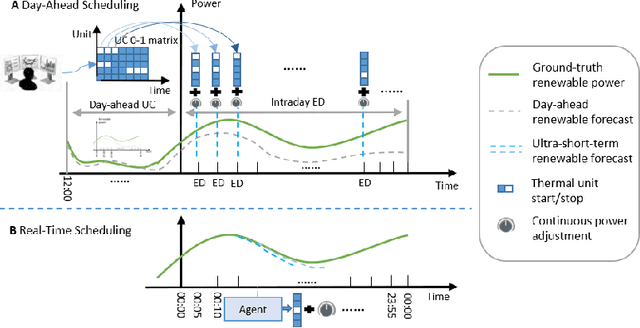
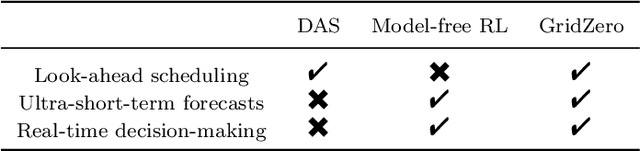
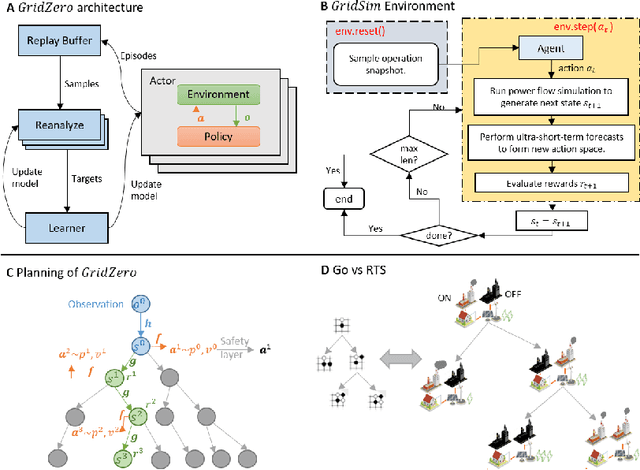
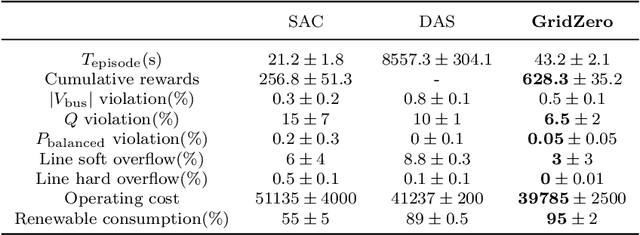
The growing renewable energy sources have posed significant challenges to traditional power scheduling. It is difficult for operators to obtain accurate day-ahead forecasts of renewable generation, thereby requiring the future scheduling system to make real-time scheduling decisions aligning with ultra-short-term forecasts. Restricted by the computation speed, traditional optimization-based methods can not solve this problem. Recent developments in reinforcement learning (RL) have demonstrated the potential to solve this challenge. However, the existing RL methods are inadequate in terms of constraint complexity, algorithm performance, and environment fidelity. We are the first to propose a systematic solution based on the state-of-the-art reinforcement learning algorithm and the real power grid environment. The proposed approach enables planning and finer time resolution adjustments of power generators, including unit commitment and economic dispatch, thus increasing the grid's ability to admit more renewable energy. The well-trained scheduling agent significantly reduces renewable curtailment and load shedding, which are issues arising from traditional scheduling's reliance on inaccurate day-ahead forecasts. High-frequency control decisions exploit the existing units' flexibility, reducing the power grid's dependence on hardware transformations and saving investment and operating costs, as demonstrated in experimental results. This research exhibits the potential of reinforcement learning in promoting low-carbon and intelligent power systems and represents a solid step toward sustainable electricity generation.