 Add to Chrome
 Add to Firefox
 Add to Edge
Two-Stage Active Distribution Network Voltage Control via LLM-RL Collaboration: A Hybrid Knowledge-Data-Driven Approach
Feb 25, 2026
The growing integration of distributed photovoltaics (PVs) into active distribution networks (ADNs) has exacerbated operational challenges, making it imperative to coordinate diverse equipment to mitigate voltage violations and enhance power quality. Although existing data-driven approaches have demonstrated effectiveness in the voltage control problem, they often require extensive trial-and-error exploration and struggle to incorporate heterogeneous information, such as day-ahead forecasts and semantic-based grid codes. Considering the operational scenarios and requirements in real-world ADNs, in this paper, we propose a hybrid knowledge-data-driven approach that leverages dynamic collaboration between a large language model (LLM) agent and a reinforcement learning (RL) agent to achieve two-stage voltage control. In the day-ahead stage, the LLM agent receives coarse region-level forecasts and generates scheduling strategies for on-load tap changer (OLTC) and shunt capacitors (SCs) to regulate the overall voltage profile. Then in the intra-day stage, based on accurate node-level measurements, the RL agent refines terminal voltages by deriving reactive power generation strategies for PV inverters. On top of the LLM-RL collaboration framework, we further propose a self-evolution mechanism for the LLM agent and a pretrain-finetune pipeline for the RL agent, effectively enhancing and coordinating the policies for both agents. The proposed approach not only aligns more closely with practical operational characteristics but also effectively utilizes the inherent knowledge and reasoning capabilities of the LLM agent, significantly improving training efficiency and voltage control performance. Comprehensive comparisons and ablation studies demonstrate the effectiveness of the proposed method.

Learning-Assisted Multi-Operator Variable Neighborhood Search for Urban Cable Routing
Dec 22, 2025Urban underground cable construction is essential for enhancing the reliability of city power grids, yet its high construction costs make planning a worthwhile optimization task. In urban environments, road layouts tightly constrain cable routing. This, on the one hand, renders relation-only models (i.e., those without explicit routes) used in prior work overly simplistic, and on the other hand, dramatically enlarges the combinatorial search space, thereby imposing much higher demands on algorithm design. In this study, we formulate urban cable routing as a connectivity-path co-optimization problem and propose a learning-assisted multi-operator variable neighborhood search (L-MVNS) algorithm. The framework first introduces an auxiliary task to generate high-quality feasible initial solutions. A hybrid genetic search (HGS) and A* serve as the connectivity optimizer and the route-planning optimizer, respectively. Building on these, a multi-operator variable neighborhood search (MVNS) iteratively co-optimizes inter-substation connectivity and detailed routes via three complementary destruction operators, a modified A* repair operator, and an adaptive neighborhood-sizing mechanism. A multi-agent deep reinforcement learning module is further embedded to prioritize promising neighborhoods. We also construct a standardized and scalable benchmark suite for evaluation. Across these cases, comprehensive experiments demonstrate effectiveness and stability: relative to representative approaches, MVNS and L-MVNS reduce total construction cost by approximately 30-50%, with L-MVNS delivering additional gains on larger instances and consistently higher stability.
One Request, Multiple Experts: LLM Orchestrates Domain Specific Models via Adaptive Task Routing
Nov 16, 2025With the integration of massive distributed energy resources and the widespread participation of novel market entities, the operation of active distribution networks (ADNs) is progressively evolving into a complex multi-scenario, multi-objective problem. Although expert engineers have developed numerous domain specific models (DSMs) to address distinct technical problems, mastering, integrating, and orchestrating these heterogeneous DSMs still entail considerable overhead for ADN operators. Therefore, an intelligent approach is urgently required to unify these DSMs and enable efficient coordination. To address this challenge, this paper proposes the ADN-Agent architecture, which leverages a general large language model (LLM) to coordinate multiple DSMs, enabling adaptive intent recognition, task decomposition, and DSM invocation. Within the ADN-Agent, we design a novel communication mechanism that provides a unified and flexible interface for diverse heterogeneous DSMs. Finally, for some language-intensive subtasks, we propose an automated training pipeline for fine-tuning small language models, thereby effectively enhancing the overall problem-solving capability of the system. Comprehensive comparisons and ablation experiments validate the efficacy of the proposed method and demonstrate that the ADN-Agent architecture outperforms existing LLM application paradigms.
RL2: Reinforce Large Language Model to Assist Safe Reinforcement Learning for Energy Management of Active Distribution Networks
Dec 02, 2024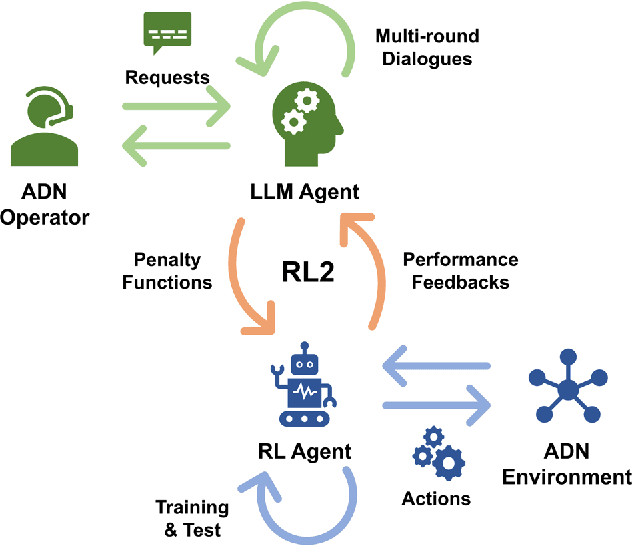
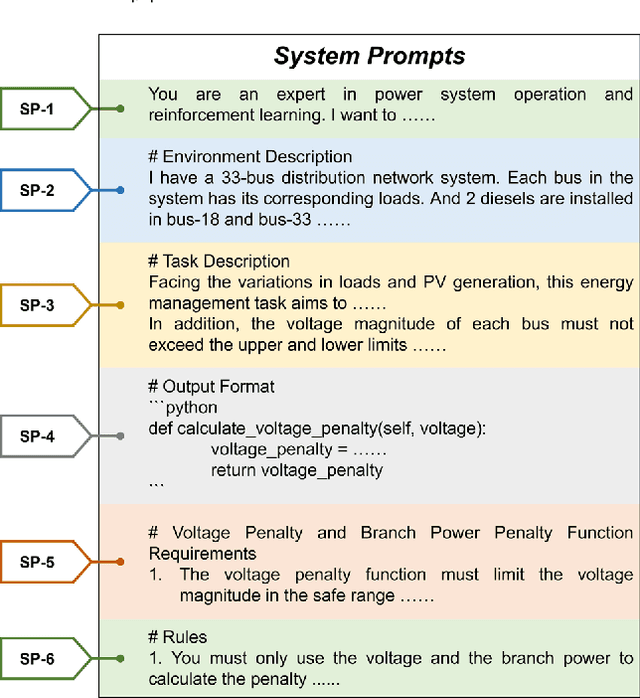
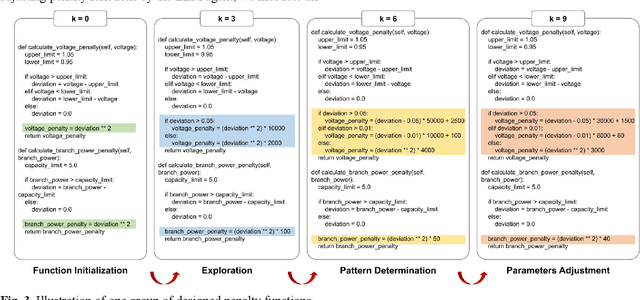
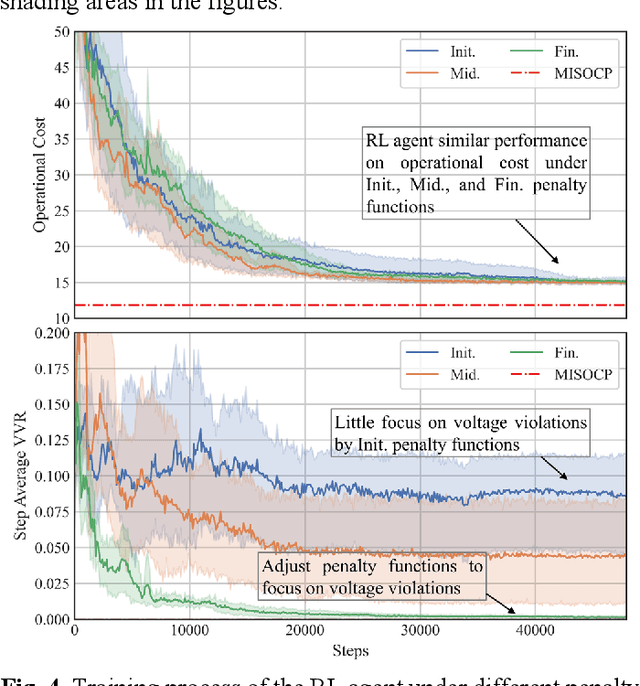
As large-scale distributed energy resources are integrated into the active distribution networks (ADNs), effective energy management in ADNs becomes increasingly prominent compared to traditional distribution networks. Although advanced reinforcement learning (RL) methods, which alleviate the burden of complicated modelling and optimization, have greatly improved the efficiency of energy management in ADNs, safety becomes a critical concern for RL applications in real-world problems. Since the design and adjustment of penalty functions, which correspond to operational safety constraints, requires extensive domain knowledge in RL and power system operation, the emerging ADN operators call for a more flexible and customized approach to address the penalty functions so that the operational safety and efficiency can be further enhanced. Empowered with strong comprehension, reasoning, and in-context learning capabilities, large language models (LLMs) provide a promising way to assist safe RL for energy management in ADNs. In this paper, we introduce the LLM to comprehend operational safety requirements in ADNs and generate corresponding penalty functions. In addition, we propose an RL2 mechanism to refine the generated functions iteratively and adaptively through multi-round dialogues, in which the LLM agent adjusts the functions' pattern and parameters based on training and test performance of the downstream RL agent. The proposed method significantly reduces the intervention of the ADN operators. Comprehensive test results demonstrate the effectiveness of the proposed method.