 Add to Chrome
 Add to Firefox
 Add to Edge
Enhanced Short Text Modeling: Leveraging Large Language Models for Topic Refinement
Mar 26, 2024
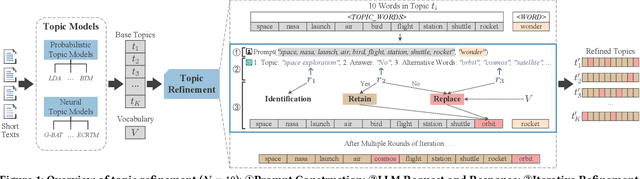

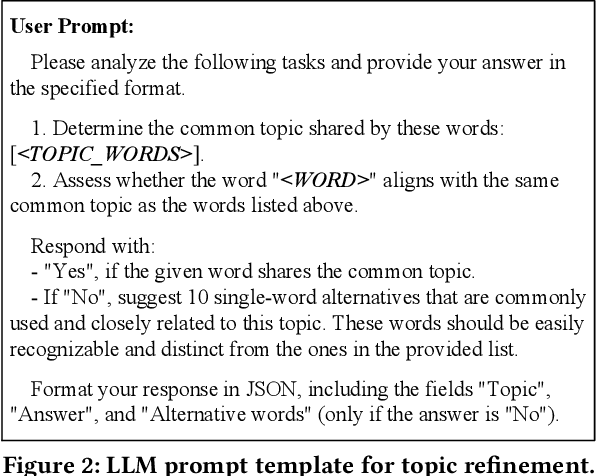
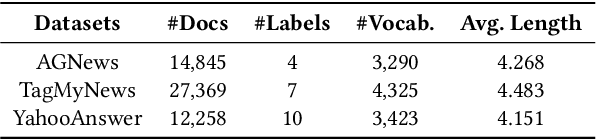
Crafting effective topic models for brief texts, like tweets and news headlines, is essential for capturing the swift shifts in social dynamics. Traditional topic models, however, often fall short in accurately representing the semantic intricacies of short texts due to their brevity and lack of contextual data. In our study, we harness the advanced capabilities of Large Language Models (LLMs) to introduce a novel approach termed "Topic Refinement". This approach does not directly involve itself in the initial modeling of topics but focuses on improving topics after they have been mined. By employing prompt engineering, we direct LLMs to eliminate off-topic words within a given topic, ensuring that only contextually relevant words are preserved or substituted with ones that fit better semantically. This method emulates human-like scrutiny and improvement of topics, thereby elevating the semantic quality of the topics generated by various models. Our comprehensive evaluation across three unique datasets has shown that our topic refinement approach significantly enhances the semantic coherence of topics.

InternLM2 Technical Report
Mar 26, 2024


The evolution of Large Language Models (LLMs) like ChatGPT and GPT-4 has sparked discussions on the advent of Artificial General Intelligence (AGI). However, replicating such advancements in open-source models has been challenging. This paper introduces InternLM2, an open-source LLM that outperforms its predecessors in comprehensive evaluations across 6 dimensions and 30 benchmarks, long-context modeling, and open-ended subjective evaluations through innovative pre-training and optimization techniques. The pre-training process of InternLM2 is meticulously detailed, highlighting the preparation of diverse data types including text, code, and long-context data. InternLM2 efficiently captures long-term dependencies, initially trained on 4k tokens before advancing to 32k tokens in pre-training and fine-tuning stages, exhibiting remarkable performance on the 200k ``Needle-in-a-Haystack" test. InternLM2 is further aligned using Supervised Fine-Tuning (SFT) and a novel Conditional Online Reinforcement Learning from Human Feedback (COOL RLHF) strategy that addresses conflicting human preferences and reward hacking. By releasing InternLM2 models in different training stages and model sizes, we provide the community with insights into the model's evolution.
Towards Human-Like Machine Comprehension: Few-Shot Relational Learning in Visually-Rich Documents
Mar 23, 2024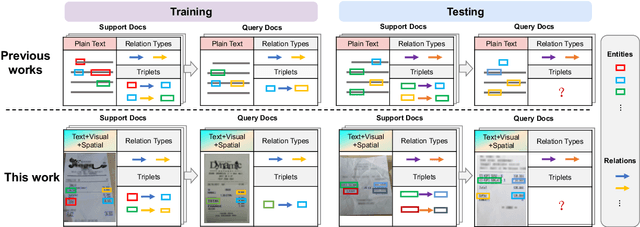
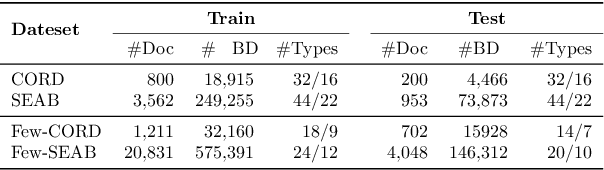
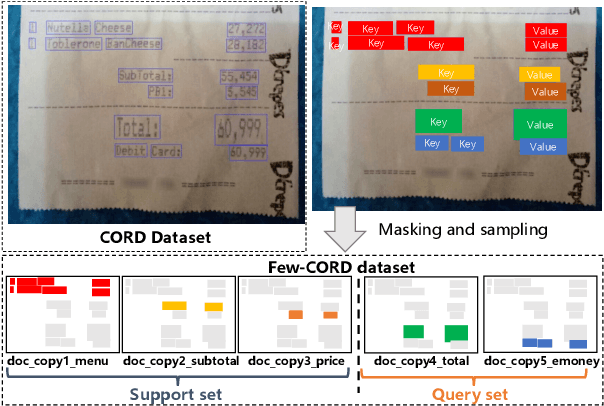
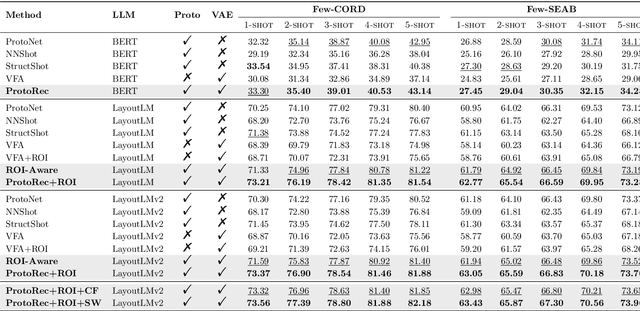
Key-value relations are prevalent in Visually-Rich Documents (VRDs), often depicted in distinct spatial regions accompanied by specific color and font styles. These non-textual cues serve as important indicators that greatly enhance human comprehension and acquisition of such relation triplets. However, current document AI approaches often fail to consider this valuable prior information related to visual and spatial features, resulting in suboptimal performance, particularly when dealing with limited examples. To address this limitation, our research focuses on few-shot relational learning, specifically targeting the extraction of key-value relation triplets in VRDs. Given the absence of a suitable dataset for this task, we introduce two new few-shot benchmarks built upon existing supervised benchmark datasets. Furthermore, we propose a variational approach that incorporates relational 2D-spatial priors and prototypical rectification techniques. This approach aims to generate relation representations that are more aware of the spatial context and unseen relation in a manner similar to human perception. Experimental results demonstrate the effectiveness of our proposed method by showcasing its ability to outperform existing methods. This study also opens up new possibilities for practical applications.
AVT2-DWF: Improving Deepfake Detection with Audio-Visual Fusion and Dynamic Weighting Strategies
Mar 22, 2024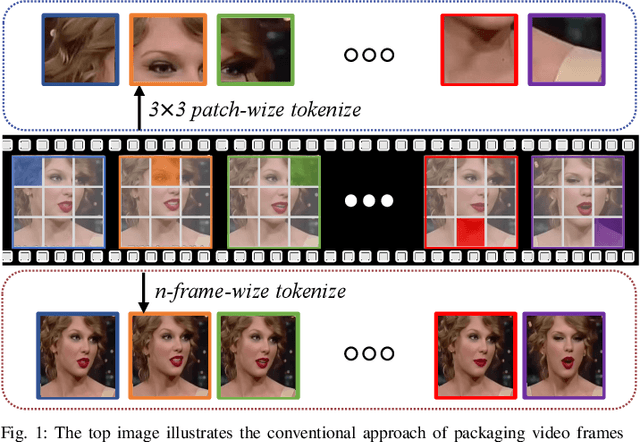
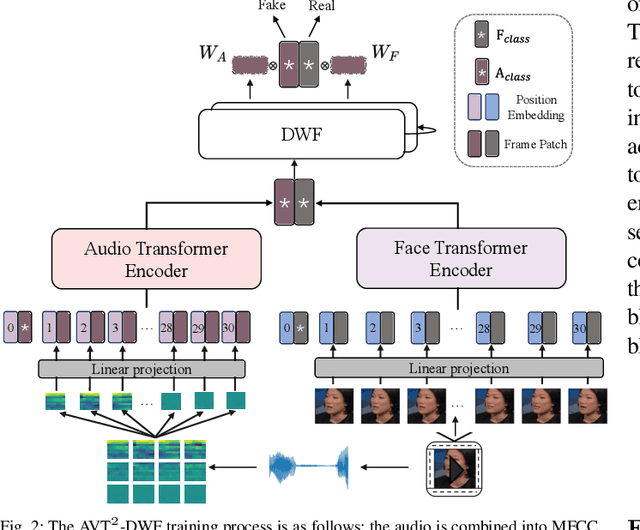
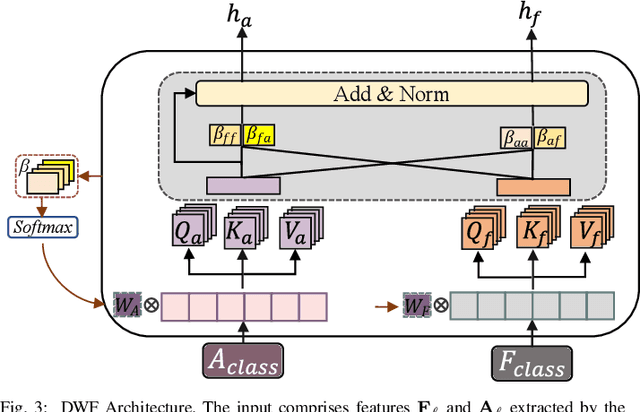
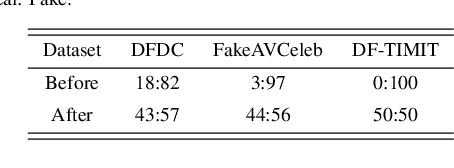
With the continuous improvements of deepfake methods, forgery messages have transitioned from single-modality to multi-modal fusion, posing new challenges for existing forgery detection algorithms. In this paper, we propose AVT2-DWF, the Audio-Visual dual Transformers grounded in Dynamic Weight Fusion, which aims to amplify both intra- and cross-modal forgery cues, thereby enhancing detection capabilities. AVT2-DWF adopts a dual-stage approach to capture both spatial characteristics and temporal dynamics of facial expressions. This is achieved through a face transformer with an n-frame-wise tokenization strategy encoder and an audio transformer encoder. Subsequently, it uses multi-modal conversion with dynamic weight fusion to address the challenge of heterogeneous information fusion between audio and visual modalities. Experiments on DeepfakeTIMIT, FakeAVCeleb, and DFDC datasets indicate that AVT2-DWF achieves state-of-the-art performance intra- and cross-dataset Deepfake detection. Code is available at https://github.com/raining-dev/AVT2-DWF.
VXP: Voxel-Cross-Pixel Large-scale Image-LiDAR Place Recognition
Mar 21, 2024Recent works on the global place recognition treat the task as a retrieval problem, where an off-the-shelf global descriptor is commonly designed in image-based and LiDAR-based modalities. However, it is non-trivial to perform accurate image-LiDAR global place recognition since extracting consistent and robust global descriptors from different domains (2D images and 3D point clouds) is challenging. To address this issue, we propose a novel Voxel-Cross-Pixel (VXP) approach, which establishes voxel and pixel correspondences in a self-supervised manner and brings them into a shared feature space. Specifically, VXP is trained in a two-stage manner that first explicitly exploits local feature correspondences and enforces similarity of global descriptors. Extensive experiments on the three benchmarks (Oxford RobotCar, ViViD++ and KITTI) demonstrate our method surpasses the state-of-the-art cross-modal retrieval by a large margin.
AffineQuant: Affine Transformation Quantization for Large Language Models
Mar 19, 2024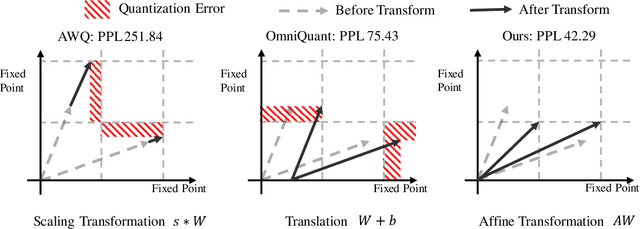
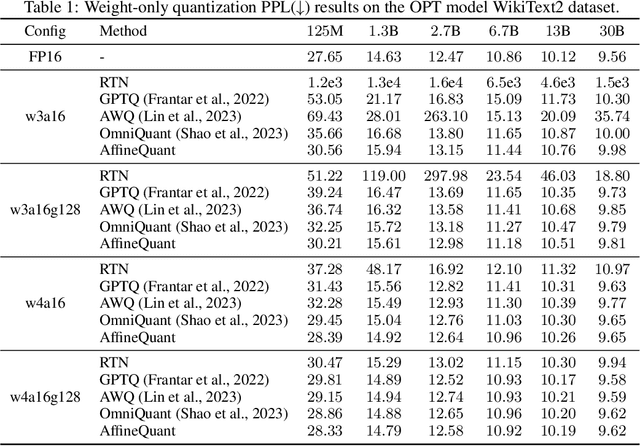
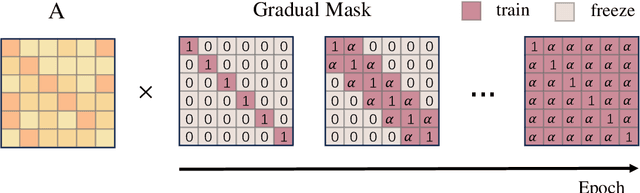
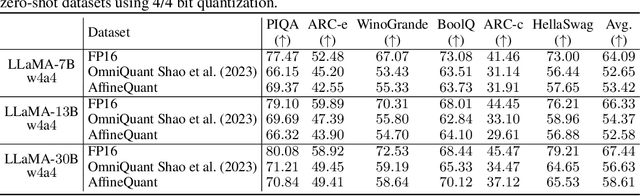
The significant resource requirements associated with Large-scale Language Models (LLMs) have generated considerable interest in the development of techniques aimed at compressing and accelerating neural networks. Among these techniques, Post-Training Quantization (PTQ) has emerged as a subject of considerable interest due to its noteworthy compression efficiency and cost-effectiveness in the context of training. Existing PTQ methods for LLMs limit the optimization scope to scaling transformations between pre- and post-quantization weights. In this paper, we advocate for the direct optimization using equivalent Affine transformations in PTQ (AffineQuant). This approach extends the optimization scope and thus significantly minimizing quantization errors. Additionally, by employing the corresponding inverse matrix, we can ensure equivalence between the pre- and post-quantization outputs of PTQ, thereby maintaining its efficiency and generalization capabilities. To ensure the invertibility of the transformation during optimization, we further introduce a gradual mask optimization method. This method initially focuses on optimizing the diagonal elements and gradually extends to the other elements. Such an approach aligns with the Levy-Desplanques theorem, theoretically ensuring invertibility of the transformation. As a result, significant performance improvements are evident across different LLMs on diverse datasets. To illustrate, we attain a C4 perplexity of 15.76 (2.26 lower vs 18.02 in OmniQuant) on the LLaMA2-7B model of W4A4 quantization without overhead. On zero-shot tasks, AffineQuant achieves an average of 58.61 accuracy (1.98 lower vs 56.63 in OmniQuant) when using 4/4-bit quantization for LLaMA-30B, which setting a new state-of-the-art benchmark for PTQ in LLMs.
StableGarment: Garment-Centric Generation via Stable Diffusion
Mar 16, 2024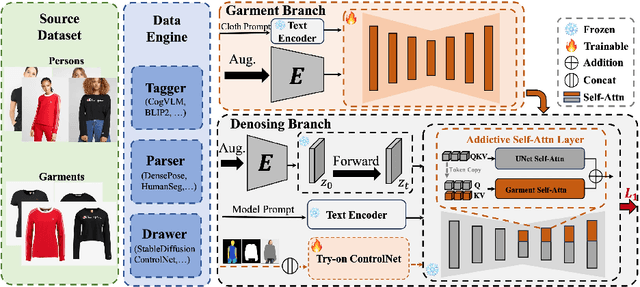
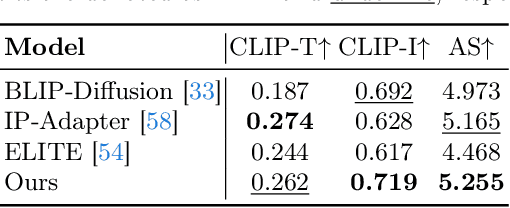
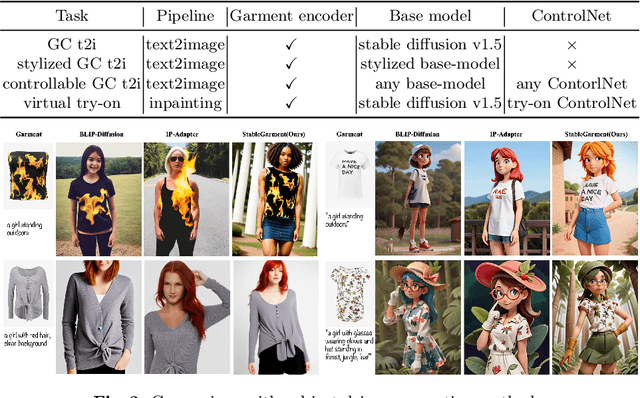
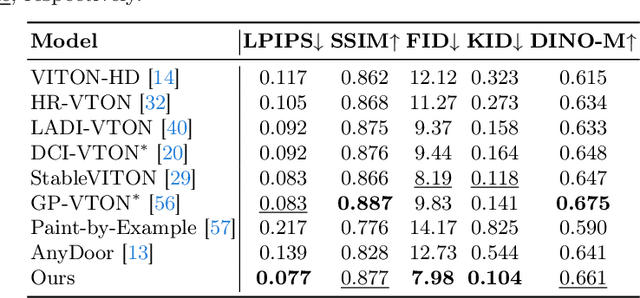
In this paper, we introduce StableGarment, a unified framework to tackle garment-centric(GC) generation tasks, including GC text-to-image, controllable GC text-to-image, stylized GC text-to-image, and robust virtual try-on. The main challenge lies in retaining the intricate textures of the garment while maintaining the flexibility of pre-trained Stable Diffusion. Our solution involves the development of a garment encoder, a trainable copy of the denoising UNet equipped with additive self-attention (ASA) layers. These ASA layers are specifically devised to transfer detailed garment textures, also facilitating the integration of stylized base models for the creation of stylized images. Furthermore, the incorporation of a dedicated try-on ControlNet enables StableGarment to execute virtual try-on tasks with precision. We also build a novel data engine that produces high-quality synthesized data to preserve the model's ability to follow prompts. Extensive experiments demonstrate that our approach delivers state-of-the-art (SOTA) results among existing virtual try-on methods and exhibits high flexibility with broad potential applications in various garment-centric image generation.
WanJuan-CC: A Safe and High-Quality Open-sourced English Webtext Dataset
Mar 12, 2024

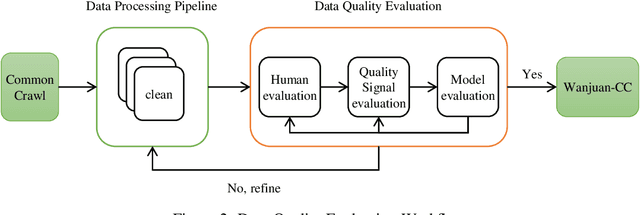
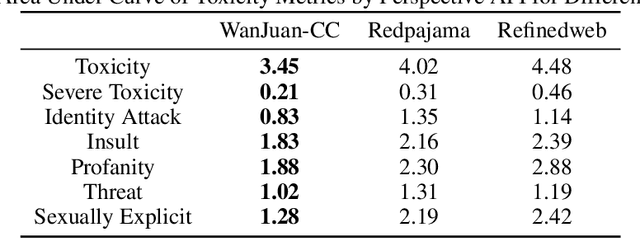
This paper presents WanJuan-CC, a safe and high-quality open-sourced English webtext dataset derived from Common Crawl data. The study addresses the challenges of constructing large-scale pre-training datasets for language models, which require vast amounts of high-quality data. A comprehensive process was designed to handle Common Crawl data, including extraction, heuristic rule filtering, fuzzy deduplication, content safety filtering, and data quality filtering. From approximately 68 billion original English documents, we obtained 2.22T Tokens of safe data and selected 1.0T Tokens of high-quality data as part of WanJuan-CC. We have open-sourced 100B Tokens from this dataset. The paper also provides statistical information related to data quality, enabling users to select appropriate data according to their needs. To evaluate the quality and utility of the dataset, we trained 1B-parameter and 3B-parameter models using WanJuan-CC and another dataset, RefinedWeb. Results show that WanJuan-CC performs better on validation datasets and downstream tasks.
Hypothesis Spaces for Deep Learning
Mar 11, 2024This paper introduces a hypothesis space for deep learning that employs deep neural networks (DNNs). By treating a DNN as a function of two variables, the physical variable and parameter variable, we consider the primitive set of the DNNs for the parameter variable located in a set of the weight matrices and biases determined by a prescribed depth and widths of the DNNs. We then complete the linear span of the primitive DNN set in a weak* topology to construct a Banach space of functions of the physical variable. We prove that the Banach space so constructed is a reproducing kernel Banach space (RKBS) and construct its reproducing kernel. We investigate two learning models, regularized learning and minimum interpolation problem in the resulting RKBS, by establishing representer theorems for solutions of the learning models. The representer theorems unfold that solutions of these learning models can be expressed as linear combination of a finite number of kernel sessions determined by given data and the reproducing kernel.
ELLA: Equip Diffusion Models with LLM for Enhanced Semantic Alignment
Mar 08, 2024Diffusion models have demonstrated remarkable performance in the domain of text-to-image generation. However, most widely used models still employ CLIP as their text encoder, which constrains their ability to comprehend dense prompts, encompassing multiple objects, detailed attributes, complex relationships, long-text alignment, etc. In this paper, we introduce an Efficient Large Language Model Adapter, termed ELLA, which equips text-to-image diffusion models with powerful Large Language Models (LLM) to enhance text alignment without training of either U-Net or LLM. To seamlessly bridge two pre-trained models, we investigate a range of semantic alignment connector designs and propose a novel module, the Timestep-Aware Semantic Connector (TSC), which dynamically extracts timestep-dependent conditions from LLM. Our approach adapts semantic features at different stages of the denoising process, assisting diffusion models in interpreting lengthy and intricate prompts over sampling timesteps. Additionally, ELLA can be readily incorporated with community models and tools to improve their prompt-following capabilities. To assess text-to-image models in dense prompt following, we introduce Dense Prompt Graph Benchmark (DPG-Bench), a challenging benchmark consisting of 1K dense prompts. Extensive experiments demonstrate the superiority of ELLA in dense prompt following compared to state-of-the-art methods, particularly in multiple object compositions involving diverse attributes and relationships.