 Add to Chrome
 Add to Firefox
 Add to Edge
ShutterMuse: Capture-Time Photography Guidance with MLLMs
Jun 24, 2026
Real-world photography requires capture-time guidance for both camera framing and subject pose. Yet existing aesthetic cropping benchmarks mainly evaluate post-hoc crop prediction and overlook subject-side recommendations, leaving the capture-time guidance capabilities of multimodal large language models (MLLMs) underexplored. To address this gap, we introduce CaptureGuide-Bench, a benchmark with two complementary tasks: photographer-side composition decision and refinement, and subject-side scene-conditioned pose recommendation. Our evaluation reveals limitations: general-purpose MLLMs can make composition decisions but lack precise refinement localization, while specialized aesthetic cropping models localize crops effectively but are limited to refinement; neither provides actionable pose guidance. To support model development, we further construct CaptureGuide-Dataset, comprising 130K samples with textual rationales and structured visual annotations, and develop ShutterMuse, a unified MLLM trained with supervised and reinforcement fine-tuning. Experiments on CaptureGuide-Bench show that ShutterMuse achieves the best overall photographer-side performance among evaluated baselines and competitive subject-side pose recommendation with substantially lower inference cost, demonstrating the potential of MLLMs as interactive assistants for photography during image capture.

FreeStyle: Free Control of Style-Content Dual-Reference Generation from Community LoRA Mining
Jun 18, 2026Style-content dual-reference generation aims to synthesize an image that preserves the structure and semantics of a content reference while adopting the style of a separate style reference.Despite recent progress, this setting remains challenging because models must balance content fidelity, style alignment, and instruction following avoiding semantic leakage from the style reference.A key bottleneck is the lack of large-scale triplet data with clean content-style separation and broad long-tail style coverage.In this work, we propose FreeStyle, a scalable dual-reference generation framework based on community LoRA mining.We treat community LoRAs as compositional anchors for style and content, and design a rigorous generation and filtering pipeline to construct large-scale Style-Reference and Content-Reference triplets across multiple base models.To address content leakage, we adopt a two-stage curriculum with stage-specific disentanglement mechanisms: an attention-level enrichment constraint that suppresses style-reference leakage in the style-transfer stage, and a frequency-aware RoPE modulation strategy that targets positional-correspondence-based leakage in the harder dual-reference stage.We also introduce a benchmark covering both style-reference and dual-reference generation, with evaluations on style similarity, content preservation, aesthetics, instruction following, and leakage rejection. The benchmark incorporates a style-invariant Content Alignment Score (CAS) and introduces a calibrated VLM-based Rejection Score for evaluating generation reliability and leakage suppression.Extensive experiments show that our model achieves a strong balance among style alignment, content preservation, and leakage suppression.
OpenCompass: A Universal Evaluation Platform for Large Language Models
May 19, 2026In recent years, the field of artificial intelligence has undergone a paradigm shift from task-specific small-scale models to general-purpose large language models (LLMs). With the rapid iteration of LLMs, objective, quantitative, and comprehensive evaluation of their capabilities has become a critical link in advancing technological development. Currently, the mainstream static benchmark dataset-based evaluation methods face challenges such as the diversity of task types, inconsistent evaluation criteria, and fragmentation of data and processing workflows, making it difficult to efficiently conduct cross-domain and large-scale model evaluation. To address the aforementioned issues, this paper proposes and open-sources OpenCompass, a one-stop, scalable, and high-concurrency-supported general-purpose LLM evaluation platform. Adhering to the design philosophy of modularization and component decoupling, the platform boasts three core advantages: high compatibility, flexibility, and high concurrency. The core architecture of OpenCompass comprises five key components: the Configuration System, Task Partitioning Module, Execution and Scheduling Module, Task Execution Unit, and Result Visualization Module. Its workflow provides rule-based, LLM-as-a-Judge, and cascaded evaluators to adapt to the requirements of different task scenarios. Supporting mainstream benchmark datasets across multiple domains, including knowledge, reasoning, computation, science, language, code, etc., the platform offers a unified and efficient LLM evaluation tool for both academia and industry, facilitating the accurate identification of strengths and weaknesses of LLMs as well as their subsequent optimization.
WithAnyone: Towards Controllable and ID Consistent Image Generation
Oct 16, 2025Identity-consistent generation has become an important focus in text-to-image research, with recent models achieving notable success in producing images aligned with a reference identity. Yet, the scarcity of large-scale paired datasets containing multiple images of the same individual forces most approaches to adopt reconstruction-based training. This reliance often leads to a failure mode we term copy-paste, where the model directly replicates the reference face rather than preserving identity across natural variations in pose, expression, or lighting. Such over-similarity undermines controllability and limits the expressive power of generation. To address these limitations, we (1) construct a large-scale paired dataset MultiID-2M, tailored for multi-person scenarios, providing diverse references for each identity; (2) introduce a benchmark that quantifies both copy-paste artifacts and the trade-off between identity fidelity and variation; and (3) propose a novel training paradigm with a contrastive identity loss that leverages paired data to balance fidelity with diversity. These contributions culminate in WithAnyone, a diffusion-based model that effectively mitigates copy-paste while preserving high identity similarity. Extensive qualitative and quantitative experiments demonstrate that WithAnyone significantly reduces copy-paste artifacts, improves controllability over pose and expression, and maintains strong perceptual quality. User studies further validate that our method achieves high identity fidelity while enabling expressive controllable generation.
OneIG-Bench: Omni-dimensional Nuanced Evaluation for Image Generation
Jun 09, 2025Text-to-image (T2I) models have garnered significant attention for generating high-quality images aligned with text prompts. However, rapid T2I model advancements reveal limitations in early benchmarks, lacking comprehensive evaluations, for example, the evaluation on reasoning, text rendering and style. Notably, recent state-of-the-art models, with their rich knowledge modeling capabilities, show promising results on the image generation problems requiring strong reasoning ability, yet existing evaluation systems have not adequately addressed this frontier. To systematically address these gaps, we introduce OneIG-Bench, a meticulously designed comprehensive benchmark framework for fine-grained evaluation of T2I models across multiple dimensions, including prompt-image alignment, text rendering precision, reasoning-generated content, stylization, and diversity. By structuring the evaluation, this benchmark enables in-depth analysis of model performance, helping researchers and practitioners pinpoint strengths and bottlenecks in the full pipeline of image generation. Specifically, OneIG-Bench enables flexible evaluation by allowing users to focus on a particular evaluation subset. Instead of generating images for the entire set of prompts, users can generate images only for the prompts associated with the selected dimension and complete the corresponding evaluation accordingly. Our codebase and dataset are now publicly available to facilitate reproducible evaluation studies and cross-model comparisons within the T2I research community.
Towards Real-Time Generation of Delay-Compensated Video Feeds for Outdoor Mobile Robot Teleoperation
Sep 16, 2024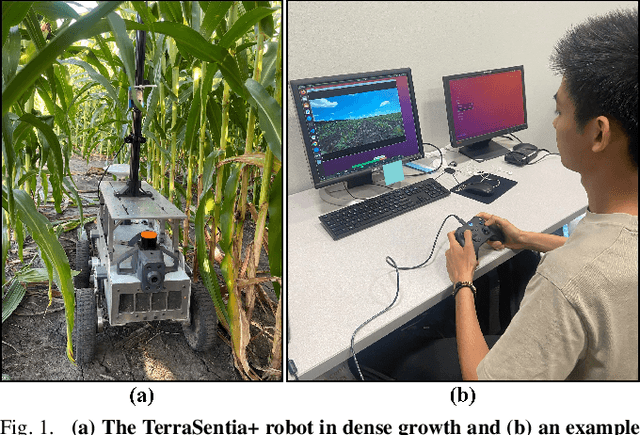

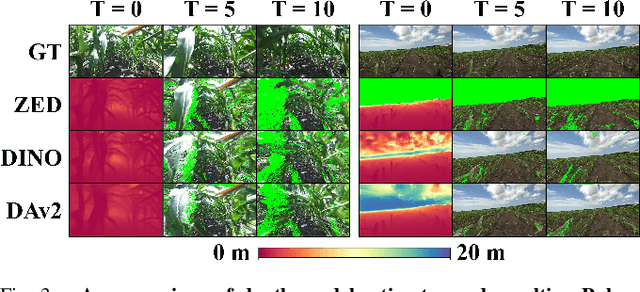

Teleoperation is an important technology to enable supervisors to control agricultural robots remotely. However, environmental factors in dense crop rows and limitations in network infrastructure hinder the reliability of data streamed to teleoperators. These issues result in delayed and variable frame rate video feeds that often deviate significantly from the robot's actual viewpoint. We propose a modular learning-based vision pipeline to generate delay-compensated images in real-time for supervisors. Our extensive offline evaluations demonstrate that our method generates more accurate images compared to state-of-the-art approaches in our setting. Additionally, we are one of the few works to evaluate a delay-compensation method in outdoor field environments with complex terrain on data from a real robot in real-time. Additional videos are provided at https://sites.google.com/illinois.edu/comp-teleop.
Learning to Turn: Diffusion Imitation for Robust Row Turning in Under-Canopy Robots
Aug 06, 2024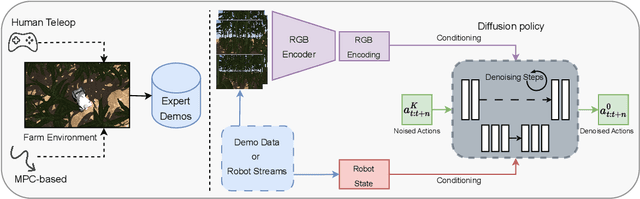
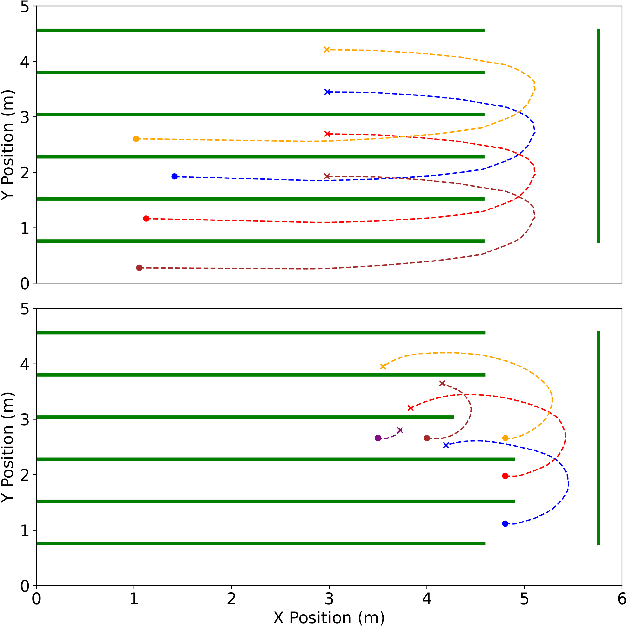
Under-canopy agricultural robots require robust navigation capabilities to enable full autonomy but struggle with tight row turning between crop rows due to degraded GPS reception, visual aliasing, occlusion, and complex vehicle dynamics. We propose an imitation learning approach using diffusion policies to learn row turning behaviors from demonstrations provided by human operators or privileged controllers. Simulation experiments in a corn field environment show potential in learning this task with only visual observations and velocity states. However, challenges remain in maintaining control within rows and handling varied initial conditions, highlighting areas for future improvement.
LinguaLinker: Audio-Driven Portraits Animation with Implicit Facial Control Enhancement
Jul 26, 2024This study delves into the intricacies of synchronizing facial dynamics with multilingual audio inputs, focusing on the creation of visually compelling, time-synchronized animations through diffusion-based techniques. Diverging from traditional parametric models for facial animation, our approach, termed LinguaLinker, adopts a holistic diffusion-based framework that integrates audio-driven visual synthesis to enhance the synergy between auditory stimuli and visual responses. We process audio features separately and derive the corresponding control gates, which implicitly govern the movements in the mouth, eyes, and head, irrespective of the portrait's origin. The advanced audio-driven visual synthesis mechanism provides nuanced control but keeps the compatibility of output video and input audio, allowing for a more tailored and effective portrayal of distinct personas across different languages. The significant improvements in the fidelity of animated portraits, the accuracy of lip-syncing, and the appropriate motion variations achieved by our method render it a versatile tool for animating any portrait in any language.
ELLA: Equip Diffusion Models with LLM for Enhanced Semantic Alignment
Mar 08, 2024Diffusion models have demonstrated remarkable performance in the domain of text-to-image generation. However, most widely used models still employ CLIP as their text encoder, which constrains their ability to comprehend dense prompts, encompassing multiple objects, detailed attributes, complex relationships, long-text alignment, etc. In this paper, we introduce an Efficient Large Language Model Adapter, termed ELLA, which equips text-to-image diffusion models with powerful Large Language Models (LLM) to enhance text alignment without training of either U-Net or LLM. To seamlessly bridge two pre-trained models, we investigate a range of semantic alignment connector designs and propose a novel module, the Timestep-Aware Semantic Connector (TSC), which dynamically extracts timestep-dependent conditions from LLM. Our approach adapts semantic features at different stages of the denoising process, assisting diffusion models in interpreting lengthy and intricate prompts over sampling timesteps. Additionally, ELLA can be readily incorporated with community models and tools to improve their prompt-following capabilities. To assess text-to-image models in dense prompt following, we introduce Dense Prompt Graph Benchmark (DPG-Bench), a challenging benchmark consisting of 1K dense prompts. Extensive experiments demonstrate the superiority of ELLA in dense prompt following compared to state-of-the-art methods, particularly in multiple object compositions involving diverse attributes and relationships.
BotChat: Evaluating LLMs' Capabilities of Having Multi-Turn Dialogues
Oct 20, 2023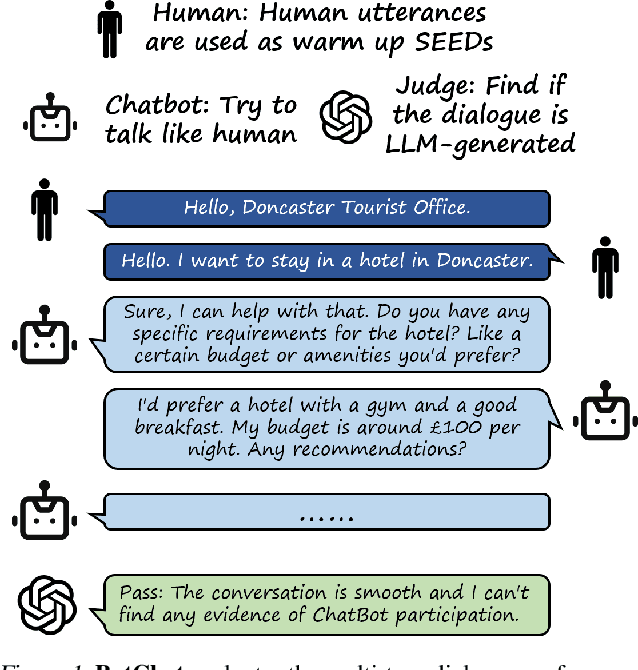


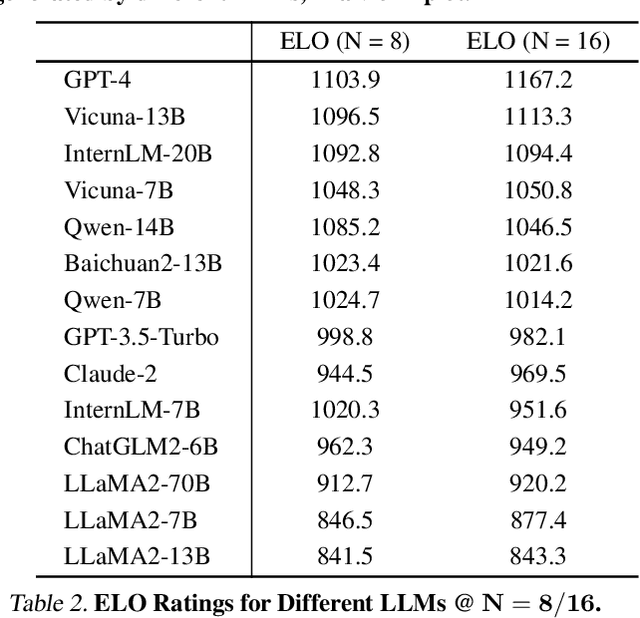
Interacting with human via high-quality multi-turn dialogues is a key feature of large language models (LLMs). However, human-based evaluation of such capability involves intensive manual labor. This report provides a preliminary evaluation of existing large language models for human-style multi-turn chatting, through an LLM-based approach. We start from real-world human dialogues and keep the very first utterances as the ChatSEED. Then we prompt LLMs to generate a full multi-turn dialogue (tens of utterances) based on the ChatSEED, utterance by utterance. Finally, we adopt state-of-the-art LLMs (GPT-4, \etc) as the judge to evaluate the generated dialogues. With different evaluation protocols, we come to substantially identical conclusions. We find that GPT-4 can generate human-style multi-turn dialogues with impressive quality, significantly outperforms its counterparts. It's difficult for a discriminator to distinguish between GPT-4 generated dialogues and human dialogues. In contrast, other LLMs struggle to generate multi-turn dialogues of satisfactory quality due to poor instruction-following capability, tendency to generate lengthy utterances, or limited general capability. All data and codes will be provided in https://github.com/open-compass/BotChat/ and we hope they can serve as a valuable resource for evaluating multi-turn chatting capabilities of LLMs.