 Add to Chrome
 Add to Firefox
 Add to Edge
Tutor-Student Reinforcement Learning: A Dynamic Curriculum for Robust Deepfake Detection
Mar 25, 2026
Standard supervised training for deepfake detection treats all samples with uniform importance, which can be suboptimal for learning robust and generalizable features. In this work, we propose a novel Tutor-Student Reinforcement Learning (TSRL) framework to dynamically optimize the training curriculum. Our method models the training process as a Markov Decision Process where a ``Tutor'' agent learns to guide a ``Student'' (the deepfake detector). The Tutor, implemented as a Proximal Policy Optimization (PPO) agent, observes a rich state representation for each training sample, encapsulating not only its visual features but also its historical learning dynamics, such as EMA loss and forgetting counts. Based on this state, the Tutor takes an action by assigning a continuous weight (0-1) to the sample's loss, thereby dynamically re-weighting the training batch. The Tutor is rewarded based on the Student's immediate performance change, specifically rewarding transitions from incorrect to correct predictions. This strategy encourages the Tutor to learn a curriculum that prioritizes high-value samples, such as hard-but-learnable examples, leading to a more efficient and effective training process. We demonstrate that this adaptive curriculum improves the Student's generalization capabilities against unseen manipulation techniques compared to traditional training methods. Code is available at https://github.com/wannac1/TSRL.
* Accepted to CVPR 2026

Omni-I2C: A Holistic Benchmark for High-Fidelity Image-to-Code Generation
Mar 18, 2026We present Omni-I2C, a comprehensive benchmark designed to evaluate the capability of Large Multimodal Models (LMMs) in converting complex, structured digital graphics into executable code. We argue that this task represents a non-trivial challenge for the current generation of LMMs: it demands an unprecedented synergy between high-fidelity visual perception -- to parse intricate spatial hierarchies and symbolic details -- and precise generative expression -- to synthesize syntactically sound and logically consistent code. Unlike traditional descriptive tasks, Omni-I2C requires a holistic understanding where any minor perceptual hallucination or coding error leads to a complete failure in visual reconstruction. Omni-I2C features 1080 meticulously curated samples, defined by its breadth across subjects, image modalities, and programming languages. By incorporating authentic user-sourced cases, the benchmark spans a vast spectrum of digital content -- from scientific visualizations to complex symbolic notations -- each paired with executable reference code. To complement this diversity, our evaluation framework provides necessary depth; by decoupling performance into perceptual fidelity and symbolic precision, it transcends surface-level accuracy to expose the granular structural failures and reasoning bottlenecks of current LMMs. Our evaluation reveals a substantial performance gap among leading LMMs; even state-of-the-art models struggle to preserve structural integrity in complex scenarios, underscoring that multimodal code generation remains a formidable challenge. Data and code are available at https://github.com/MiliLab/Omni-I2C.
Make the Most of Everything: Further Considerations on Disrupting Diffusion-based Customization
Mar 18, 2025The fine-tuning technique for text-to-image diffusion models facilitates image customization but risks privacy breaches and opinion manipulation. Current research focuses on prompt- or image-level adversarial attacks for anti-customization, yet it overlooks the correlation between these two levels and the relationship between internal modules and inputs. This hinders anti-customization performance in practical threat scenarios. We propose Dual Anti-Diffusion (DADiff), a two-stage adversarial attack targeting diffusion customization, which, for the first time, integrates the adversarial prompt-level attack into the generation process of image-level adversarial examples. In stage 1, we generate prompt-level adversarial vectors to guide the subsequent image-level attack. In stage 2, besides conducting the end-to-end attack on the UNet model, we disrupt its self- and cross-attention modules, aiming to break the correlations between image pixels and align the cross-attention results computed using instance prompts and adversarial prompt vectors within the images. Furthermore, we introduce a local random timestep gradient ensemble strategy, which updates adversarial perturbations by integrating random gradients from multiple segmented timesets. Experimental results on various mainstream facial datasets demonstrate 10%-30% improvements in cross-prompt, keyword mismatch, cross-model, and cross-mechanism anti-customization with DADiff compared to existing methods.
ErasableMask: A Robust and Erasable Privacy Protection Scheme against Black-box Face Recognition Models
Dec 24, 2024


While face recognition (FR) models have brought remarkable convenience in face verification and identification, they also pose substantial privacy risks to the public. Existing facial privacy protection schemes usually adopt adversarial examples to disrupt face verification of FR models. However, these schemes often suffer from weak transferability against black-box FR models and permanently damage the identifiable information that cannot fulfill the requirements of authorized operations such as forensics and authentication. To address these limitations, we propose ErasableMask, a robust and erasable privacy protection scheme against black-box FR models. Specifically, via rethinking the inherent relationship between surrogate FR models, ErasableMask introduces a novel meta-auxiliary attack, which boosts black-box transferability by learning more general features in a stable and balancing optimization strategy. It also offers a perturbation erasion mechanism that supports the erasion of semantic perturbations in protected face without degrading image quality. To further improve performance, ErasableMask employs a curriculum learning strategy to mitigate optimization conflicts between adversarial attack and perturbation erasion. Extensive experiments on the CelebA-HQ and FFHQ datasets demonstrate that ErasableMask achieves the state-of-the-art performance in transferability, achieving over 72% confidence on average in commercial FR systems. Moreover, ErasableMask also exhibits outstanding perturbation erasion performance, achieving over 90% erasion success rate.
Three-in-One: Robust Enhanced Universal Transferable Anti-Facial Retrieval in Online Social Networks
Dec 23, 2024


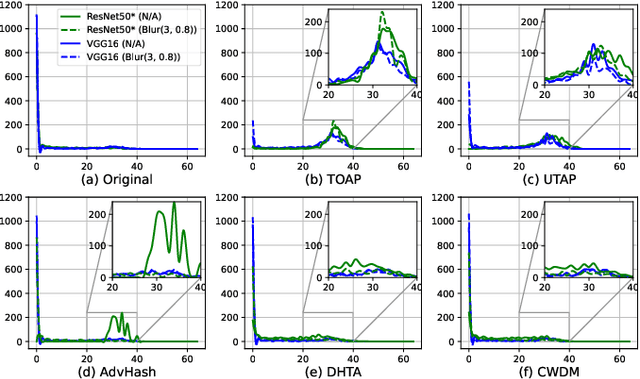
Deep hash-based retrieval techniques are widely used in facial retrieval systems to improve the efficiency of facial matching. However, it also carries the danger of exposing private information. Deep hash models are easily influenced by adversarial examples, which can be leveraged to protect private images from malicious retrieval. The existing adversarial example methods against deep hash models focus on universality and transferability, lacking the research on its robustness in online social networks (OSNs), which leads to their failure in anti-retrieval after post-processing. Therefore, we provide the first in-depth discussion on robustness adversarial perturbation in universal transferable anti-facial retrieval and propose Three-in-One Adversarial Perturbation (TOAP). Specifically, we construct a local and global Compression Generator (CG) to simulate complex post-processing scenarios, which can be used to mitigate perturbation. Then, we propose robust optimization objectives based on the discovery of the variation patterns of model's distribution after post-processing, and generate adversarial examples using these objectives and meta-learning. Finally, we iteratively optimize perturbation by alternately generating adversarial examples and fine-tuning the CG, balancing the performance of perturbation while enhancing CG's ability to mitigate them. Numerous experiments demonstrate that, in addition to its advantages in universality and transferability, TOAP significantly outperforms current state-of-the-art methods in multiple robustness metrics. It further improves universality and transferability by 5% to 28%, and achieves up to about 33% significant improvement in several simulated post-processing scenarios as well as mainstream OSNs, demonstrating that TOAP can effectively protect private images from malicious retrieval in real-world scenarios.
TOAP: Towards Better Robustness in Universal Transferable Anti-Facial Retrieval
Dec 12, 2024Deep hash-based retrieval techniques are widely used in facial retrieval systems to improve the efficiency of facial matching. However, it also brings the risk of privacy leakage. Deep hash models are easily influenced by adversarial examples, which can be leveraged to prevent the malicious retrieval of private images. The existing adversarial example methods against deep hash models focus on universality and transferability, lacking the research on its robustness in online social networks (OSNs), which leads to their failure in anti-retrieval after post-processing. Therefore, we provide the first in-depth discussion on robustness adversarial perturbation in universal transferable anti-facial retrieval and propose Three-in-One Adversarial Perturbation (TOAP). Specifically, we firstly analyze the performance of deep hash models after post-processing and construct a local and global Compression Generator (CG) to simulate complex post-processing scenarios. Then, we explore the variation patterns of the model's objective under image post-processing and propose robust optimization objectives, cluster centers and data space centers, optimizing them using meta-learning. Finally, we iteratively optimize perturbation by alternately generating adversarial examples and fine-tuning the CG, balancing the performance of perturbation while enhancing CG's ability to mitigate them. Numerous experiments demonstrate that, in addition to its advantages in universality and transferability, TOAP significantly outperforms current state-of-the-art methods in multiple robustness metrics. It further improves universality and transferability by 5% to 28%, and achieves up to about 33% significant improvement in several simulated post-processing scenarios as well as mainstream OSNs, demonstrating that TOAP can effectively protect private images from malicious retrieval in real-world scenarios.
StyleMark: A Robust Watermarking Method for Art Style Images Against Black-Box Arbitrary Style Transfer
Dec 10, 2024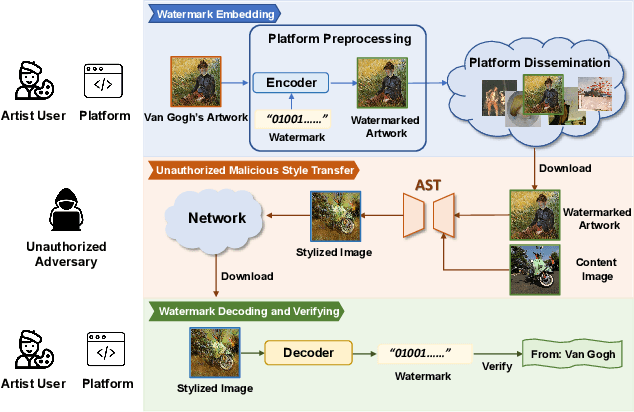

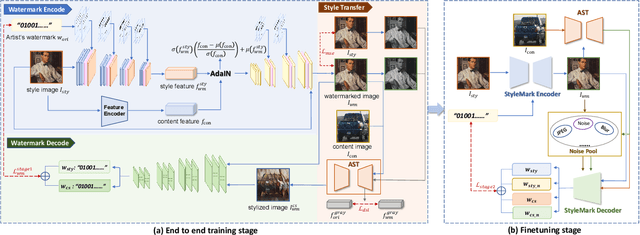
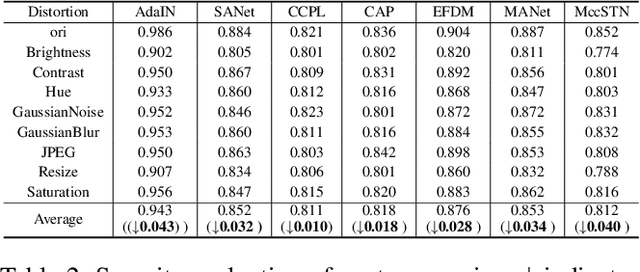
Arbitrary Style Transfer (AST) achieves the rendering of real natural images into the painting styles of arbitrary art style images, promoting art communication. However, misuse of unauthorized art style images for AST may infringe on artists' copyrights. One countermeasure is robust watermarking, which tracks image propagation by embedding copyright watermarks into carriers. Unfortunately, AST-generated images lose the structural and semantic information of the original style image, hindering end-to-end robust tracking by watermarks. To fill this gap, we propose StyleMark, the first robust watermarking method for black-box AST, which can be seamlessly applied to art style images achieving precise attribution of artistic styles after AST. Specifically, we propose a new style watermark network that adjusts the mean activations of style features through multi-scale watermark embedding, thereby planting watermark traces into the shared style feature space of style images. Furthermore, we design a distribution squeeze loss, which constrain content statistical feature distortion, forcing the reconstruction network to focus on integrating style features with watermarks, thus optimizing the intrinsic watermark distribution. Finally, based on solid end-to-end training, StyleMark mitigates the optimization conflict between robustness and watermark invisibility through decoder fine-tuning under random noise. Experimental results demonstrate that StyleMark exhibits significant robustness against black-box AST and common pixel-level distortions, while also securely defending against malicious adaptive attacks.
Take Fake as Real: Realistic-like Robust Black-box Adversarial Attack to Evade AIGC Detection
Dec 09, 2024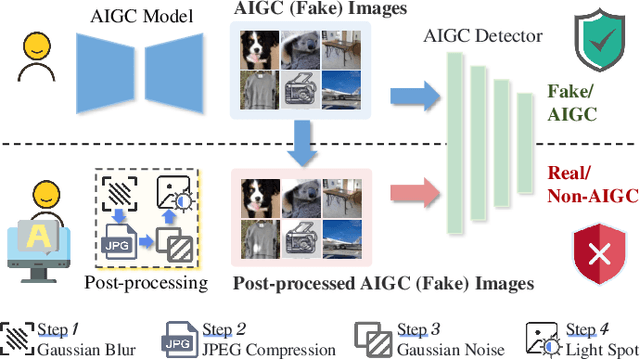
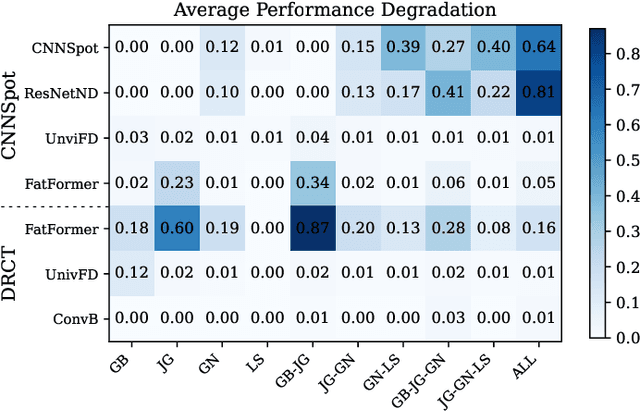
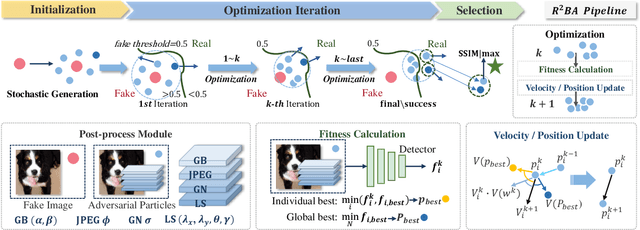
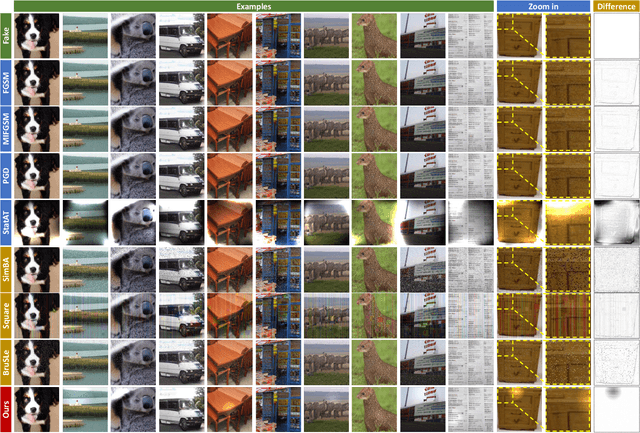
The security of AI-generated content (AIGC) detection based on GANs and diffusion models is closely related to the credibility of multimedia content. Malicious adversarial attacks can evade these developing AIGC detection. However, most existing adversarial attacks focus only on GAN-generated facial images detection, struggle to be effective on multi-class natural images and diffusion-based detectors, and exhibit poor invisibility. To fill this gap, we first conduct an in-depth analysis of the vulnerability of AIGC detectors and discover the feature that detectors vary in vulnerability to different post-processing. Then, considering the uncertainty of detectors in real-world scenarios, and based on the discovery, we propose a Realistic-like Robust Black-box Adversarial attack (R$^2$BA) with post-processing fusion optimization. Unlike typical perturbations, R$^2$BA uses real-world post-processing, i.e., Gaussian blur, JPEG compression, Gaussian noise and light spot to generate adversarial examples. Specifically, we use a stochastic particle swarm algorithm with inertia decay to optimize post-processing fusion intensity and explore the detector's decision boundary. Guided by the detector's fake probability, R$^2$BA enhances/weakens the detector-vulnerable/detector-robust post-processing intensity to strike a balance between adversariality and invisibility. Extensive experiments on popular/commercial AIGC detectors and datasets demonstrate that R$^2$BA exhibits impressive anti-detection performance, excellent invisibility, and strong robustness in GAN-based and diffusion-based cases. Compared to state-of-the-art white-box and black-box attacks, R$^2$BA shows significant improvements of 15% and 21% in anti-detection performance under the original and robust scenario respectively, offering valuable insights for the security of AIGC detection in real-world applications.
Trinity Detector:text-assisted and attention mechanisms based spectral fusion for diffusion generation image detection
Apr 26, 2024
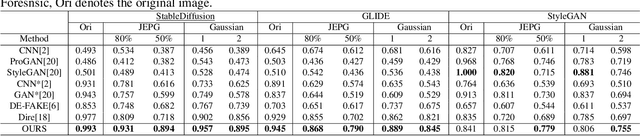

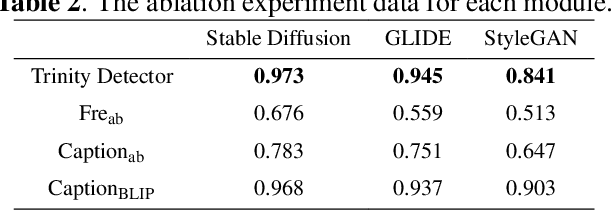
Artificial Intelligence Generated Content (AIGC) techniques, represented by text-to-image generation, have led to a malicious use of deep forgeries, raising concerns about the trustworthiness of multimedia content. Adapting traditional forgery detection methods to diffusion models proves challenging. Thus, this paper proposes a forgery detection method explicitly designed for diffusion models called Trinity Detector. Trinity Detector incorporates coarse-grained text features through a CLIP encoder, coherently integrating them with fine-grained artifacts in the pixel domain for comprehensive multimodal detection. To heighten sensitivity to diffusion-generated image features, a Multi-spectral Channel Attention Fusion Unit (MCAF) is designed, extracting spectral inconsistencies through adaptive fusion of diverse frequency bands and further integrating spatial co-occurrence of the two modalities. Extensive experimentation validates that our Trinity Detector method outperforms several state-of-the-art methods, our performance is competitive across all datasets and up to 17.6\% improvement in transferability in the diffusion datasets.
Double Privacy Guard: Robust Traceable Adversarial Watermarking against Face Recognition
Apr 23, 2024


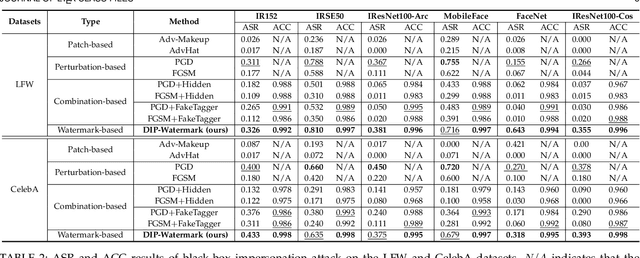
The wide deployment of Face Recognition (FR) systems poses risks of privacy leakage. One countermeasure to address this issue is adversarial attacks, which deceive malicious FR searches but simultaneously interfere the normal identity verification of trusted authorizers. In this paper, we propose the first Double Privacy Guard (DPG) scheme based on traceable adversarial watermarking. DPG employs a one-time watermark embedding to deceive unauthorized FR models and allows authorizers to perform identity verification by extracting the watermark. Specifically, we propose an information-guided adversarial attack against FR models. The encoder embeds an identity-specific watermark into the deep feature space of the carrier, guiding recognizable features of the image to deviate from the source identity. We further adopt a collaborative meta-optimization strategy compatible with sub-tasks, which regularizes the joint optimization direction of the encoder and decoder. This strategy enhances the representation of universal carrier features, mitigating multi-objective optimization conflicts in watermarking. Experiments confirm that DPG achieves significant attack success rates and traceability accuracy on state-of-the-art FR models, exhibiting remarkable robustness that outperforms the existing privacy protection methods using adversarial attacks and deep watermarking, or simple combinations of the two. Our work potentially opens up new insights into proactive protection for FR privacy.