 Add to Chrome
 Add to Firefox
 Add to Edge
Intern-S2-Mobius: Foundation Model with Decoupled Knowledge and Reasoning
Aug 14, 2026
We introduce Mobius-v0, an architecture that comprises a globally shared Memory (FFN) that stores knowledge vectors and multiple Reasoners (Self-Attn) that iteratively achieve compositional reasoning. Using hidden states as cache and carrier, reasoners repeatedly query memory for required knowledge-vectors, while the knowledge is transmitted back to reasoning operators. Through this knowledge-reasoning-separation architecture, Mobius achieves better knowledge compression and reasoning efficiency. Built upon Mobius-v0 architecture: 1) Our 7B model trained-from-scratch achieves similar downstream score as a 7B Transformer baseline with 62.6% of baseline's training data. 2) Our Intern-S2-Mobius, continually-pretrained from Qwen3.5-35B, achieves similar downstream score while delivering nearly 4x end-to-end inference speedup.

Intern-S2-Preview: Scientific Agentic Foundation Model
Aug 13, 2026Scientific discovery increasingly requires AI systems that can reason over scientific evidence of heterogeneous modalities, interact with scientific tools and environments, and sustain progress across long task horizons. We present Intern-S2-Preview, a series of scientific agentic foundation models designed to support multimodal scientific understanding, reasoning, generation, and long-horizon tasks. The training pipeline begins with scientific multimodal pre-training over rendered scientific documents, interleaved image-text data, and diverse scientific corpora. Starting from the pretrained checkpoint, we apply a unified post-training pipeline consisting of supervised fine-tuning, scalable multi-task reinforcement learning (RL), black- and white-box agentic RL, and on-policy distillation. This pipeline is supported by practical techniques that improve rollout and training stability and efficiency, including partial rollout with off-policy correction, adaptive length regularization, online speculative decoding, robust multi-task optimization, and trace-aware experience assembly for agentic tasks. At the architecture level, Intern-S2-Preview-397B extends time series modelling from efficient long-sequence understanding to numerical forecasting, while Memory Decoder is studied as a separate memory-augmented path for rapid scientific specialization without modifying the frozen 397B backbone. Evaluations across scientific, multimodal, agentic, and general-purpose benchmarks show that Intern-S2-Preview-397B achieves competitive or leading results in multiple settings. The time series modules improve scientific signal understanding and forecasting on SciTS, while the separate Intern-MemDec-4B extension improves the Biology-Instructions average score from 56.92 to 60.32 without modifying the frozen 397B backbone.
Scalable Visual Pretraining for Language Intelligence
Jul 10, 2026The rapid progress of large foundation models has been driven predominantly by pretraining on large-scale text corpora. However, many forms of knowledge are conveyed through visual representations, where figures, typeset equations, and page layouts carry rich information that cannot be faithfully or completely captured by text alone. Yet current pretraining approaches discard these visual cues by converting visually rich sources, such as documents and web pages, into plain text for learning language intelligence. This paper challenges the default assumption that language models must be trained on text-only representations and shows that Visual Pretraining is a scalable learner for foundation model intelligence. To this end, we conduct a systematic study of unsupervised visual pretraining paradigms that directly leverage visual documents without text extraction. Across multiple backbones and benchmarks, visual pretraining on the same underlying corpora consistently outperforms text-only pretraining, offering an efficient pathway to scalable language intelligence.
Synthetic Pre-Pre-Training Improves Language Model Robustness to Noisy Pre-Training Data
May 11, 2026Large language models (LLMs) rely on web-scale corpora for pre-training. The noise inherent in these datasets tends to obscure meaningful patterns and ultimately degrade model performance. Data curation mitigates but cannot eliminate such noise, so pre-training corpora remain noisy in practice. We therefore study whether a lightweight pre-pre-training (PPT) stage based on synthetic data with learnable temporal structure helps resist noisy data during the pre-training (PT) stage. Across various corruption settings, our method consistently improves robustness to noise during PT, with larger relative gains at higher noise levels. For a 1B-parameter model, a synthetic PPT stage with only 65M tokens achieves the same final loss as the baseline while using up to 49\% fewer natural-text PT tokens across different noise levels. Mechanistic analyses suggest PPT does not immediately suppress attention to noisy tokens. Rather, PPT-initialized models gradually downweight attention between corrupted tokens during noisy PT. This indicates that synthetic PPT inhibits noise self-modeling and shapes the subsequent optimization trajectory. Code is available at https://github.com/guox18/formal-language-prepretraining.
Intern-S1-Pro: Scientific Multimodal Foundation Model at Trillion Scale
Mar 26, 2026We introduce Intern-S1-Pro, the first one-trillion-parameter scientific multimodal foundation model. Scaling to this unprecedented size, the model delivers a comprehensive enhancement across both general and scientific domains. Beyond stronger reasoning and image-text understanding capabilities, its intelligence is augmented with advanced agent capabilities. Simultaneously, its scientific expertise has been vastly expanded to master over 100 specialized tasks across critical science fields, including chemistry, materials, life sciences, and earth sciences. Achieving this massive scale is made possible by the robust infrastructure support of XTuner and LMDeploy, which facilitates highly efficient Reinforcement Learning (RL) training at the 1-trillion parameter level while ensuring strict precision consistency between training and inference. By seamlessly integrating these advancements, Intern-S1-Pro further fortifies the fusion of general and specialized intelligence, working as a Specializable Generalist, demonstrating its position in the top tier of open-source models for general capabilities, while outperforming proprietary models in the depth of specialized scientific tasks.
Rethinking Multiple-Choice Questions for RLVR: Unlocking Potential via Distractor Design
Mar 13, 2026Reinforcement Learning with Verifiable Rewards (RLVR) significantly enhances the reasoning capabilities of Large Language Models. When applied to RLVR, Multiple-Choice Questions (MCQs) offer a scalable source of verifiable data but risk inducing reward hacking, where models shortcut reasoning via random guessing or simple elimination. Current approaches often mitigate this by converting MCQs to open-ended formats, thereby discarding the contrastive signal provided by expert-designed distractors. In this work, we systematically investigate the impact of option design on RLVR. Our analysis highlights two primary insights: (1) Mismatches in option counts between training and testing degrade performance. (2) Strong distractors effectively mitigate random guessing, enabling effective RLVR training even with 2-way questions. Motivated by these findings, we propose Iterative Distractor Curation (IDC), a framework that actively constructs high-quality distractors to block elimination shortcuts and promote deep reasoning. Experiments on various benchmarks demonstrate that our method effectively enhances distractor quality and yields significant gains in RLVR training compared to the original data.
Which Reasoning Trajectories Teach Students to Reason Better? A Simple Metric of Informative Alignment
Jan 20, 2026Long chain-of-thought (CoT) trajectories provide rich supervision signals for distilling reasoning from teacher to student LLMs. However, both prior work and our experiments show that trajectories from stronger teachers do not necessarily yield better students, highlighting the importance of data-student suitability in distillation. Existing methods assess suitability primarily through student likelihood, favoring trajectories that closely align with the model's current behavior but overlooking more informative ones. Addressing this, we propose Rank-Surprisal Ratio (RSR), a simple metric that captures both alignment and informativeness to assess the suitability of a reasoning trajectory. RSR is motivated by the observation that effective trajectories typically combine low absolute probability with relatively high-ranked tokens under the student model, balancing learning signal strength and behavioral alignment. Concretely, RSR is defined as the ratio of a trajectory's average token-wise rank to its average negative log-likelihood, and is straightforward to compute and interpret. Across five student models and reasoning trajectories from 11 diverse teachers, RSR strongly correlates with post-training performance (average Spearman 0.86), outperforming existing metrics. We further demonstrate its practical utility in both trajectory selection and teacher selection.
What are the Essential Factors in Crafting Effective Long Context Multi-Hop Instruction Datasets? Insights and Best Practices
Sep 03, 2024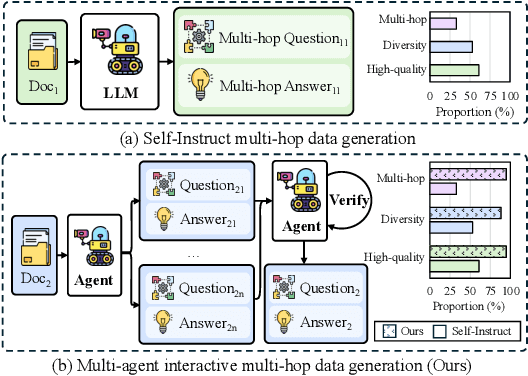
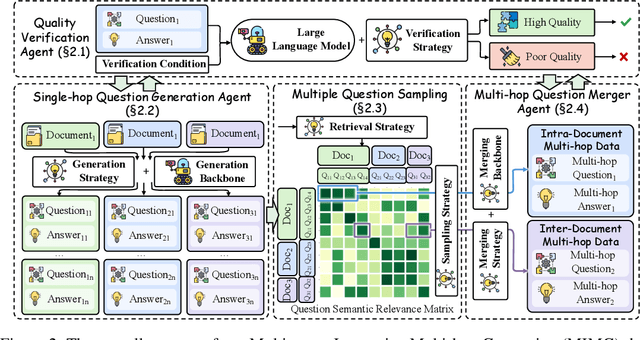
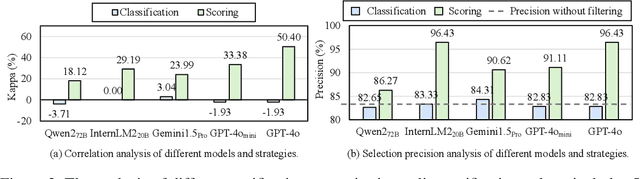
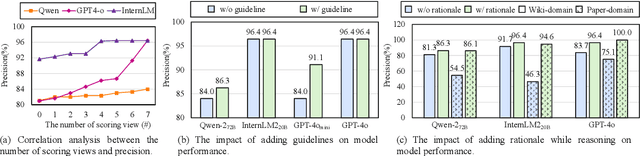
Recent advancements in large language models (LLMs) with extended context windows have significantly improved tasks such as information extraction, question answering, and complex planning scenarios. In order to achieve success in long context tasks, a large amount of work has been done to enhance the long context capabilities of the model through synthetic data. Existing methods typically utilize the Self-Instruct framework to generate instruction tuning data for better long context capability improvement. However, our preliminary experiments indicate that less than 35% of generated samples are multi-hop, and more than 40% exhibit poor quality, limiting comprehensive understanding and further research. To improve the quality of synthetic data, we propose the Multi-agent Interactive Multi-hop Generation (MIMG) framework, incorporating a Quality Verification Agent, a Single-hop Question Generation Agent, a Multiple Question Sampling Strategy, and a Multi-hop Question Merger Agent. This framework improves the data quality, with the proportion of high-quality, multi-hop, and diverse data exceeding 85%. Furthermore, we systematically investigate strategies for document selection, question merging, and validation techniques through extensive experiments across various models. Our findings show that our synthetic high-quality long-context instruction data significantly enhances model performance, even surpassing models trained on larger amounts of human-annotated data. Our code is available at: https://github.com/WowCZ/LongMIT.
InternLM2 Technical Report
Mar 26, 2024


The evolution of Large Language Models (LLMs) like ChatGPT and GPT-4 has sparked discussions on the advent of Artificial General Intelligence (AGI). However, replicating such advancements in open-source models has been challenging. This paper introduces InternLM2, an open-source LLM that outperforms its predecessors in comprehensive evaluations across 6 dimensions and 30 benchmarks, long-context modeling, and open-ended subjective evaluations through innovative pre-training and optimization techniques. The pre-training process of InternLM2 is meticulously detailed, highlighting the preparation of diverse data types including text, code, and long-context data. InternLM2 efficiently captures long-term dependencies, initially trained on 4k tokens before advancing to 32k tokens in pre-training and fine-tuning stages, exhibiting remarkable performance on the 200k ``Needle-in-a-Haystack" test. InternLM2 is further aligned using Supervised Fine-Tuning (SFT) and a novel Conditional Online Reinforcement Learning from Human Feedback (COOL RLHF) strategy that addresses conflicting human preferences and reward hacking. By releasing InternLM2 models in different training stages and model sizes, we provide the community with insights into the model's evolution.
WanJuan-CC: A Safe and High-Quality Open-sourced English Webtext Dataset
Mar 12, 2024

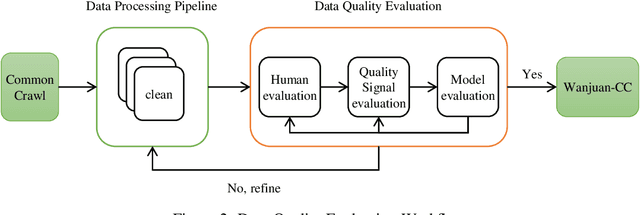
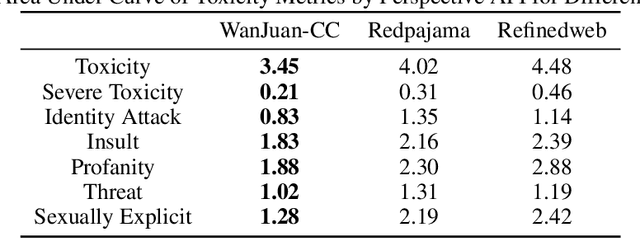
This paper presents WanJuan-CC, a safe and high-quality open-sourced English webtext dataset derived from Common Crawl data. The study addresses the challenges of constructing large-scale pre-training datasets for language models, which require vast amounts of high-quality data. A comprehensive process was designed to handle Common Crawl data, including extraction, heuristic rule filtering, fuzzy deduplication, content safety filtering, and data quality filtering. From approximately 68 billion original English documents, we obtained 2.22T Tokens of safe data and selected 1.0T Tokens of high-quality data as part of WanJuan-CC. We have open-sourced 100B Tokens from this dataset. The paper also provides statistical information related to data quality, enabling users to select appropriate data according to their needs. To evaluate the quality and utility of the dataset, we trained 1B-parameter and 3B-parameter models using WanJuan-CC and another dataset, RefinedWeb. Results show that WanJuan-CC performs better on validation datasets and downstream tasks.