 Add to Chrome
 Add to Firefox
 Add to Edge
Chain of Functions: A Programmatic Pipeline for Fine-Grained Chart Reasoning Data
Mar 20, 2025
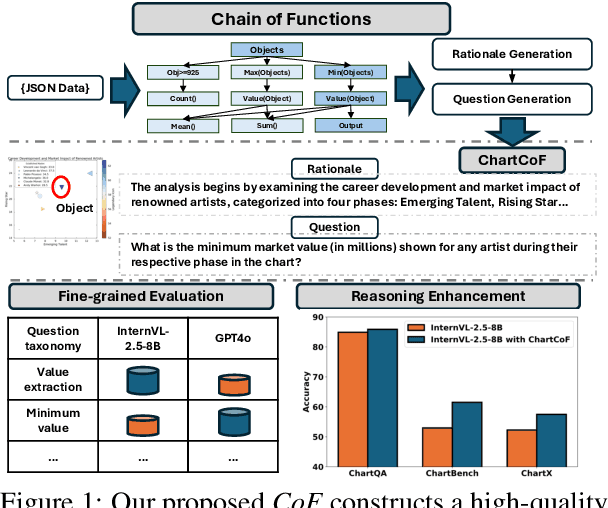

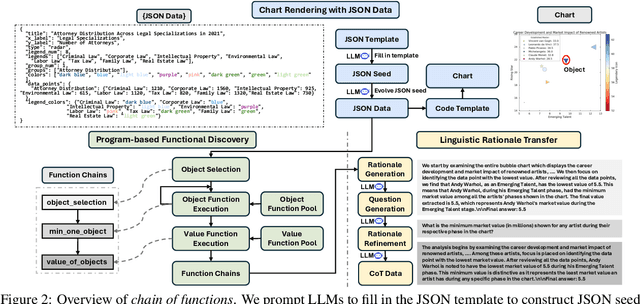
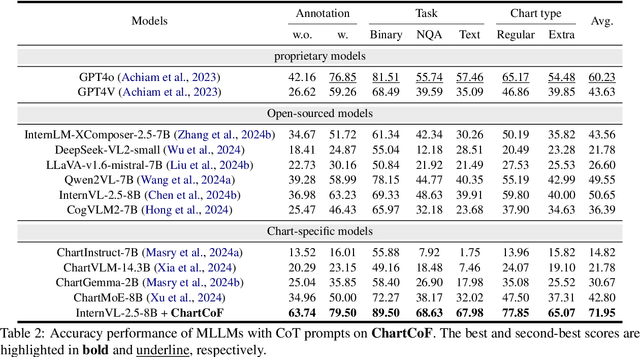
Visual reasoning is crucial for multimodal large language models (MLLMs) to address complex chart queries, yet high-quality rationale data remains scarce. Existing methods leveraged (M)LLMs for data generation, but direct prompting often yields limited precision and diversity. In this paper, we propose \textit{Chain of Functions (CoF)}, a novel programmatic reasoning data generation pipeline that utilizes freely-explored reasoning paths as supervision to ensure data precision and diversity. Specifically, it starts with human-free exploration among the atomic functions (e.g., maximum data and arithmetic operations) to generate diverse function chains, which are then translated into linguistic rationales and questions with only a moderate open-sourced LLM. \textit{CoF} provides multiple benefits: 1) Precision: function-governed generation reduces hallucinations compared to freeform generation; 2) Diversity: enumerating function chains enables varied question taxonomies; 3) Explainability: function chains serve as built-in rationales, allowing fine-grained evaluation beyond overall accuracy; 4) Practicality: eliminating reliance on extremely large models. Employing \textit{CoF}, we construct the \textit{ChartCoF} dataset, with 1.4k complex reasoning Q\&A for fine-grained analysis and 50k Q\&A for reasoning enhancement. The fine-grained evaluation on \textit{ChartCoF} reveals varying performance across question taxonomies for each MLLM, and the experiments also show that finetuning with \textit{ChartCoF} achieves state-of-the-art performance among same-scale MLLMs on widely used benchmarks. Furthermore, the novel paradigm of function-governed rationale generation in \textit{CoF} could inspire broader applications beyond charts.

DeGauss: Dynamic-Static Decomposition with Gaussian Splatting for Distractor-free 3D Reconstruction
Mar 17, 2025
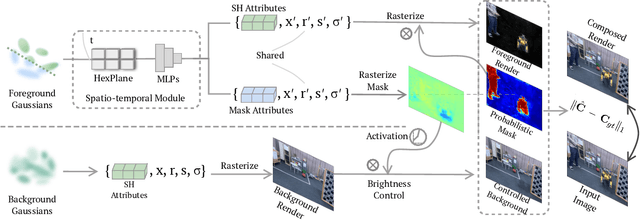

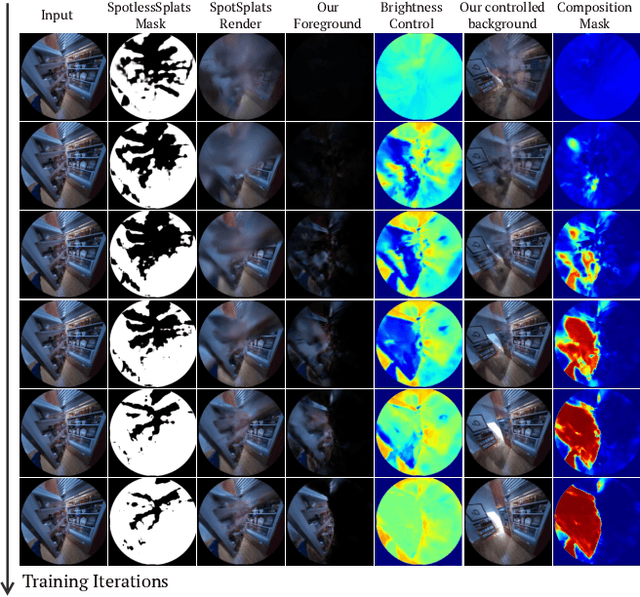
Reconstructing clean, distractor-free 3D scenes from real-world captures remains a significant challenge, particularly in highly dynamic and cluttered settings such as egocentric videos. To tackle this problem, we introduce DeGauss, a simple and robust self-supervised framework for dynamic scene reconstruction based on a decoupled dynamic-static Gaussian Splatting design. DeGauss models dynamic elements with foreground Gaussians and static content with background Gaussians, using a probabilistic mask to coordinate their composition and enable independent yet complementary optimization. DeGauss generalizes robustly across a wide range of real-world scenarios, from casual image collections to long, dynamic egocentric videos, without relying on complex heuristics or extensive supervision. Experiments on benchmarks including NeRF-on-the-go, ADT, AEA, Hot3D, and EPIC-Fields demonstrate that DeGauss consistently outperforms existing methods, establishing a strong baseline for generalizable, distractor-free 3D reconstructionin highly dynamic, interaction-rich environments.
RaSA: Rank-Sharing Low-Rank Adaptation
Mar 16, 2025Low-rank adaptation (LoRA) has been prominently employed for parameter-efficient fine-tuning of large language models (LLMs). However, the limited expressive capacity of LoRA, stemming from the low-rank constraint, has been recognized as a bottleneck, particularly in rigorous tasks like code generation and mathematical reasoning. To address this limitation, we introduce Rank-Sharing Low-Rank Adaptation (RaSA), an innovative extension that enhances the expressive capacity of LoRA by leveraging partial rank sharing across layers. By forming a shared rank pool and applying layer-specific weighting, RaSA effectively increases the number of ranks without augmenting parameter overhead. Our theoretically grounded and empirically validated approach demonstrates that RaSA not only maintains the core advantages of LoRA but also significantly boosts performance in challenging code and math tasks. Code, data and scripts are available at: https://github.com/zwhe99/RaSA.
DAST: Difficulty-Aware Self-Training on Large Language Models
Mar 12, 2025Present Large Language Models (LLM) self-training methods always under-sample on challenging queries, leading to inadequate learning on difficult problems which limits LLMs' ability. Therefore, this work proposes a difficulty-aware self-training (DAST) framework that focuses on improving both the quantity and quality of self-generated responses on challenging queries during self-training. DAST is specified in three components: 1) sampling-based difficulty level estimation, 2) difficulty-aware data augmentation, and 3) the self-training algorithm using SFT and DPO respectively. Experiments on mathematical tasks demonstrate the effectiveness and generalization of DAST, highlighting the critical role of difficulty-aware strategies in advancing LLM self-training.
Self-Consistent Equation-guided Neural Networks for Censored Time-to-Event Data
Mar 12, 2025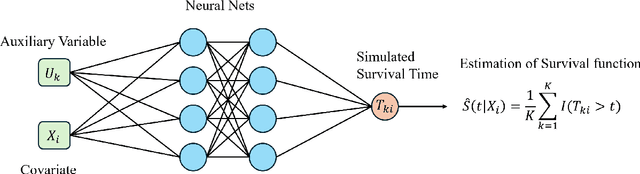
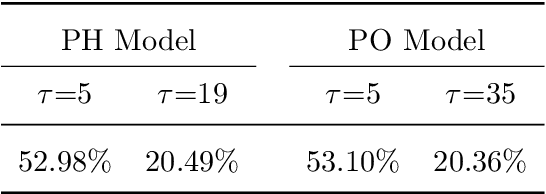
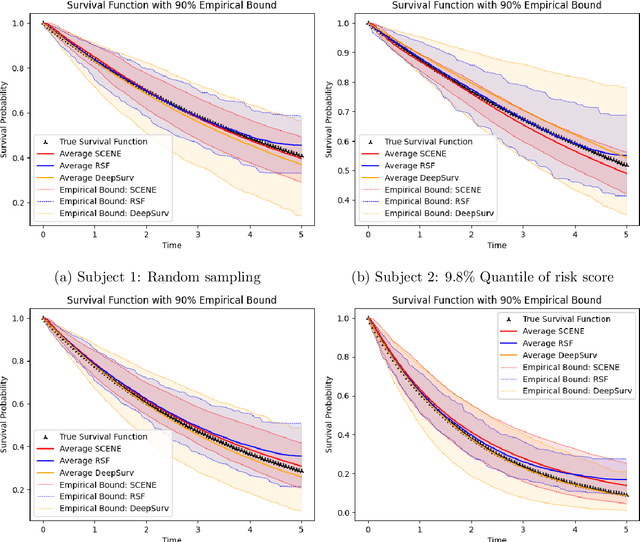
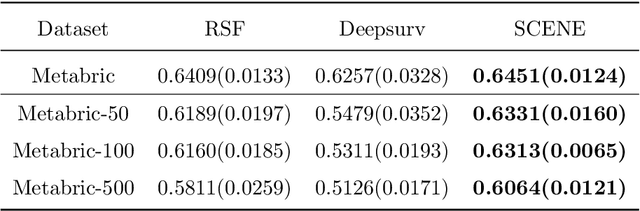
In survival analysis, estimating the conditional survival function given predictors is often of interest. There is a growing trend in the development of deep learning methods for analyzing censored time-to-event data, especially when dealing with high-dimensional predictors that are complexly interrelated. Many existing deep learning approaches for estimating the conditional survival functions extend the Cox regression models by replacing the linear function of predictor effects by a shallow feed-forward neural network while maintaining the proportional hazards assumption. Their implementation can be computationally intensive due to the use of the full dataset at each iteration because the use of batch data may distort the at-risk set of the partial likelihood function. To overcome these limitations, we propose a novel deep learning approach to non-parametric estimation of the conditional survival functions using the generative adversarial networks leveraging self-consistent equations. The proposed method is model-free and does not require any parametric assumptions on the structure of the conditional survival function. We establish the convergence rate of our proposed estimator of the conditional survival function. In addition, we evaluate the performance of the proposed method through simulation studies and demonstrate its application on a real-world dataset.
Multimodal Human-AI Synergy for Medical Imaging Quality Control: A Hybrid Intelligence Framework with Adaptive Dataset Curation and Closed-Loop Evaluation
Mar 10, 2025Medical imaging quality control (QC) is essential for accurate diagnosis, yet traditional QC methods remain labor-intensive and subjective. To address this challenge, in this study, we establish a standardized dataset and evaluation framework for medical imaging QC, systematically assessing large language models (LLMs) in image quality assessment and report standardization. Specifically, we first constructed and anonymized a dataset of 161 chest X-ray (CXR) radiographs and 219 CT reports for evaluation. Then, multiple LLMs, including Gemini 2.0-Flash, GPT-4o, and DeepSeek-R1, were evaluated based on recall, precision, and F1 score to detect technical errors and inconsistencies. Experimental results show that Gemini 2.0-Flash achieved a Macro F1 score of 90 in CXR tasks, demonstrating strong generalization but limited fine-grained performance. DeepSeek-R1 excelled in CT report auditing with a 62.23\% recall rate, outperforming other models. However, its distilled variants performed poorly, while InternLM2.5-7B-chat exhibited the highest additional discovery rate, indicating broader but less precise error detection. These findings highlight the potential of LLMs in medical imaging QC, with DeepSeek-R1 and Gemini 2.0-Flash demonstrating superior performance.
Next Token Is Enough: Realistic Image Quality and Aesthetic Scoring with Multimodal Large Language Model
Mar 08, 2025The rapid expansion of mobile internet has resulted in a substantial increase in user-generated content (UGC) images, thereby making the thorough assessment of UGC images both urgent and essential. Recently, multimodal large language models (MLLMs) have shown great potential in image quality assessment (IQA) and image aesthetic assessment (IAA). Despite this progress, effectively scoring the quality and aesthetics of UGC images still faces two main challenges: 1) A single score is inadequate to capture the hierarchical human perception. 2) How to use MLLMs to output numerical scores, such as mean opinion scores (MOS), remains an open question. To address these challenges, we introduce a novel dataset, named Realistic image Quality and Aesthetic (RealQA), including 14,715 UGC images, each of which is annoted with 10 fine-grained attributes. These attributes span three levels: low level (e.g., image clarity), middle level (e.g., subject integrity) and high level (e.g., composition). Besides, we conduct a series of in-depth and comprehensive investigations into how to effectively predict numerical scores using MLLMs. Surprisingly, by predicting just two extra significant digits, the next token paradigm can achieve SOTA performance. Furthermore, with the help of chain of thought (CoT) combined with the learnt fine-grained attributes, the proposed method can outperform SOTA methods on five public datasets for IQA and IAA with superior interpretability and show strong zero-shot generalization for video quality assessment (VQA). The code and dataset will be released.
An End-to-End Learning-Based Multi-Sensor Fusion for Autonomous Vehicle Localization
Mar 07, 2025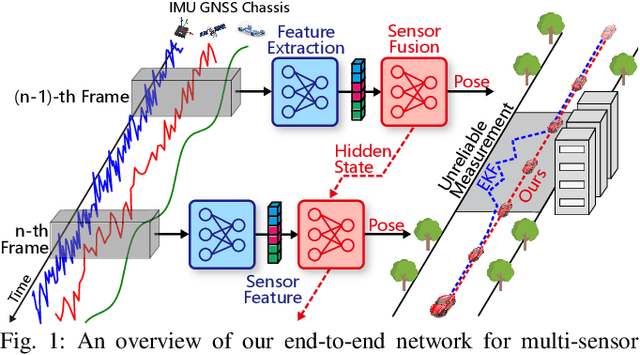
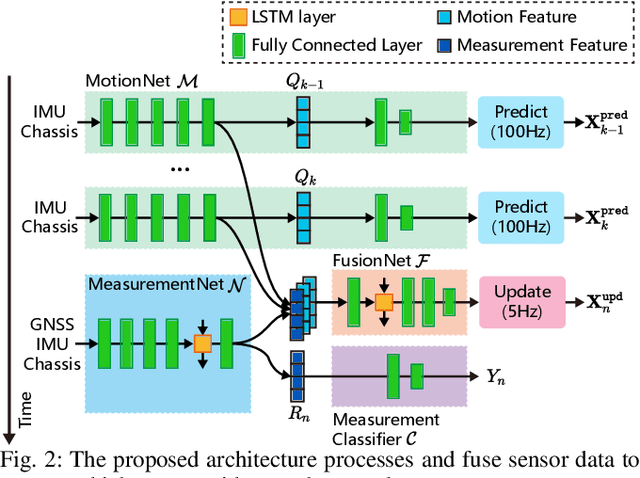
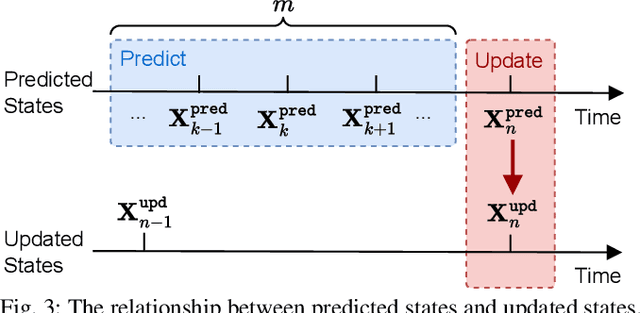

Multi-sensor fusion is essential for autonomous vehicle localization, as it is capable of integrating data from various sources for enhanced accuracy and reliability. The accuracy of the integrated location and orientation depends on the precision of the uncertainty modeling. Traditional methods of uncertainty modeling typically assume a Gaussian distribution and involve manual heuristic parameter tuning. However, these methods struggle to scale effectively and address long-tail scenarios. To address these challenges, we propose a learning-based method that encodes sensor information using higher-order neural network features, thereby eliminating the need for uncertainty estimation. This method significantly eliminates the need for parameter fine-tuning by developing an end-to-end neural network that is specifically designed for multi-sensor fusion. In our experiments, we demonstrate the effectiveness of our approach in real-world autonomous driving scenarios. Results show that the proposed method outperforms existing multi-sensor fusion methods in terms of both accuracy and robustness. A video of the results can be viewed at https://youtu.be/q4iuobMbjME.
Adding Alignment Control to Language Models
Mar 07, 2025Post-training alignment has increasingly become a crucial factor in enhancing the usability of language models (LMs). However, the strength of alignment varies depending on individual preferences. This paper proposes a method to incorporate alignment control into a single model, referred to as CLM. This approach adds one identity layer preceding the initial layers and performs preference learning only on this layer to map unaligned input token embeddings into the aligned space. Experimental results demonstrate that this efficient fine-tuning method performs comparable to full fine-tuning. During inference, the input embeddings are processed through the aligned and unaligned layers, which are then merged through the interpolation coefficient. By controlling this parameter, the alignment exhibits a clear interpolation and extrapolation phenomenon.
Sampling-Efficient Test-Time Scaling: Self-Estimating the Best-of-N Sampling in Early Decoding
Mar 03, 2025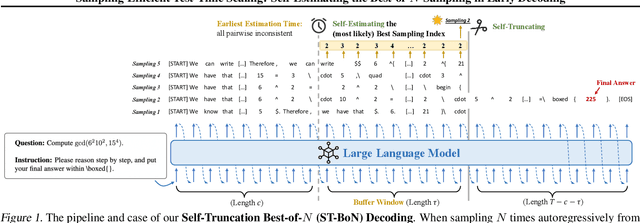
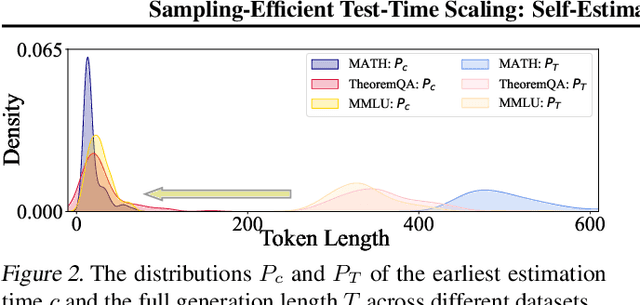
Test-time scaling improves large language model performance by adding extra compute during decoding. Best-of-N (BoN) sampling serves as a common scaling technique, broadening the search space for finding better solutions from the model distribution. However, traditional BoN requires N full generations, leading to high GPU memory overhead and time latency. Moreover, some methods depend on reward models, adding computational cost and limiting domain generalization. In this paper, we propose Self-Truncation Best-of-N (ST-BoN), a novel decoding method that avoids fully generating all samplings and eliminates the need for reward models. ST-BoN introduces early sampling consistency to estimate the most promising sample, truncating suboptimal ones to free memory and accelerate inference. This pushes the sampling-efficient test-time scaling. Compared to traditional BoN, ST-BoN can reduce dynamic GPU memory overhead by over 90% and time latency by 50%, while achieving comparable or even better performance across reasoning and open-ended domains.