 Add to Chrome
 Add to Firefox
 Add to Edge
Adaptive Domain Learning for Cross-domain Image Denoising
Nov 03, 2024
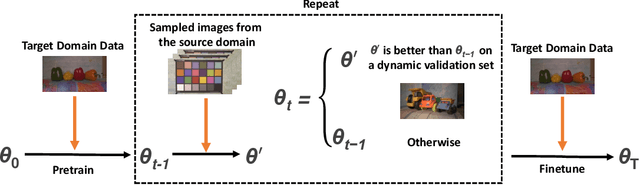
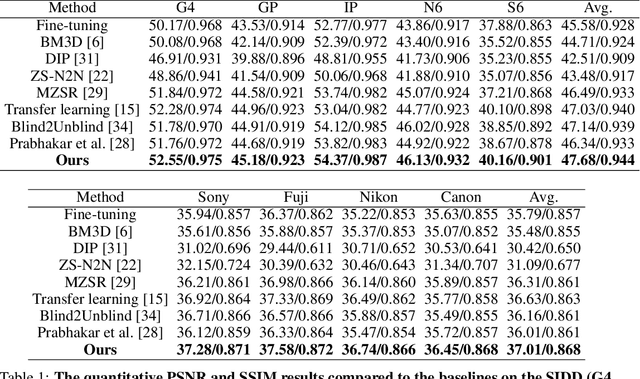
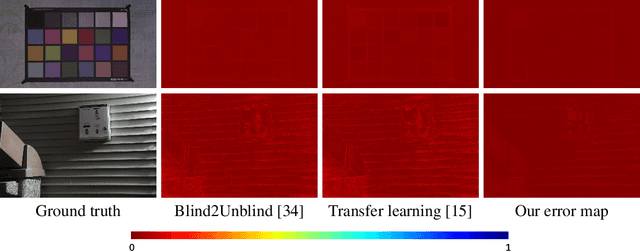
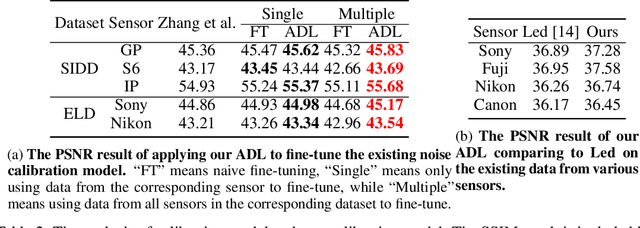
Different camera sensors have different noise patterns, and thus an image denoising model trained on one sensor often does not generalize well to a different sensor. One plausible solution is to collect a large dataset for each sensor for training or fine-tuning, which is inevitably time-consuming. To address this cross-domain challenge, we present a novel adaptive domain learning (ADL) scheme for cross-domain RAW image denoising by utilizing existing data from different sensors (source domain) plus a small amount of data from the new sensor (target domain). The ADL training scheme automatically removes the data in the source domain that are harmful to fine-tuning a model for the target domain (some data are harmful as adding them during training lowers the performance due to domain gaps). Also, we introduce a modulation module to adopt sensor-specific information (sensor type and ISO) to understand input data for image denoising. We conduct extensive experiments on public datasets with various smartphone and DSLR cameras, which show our proposed model outperforms prior work on cross-domain image denoising, given a small amount of image data from the target domain sensor.

LiDAR-GS:Real-time LiDAR Re-Simulation using Gaussian Splatting
Oct 07, 2024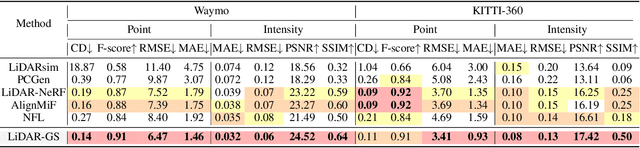
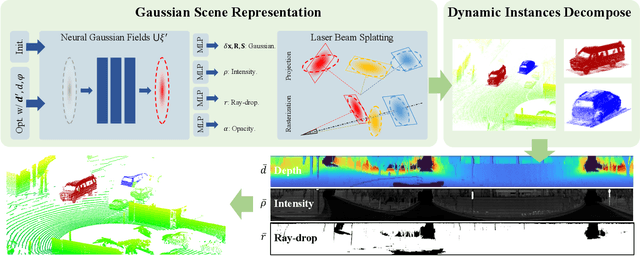
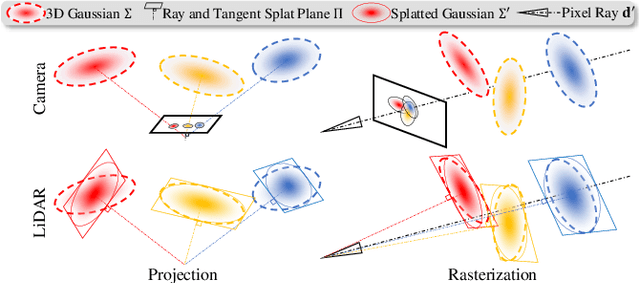
LiDAR simulation plays a crucial role in closed-loop simulation for autonomous driving. Although recent advancements, such as the use of reconstructed mesh and Neural Radiance Fields (NeRF), have made progress in simulating the physical properties of LiDAR, these methods have struggled to achieve satisfactory frame rates and rendering quality. To address these limitations, we present LiDAR-GS, the first LiDAR Gaussian Splatting method, for real-time high-fidelity re-simulation of LiDAR sensor scans in public urban road scenes. The vanilla Gaussian Splatting, designed for camera models, cannot be directly applied to LiDAR re-simulation. To bridge the gap between passive camera and active LiDAR, our LiDAR-GS designs a differentiable laser beam splatting, grounded in the LiDAR range view model. This innovation allows for precise surface splatting by projecting lasers onto micro cross-sections, effectively eliminating artifacts associated with local affine approximations. Additionally, LiDAR-GS leverages Neural Gaussian Fields, which further integrate view-dependent clues, to represent key LiDAR properties that are influenced by the incident angle and external factors. Combining these practices with some essential adaptations, e.g., dynamic instances decomposition, our approach succeeds in simultaneously re-simulating depth, intensity, and ray-drop channels, achieving state-of-the-art results in both rendering frame rate and quality on publically available large scene datasets. Our source code will be made publicly available.
SimMAT: Exploring Transferability from Vision Foundation Models to Any Image Modality
Sep 12, 2024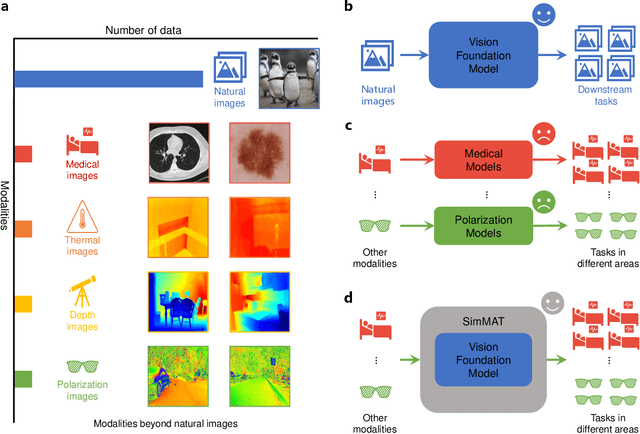


Foundation models like ChatGPT and Sora that are trained on a huge scale of data have made a revolutionary social impact. However, it is extremely challenging for sensors in many different fields to collect similar scales of natural images to train strong foundation models. To this end, this work presents a simple and effective framework SimMAT to study an open problem: the transferability from vision foundation models trained on natural RGB images to other image modalities of different physical properties (e.g., polarization). SimMAT consists of a modality-agnostic transfer layer (MAT) and a pretrained foundation model. We apply SimMAT to a representative vision foundation model Segment Anything Model (SAM) to support any evaluated new image modality. Given the absence of relevant benchmarks, we construct a new benchmark to evaluate the transfer learning performance. Our experiments confirm the intriguing potential of transferring vision foundation models in enhancing other sensors' performance. Specifically, SimMAT can improve the segmentation performance (mIoU) from 22.15% to 53.88% on average for evaluated modalities and consistently outperforms other baselines. We hope that SimMAT can raise awareness of cross-modal transfer learning and benefit various fields for better results with vision foundation models.
HiPrompt: Tuning-free Higher-Resolution Generation with Hierarchical MLLM Prompts
Sep 04, 2024


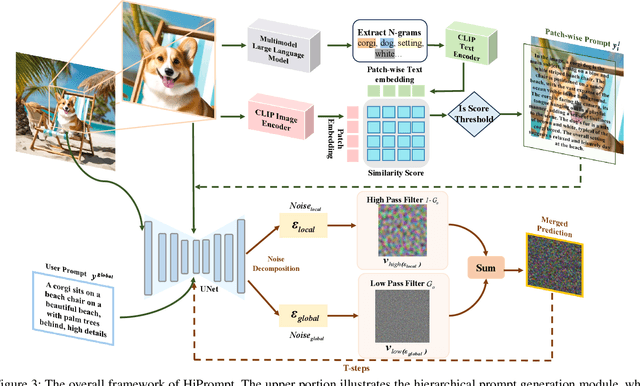
The potential for higher-resolution image generation using pretrained diffusion models is immense, yet these models often struggle with issues of object repetition and structural artifacts especially when scaling to 4K resolution and higher. We figure out that the problem is caused by that, a single prompt for the generation of multiple scales provides insufficient efficacy. In response, we propose HiPrompt, a new tuning-free solution that tackles the above problems by introducing hierarchical prompts. The hierarchical prompts offer both global and local guidance. Specifically, the global guidance comes from the user input that describes the overall content, while the local guidance utilizes patch-wise descriptions from MLLMs to elaborately guide the regional structure and texture generation. Furthermore, during the inverse denoising process, the generated noise is decomposed into low- and high-frequency spatial components. These components are conditioned on multiple prompt levels, including detailed patch-wise descriptions and broader image-level prompts, facilitating prompt-guided denoising under hierarchical semantic guidance. It further allows the generation to focus more on local spatial regions and ensures the generated images maintain coherent local and global semantics, structures, and textures with high definition. Extensive experiments demonstrate that HiPrompt outperforms state-of-the-art works in higher-resolution image generation, significantly reducing object repetition and enhancing structural quality.
Follow-Your-Canvas: Higher-Resolution Video Outpainting with Extensive Content Generation
Sep 02, 2024This paper explores higher-resolution video outpainting with extensive content generation. We point out common issues faced by existing methods when attempting to largely outpaint videos: the generation of low-quality content and limitations imposed by GPU memory. To address these challenges, we propose a diffusion-based method called \textit{Follow-Your-Canvas}. It builds upon two core designs. First, instead of employing the common practice of "single-shot" outpainting, we distribute the task across spatial windows and seamlessly merge them. It allows us to outpaint videos of any size and resolution without being constrained by GPU memory. Second, the source video and its relative positional relation are injected into the generation process of each window. It makes the generated spatial layout within each window harmonize with the source video. Coupling with these two designs enables us to generate higher-resolution outpainting videos with rich content while keeping spatial and temporal consistency. Follow-Your-Canvas excels in large-scale video outpainting, e.g., from 512X512 to 1152X2048 (9X), while producing high-quality and aesthetically pleasing results. It achieves the best quantitative results across various resolution and scale setups. The code is released on https://github.com/mayuelala/FollowYourCanvas
Diffusion-Based Visual Art Creation: A Survey and New Perspectives
Aug 22, 2024The integration of generative AI in visual art has revolutionized not only how visual content is created but also how AI interacts with and reflects the underlying domain knowledge. This survey explores the emerging realm of diffusion-based visual art creation, examining its development from both artistic and technical perspectives. We structure the survey into three phases, data feature and framework identification, detailed analyses using a structured coding process, and open-ended prospective outlooks. Our findings reveal how artistic requirements are transformed into technical challenges and highlight the design and application of diffusion-based methods within visual art creation. We also provide insights into future directions from technical and synergistic perspectives, suggesting that the confluence of generative AI and art has shifted the creative paradigm and opened up new possibilities. By summarizing the development and trends of this emerging interdisciplinary area, we aim to shed light on the mechanisms through which AI systems emulate and possibly, enhance human capacities in artistic perception and creativity.
TALE: Training-free Cross-domain Image Composition via Adaptive Latent Manipulation and Energy-guided Optimization
Aug 07, 2024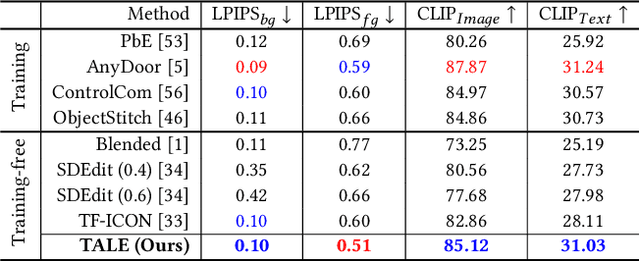
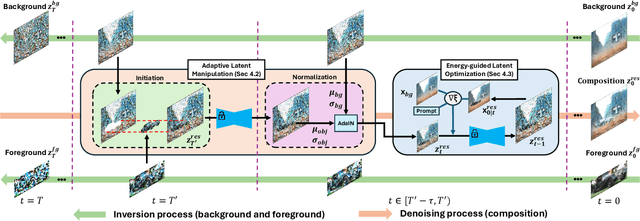

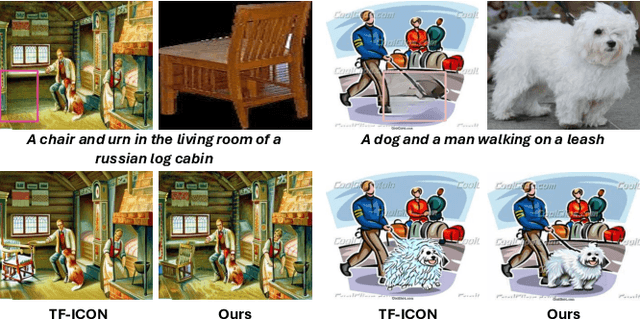
We present TALE, a novel training-free framework harnessing the generative capabilities of text-to-image diffusion models to address the cross-domain image composition task that focuses on flawlessly incorporating user-specified objects into a designated visual contexts regardless of domain disparity. Previous methods often involve either training auxiliary networks or finetuning diffusion models on customized datasets, which are expensive and may undermine the robust textual and visual priors of pre-trained diffusion models. Some recent works attempt to break the barrier by proposing training-free workarounds that rely on manipulating attention maps to tame the denoising process implicitly. However, composing via attention maps does not necessarily yield desired compositional outcomes. These approaches could only retain some semantic information and usually fall short in preserving identity characteristics of input objects or exhibit limited background-object style adaptation in generated images. In contrast, TALE is a novel method that operates directly on latent space to provide explicit and effective guidance for the composition process to resolve these problems. Specifically, we equip TALE with two mechanisms dubbed Adaptive Latent Manipulation and Energy-guided Latent Optimization. The former formulates noisy latents conducive to initiating and steering the composition process by directly leveraging background and foreground latents at corresponding timesteps, and the latter exploits designated energy functions to further optimize intermediate latents conforming to specific conditions that complement the former to generate desired final results. Our experiments demonstrate that TALE surpasses prior baselines and attains state-of-the-art performance in image-guided composition across various photorealistic and artistic domains.
MMTrail: A Multimodal Trailer Video Dataset with Language and Music Descriptions
Jul 30, 2024



Massive multi-modality datasets play a significant role in facilitating the success of large video-language models. However, current video-language datasets primarily provide text descriptions for visual frames, considering audio to be weakly related information. They usually overlook exploring the potential of inherent audio-visual correlation, leading to monotonous annotation within each modality instead of comprehensive and precise descriptions. Such ignorance results in the difficulty of multiple cross-modality studies. To fulfill this gap, we present MMTrail, a large-scale multi-modality video-language dataset incorporating more than 20M trailer clips with visual captions, and 2M high-quality clips with multimodal captions. Trailers preview full-length video works and integrate context, visual frames, and background music. In particular, the trailer has two main advantages: (1) the topics are diverse, and the content characters are of various types, e.g., film, news, and gaming. (2) the corresponding background music is custom-designed, making it more coherent with the visual context. Upon these insights, we propose a systemic captioning framework, achieving various modality annotations with more than 27.1k hours of trailer videos. Here, to ensure the caption retains music perspective while preserving the authority of visual context, we leverage the advanced LLM to merge all annotations adaptively. In this fashion, our MMtrail dataset potentially paves the path for fine-grained large multimodal-language model training. In experiments, we provide evaluation metrics and benchmark results on our dataset, demonstrating the high quality of our annotation and its effectiveness for model training.
Learning High-resolution Vector Representation from Multi-Camera Images for 3D Object Detection
Jul 22, 2024The Bird's-Eye-View (BEV) representation is a critical factor that directly impacts the 3D object detection performance, but the traditional BEV grid representation induces quadratic computational cost as the spatial resolution grows. To address this limitation, we present a new camera-based 3D object detector with high-resolution vector representation: VectorFormer. The presented high-resolution vector representation is combined with the lower-resolution BEV representation to efficiently exploit 3D geometry from multi-camera images at a high resolution through our two novel modules: vector scattering and gathering. To this end, the learned vector representation with richer scene contexts can serve as the decoding query for final predictions. We conduct extensive experiments on the nuScenes dataset and demonstrate state-of-the-art performance in NDS and inference time. Furthermore, we investigate query-BEV-based methods incorporated with our proposed vector representation and observe a consistent performance improvement.
Gaussian-Informed Continuum for Physical Property Identification and Simulation
Jun 21, 2024This paper studies the problem of estimating physical properties (system identification) through visual observations. To facilitate geometry-aware guidance in physical property estimation, we introduce a novel hybrid framework that leverages 3D Gaussian representation to not only capture explicit shapes but also enable the simulated continuum to deduce implicit shapes during training. We propose a new dynamic 3D Gaussian framework based on motion factorization to recover the object as 3D Gaussian point sets across different time states. Furthermore, we develop a coarse-to-fine filling strategy to generate the density fields of the object from the Gaussian reconstruction, allowing for the extraction of object continuums along with their surfaces and the integration of Gaussian attributes into these continuums. In addition to the extracted object surfaces, the Gaussian-informed continuum also enables the rendering of object masks during simulations, serving as implicit shape guidance for physical property estimation. Extensive experimental evaluations demonstrate that our pipeline achieves state-of-the-art performance across multiple benchmarks and metrics. Additionally, we illustrate the effectiveness of the proposed method through real-world demonstrations, showcasing its practical utility. Our project page is at https://jukgei.github.io/project/gic.