 Add to Chrome
 Add to Firefox
 Add to Edge
AudioX-Turbo: A Unified Framework for Efficient Anything-to-Audio Generation
Jun 10, 2026
Audio and music generation based on flexible multimodal control signals is a widely applicable topic, with the following key challenges: 1) a unified multimodal modeling framework, 2) large-scale, high-quality training data, and 3) the prohibitive inference cost of multi-step diffusion sampling. As such, we propose AudioX-Turbo, a unified and efficient framework for anything-to-audio generation that integrates varied multimodal conditions (i.e., text, video, and audio signals) in this work. AudioX-Turbo follows a teacher-student paradigm. The teacher AudioX-Base is built on a Multimodal Diffusion Transformer with a Multimodal Adaptive Fusion module that aligns diverse multimodal inputs for high-fidelity synthesis, and is then distilled into the few-step student AudioX-Turbo via Distribution Matching Distillation adapted to flow matching, complemented by a diffusion-based discriminator for high-quality few-step generation. To support the training of AudioX-Turbo, we construct a large-scale, high-quality dataset, IF-caps-Pro, comprising approximately 9.2M samples curated through a two-stage data collection and annotation pipeline. We benchmark AudioX-Turbo across a wide range of tasks, finding that our model achieves superior performance, especially on text-to-audio and text-to-music generation, while operating at only 4 sampling steps and requiring approximately 25x fewer function evaluations (NFE) than multi-step baselines. These results demonstrate that our method is capable of audio generation under flexible multimodal control, showing efficient and powerful instruction-following capabilities. The code and datasets will be available at https://zeyuet.github.io/AudioX-Turbo/.

UAT: Unified Audio-Text Diffusion for Audio Generation, Editing, and Captioning
Jun 03, 2026Audio generation and audio-to-text understanding remain largely separate, with diffusion models dominating high-fidelity synthesis and autoregressive (AR) language models driving captioning and semantic prediction. Existing unified approaches typically rely on either heterogeneous modules or AR-centric modeling, which can hinder joint optimization and limit acoustic fidelity. We present UAT, to our knowledge, the first diffusion-centric framework that supports unified audio generation, editing, and captioning. UAT couples continuous latent diffusion for audio with masked discrete diffusion for text, enabling bidirectional audio-text modeling within a shared dual-stream backbone. Experiments show that UAT preserves strong audio generation and editing capabilities while achieving competitive captioning performance, demonstrating a favorable balance between acoustic synthesis and semantic prediction. Demo samples are available at https://UAT-demo.github.io.
Audio-Omni: Extending Multi-modal Understanding to Versatile Audio Generation and Editing
Apr 12, 2026Recent progress in multimodal models has spurred rapid advances in audio understanding, generation, and editing. However, these capabilities are typically addressed by specialized models, leaving the development of a truly unified framework that can seamlessly integrate all three tasks underexplored. While some pioneering works have explored unifying audio understanding and generation, they often remain confined to specific domains. To address this, we introduce Audio-Omni, the first end-to-end framework to unify generation and editing across general sound, music, and speech domains, with integrated multi-modal understanding capabilities. Our architecture synergizes a frozen Multimodal Large Language Model for high-level reasoning with a trainable Diffusion Transformer for high-fidelity synthesis. To overcome the critical data scarcity in audio editing, we construct AudioEdit, a new large-scale dataset comprising over one million meticulously curated editing pairs. Extensive experiments demonstrate that Audio-Omni achieves state-of-the-art performance across a suite of benchmarks, outperforming prior unified approaches while achieving performance on par with or superior to specialized expert models. Beyond its core capabilities, Audio-Omni exhibits remarkable inherited capabilities, including knowledge-augmented reasoning generation, in-context generation, and zero-shot cross-lingual control for audio generation, highlighting a promising direction toward universal generative audio intelligence. The code, model, and dataset will be publicly released on https://zeyuet.github.io/Audio-Omni.
ScaleCUA: Scaling Open-Source Computer Use Agents with Cross-Platform Data
Sep 18, 2025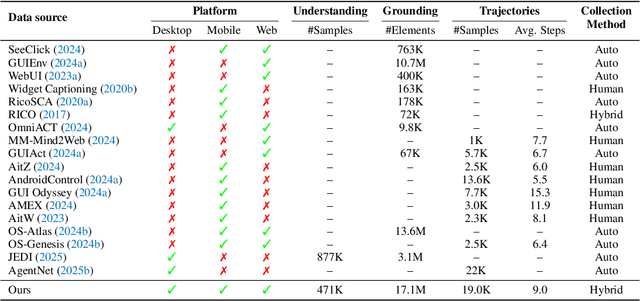
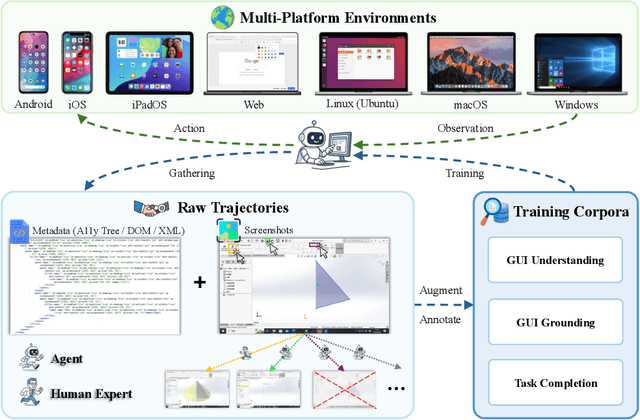
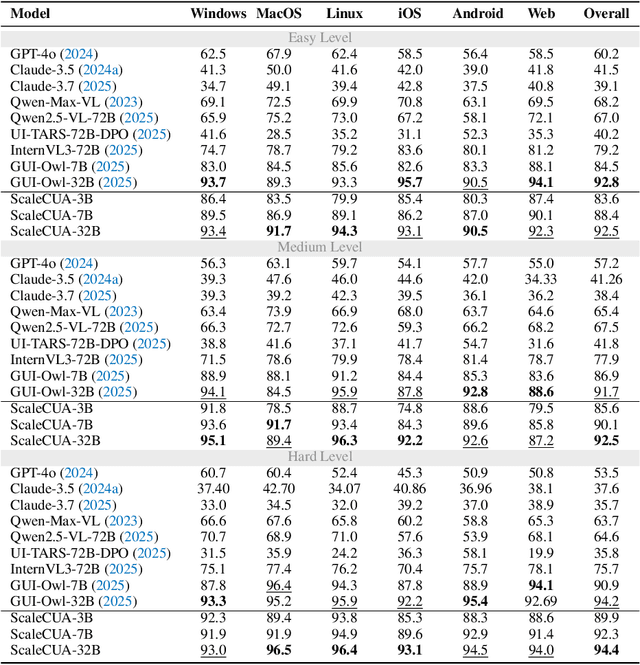
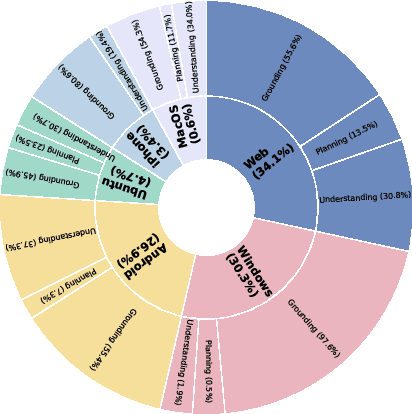
Vision-Language Models (VLMs) have enabled computer use agents (CUAs) that operate GUIs autonomously, showing great potential, yet progress is limited by the lack of large-scale, open-source computer use data and foundation models. In this work, we introduce ScaleCUA, a step toward scaling open-source CUAs. It offers a large-scale dataset spanning 6 operating systems and 3 task domains, built via a closed-loop pipeline uniting automated agents with human experts. Trained on this scaled-up data, ScaleCUA can operate seamlessly across platforms. Specifically, it delivers strong gains over baselines (+26.6 on WebArena-Lite-v2, +10.7 on ScreenSpot-Pro) and sets new state-of-the-art results (94.4% on MMBench-GUI L1-Hard, 60.6% on OSWorld-G, 47.4% on WebArena-Lite-v2). These findings underscore the power of data-driven scaling for general-purpose computer use agents. We will release data, models, and code to advance future research: https://github.com/OpenGVLab/ScaleCUA.
WeTok: Powerful Discrete Tokenization for High-Fidelity Visual Reconstruction
Aug 07, 2025Visual tokenizer is a critical component for vision generation. However, the existing tokenizers often face unsatisfactory trade-off between compression ratios and reconstruction fidelity. To fill this gap, we introduce a powerful and concise WeTok tokenizer, which surpasses the previous leading tokenizers via two core innovations. (1) Group-wise lookup-free Quantization (GQ). We partition the latent features into groups, and perform lookup-free quantization for each group. As a result, GQ can efficiently overcome memory and computation limitations of prior tokenizers, while achieving a reconstruction breakthrough with more scalable codebooks. (2) Generative Decoding (GD). Different from prior tokenizers, we introduce a generative decoder with a prior of extra noise variable. In this case, GD can probabilistically model the distribution of visual data conditioned on discrete tokens, allowing WeTok to reconstruct visual details, especially at high compression ratios. Extensive experiments on mainstream benchmarks show superior performance of our WeTok. On the ImageNet 50k validation set, WeTok achieves a record-low zero-shot rFID (WeTok: 0.12 vs. FLUX-VAE: 0.18 vs. SD-VAE 3.5: 0.19). Furthermore, our highest compression model achieves a zero-shot rFID of 3.49 with a compression ratio of 768, outperforming Cosmos (384) 4.57 which has only 50% compression rate of ours. Code and models are available: https://github.com/zhuangshaobin/WeTok.
AudioX: Diffusion Transformer for Anything-to-Audio Generation
Mar 13, 2025Audio and music generation have emerged as crucial tasks in many applications, yet existing approaches face significant limitations: they operate in isolation without unified capabilities across modalities, suffer from scarce high-quality, multi-modal training data, and struggle to effectively integrate diverse inputs. In this work, we propose AudioX, a unified Diffusion Transformer model for Anything-to-Audio and Music Generation. Unlike previous domain-specific models, AudioX can generate both general audio and music with high quality, while offering flexible natural language control and seamless processing of various modalities including text, video, image, music, and audio. Its key innovation is a multi-modal masked training strategy that masks inputs across modalities and forces the model to learn from masked inputs, yielding robust and unified cross-modal representations. To address data scarcity, we curate two comprehensive datasets: vggsound-caps with 190K audio captions based on the VGGSound dataset, and V2M-caps with 6 million music captions derived from the V2M dataset. Extensive experiments demonstrate that AudioX not only matches or outperforms state-of-the-art specialized models, but also offers remarkable versatility in handling diverse input modalities and generation tasks within a unified architecture. The code and datasets will be available at https://zeyuet.github.io/AudioX/
YuE: Scaling Open Foundation Models for Long-Form Music Generation
Mar 11, 2025We tackle the task of long-form music generation--particularly the challenging \textbf{lyrics-to-song} problem--by introducing YuE, a family of open foundation models based on the LLaMA2 architecture. Specifically, YuE scales to trillions of tokens and generates up to five minutes of music while maintaining lyrical alignment, coherent musical structure, and engaging vocal melodies with appropriate accompaniment. It achieves this through (1) track-decoupled next-token prediction to overcome dense mixture signals, (2) structural progressive conditioning for long-context lyrical alignment, and (3) a multitask, multiphase pre-training recipe to converge and generalize. In addition, we redesign the in-context learning technique for music generation, enabling versatile style transfer (e.g., converting Japanese city pop into an English rap while preserving the original accompaniment) and bidirectional generation. Through extensive evaluation, we demonstrate that YuE matches or even surpasses some of the proprietary systems in musicality and vocal agility. In addition, fine-tuning YuE enables additional controls and enhanced support for tail languages. Furthermore, beyond generation, we show that YuE's learned representations can perform well on music understanding tasks, where the results of YuE match or exceed state-of-the-art methods on the MARBLE benchmark. Keywords: lyrics2song, song generation, long-form, foundation model, music generation
Audio-FLAN: A Preliminary Release
Feb 23, 2025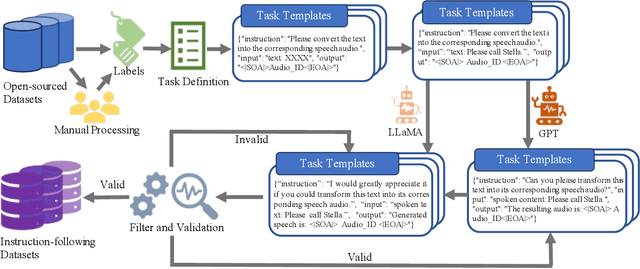
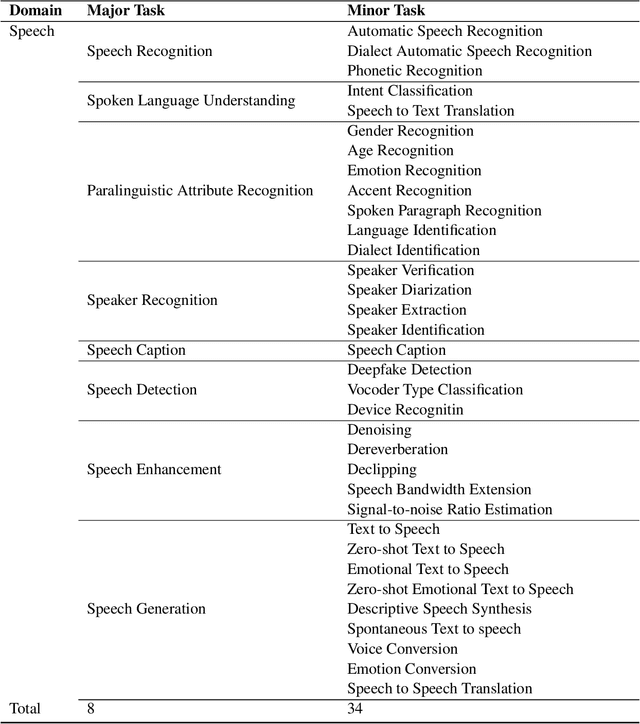
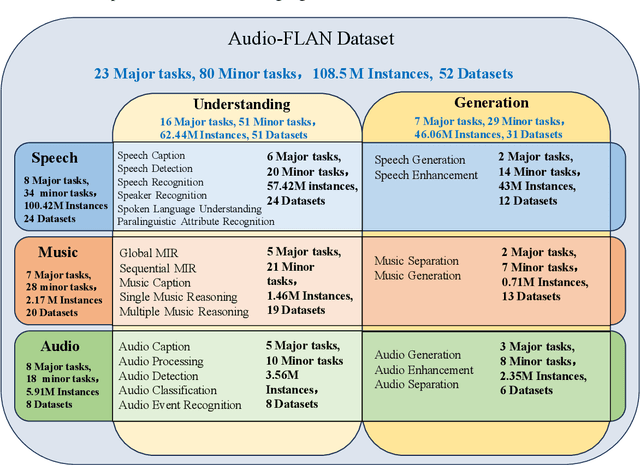
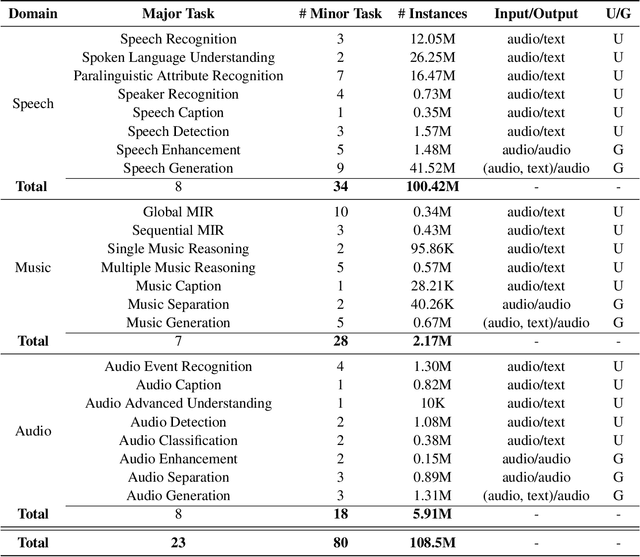
Recent advancements in audio tokenization have significantly enhanced the integration of audio capabilities into large language models (LLMs). However, audio understanding and generation are often treated as distinct tasks, hindering the development of truly unified audio-language models. While instruction tuning has demonstrated remarkable success in improving generalization and zero-shot learning across text and vision, its application to audio remains largely unexplored. A major obstacle is the lack of comprehensive datasets that unify audio understanding and generation. To address this, we introduce Audio-FLAN, a large-scale instruction-tuning dataset covering 80 diverse tasks across speech, music, and sound domains, with over 100 million instances. Audio-FLAN lays the foundation for unified audio-language models that can seamlessly handle both understanding (e.g., transcription, comprehension) and generation (e.g., speech, music, sound) tasks across a wide range of audio domains in a zero-shot manner. The Audio-FLAN dataset is available on HuggingFace and GitHub and will be continuously updated.
Foundation Models for Music: A Survey
Aug 27, 2024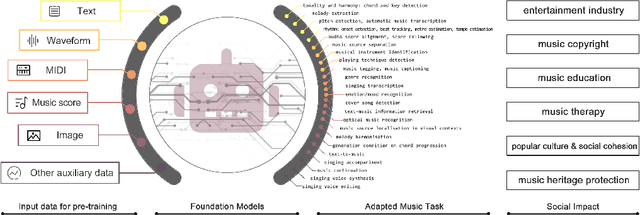
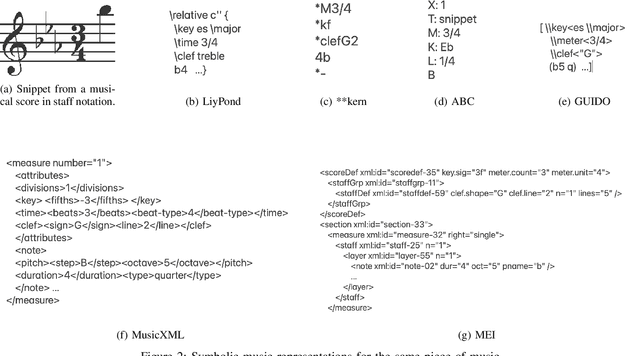
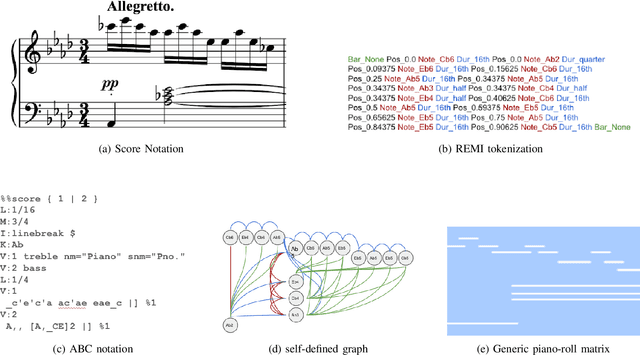
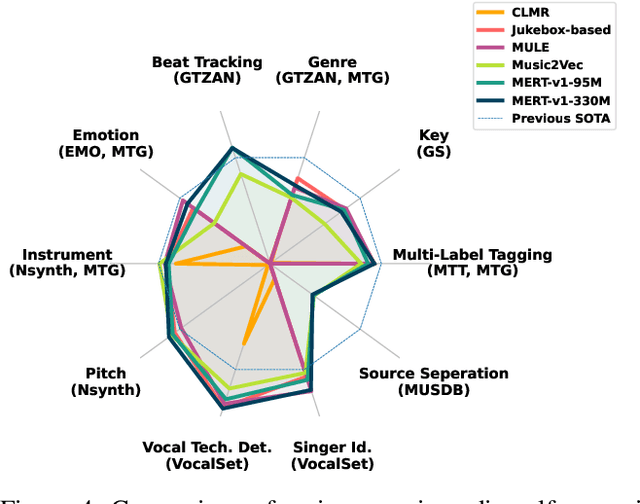
In recent years, foundation models (FMs) such as large language models (LLMs) and latent diffusion models (LDMs) have profoundly impacted diverse sectors, including music. This comprehensive review examines state-of-the-art (SOTA) pre-trained models and foundation models in music, spanning from representation learning, generative learning and multimodal learning. We first contextualise the significance of music in various industries and trace the evolution of AI in music. By delineating the modalities targeted by foundation models, we discover many of the music representations are underexplored in FM development. Then, emphasis is placed on the lack of versatility of previous methods on diverse music applications, along with the potential of FMs in music understanding, generation and medical application. By comprehensively exploring the details of the model pre-training paradigm, architectural choices, tokenisation, finetuning methodologies and controllability, we emphasise the important topics that should have been well explored, like instruction tuning and in-context learning, scaling law and emergent ability, as well as long-sequence modelling etc. A dedicated section presents insights into music agents, accompanied by a thorough analysis of datasets and evaluations essential for pre-training and downstream tasks. Finally, by underscoring the vital importance of ethical considerations, we advocate that following research on FM for music should focus more on such issues as interpretability, transparency, human responsibility, and copyright issues. The paper offers insights into future challenges and trends on FMs for music, aiming to shape the trajectory of human-AI collaboration in the music realm.
MMTrail: A Multimodal Trailer Video Dataset with Language and Music Descriptions
Jul 30, 2024



Massive multi-modality datasets play a significant role in facilitating the success of large video-language models. However, current video-language datasets primarily provide text descriptions for visual frames, considering audio to be weakly related information. They usually overlook exploring the potential of inherent audio-visual correlation, leading to monotonous annotation within each modality instead of comprehensive and precise descriptions. Such ignorance results in the difficulty of multiple cross-modality studies. To fulfill this gap, we present MMTrail, a large-scale multi-modality video-language dataset incorporating more than 20M trailer clips with visual captions, and 2M high-quality clips with multimodal captions. Trailers preview full-length video works and integrate context, visual frames, and background music. In particular, the trailer has two main advantages: (1) the topics are diverse, and the content characters are of various types, e.g., film, news, and gaming. (2) the corresponding background music is custom-designed, making it more coherent with the visual context. Upon these insights, we propose a systemic captioning framework, achieving various modality annotations with more than 27.1k hours of trailer videos. Here, to ensure the caption retains music perspective while preserving the authority of visual context, we leverage the advanced LLM to merge all annotations adaptively. In this fashion, our MMtrail dataset potentially paves the path for fine-grained large multimodal-language model training. In experiments, we provide evaluation metrics and benchmark results on our dataset, demonstrating the high quality of our annotation and its effectiveness for model training.