 Add to Chrome
 Add to Firefox
 Add to Edge
ChemATP: A Training-Free Chemical Reasoning Framework for Large Language Models
Dec 22, 2025
Large Language Models (LLMs) exhibit strong general reasoning but struggle in molecular science due to the lack of explicit chemical priors in standard string representations. Current solutions face a fundamental dilemma. Training-based methods inject priors into parameters, but this static coupling hinders rapid knowledge updates and often compromises the model's general reasoning capabilities. Conversely, existing training-free methods avoid these issues but rely on surface-level prompting, failing to provide the fine-grained atom-level priors essential for precise chemical reasoning. To address this issue, we introduce ChemATP, a framework that decouples chemical knowledge from the reasoning engine. By constructing the first atom-level textual knowledge base, ChemATP enables frozen LLMs to explicitly retrieve and reason over this information dynamically. This architecture ensures interpretability and adaptability while preserving the LLM's intrinsic general intelligence. Experiments show that ChemATP significantly outperforms training-free baselines and rivals state-of-the-art training-based models, demonstrating that explicit prior injection is a competitive alternative to implicit parameter updates.

ABE-CLIP: Training-Free Attribute Binding Enhancement for Compositional Image-Text Matching
Dec 19, 2025Contrastive Language-Image Pretraining (CLIP) has achieved remarkable performance in various multimodal tasks. However, it still struggles with compositional image-text matching, particularly in accurately associating objects with their corresponding attributes, because its inherent global representation often overlooks fine-grained semantics for attribute binding. Existing methods often require additional training or extensive hard negative sampling, yet they frequently show limited generalization to novel compositional concepts and fail to fundamentally address the drawbacks of global representations. In this paper, we propose ABE-CLIP, a novel training-free Attribute Binding Enhancement method designed to strengthen attribute-object binding in CLIP-like models. Specifically, we employ a Semantic Refinement Mechanism to refine token embeddings for both object and attribute phrases in the text, thereby mitigating attribute confusion and improving semantic precision. We further introduce a Local Token-Patch Alignment strategy that computes similarity scores between refined textual tokens and their most relevant image patches. By aggregating localized similarity scores, ABE-CLIP computes the final image-text similarity. Experiments on multiple datasets demonstrate that ABE-CLIP significantly improves attribute-object binding performance, even surpassing methods that require extensive training.
Semi-Supervised Multi-View Crowd Counting by Ranking Multi-View Fusion Models
Dec 18, 2025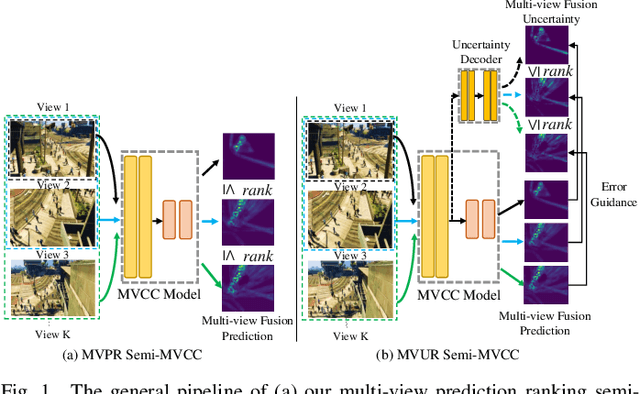
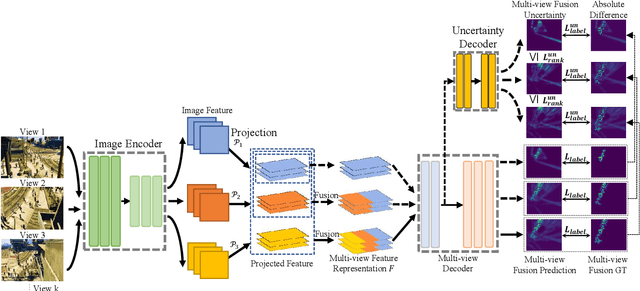
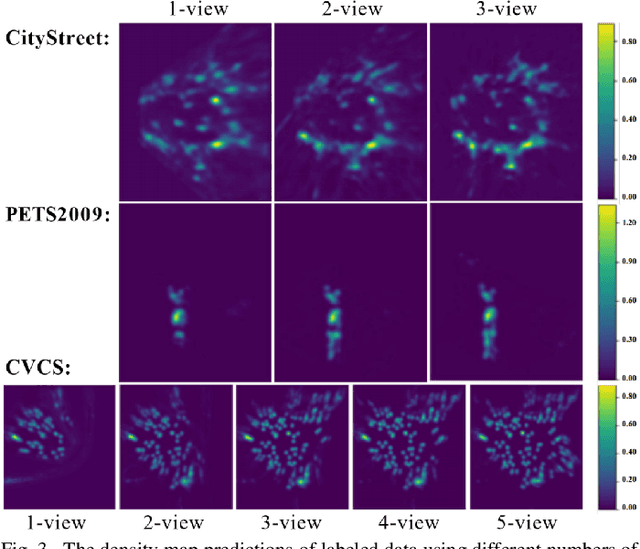
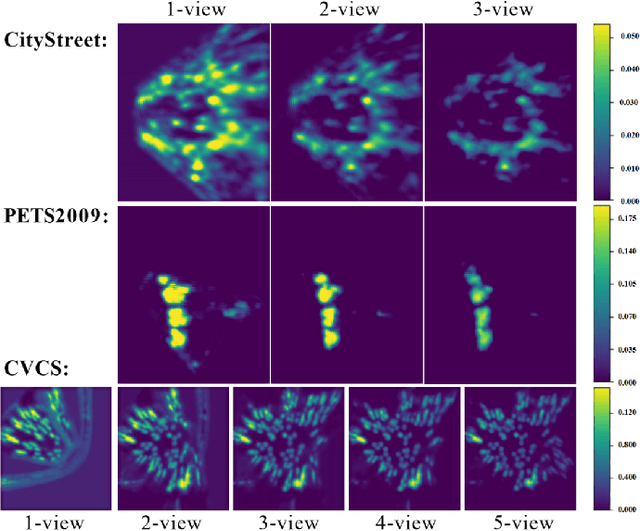
Multi-view crowd counting has been proposed to deal with the severe occlusion issue of crowd counting in large and wide scenes. However, due to the difficulty of collecting and annotating multi-view images, the datasets for multi-view counting have a limited number of multi-view frames and scenes. To solve the problem of limited data, one approach is to collect synthetic data to bypass the annotating step, while another is to propose semi- or weakly-supervised or unsupervised methods that demand less multi-view data. In this paper, we propose two semi-supervised multi-view crowd counting frameworks by ranking the multi-view fusion models of different numbers of input views, in terms of the model predictions or the model uncertainties. Specifically, for the first method (vanilla model), we rank the multi-view fusion models' prediction results of different numbers of camera-view inputs, namely, the model's predictions with fewer camera views shall not be larger than the predictions with more camera views. For the second method, we rank the estimated model uncertainties of the multi-view fusion models with a variable number of view inputs, guided by the multi-view fusion models' prediction errors, namely, the model uncertainties with more camera views shall not be larger than those with fewer camera views. These constraints are introduced into the model training in a semi-supervised fashion for multi-view counting with limited labeled data. The experiments demonstrate the advantages of the proposed multi-view model ranking methods compared with other semi-supervised counting methods.
Memory in the Age of AI Agents
Dec 15, 2025Memory has emerged, and will continue to remain, a core capability of foundation model-based agents. As research on agent memory rapidly expands and attracts unprecedented attention, the field has also become increasingly fragmented. Existing works that fall under the umbrella of agent memory often differ substantially in their motivations, implementations, and evaluation protocols, while the proliferation of loosely defined memory terminologies has further obscured conceptual clarity. Traditional taxonomies such as long/short-term memory have proven insufficient to capture the diversity of contemporary agent memory systems. This work aims to provide an up-to-date landscape of current agent memory research. We begin by clearly delineating the scope of agent memory and distinguishing it from related concepts such as LLM memory, retrieval augmented generation (RAG), and context engineering. We then examine agent memory through the unified lenses of forms, functions, and dynamics. From the perspective of forms, we identify three dominant realizations of agent memory, namely token-level, parametric, and latent memory. From the perspective of functions, we propose a finer-grained taxonomy that distinguishes factual, experiential, and working memory. From the perspective of dynamics, we analyze how memory is formed, evolved, and retrieved over time. To support practical development, we compile a comprehensive summary of memory benchmarks and open-source frameworks. Beyond consolidation, we articulate a forward-looking perspective on emerging research frontiers, including memory automation, reinforcement learning integration, multimodal memory, multi-agent memory, and trustworthiness issues. We hope this survey serves not only as a reference for existing work, but also as a conceptual foundation for rethinking memory as a first-class primitive in the design of future agentic intelligence.
ATLAS: A High-Difficulty, Multidisciplinary Benchmark for Frontier Scientific Reasoning
Nov 18, 2025The rapid advancement of Large Language Models (LLMs) has led to performance saturation on many established benchmarks, questioning their ability to distinguish frontier models. Concurrently, existing high-difficulty benchmarks often suffer from narrow disciplinary focus, oversimplified answer formats, and vulnerability to data contamination, creating a fidelity gap with real-world scientific inquiry. To address these challenges, we introduce ATLAS (AGI-Oriented Testbed for Logical Application in Science), a large-scale, high-difficulty, and cross-disciplinary evaluation suite composed of approximately 800 original problems. Developed by domain experts (PhD-level and above), ATLAS spans seven core scientific fields: mathematics, physics, chemistry, biology, computer science, earth science, and materials science. Its key features include: (1) High Originality and Contamination Resistance, with all questions newly created or substantially adapted to prevent test data leakage; (2) Cross-Disciplinary Focus, designed to assess models' ability to integrate knowledge and reason across scientific domains; (3) High-Fidelity Answers, prioritizing complex, open-ended answers involving multi-step reasoning and LaTeX-formatted expressions over simple multiple-choice questions; and (4) Rigorous Quality Control, employing a multi-stage process of expert peer review and adversarial testing to ensure question difficulty, scientific value, and correctness. We also propose a robust evaluation paradigm using a panel of LLM judges for automated, nuanced assessment of complex answers. Preliminary results on leading models demonstrate ATLAS's effectiveness in differentiating their advanced scientific reasoning capabilities. We plan to develop ATLAS into a long-term, open, community-driven platform to provide a reliable "ruler" for progress toward Artificial General Intelligence.
MonkeyOCR v1.5 Technical Report: Unlocking Robust Document Parsing for Complex Patterns
Nov 16, 2025Document parsing is a core task in document intelligence, supporting applications such as information extraction, retrieval-augmented generation, and automated document analysis. However, real-world documents often feature complex layouts with multi-level tables, embedded images or formulas, and cross-page structures, which remain challenging for existing OCR systems. We introduce MonkeyOCR v1.5, a unified vision-language framework that enhances both layout understanding and content recognition through a two-stage pipeline. The first stage employs a large multimodal model to jointly predict layout and reading order, leveraging visual information to ensure sequential consistency. The second stage performs localized recognition of text, formulas, and tables within detected regions, maintaining high visual fidelity while reducing error propagation. To address complex table structures, we propose a visual consistency-based reinforcement learning scheme that evaluates recognition quality via render-and-compare alignment, improving structural accuracy without manual annotations. Additionally, two specialized modules, Image-Decoupled Table Parsing and Type-Guided Table Merging, are introduced to enable reliable parsing of tables containing embedded images and reconstruction of tables crossing pages or columns. Comprehensive experiments on OmniDocBench v1.5 demonstrate that MonkeyOCR v1.5 achieves state-of-the-art performance, outperforming PPOCR-VL and MinerU 2.5 while showing exceptional robustness in visually complex document scenarios. A trial link can be found at https://github.com/Yuliang-Liu/MonkeyOCR .
xHAP: Cross-Modal Attention for Haptic Feedback Estimation in the Tactile Internet
Nov 12, 2025The Tactile Internet requires ultra-low latency and high-fidelity haptic feedback to enable immersive teleoperation. A key challenge is to ensure ultra-reliable and low-latency transmission of haptic packets under channel variations and potential network outages. To address these issues, one approach relies on local estimation of haptic feedback at the operator side. However, designing an accurate estimator that can faithfully reproduce the true haptic forces remains a significant challenge. In this paper, we propose a novel deep learning architecture, xHAP, based on cross-modal attention to estimate haptic feedback. xHAP fuses information from two distinct data streams: the teleoperator's historical force feedback and the operator's control action sequence. We employ modality-specific encoders to learn temporal representations, followed by a cross-attention layer where the teleoperator haptic data attend to the operator input. This fusion allows the model to selectively focus on the most relevant operator sensory data when predicting the teleoperator's haptic feedback. The proposed architecture reduces the mean-squared error by more than two orders of magnitude compared to existing methods and lowers the SNR requirement for reliable transmission by $10~\mathrm{dB}$ at an error threshold of $0.1$ in a 3GPP UMa scenario. Additionally, it increases coverage by $138\%$ and supports $59.6\%$ more haptic users even under 10 dB lower SNR compared to the baseline.
AgentPRM: Process Reward Models for LLM Agents via Step-Wise Promise and Progress
Nov 11, 2025Despite rapid development, large language models (LLMs) still encounter challenges in multi-turn decision-making tasks (i.e., agent tasks) like web shopping and browser navigation, which require making a sequence of intelligent decisions based on environmental feedback. Previous work for LLM agents typically relies on elaborate prompt engineering or fine-tuning with expert trajectories to improve performance. In this work, we take a different perspective: we explore constructing process reward models (PRMs) to evaluate each decision and guide the agent's decision-making process. Unlike LLM reasoning, where each step is scored based on correctness, actions in agent tasks do not have a clear-cut correctness. Instead, they should be evaluated based on their proximity to the goal and the progress they have made. Building on this insight, we propose a re-defined PRM for agent tasks, named AgentPRM, to capture both the interdependence between sequential decisions and their contribution to the final goal. This enables better progress tracking and exploration-exploitation balance. To scalably obtain labeled data for training AgentPRM, we employ a Temporal Difference-based (TD-based) estimation method combined with Generalized Advantage Estimation (GAE), which proves more sample-efficient than prior methods. Extensive experiments across different agentic tasks show that AgentPRM is over $8\times$ more compute-efficient than baselines, and it demonstrates robust improvement when scaling up test-time compute. Moreover, we perform detailed analyses to show how our method works and offer more insights, e.g., applying AgentPRM to the reinforcement learning of LLM agents.
Counteracting Matthew Effect in Self-Improvement of LVLMs through Head-Tail Re-balancing
Oct 30, 2025Self-improvement has emerged as a mainstream paradigm for advancing the reasoning capabilities of large vision-language models (LVLMs), where models explore and learn from successful trajectories iteratively. However, we identify a critical issue during this process: the model excels at generating high-quality trajectories for simple queries (i.e., head data) but struggles with more complex ones (i.e., tail data). This leads to an imbalanced optimization that drives the model to prioritize simple reasoning skills, while hindering its ability to tackle more complex reasoning tasks. Over iterations, this imbalance becomes increasingly pronounced--a dynamic we term the "Matthew effect"--which ultimately hinders further model improvement and leads to performance bottlenecks. To counteract this challenge, we introduce four efficient strategies from two perspectives: distribution-reshaping and trajectory-resampling, to achieve head-tail re-balancing during the exploration-and-learning self-improvement process. Extensive experiments on Qwen2-VL-7B-Instruct and InternVL2.5-4B models across visual reasoning tasks demonstrate that our methods consistently improve visual reasoning capabilities, outperforming vanilla self-improvement by 3.86 points on average.
GTR-Mamba: Geometry-to-Tangent Routing for Hyperbolic POI Recommendation
Oct 27, 2025Next Point-of-Interest (POI) recommendation is a critical task in modern Location-Based Social Networks (LBSNs), aiming to model the complex decision-making process of human mobility to provide personalized recommendations for a user's next check-in location. Existing POI recommendation models, predominantly based on Graph Neural Networks and sequential models, have been extensively studied. However, these models face a fundamental limitation: they struggle to simultaneously capture the inherent hierarchical structure of spatial choices and the dynamics and irregular shifts of user-specific temporal contexts. To overcome this limitation, we propose GTR-Mamba, a novel framework for cross-manifold conditioning and routing. GTR-Mamba leverages the distinct advantages of different mathematical spaces for different tasks: it models the static, tree-like preference hierarchies in hyperbolic geometry, while routing the dynamic sequence updates to a novel Mamba layer in the computationally stable and efficient Euclidean tangent space. This process is coordinated by a cross-manifold channel that fuses spatio-temporal information to explicitly steer the State Space Model (SSM), enabling flexible adaptation to contextual changes. Extensive experiments on three real-world datasets demonstrate that GTR-Mamba consistently outperforms state-of-the-art baseline models in next POI recommendation.