 Add to Chrome
 Add to Firefox
 Add to Edge
PHF: Privileged Hidden Flow for On-Policy Self-Distillation
Jun 28, 2026
On-policy self-distillation (OPSD) trains a reasoning model on rollouts sampled from its own policy by matching a privileged teacher that also sees verified reference solutions. Existing OPSD objectives supervise only the output distribution, so privileged context affects training through a token-level divergence without directly supervising the internal computation that produced that distribution. We propose Privileged Hidden Flow (PHF), which additionally distills how a privileged teacher's hidden states move along the same rollout. Rather than forcing each student hidden vector to match the teacher vector at the same token position, PHF aligns token-to-token transition directions and trajectory geometry over selected generated positions. The all-layer recipe also includes an adjacent-layer relation computed from these same transitions, without pointwise hidden-state imitation. Under the same 100-step training schedule, PHF improves the Average@12 aggregate over our reproduced OPSD baseline on Qwen3-1.7B, 4B, and 8B, with observed gains of about +2.2, +1.5, and +1.7 points. The transport objective is exactly invariant to shared trajectory offsets; its local geometry term is also invariant to orthogonal transformations of transition directions. Ablations distinguish the fixed PHF recipe from pointwise hidden-state matching, single-channel transition losses, and layer-subset choices, supporting PHF as a compact hidden-flow extension to OPSD.

IRDS: Interpretable RLVR Data Selection via Verifier-Coupled Sparse Autoencoder Coverage
May 27, 2026Reinforcement learning with verifiable rewards (RLVR) has become a key technique for en- hancing LLM reasoning, yet its data ineffi- ciency remains a major bottleneck. Existing methods address this problem only partially, each missing at least one of subset-level cov- erage, verifier signal use, or interpretability. To address this gap, we present IRDS (Inter- pretable RLVR Data Selection), which selects RLVR training instances on a sparse autoen- coder (SAE) cluster basis so the selection itself is auditable on recognizable problem motifs. To select instances the model both fails on and can still learn from, we introduce a verifier- coupled coverage objective on the SAE basis and solve it by greedy log-determinant max- imization. Experiments on three instruction- tuned models and six math reasoning bench- marks show that IRDS achieves the highest overall accuracy, exceeding the strongest base- line by +3.9/+4.0 pp on the two Qwen models and by +0.5 pp on Llama-3.1-8B, while run- ning an order of magnitude cheaper than the trajectory-based baseline.
Embodied3DBench: Benchmarking Low-Level Embodied Spatial Intelligence of Vision Language Models
May 27, 2026Are current Vision Language Models (VLMs) ready to comprehend and reason about complex embodied interactions in 3D environments? We introduce Embodied3DBench, a robot-centric benchmark targeting low-level spatial intelligence in embodied 3D environments. To systematically evaluate these foundational perceptual capabilities, the benchmark includes 6 task categories divided into two core groups: Spatial Structural Understanding (Grounding, Spatial Relation Prediction, and Multi-view Correspondence) and Interaction-Oriented Perception (Affordance Prediction, Grasp Point Prediction, and Trajectory Prediction). The benchmark spans 12 subcategories and contains over 21k high-quality question-answer pairs. We evaluate 13 state-of-the-art models, and the results show that while current models exhibit relatively strong high-level spatial reasoning, such as understanding object-to-object positional relations, they remain fragile in interaction-oriented perception, highlighting a significant lack of robust 3D-aware interaction priors. To actively bridge this capability gap revealed by our benchmark, we further synthesize a large-scale training dataset comprising 1.3M QA pairs. Notably, fine-tuning on this dataset yields significant improvements in low-level spatial intelligence. Ultimately, Embodied3DBench fills a critical gap by providing both a systematic evaluation framework and a scalable data solution, setting a clear target for the development of interaction-aware multimodal systems.
SAE-FD: Sparse Autoencoder Feature Distillation for Continual Learning of Large Language Models
May 25, 2026Continual learning enables large language models to adapt to evolving tasks without retraining from scratch, yet catastrophic forgetting remains a central obstacle. Among continual learning methods, regularization-based approaches are widely used to constrain model updates and reduce forgetting, operating in weight space, gradient space, or output space. However, these dense representation spaces suffer from feature superposition, where multiple concepts are encoded in overlapping dimensions, making it difficult to selectively protect previously learned knowledge without impeding new-task learning. To address this issue, we propose \method (Sparse Autoencoder Feature Distillation), which anchors model representations in the sparse feature space of a pre-trained Sparse Autoencoder, where dense activations are decomposed into a sparse overcomplete basis that reduces representational entanglement, enabling more targeted regularization with less interference to new-task learning. Experiments on two continual learning benchmarks across three model architectures show that \method consistently outperforms existing regularization-based methods, achieving up to 52.70% average accuracy with only -0.46 backward transfer.
SLIM: Sparse Latent Steering for Interpretable and Property-Directed LLM-Based Molecular Editing
May 11, 2026Large language models possess strong chemical reasoning capabilities, making them effective molecular editors. However, property-relevant information is implicitly entangled across their dense hidden states, providing no explicit handle for property control: a substantial fraction of edits fail to improve or even degrade target properties. To address these issues, we propose SLIM (Sparse Latent Interpretable Molecular editing), a plug-and-play framework that decomposes the editor's hidden states into sparse, property-aligned features via a Sparse Autoencoder with learnable importance gates. Steering in this sparse feature space precisely activates property-relevant dimensions, improving editing success rate without modifying model parameters. The same sparse basis further supports interpretable analysis of editing behavior. Experiments on the MolEditRL benchmark across four model architectures and eight molecular properties show consistent gains over baselines, with improvements of up to 42.4 points.
Enhance the Safety in Reinforcement Learning by ADRC Lagrangian Methods
Jan 26, 2026Safe reinforcement learning (Safe RL) seeks to maximize rewards while satisfying safety constraints, typically addressed through Lagrangian-based methods. However, existing approaches, including PID and classical Lagrangian methods, suffer from oscillations and frequent safety violations due to parameter sensitivity and inherent phase lag. To address these limitations, we propose ADRC-Lagrangian methods that leverage Active Disturbance Rejection Control (ADRC) for enhanced robustness and reduced oscillations. Our unified framework encompasses classical and PID Lagrangian methods as special cases while significantly improving safety performance. Extensive experiments demonstrate that our approach reduces safety violations by up to 74%, constraint violation magnitudes by 89%, and average costs by 67\%, establishing superior effectiveness for Safe RL in complex environments.
ChemATP: A Training-Free Chemical Reasoning Framework for Large Language Models
Dec 22, 2025Large Language Models (LLMs) exhibit strong general reasoning but struggle in molecular science due to the lack of explicit chemical priors in standard string representations. Current solutions face a fundamental dilemma. Training-based methods inject priors into parameters, but this static coupling hinders rapid knowledge updates and often compromises the model's general reasoning capabilities. Conversely, existing training-free methods avoid these issues but rely on surface-level prompting, failing to provide the fine-grained atom-level priors essential for precise chemical reasoning. To address this issue, we introduce ChemATP, a framework that decouples chemical knowledge from the reasoning engine. By constructing the first atom-level textual knowledge base, ChemATP enables frozen LLMs to explicitly retrieve and reason over this information dynamically. This architecture ensures interpretability and adaptability while preserving the LLM's intrinsic general intelligence. Experiments show that ChemATP significantly outperforms training-free baselines and rivals state-of-the-art training-based models, demonstrating that explicit prior injection is a competitive alternative to implicit parameter updates.
SR3D: Unleashing Single-view 3D Reconstruction for Transparent and Specular Object Grasping
May 30, 2025Recent advancements in 3D robotic manipulation have improved grasping of everyday objects, but transparent and specular materials remain challenging due to depth sensing limitations. While several 3D reconstruction and depth completion approaches address these challenges, they suffer from setup complexity or limited observation information utilization. To address this, leveraging the power of single view 3D object reconstruction approaches, we propose a training free framework SR3D that enables robotic grasping of transparent and specular objects from a single view observation. Specifically, given single view RGB and depth images, SR3D first uses the external visual models to generate 3D reconstructed object mesh based on RGB image. Then, the key idea is to determine the 3D object's pose and scale to accurately localize the reconstructed object back into its original depth corrupted 3D scene. Therefore, we propose view matching and keypoint matching mechanisms,which leverage both the 2D and 3D's inherent semantic and geometric information in the observation to determine the object's 3D state within the scene, thereby reconstructing an accurate 3D depth map for effective grasp detection. Experiments in both simulation and real world show the reconstruction effectiveness of SR3D.
CrayonRobo: Object-Centric Prompt-Driven Vision-Language-Action Model for Robotic Manipulation
May 04, 2025In robotic, task goals can be conveyed through various modalities, such as language, goal images, and goal videos. However, natural language can be ambiguous, while images or videos may offer overly detailed specifications. To tackle these challenges, we introduce CrayonRobo that leverages comprehensive multi-modal prompts that explicitly convey both low-level actions and high-level planning in a simple manner. Specifically, for each key-frame in the task sequence, our method allows for manual or automatic generation of simple and expressive 2D visual prompts overlaid on RGB images. These prompts represent the required task goals, such as the end-effector pose and the desired movement direction after contact. We develop a training strategy that enables the model to interpret these visual-language prompts and predict the corresponding contact poses and movement directions in SE(3) space. Furthermore, by sequentially executing all key-frame steps, the model can complete long-horizon tasks. This approach not only helps the model explicitly understand the task objectives but also enhances its robustness on unseen tasks by providing easily interpretable prompts. We evaluate our method in both simulated and real-world environments, demonstrating its robust manipulation capabilities.
ManipLLM: Embodied Multimodal Large Language Model for Object-Centric Robotic Manipulation
Dec 24, 2023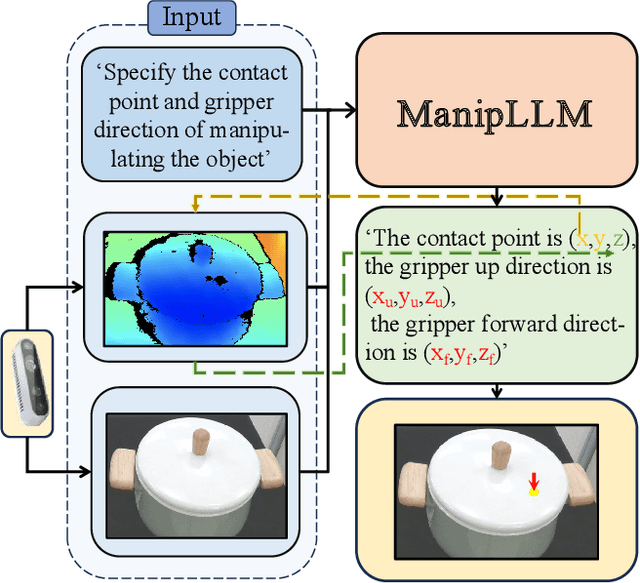
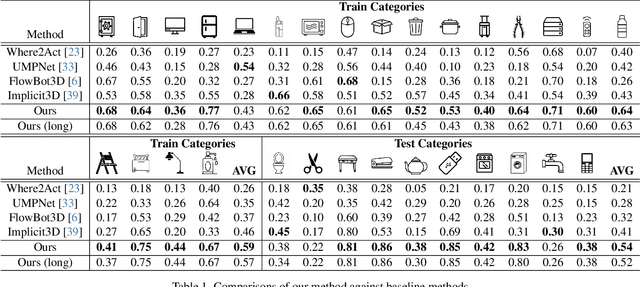
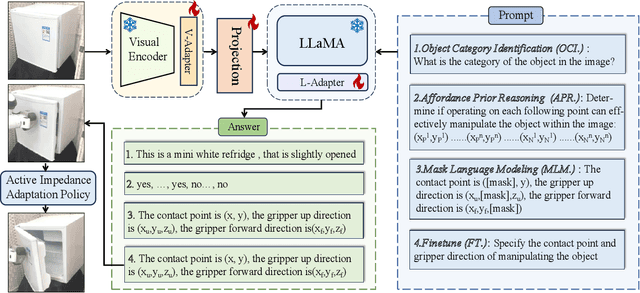
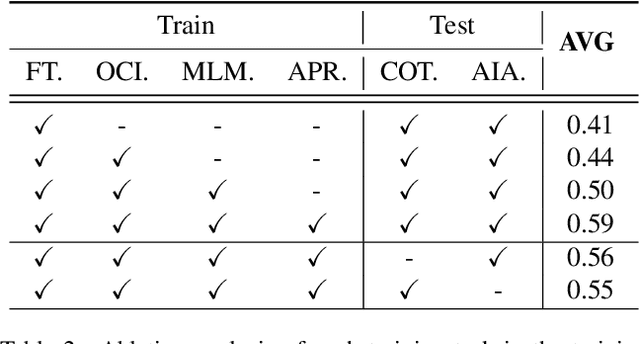
Robot manipulation relies on accurately predicting contact points and end-effector directions to ensure successful operation. However, learning-based robot manipulation, trained on a limited category within a simulator, often struggles to achieve generalizability, especially when confronted with extensive categories. Therefore, we introduce an innovative approach for robot manipulation that leverages the robust reasoning capabilities of Multimodal Large Language Models (MLLMs) to enhance the stability and generalization of manipulation. By fine-tuning the injected adapters, we preserve the inherent common sense and reasoning ability of the MLLMs while equipping them with the ability for manipulation. The fundamental insight lies in the introduced fine-tuning paradigm, encompassing object category understanding, affordance prior reasoning, and object-centric pose prediction to stimulate the reasoning ability of MLLM in manipulation. During inference, our approach utilizes an RGB image and text prompt to predict the end effector's pose in chain of thoughts. After the initial contact is established, an active impedance adaptation policy is introduced to plan the upcoming waypoints in a closed-loop manner. Moreover, in real world, we design a test-time adaptation (TTA) strategy for manipulation to enable the model better adapt to the current real-world scene configuration. Experiments in simulator and real-world show the promising performance of ManipLLM. More details and demonstrations can be found at https://sites.google.com/view/manipllm.