 Add to Chrome
 Add to Firefox
 Add to Edge
IACM-RL: Intent-Aware Context Management and Reinforcement Learning for Complex Tool Invocation under Dynamic Intent Fluctuations
Aug 03, 2026
Executing long-horizon tool invocations in real-world environments is severely challenged by dynamic user intent noise. Existing methods attempt robustness via implicit history scanning or text compression, yet predominantly assume perfect instructions in simplistic scenarios. Inevitably, under fluctuating contexts, obsolete constraints dilute model attention, triggering catastrophic intent deviation and infinite API loops. To resolve this, we propose IACM-RL, a comprehensive framework for robust tool invocation. First, we introduce the DynamicIntent pipeline, synthesizing trajectories across 13 fine-grained fluctuation scenarios, paired with a five-dimensional diagnostic metric suite. Second, IACM-RL deploys a BeliefState-based Self-Generated Context Manager that proactively tracks shifting goals and isolates overwritten parameters using structural stale flags. To autonomously internalize this state-tracking capability, we optimize the policy using a hierarchical intent-driven reward alongside three auxiliary losses (action calibration, CM extraction, and state distillation). Experiments on DynamicIntent, BFCL-V3, and $\mathrmτ^2$-Bench demonstrate that IACM-RL significantly outperforms baselines, reducing infinite loops and stale context errors while enhancing out-of-domain generalization.

GeoEyes: On-Demand Visual Focusing for Evidence-Grounded Understanding of Ultra-High-Resolution Remote Sensing Imagery
Feb 15, 2026The "thinking-with-images" paradigm enables multimodal large language models (MLLMs) to actively explore visual scenes via zoom-in tools. This is essential for ultra-high-resolution (UHR) remote sensing VQA, where task-relevant cues are sparse and tiny. However, we observe a consistent failure mode in existing zoom-enabled MLLMs: Tool Usage Homogenization, where tool calls collapse into task-agnostic patterns, limiting effective evidence acquisition. To address this, we propose GeoEyes, a staged training framework consisting of (1) a cold-start SFT dataset, UHR Chain-of-Zoom (UHR-CoZ), which covers diverse zooming regimes, and (2) an agentic reinforcement learning method, AdaZoom-GRPO, that explicitly rewards evidence gain and answer improvement during zoom interactions. The resulting model learns on-demand zooming with proper stopping behavior and achieves substantial improvements on UHR remote sensing benchmarks, with 54.23% accuracy on XLRS-Bench.
Text Before Vision: Staged Knowledge Injection Matters for Agentic RLVR in Ultra-High-Resolution Remote Sensing Understanding
Feb 15, 2026Multimodal reasoning for ultra-high-resolution (UHR) remote sensing (RS) is usually bottlenecked by visual evidence acquisition: the model necessitates localizing tiny task-relevant regions in massive pixel spaces. While Agentic Reinforcement Learning with Verifiable Rewards (RLVR) using zoom-in tools offers a path forward, we find that standard reinforcement learning struggles to navigate these vast visual spaces without structured domain priors. In this paper, we investigate the interplay between post-training paradigms: comparing Cold-start Supervised Fine-Tuning (SFT), RLVR, and Agentic RLVR on the UHR RS benchmark.Our controlled studies yield a counter-intuitive finding: high-quality Earth-science text-only QA is a primary driver of UHR visual reasoning gains. Despite lacking images, domain-specific text injects the concepts, mechanistic explanations, and decision rules necessary to guide visual evidence retrieval.Based on this, we propose a staged knowledge injection recipe: (1) cold-starting with scalable, knowledge-graph-verified Earth-science text QA to instill reasoning structures;and (2) "pre-warming" on the same hard UHR image-text examples during SFT to stabilize and amplify subsequent tool-based RL. This approach achieves a 60.40% Pass@1 on XLRS-Bench, significantly outperforming larger general purpose models (e.g., GPT-5.2, Gemini 3.0 Pro, Intern-S1) and establishing a new state-of-the-art.
SciAgentGym: Benchmarking Multi-Step Scientific Tool-use in LLM Agents
Feb 13, 2026Scientific reasoning inherently demands integrating sophisticated toolkits to navigate domain-specific knowledge. Yet, current benchmarks largely overlook agents' ability to orchestrate tools for such rigorous workflows. To bridge this gap, we introduce SciAgentGym, a scalable interactive environment featuring 1,780 domain-specific tools across four natural science disciplines, supported by a robust execution infrastructure. Complementing this, we present SciAgentBench, a tiered evaluation suite designed to stress-test agentic capabilities from elementary actions to long-horizon workflows. Our evaluation identifies a critical bottleneck: state-of-the-art models struggle with complex scientific tool-use. Even for a leading model like GPT-5, success rates drop sharply from 60.6% to 30.9% as interaction horizons extend, primarily due to failures in multi-step workflow execution. To address this, we propose SciForge, a data synthesis method that models the tool action space as a dependency graph to generate logic-aware training trajectories. By fine-tuning on these trajectories, our SciAgent-8B outperforms the significantly larger Qwen3-VL-235B-Instruct while exhibiting positive cross-domain transfer of scientific tool-use capabilities. These results underscore the promising potential of next-generation autonomous scientific agents.
DFPO: Scaling Value Modeling via Distributional Flow towards Robust and Generalizable LLM Post-Training
Feb 05, 2026Training reinforcement learning (RL) systems in real-world environments remains challenging due to noisy supervision and poor out-of-domain (OOD) generalization, especially in LLM post-training. Recent distributional RL methods improve robustness by modeling values with multiple quantile points, but they still learn each quantile independently as a scalar. This results in rough-grained value representations that lack fine-grained conditioning on state information, struggling under complex and OOD conditions. We propose DFPO (Distributional Value Flow Policy Optimization with Conditional Risk and Consistency Control), a robust distributional RL framework that models values as continuous flows across time steps. By scaling value modeling through learning of a value flow field instead of isolated quantile predictions, DFPO captures richer state information for more accurate advantage estimation. To stabilize training under noisy feedback, DFPO further integrates conditional risk control and consistency constraints along value flow trajectories. Experiments on dialogue, math reasoning, and scientific tasks show that DFPO outperforms PPO, FlowRL, and other robust baselines under noisy supervision, achieving improved training stability and generalization.
Human-AI Collaboration Mechanism Study on AIGC Assisted Image Production for Special Coverage
Dec 14, 2025Artificial Intelligence Generated Content (AIGC) assisting image production triggers controversy in journalism while attracting attention from media agencies. Key issues involve misinformation, authenticity, semantic fidelity, and interpretability. Most AIGC tools are opaque "black boxes," hindering the dual demands of content accuracy and semantic alignment and creating ethical, sociotechnical, and trust dilemmas. This paper explores pathways for controllable image production in journalism's special coverage and conducts two experiments with projects from China's media agency: (1) Experiment 1 tests cross-platform adaptability via standardized prompts across three scenes, revealing disparities in semantic alignment, cultural specificity, and visual realism driven by training-corpus bias and platform-level filtering. (2) Experiment 2 builds a human-in-the-loop modular pipeline combining high-precision segmentation (SAM, GroundingDINO), semantic alignment (BrushNet), and style regulating (Style-LoRA, Prompt-to-Prompt), ensuring editorial fidelity through CLIP-based semantic scoring, NSFW/OCR/YOLO filtering, and verifiable content credentials. Traceable deployment preserves semantic representation. Consequently, we propose a human-AI collaboration mechanism for AIGC assisted image production in special coverage and recommend evaluating Character Identity Stability (CIS), Cultural Expression Accuracy (CEA), and User-Public Appropriateness (U-PA).
AgentPRM: Process Reward Models for LLM Agents via Step-Wise Promise and Progress
Nov 11, 2025Despite rapid development, large language models (LLMs) still encounter challenges in multi-turn decision-making tasks (i.e., agent tasks) like web shopping and browser navigation, which require making a sequence of intelligent decisions based on environmental feedback. Previous work for LLM agents typically relies on elaborate prompt engineering or fine-tuning with expert trajectories to improve performance. In this work, we take a different perspective: we explore constructing process reward models (PRMs) to evaluate each decision and guide the agent's decision-making process. Unlike LLM reasoning, where each step is scored based on correctness, actions in agent tasks do not have a clear-cut correctness. Instead, they should be evaluated based on their proximity to the goal and the progress they have made. Building on this insight, we propose a re-defined PRM for agent tasks, named AgentPRM, to capture both the interdependence between sequential decisions and their contribution to the final goal. This enables better progress tracking and exploration-exploitation balance. To scalably obtain labeled data for training AgentPRM, we employ a Temporal Difference-based (TD-based) estimation method combined with Generalized Advantage Estimation (GAE), which proves more sample-efficient than prior methods. Extensive experiments across different agentic tasks show that AgentPRM is over $8\times$ more compute-efficient than baselines, and it demonstrates robust improvement when scaling up test-time compute. Moreover, we perform detailed analyses to show how our method works and offer more insights, e.g., applying AgentPRM to the reinforcement learning of LLM agents.
Data Proportion Detection for Optimized Data Management for Large Language Models
Sep 26, 2024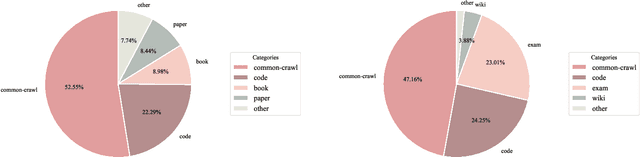
Large language models (LLMs) have demonstrated exceptional performance across a wide range of tasks and domains, with data preparation playing a critical role in achieving these results. Pre-training data typically combines information from multiple domains. To maximize performance when integrating data from various domains, determining the optimal data proportion is essential. However, state-of-the-art (SOTA) LLMs rarely disclose details about their pre-training data, making it difficult for researchers to identify ideal data proportions. In this paper, we introduce a new topic, \textit{data proportion detection}, which enables the automatic estimation of pre-training data proportions by analyzing the generated outputs of LLMs. We provide rigorous theoretical proofs, practical algorithms, and preliminary experimental results for data proportion detection. Based on these findings, we offer valuable insights into the challenges and future directions for effective data proportion detection and data management.
Channel-Spatial-Based Few-Shot Bird Sound Event Detection
Jun 25, 2023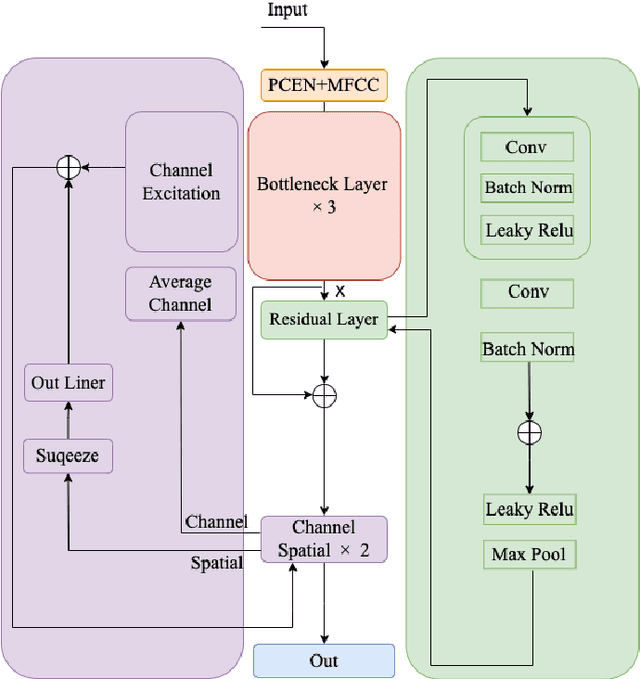
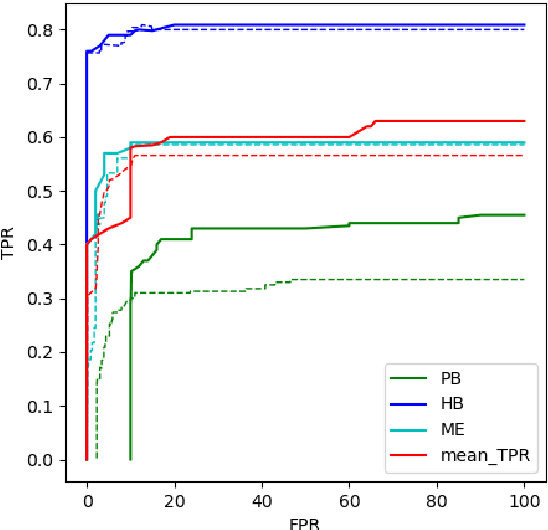
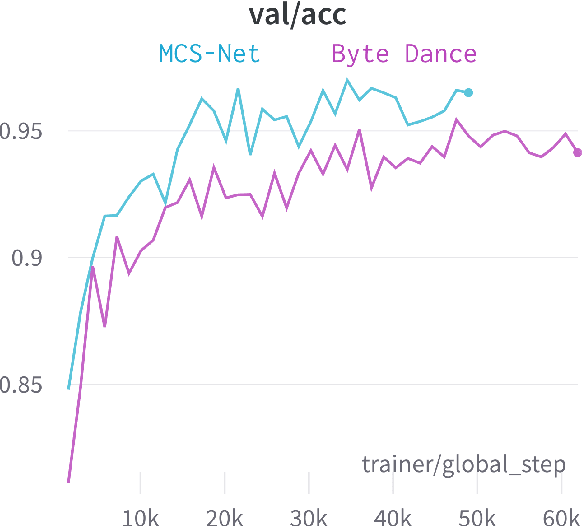
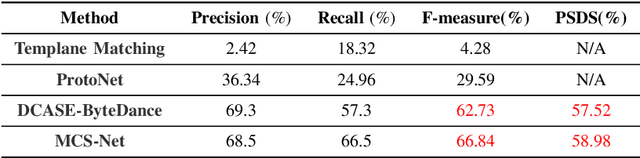
In this paper, we propose a model for bird sound event detection that focuses on a small number of training samples within the everyday long-tail distribution. As a result, we investigate bird sound detection using the few-shot learning paradigm. By integrating channel and spatial attention mechanisms, improved feature representations can be learned from few-shot training datasets. We develop a Metric Channel-Spatial Network model by incorporating a Channel Spatial Squeeze-Excitation block into the prototype network, combining it with these attention mechanisms. We evaluate the Metric Channel Spatial Network model on the DCASE 2022 Take5 dataset benchmark, achieving an F-measure of 66.84% and a PSDS of 58.98%. Our experiment demonstrates that the combination of channel and spatial attention mechanisms effectively enhances the performance of bird sound classification and detection.