 Add to Chrome
 Add to Firefox
 Add to Edge
ErrorRadar: Benchmarking Complex Mathematical Reasoning of Multimodal Large Language Models Via Error Detection
Oct 06, 2024
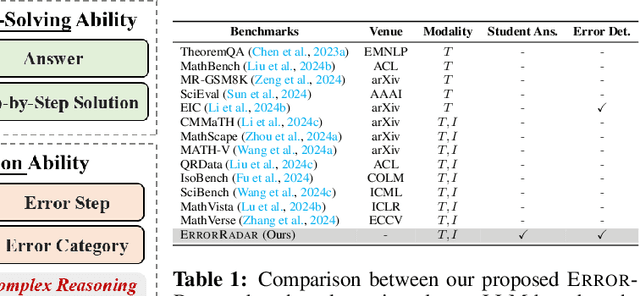
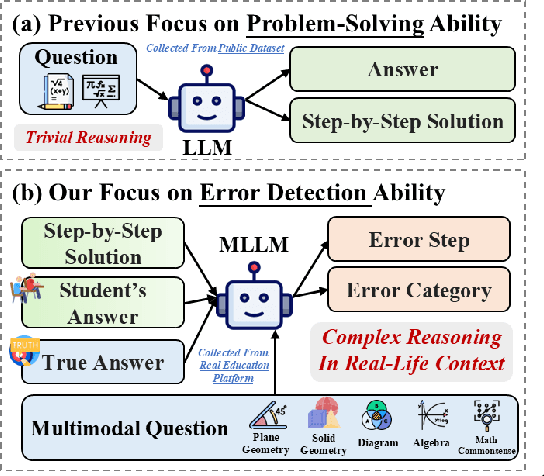
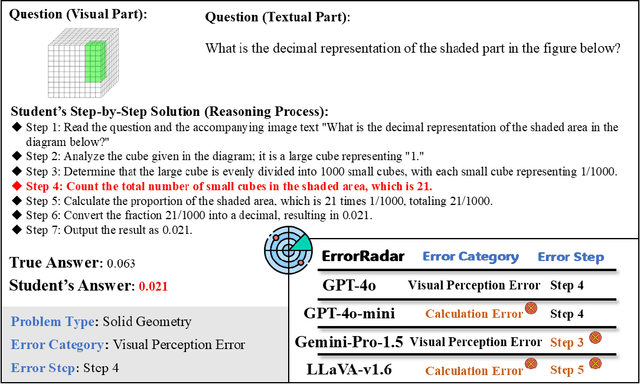
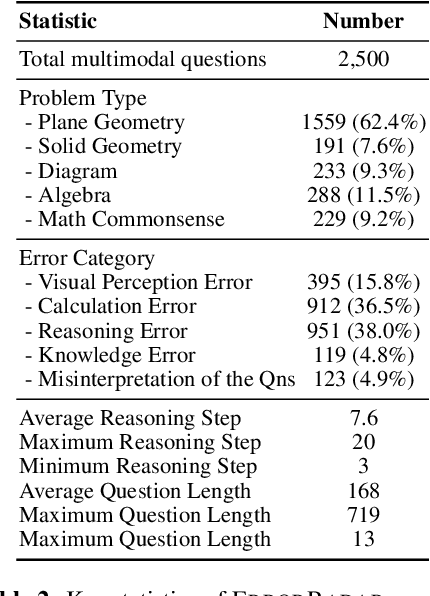
As the field of Multimodal Large Language Models (MLLMs) continues to evolve, their potential to revolutionize artificial intelligence is particularly promising, especially in addressing mathematical reasoning tasks. Current mathematical benchmarks predominantly focus on evaluating MLLMs' problem-solving ability, yet there is a crucial gap in addressing more complex scenarios such as error detection, for enhancing reasoning capability in complicated settings. To fill this gap, we formally formulate the new task: multimodal error detection, and introduce ErrorRadar, the first benchmark designed to assess MLLMs' capabilities in such a task. ErrorRadar evaluates two sub-tasks: error step identification and error categorization, providing a comprehensive framework for evaluating MLLMs' complex mathematical reasoning ability. It consists of 2,500 high-quality multimodal K-12 mathematical problems, collected from real-world student interactions in an educational organization, with rigorous annotation and rich metadata such as problem type and error category. Through extensive experiments, we evaluated both open-source and closed-source representative MLLMs, benchmarking their performance against educational expert evaluators. Results indicate significant challenges still remain, as GPT-4o with best performance is still around 10% behind human evaluation. The dataset will be available upon acceptance.

Can Watermarked LLMs be Identified by Users via Crafted Prompts?
Oct 04, 2024
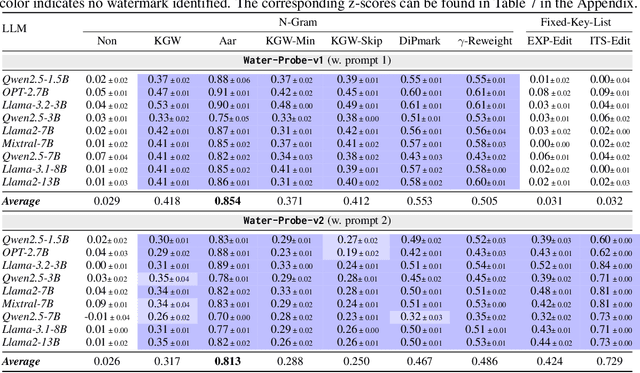


Text watermarking for Large Language Models (LLMs) has made significant progress in detecting LLM outputs and preventing misuse. Current watermarking techniques offer high detectability, minimal impact on text quality, and robustness to text editing. However, current researches lack investigation into the imperceptibility of watermarking techniques in LLM services. This is crucial as LLM providers may not want to disclose the presence of watermarks in real-world scenarios, as it could reduce user willingness to use the service and make watermarks more vulnerable to attacks. This work is the first to investigate the imperceptibility of watermarked LLMs. We design an identification algorithm called Water-Probe that detects watermarks through well-designed prompts to the LLM. Our key motivation is that current watermarked LLMs expose consistent biases under the same watermark key, resulting in similar differences across prompts under different watermark keys. Experiments show that almost all mainstream watermarking algorithms are easily identified with our well-designed prompts, while Water-Probe demonstrates a minimal false positive rate for non-watermarked LLMs. Finally, we propose that the key to enhancing the imperceptibility of watermarked LLMs is to increase the randomness of watermark key selection. Based on this, we introduce the Water-Bag strategy, which significantly improves watermark imperceptibility by merging multiple watermark keys.
Trustworthiness in Retrieval-Augmented Generation Systems: A Survey
Sep 16, 2024

Retrieval-Augmented Generation (RAG) has quickly grown into a pivotal paradigm in the development of Large Language Models (LLMs). While much of the current research in this field focuses on performance optimization, particularly in terms of accuracy and efficiency, the trustworthiness of RAG systems remains an area still under exploration. From a positive perspective, RAG systems are promising to enhance LLMs by providing them with useful and up-to-date knowledge from vast external databases, thereby mitigating the long-standing problem of hallucination. While from a negative perspective, RAG systems are at the risk of generating undesirable contents if the retrieved information is either inappropriate or poorly utilized. To address these concerns, we propose a unified framework that assesses the trustworthiness of RAG systems across six key dimensions: factuality, robustness, fairness, transparency, accountability, and privacy. Within this framework, we thoroughly review the existing literature on each dimension. Additionally, we create the evaluation benchmark regarding the six dimensions and conduct comprehensive evaluations for a variety of proprietary and open-source models. Finally, we identify the potential challenges for future research based on our investigation results. Through this work, we aim to lay a structured foundation for future investigations and provide practical insights for enhancing the trustworthiness of RAG systems in real-world applications.
WaterSeeker: Efficient Detection of Watermarked Segments in Large Documents
Sep 08, 2024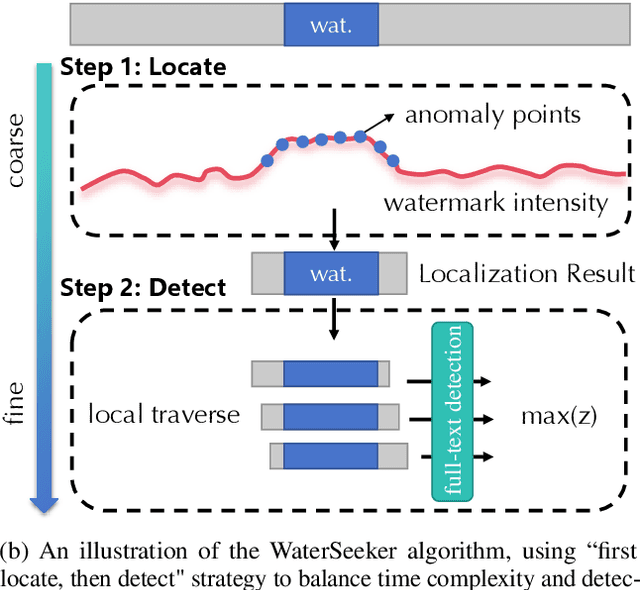
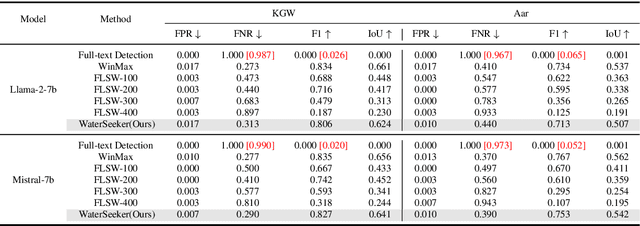


Watermarking algorithms for large language models (LLMs) have attained high accuracy in detecting LLM-generated text. However, existing methods primarily focus on distinguishing fully watermarked text from non-watermarked text, overlooking real-world scenarios where LLMs generate only small sections within large documents. In this scenario, balancing time complexity and detection performance poses significant challenges. This paper presents WaterSeeker, a novel approach to efficiently detect and locate watermarked segments amid extensive natural text. It first applies an efficient anomaly extraction method to preliminarily locate suspicious watermarked regions. Following this, it conducts a local traversal and performs full-text detection for more precise verification. Theoretical analysis and experimental results demonstrate that WaterSeeker achieves a superior balance between detection accuracy and computational efficiency. Moreover, WaterSeeker's localization ability supports the development of interpretable AI detection systems. This work pioneers a new direction in watermarked segment detection, facilitating more reliable AI-generated content identification.
DAMe: Personalized Federated Social Event Detection with Dual Aggregation Mechanism
Sep 01, 2024


Training social event detection models through federated learning (FedSED) aims to improve participants' performance on the task. However, existing federated learning paradigms are inadequate for achieving FedSED's objective and exhibit limitations in handling the inherent heterogeneity in social data. This paper proposes a personalized federated learning framework with a dual aggregation mechanism for social event detection, namely DAMe. We present a novel local aggregation strategy utilizing Bayesian optimization to incorporate global knowledge while retaining local characteristics. Moreover, we introduce a global aggregation strategy to provide clients with maximum external knowledge of their preferences. In addition, we incorporate a global-local event-centric constraint to prevent local overfitting and ``client-drift''. Experiments within a realistic simulation of a natural federated setting, utilizing six social event datasets spanning six languages and two social media platforms, along with an ablation study, have demonstrated the effectiveness of the proposed framework. Further robustness analyses have shown that DAMe is resistant to injection attacks.
TaSL: Task Skill Localization and Consolidation for Language Model Continual Learning
Aug 09, 2024Language model continual learning (CL) has recently garnered significant interest due to its potential to adapt large language models (LLMs) to dynamic real-world environments without re-training. A key challenge in this field is catastrophic forgetting, where models lose previously acquired knowledge when learning new tasks. Existing methods commonly employ multiple parameter-efficient fine-tuning (PEFT) blocks to acquire task-specific knowledge for each task, but these approaches lack efficiency and overlook the potential for knowledge transfer through task interaction. In this paper, we present a novel CL framework for language models called Task Skill Localization and Consolidation (TaSL), which enhances knowledge transfer without relying on memory replay. TaSL first divides the model into `skill units' based on parameter dependencies, enabling more granular control. It then employs a novel group-wise skill localization technique to identify the importance distribution of skill units for a new task. By comparing this importance distribution with those from previous tasks, we implement a fine-grained skill consolidation strategy that retains task-specific knowledge, thereby preventing forgetting, and updates task-shared knowledge, which facilitates bi-directional knowledge transfer. As a result, TaSL achieves a superior balance between retaining previous knowledge and excelling in new tasks. TaSL also shows strong generalizability, suitable for general models and customizable for PEFT methods like LoRA. Additionally, it demonstrates notable extensibility, allowing integration with memory replay to further enhance performance. Extensive experiments on two CL benchmarks, with varying model sizes (from 220M to 7B), demonstrate the effectiveness of TaSL and its variants across different settings.
Personalized Multi-task Training for Recommender System
Jul 31, 2024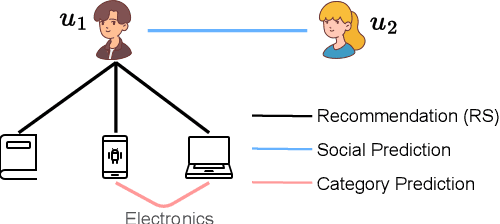
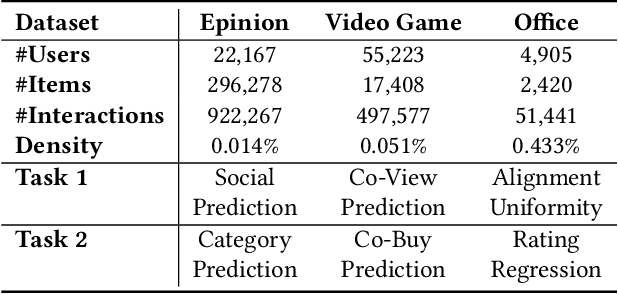
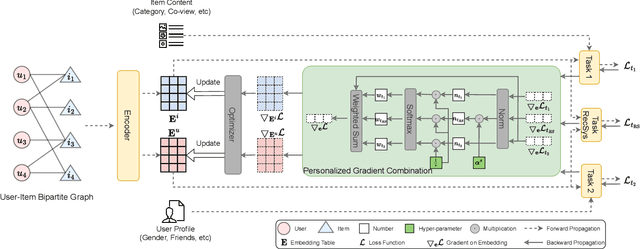
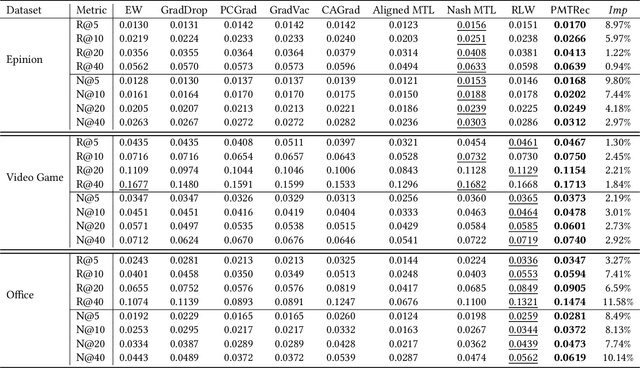
In the vast landscape of internet information, recommender systems (RecSys) have become essential for guiding users through a sea of choices aligned with their preferences. These systems have applications in diverse domains, such as news feeds, game suggestions, and shopping recommendations. Personalization is a key technique in RecSys, where modern methods leverage representation learning to encode user/item interactions into embeddings, forming the foundation for personalized recommendations. However, integrating information from multiple sources to enhance recommendation performance remains challenging. This paper introduces a novel approach named PMTRec, the first personalized multi-task learning algorithm to obtain comprehensive user/item embeddings from various information sources. Addressing challenges specific to personalized RecSys, we develop modules to handle personalized task weights, diverse task orientations, and variations in gradient magnitudes across tasks. PMTRec dynamically adjusts task weights based on gradient norms for each user/item, employs a Task Focusing module to align gradient combinations with the main recommendation task, and uses a Gradient Magnitude Balancing module to ensure balanced training across tasks. Through extensive experiments on three real-world datasets with different scales, we demonstrate that PMTRec significantly outperforms existing multi-task learning methods, showcasing its effectiveness in achieving enhanced recommendation accuracy by leveraging multiple tasks simultaneously. Our contributions open new avenues for advancing personalized multi-task training in recommender systems.
Do We Really Need Graph Convolution During Training? Light Post-Training Graph-ODE for Efficient Recommendation
Jul 29, 2024


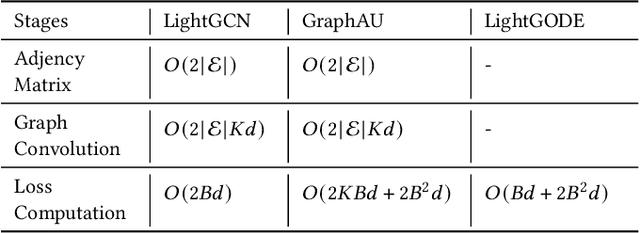
The efficiency and scalability of graph convolution networks (GCNs) in training recommender systems (RecSys) have been persistent concerns, hindering their deployment in real-world applications. This paper presents a critical examination of the necessity of graph convolutions during the training phase and introduces an innovative alternative: the Light Post-Training Graph Ordinary-Differential-Equation (LightGODE). Our investigation reveals that the benefits of GCNs are more pronounced during testing rather than training. Motivated by this, LightGODE utilizes a novel post-training graph convolution method that bypasses the computation-intensive message passing of GCNs and employs a non-parametric continuous graph ordinary-differential-equation (ODE) to dynamically model node representations. This approach drastically reduces training time while achieving fine-grained post-training graph convolution to avoid the distortion of the original training embedding space, termed the embedding discrepancy issue. We validate our model across several real-world datasets of different scales, demonstrating that LightGODE not only outperforms GCN-based models in terms of efficiency and effectiveness but also significantly mitigates the embedding discrepancy commonly associated with deeper graph convolution layers. Our LightGODE challenges the prevailing paradigms in RecSys training and suggests re-evaluating the role of graph convolutions, potentially guiding future developments of efficient large-scale graph-based RecSys.
GC-Bench: An Open and Unified Benchmark for Graph Condensation
Jun 30, 2024Graph condensation (GC) has recently garnered considerable attention due to its ability to reduce large-scale graph datasets while preserving their essential properties. The core concept of GC is to create a smaller, more manageable graph that retains the characteristics of the original graph. Despite the proliferation of graph condensation methods developed in recent years, there is no comprehensive evaluation and in-depth analysis, which creates a great obstacle to understanding the progress in this field. To fill this gap, we develop a comprehensive Graph Condensation Benchmark (GC-Bench) to analyze the performance of graph condensation in different scenarios systematically. Specifically, GC-Bench systematically investigates the characteristics of graph condensation in terms of the following dimensions: effectiveness, transferability, and complexity. We comprehensively evaluate 12 state-of-the-art graph condensation algorithms in node-level and graph-level tasks and analyze their performance in 12 diverse graph datasets. Further, we have developed an easy-to-use library for training and evaluating different GC methods to facilitate reproducible research. The GC-Bench library is available at https://github.com/RingBDStack/GC-Bench.
LLMs Assist NLP Researchers: Critique Paper (Meta-)Reviewing
Jun 25, 2024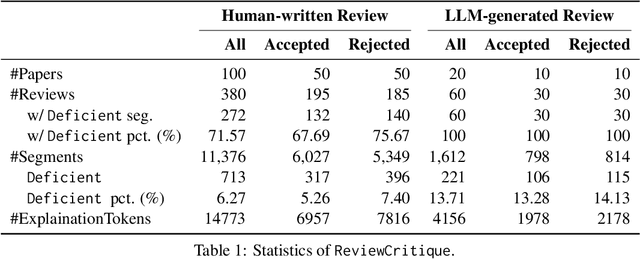
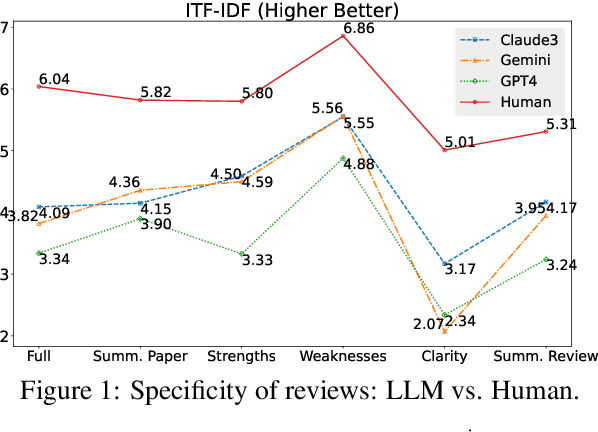
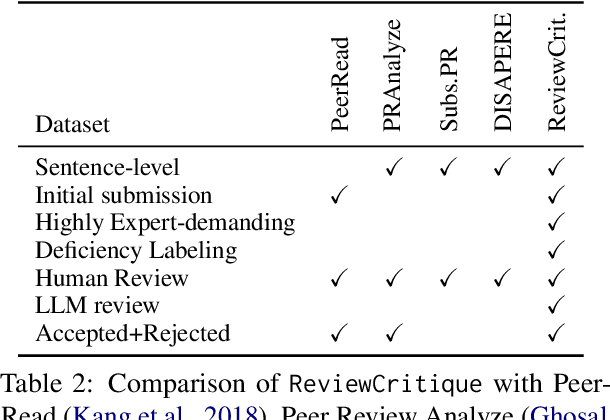
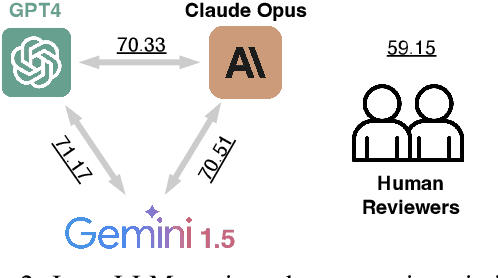
This work is motivated by two key trends. On one hand, large language models (LLMs) have shown remarkable versatility in various generative tasks such as writing, drawing, and question answering, significantly reducing the time required for many routine tasks. On the other hand, researchers, whose work is not only time-consuming but also highly expertise-demanding, face increasing challenges as they have to spend more time reading, writing, and reviewing papers. This raises the question: how can LLMs potentially assist researchers in alleviating their heavy workload? This study focuses on the topic of LLMs assist NLP Researchers, particularly examining the effectiveness of LLM in assisting paper (meta-)reviewing and its recognizability. To address this, we constructed the ReviewCritique dataset, which includes two types of information: (i) NLP papers (initial submissions rather than camera-ready) with both human-written and LLM-generated reviews, and (ii) each review comes with "deficiency" labels and corresponding explanations for individual segments, annotated by experts. Using ReviewCritique, this study explores two threads of research questions: (i) "LLMs as Reviewers", how do reviews generated by LLMs compare with those written by humans in terms of quality and distinguishability? (ii) "LLMs as Metareviewers", how effectively can LLMs identify potential issues, such as Deficient or unprofessional review segments, within individual paper reviews? To our knowledge, this is the first work to provide such a comprehensive analysis.