 Add to Chrome
 Add to Firefox
 Add to Edge
Beyond Holistic Models: Systematic Component-level Benchmarking of Deep Multivariate Time-Series Forecasting
May 26, 2026
While previous research in multivariate time series forecasting has focused on developing complex holistic models, this work advocates for a shift toward a granular, component-level understanding of their impacts. We propose TSCOMP, the first large-scale benchmark that systematically deconstructs deep forecasting methods into their core, fine-grained components--spanning series preprocessing, encoding strategies, network architectures including specific and large time-series models, and optimization methods. Using constrained orthogonal experimental design and extensive evaluations, we conduct multi-view analyses that reveal component effectiveness across different backbones, data characteristics, and their interactions. Beyond providing insights, this benchmark establishes a fine-grained performance corpus comprising over 20,000 model-dataset evaluations, which supports the learning of automated component selection, enabling zero-shot model construction on new datasets. Our experiments demonstrate that the corpus-driven approach, despite its simplicity, consistently outperforms state-of-the-art methods, validating the soundness of our evaluation design and confirming that systematic component selection surpasses manually designed complex architectures. All code and the performance corpus are publicly available at https://github.com/SUFE-AILAB/TSCOMP.

Rethinking Weak Supervision in Anomaly Detection: A Comprehensive Benchmark
May 26, 2026Weakly supervised anomaly detection (WSAD) has developed in three primary directions: incomplete, inexact, and inaccurate supervision. However, these directions remain isolated, lacking a unified framework to assess whether they address unique challenges or share fundamental mechanics. This paper introduces WSADBench, the first benchmark that unifies evaluation across distinct weakly supervised scenarios, benchmarking diverse approaches from specialized WSAD methods to advanced tabular foundation models. WSADBench establishes standardized protocols to evaluate 36 algorithms across 4 modalities by systematically varying label quantity, granularity, and quality, revealing the performance boundaries of various methods. Based on over 700K experiments, WSADBench reveals four critical insights: (i) Strong intrinsic correlations exist between these weak supervision scenarios, challenging the isolation of current research directions. (ii) Specialized WSAD algorithms excel only in extreme label-scarcity regimes but are quickly dominated by tabular foundation models and general classification methods as supervision increases or in OOD scenarios. (iii) Unlabeled data shows inconsistent utility across settings, with marginal gains compared to label refinement. (iv) Models exhibit asymmetric sensitivity to different types of label noise. We release WSADBench as an open-source benchmark with code and datasets to facilitate future WSAD research: https://github.com/SUFE-AILAB/WSADBench.
ADGym: Design Choices for Deep Anomaly Detection
Sep 27, 2023
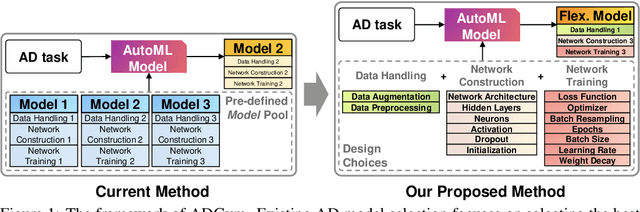


Deep learning (DL) techniques have recently been applied to anomaly detection (AD), yielding successful outcomes in areas such as finance, medical services, and cloud computing. However, much of the current research evaluates a deep AD algorithm holistically, failing to understand the contributions of individual design choices like loss functions and network architectures. Consequently, the importance of prerequisite steps, such as preprocessing, might be overshadowed by the spotlight on novel loss functions and architectures. In this paper, we address these oversights by posing two questions: (i) Which components (i.e., design choices) of deep AD methods are pivotal in detecting anomalies? (ii) How can we construct tailored AD algorithms for specific datasets by selecting the best design choices automatically, rather than relying on generic, pre-existing solutions? To this end, we introduce ADGym, the first platform designed for comprehensive evaluation and automatic selection of AD design elements in deep methods. Extensive experiments reveal that merely adopting existing leading methods is not ideal. Models crafted using ADGym markedly surpass current state-of-the-art techniques.
Weakly Supervised Anomaly Detection: A Survey
Feb 09, 2023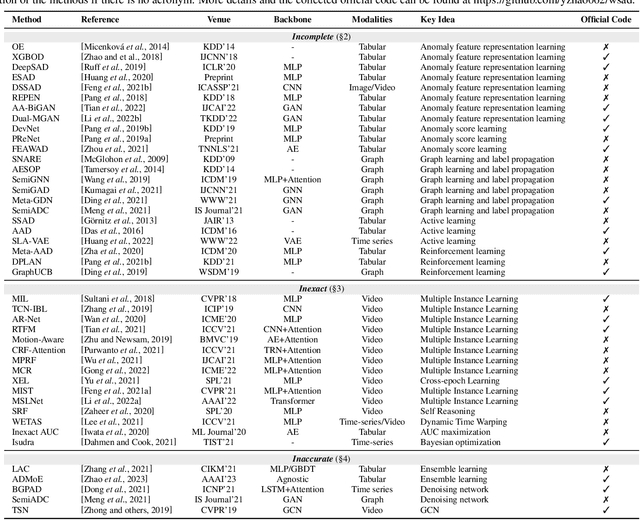
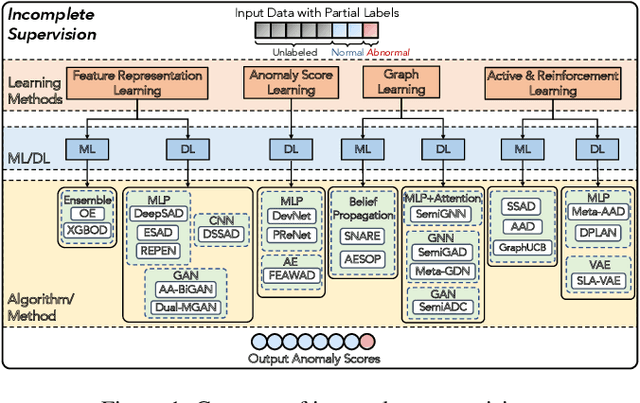
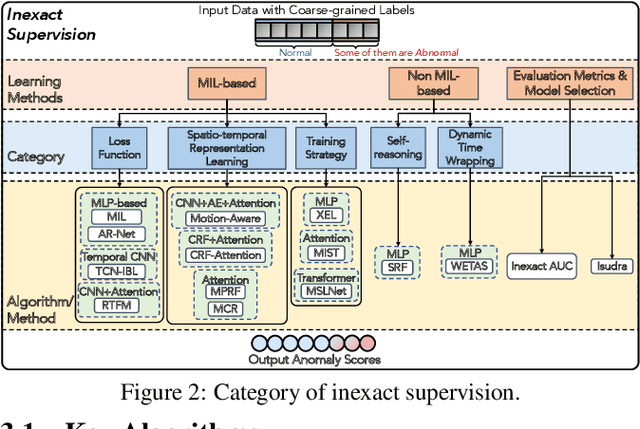
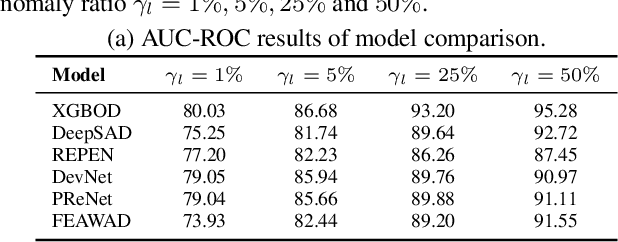
Anomaly detection (AD) is a crucial task in machine learning with various applications, such as detecting emerging diseases, identifying financial frauds, and detecting fake news. However, obtaining complete, accurate, and precise labels for AD tasks can be expensive and challenging due to the cost and difficulties in data annotation. To address this issue, researchers have developed AD methods that can work with incomplete, inexact, and inaccurate supervision, collectively summarized as weakly supervised anomaly detection (WSAD) methods. In this study, we present the first comprehensive survey of WSAD methods by categorizing them into the above three weak supervision settings across four data modalities (i.e., tabular, graph, time-series, and image/video data). For each setting, we provide formal definitions, key algorithms, and potential future directions. To support future research, we conduct experiments on a selected setting and release the source code, along with a collection of WSAD methods and data.