 Add to Chrome
 Add to Firefox
 Add to Edge
InstructVVT: Instruction-Driven Video Virtual Try-On without Auxiliary Spatial Priors
Aug 14, 2026
Video virtual try-on is a highly constrained editing task requiring the precise replacement of a target person's clothing while strictly preserving the original video's spatial structure and temporal dynamics. Existing methods heavily rely on auxiliary handcrafted spatial priors (e.g., masks, poses) for editing control. However, these priors are prone to failure in unconstrained real-world videos and often compress rich visual context into incomplete structural signals. Furthermore, standard reconstruction objectives fail to fully capture try-on-specific human preferences. To address these challenges, we propose InstructVVT, an instruction-driven and reference-guided video virtual try-on framework based on a Diffusion Transformer (DiT) that operates without inference-time spatial priors. Our core insight is to recover fine-grained control directly from the input triplet (source video, reference garment, and instruction) via a dual-level reference conditioning scheme. Specifically, an MLLM infers semantic edit tokens for target disambiguation and structural preservation, while a lightweight conditioning pathway explicitly injects fine-grained visual garment details. Finally, we design a try-on-specific reward and utilize the DiffusionNFT algorithm to align the model with human preferences. Extensive experiments on ViViD-S and TripVVT-Bench demonstrate that InstructVVT outperforms state-of-the-art open-source methods in garment fidelity, structural preservation, and temporal consistency, despite requiring fewer inference-time controls.

Process-Reward Tactic Evolution for Long-Horizon Bioinformatics Workflows
Jun 18, 2026LLM agents can write code and call tools, but reliable bioinformatics work requires long-horizon interaction with workflow software, typed data objects, provenance, and biological checks. We study this setting through Galaxy workflow execution. The agent must explore task data, construct or adapt an executable workflow DAG, bind inputs and dataset collections, monitor execution, debug failures, and validate biological outputs. We propose Process-Reward Tactic Evolution, a Galaxy-based training framework that turns verified workflow rollouts into reusable \tactics. During training, agents practice on curriculum-organized Galaxy tasks in Agent Gym; process verifiers score workflow construction, software interaction, execution, and biological correctness; successful and failed traces are distilled into a tactic library. At inference, the trained executor, Process-Reward Tactic Evolution, uses this library to execute held-out peer reviewed Galaxy workflow converted BioWorkflow Bench and BioAgent Bench tasks in isolated environments. The paper evaluates whether process-supervised tactic accumulation improves long-horizon bioinformatics workflow completion, biological correctness, and execution efficiency over no-memory and reflection-style baselines.
Spiking Pyramid Wavelet Transformation for High-efficient and Low-energy Image Restoration
Jun 17, 2026Spiking neural networks (SNNs) have garnered significant interest in computer vision due to their potential for efficiency and biological inspiration. While spiking CNN-based methods have shown promise for image restoration (IR) tasks, their performance is constrained by the inherent receptive field limitations of CNN operations. In the paper, we explore the benefits of discrete wavelet transformation and propose a spiking pyramid wavelet-based model (SPWM) for high-efficient and low-energy target. Specifically, we develop a spiking dual pyramid wavelet (SDPW) block to model long-range dependency and exploit the properties of the degradation in the wavelet domain. Experimental results on several benchmarks demonstrate that SPWM significantly lowers computational costs and energy consumption while maintaining image quality. Our method showcases the potential of SNNs in the field of IR, offering new insights for future applications of resource-limited devices.
Towards World Models in Biomedical Research
Jun 04, 2026A central goal of biomedicine is to understand, predict and ultimately control the dynamic mechanisms by which biological systems respond to perturbations, disease progression and therapeutic intervention. Although foundation models and large language models have accelerated biomedical data interpretation, most current systems remain focused on static pattern recognition rather than prospective simulation of biological futures. Here we propose biomedical world models as a paradigm for AI-driven discovery. These models learn latent representations of molecular, cellular, tissue and clinical states, together with intervention-conditioned dynamics that allow future trajectories to be simulated before actions are taken. We discuss how biomedical world models could function as data engines, environment simulators and scientific planning substrates across applications including virtual cells, organoids, virtual patients and surgical simulation. We outline the data infrastructure, evaluation benchmarks, safety constraints and governance frameworks required. Biomedical world models may provide a foundation for simulation-guided, closed-loop and experimentally actionable biomedical discovery.
From Contrast to Consistency: Rethinking Event-based Continuous-Time Optical Flow Estimation
May 26, 2026Estimating continuous optical flow is a fundamental yet challenging problem in dynamic visual perception. Event-based cameras, with microsecond latency and high dynamic range, capture brightness changes asynchronously, offering a unique opportunity to model motion with fine temporal precision. However, the scarcity of temporally dense ground-truth annotations limits the effectiveness of supervised learning, while contrast maximization (CM) frameworks, focused on sharpening the Image of Warped Events (IWE), often neglect temporal continuity and structural coherence, leading to distorted trajectories under complex motion. To overcome these challenges, we propose a hybrid-supervised framework for continuous-time optical flow estimation, grounded in the principle of Spatio-temporal Structural Consistency (STSC). This paradigm jointly enforces local structural stability and trajectory continuity, ensuring physically coherent motion across time. To further enhance representation and robustness, we design a bidirectionally complementary multi-scale architecture and employ a curriculum-guided hybrid training strategy, enabling a smooth transition from supervised point constraints to self-supervised manifold regularization. Comprehensive experiments across multiple benchmarks show that our method achieves state-of-the-art performance in both continuous-time and standard optical flow estimation, demonstrating the effectiveness of the proposed learning paradigm.
SimInsert: Seamless Video Object Insertion via Regional Sparse Attention Fusion
May 22, 2026Video object insertion requires ensuring spatio-temporal coherence and interactive realism, extending far beyond simple content placement. However, current approaches are often hindered by a reliance on explicit motion engineering or resource-intensive retraining, restricting their flexibility and generalization. To bridge this gap, we present \textit{SimInsert}, a training-free paradigm that efficiently decouples the task into intuitive single-frame editing and semantic motion description. By harnessing the robust generative priors of image-to-video diffusion models, SimInsert propagates edits temporally, strictly preserving background invariance while enabling plausible, text-driven interactions between the inserted object and the dynamic environment. Our approach hinges on non-invasive guidance mechanisms that enforce structural consistency, facilitate seamless boundary fusion, and counteract the fidelity drift that typically accumulates during the denoising trajectory. Extensive quantitative experiments validate our efficacy: SimInsert surpasses state-of-the-art methods with an 18.8\% gain in PSNR, 20.1\% in SSIM, and a 44.1\% decrease in LPIPS, offering a streamlined solution for high-fidelity video editing.
PhysCodeBench: Benchmarking Physics-Aware Symbolic Simulation of 3D Scenes via Self-Corrective Multi-Agent Refinement
Apr 26, 2026Physics-aware symbolic simulation of 3D scenes is critical for robotics, embodied AI, and scientific computing, requiring models to understand natural language descriptions of physical phenomena and translate them into executable simulation environments. While large language models (LLMs) excel at general code generation, they struggle with the semantic gap between physical descriptions and simulation implementation. We introduce PhysCodeBench, the first comprehensive benchmark for evaluating physics-aware symbolic simulation, comprising 700 manually-crafted diverse samples across mechanics, fluid dynamics, and soft-body physics with expert annotations. Our evaluation framework measures both code executability and physical accuracy through automated and visual assessment. Building on this, we propose a Self-Corrective Multi-Agent Refinement Framework (SMRF) with three specialized agents (simulation generator, error corrector, and simulation refiner) that collaborate iteratively with domain-specific validation to produce physically accurate simulations. SMRF achieves 67.7 points overall performance compared to 36.3 points for the best baseline among evaluated SOTA models, representing a 31.4-point improvement. Our analysis demonstrates that error correction is critical for accurate physics-aware symbolic simulation and that specialized multi-agent approaches significantly outperform single-agent methods across the tested physical domains.
FreeControl: Efficient, Training-Free Structural Control via One-Step Attention Extraction
Nov 07, 2025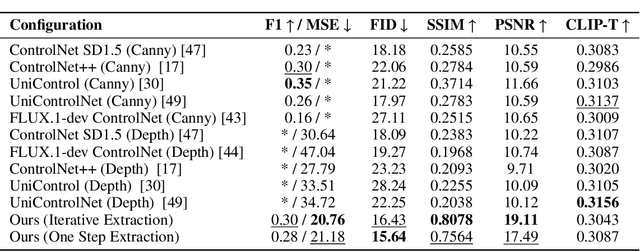
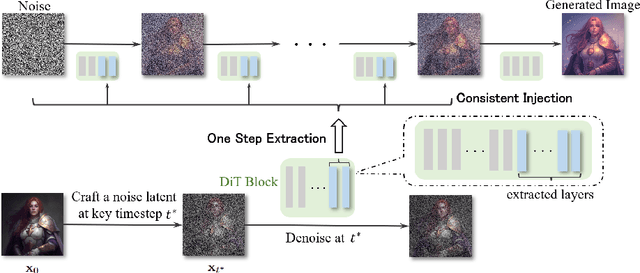
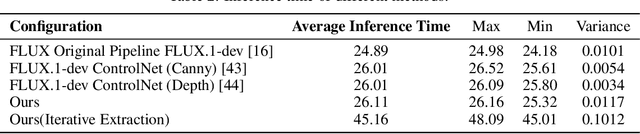
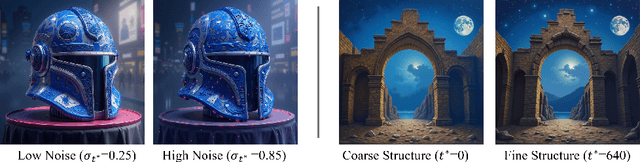
Controlling the spatial and semantic structure of diffusion-generated images remains a challenge. Existing methods like ControlNet rely on handcrafted condition maps and retraining, limiting flexibility and generalization. Inversion-based approaches offer stronger alignment but incur high inference cost due to dual-path denoising. We present FreeControl, a training-free framework for semantic structural control in diffusion models. Unlike prior methods that extract attention across multiple timesteps, FreeControl performs one-step attention extraction from a single, optimally chosen key timestep and reuses it throughout denoising. This enables efficient structural guidance without inversion or retraining. To further improve quality and stability, we introduce Latent-Condition Decoupling (LCD): a principled separation of the key timestep and the noised latent used in attention extraction. LCD provides finer control over attention quality and eliminates structural artifacts. FreeControl also supports compositional control via reference images assembled from multiple sources - enabling intuitive scene layout design and stronger prompt alignment. FreeControl introduces a new paradigm for test-time control, enabling structurally and semantically aligned, visually coherent generation directly from raw images, with the flexibility for intuitive compositional design and compatibility with modern diffusion models at approximately 5 percent additional cost.
ClinicalGPT-R1: Pushing reasoning capability of generalist disease diagnosis with large language model
Apr 15, 2025Recent advances in reasoning with large language models (LLMs)has shown remarkable reasoning capabilities in domains such as mathematics and coding, yet their application to clinical diagnosis remains underexplored. Here, we introduce ClinicalGPT-R1, a reasoning enhanced generalist large language model for disease diagnosis. Trained on a dataset of 20,000 real-world clinical records, ClinicalGPT-R1 leverages diverse training strategies to enhance diagnostic reasoning. To benchmark performance, we curated MedBench-Hard, a challenging dataset spanning seven major medical specialties and representative diseases. Experimental results demonstrate that ClinicalGPT-R1 outperforms GPT-4o in Chinese diagnostic tasks and achieves comparable performance to GPT-4 in English settings. This comparative study effectively validates the superior performance of ClinicalGPT-R1 in disease diagnosis tasks. Resources are available at https://github.com/medfound/medfound.
Targetless Intrinsics and Extrinsic Calibration of Multiple LiDARs and Cameras with IMU using Continuous-Time Estimation
Jan 06, 2025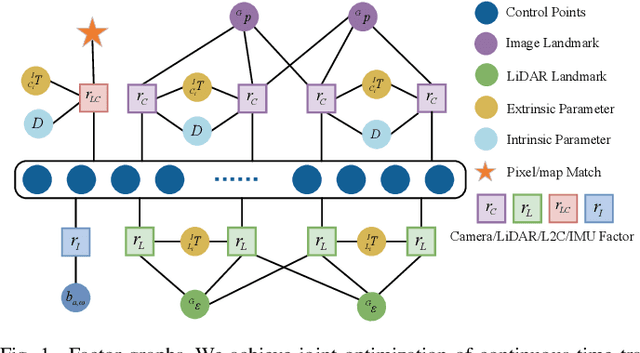
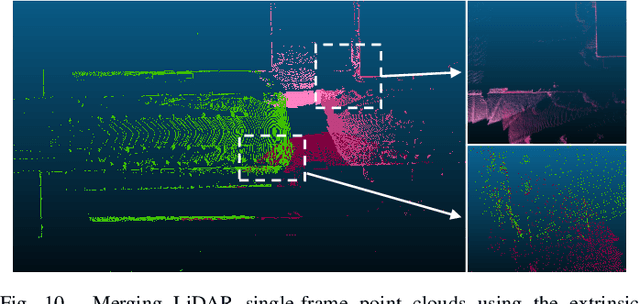
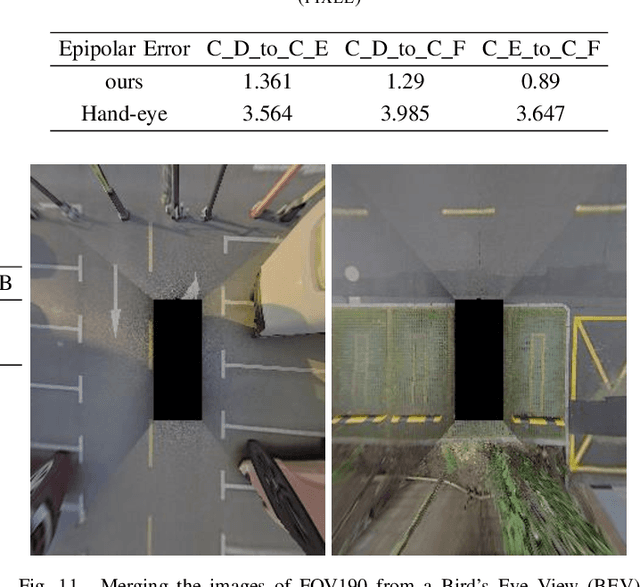
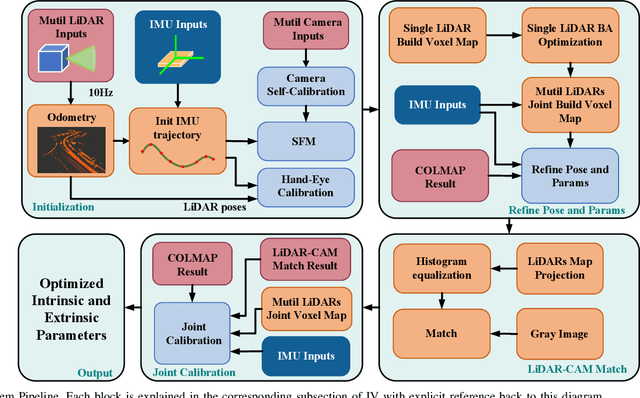
Accurate spatiotemporal calibration is a prerequisite for multisensor fusion. However, sensors are typically asynchronous, and there is no overlap between the fields of view of cameras and LiDARs, posing challenges for intrinsic and extrinsic parameter calibration. To address this, we propose a calibration pipeline based on continuous-time and bundle adjustment (BA) capable of simultaneous intrinsic and extrinsic calibration (6 DOF transformation and time offset). We do not require overlapping fields of view or any calibration board. Firstly, we establish data associations between cameras using Structure from Motion (SFM) and perform self-calibration of camera intrinsics. Then, we establish data associations between LiDARs through adaptive voxel map construction, optimizing for extrinsic calibration within the map. Finally, by matching features between the intensity projection of LiDAR maps and camera images, we conduct joint optimization for intrinsic and extrinsic parameters. This pipeline functions in texture-rich structured environments, allowing simultaneous calibration of any number of cameras and LiDARs without the need for intricate sensor synchronization triggers. Experimental results demonstrate our method's ability to fulfill co-visibility and motion constraints between sensors without accumulating errors.