 Add to Chrome
 Add to Firefox
 Add to Edge
Rewrite to Translate, Translate to Reward: Reinforcement Learning for Source Rewriting in Machine Translation
Jun 06, 2026
Although directly prompting off-the-shelf Large Language Models (LLMs) to generate meaning-preserving source rewrites can effectively enhance Machine Translation (MT) quality, doing so requires manually tuning prompts for different MT models. In this work, we propose RLSR (Reinforcement Learning for Source Rewriting), a novel RL-based framework for training a source rewriting model without tuning prompts for each MT model. RLSR optimizes the rewriting model by directly using the improvement in downstream translation quality yielded by each rewritten source as the reward. Extensive experiments across six MT models and 16 language pairs demonstrate that our 4B rewriting models trained via RLSR significantly outperform the no-rewriting baseline and existing same-scale prompt-based rewriting baselines, while achieving competitive performance against prompt-based baselines based on the 235B LLM.

XQ-MEval: A Dataset with Cross-lingual Parallel Quality for Benchmarking Translation Metrics
Apr 16, 2026Automatic evaluation metrics are essential for building multilingual translation systems. The common practice of evaluating these systems is averaging metric scores across languages, yet this is suspicious since metrics may suffer from cross-lingual scoring bias, where translations of equal quality receive different scores across languages. This problem has not been systematically studied because no benchmark exists that provides parallel-quality instances across languages, and expert annotation is not realistic. In this work, we propose XQ-MEval, a semi-automatically built dataset covering nine translation directions, to benchmark translation metrics. Specifically, we inject MQM-defined errors into gold translations automatically, filter them by native speakers for reliability, and merge errors to generate pseudo translations with controllable quality. These pseudo translations are then paired with corresponding sources and references to form triplets used in assessing the qualities of translation metrics. Using XQ-MEval, our experiments on nine representative metrics reveal the inconsistency between averaging and human judgment and provide the first empirical evidence of cross-lingual scoring bias. Finally, we propose a normalization strategy derived from XQ-MEval that aligns score distributions across languages, improving the fairness and reliability of multilingual metric evaluation.
CArtBench: Evaluating Vision-Language Models on Chinese Art Understanding, Interpretation, and Authenticity
Apr 13, 2026We introduce CARTBENCH, a museum-grounded benchmark for evaluating vision-language models (VLMs) on Chinese artworks beyond short-form recognition and QA. CARTBENCH comprises four subtasks: CURATORQA for evidence-grounded recognition and reasoning, CATALOGCAPTION for structured four-section expert-style appreciation, REINTERPRET for defensible reinterpretation with expert ratings, and CONNOISSEURPAIRS for diagnostic authenticity discrimination under visually similar confounds. CARTBENCH is built by aligning image-bearing Palace Museum objects from Wikidata with authoritative catalog pages, spanning five art categories across multiple dynasties. Across nine representative VLMs, we find that high overall CURATORQA accuracy can mask sharp drops on hard evidence linking and style-to-period inference; long-form appreciation remains far from expert references; and authenticity-oriented diagnostic discrimination stays near chance, underscoring the difficulty of connoisseur-level reasoning for current models.
Is Human Annotation Necessary? Iterative MBR Distillation for Error Span Detection in Machine Translation
Mar 16, 2026Error Span Detection (ESD) is a crucial subtask in Machine Translation (MT) evaluation, aiming to identify the location and severity of translation errors. While fine-tuning models on human-annotated data improves ESD performance, acquiring such data is expensive and prone to inconsistencies among annotators. To address this, we propose a novel self-evolution framework based on Minimum Bayes Risk (MBR) decoding, named Iterative MBR Distillation for ESD, which eliminates the reliance on human annotations by leveraging an off-the-shelf LLM to generate pseudo-labels. Extensive experiments on the WMT Metrics Shared Task datasets demonstrate that models trained solely on these self-generated pseudo-labels outperform both unadapted base model and supervised baselines trained on human annotations at the system and span levels, while maintaining competitive sentence-level performance.
Registering Source Tokens to Target Language Spaces in Multilingual Neural Machine Translation
Jan 06, 2025


The multilingual neural machine translation (MNMT) enables arbitrary translations across multiple languages by training a model with limited parameters using parallel data only. However, the performance of such MNMT models still lags behind that of large language models (LLMs), limiting their practicality. In this work, we address this limitation by introducing registering to achieve the new state-of-the-art of decoder-only MNMT models. Specifically, we insert a set of artificial tokens specifying the target language, called registers, into the input sequence between the source and target tokens. By modifying the attention mask, the target token generation only pays attention to the activation of registers, representing the source tokens in the target language space. Experiments on EC-40, a large-scale benchmark, show that our method outperforms related methods driven by optimizing multilingual representations. We further scale up and collect 9.3 billion sentence pairs across 24 languages from public datasets to pre-train two models, namely MITRE (multilingual translation with registers). One of them, MITRE-913M, outperforms NLLB-3.3B, achieves comparable performance with commercial LLMs, and shows strong adaptability in fine-tuning. Finally, we open-source our models to facilitate further research and development in MNMT: https://github.com/zhiqu22/mitre.
Improving Language Transfer Capability of Decoder-only Architecture in Multilingual Neural Machine Translation
Dec 03, 2024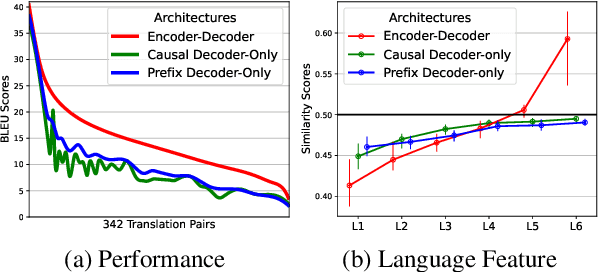


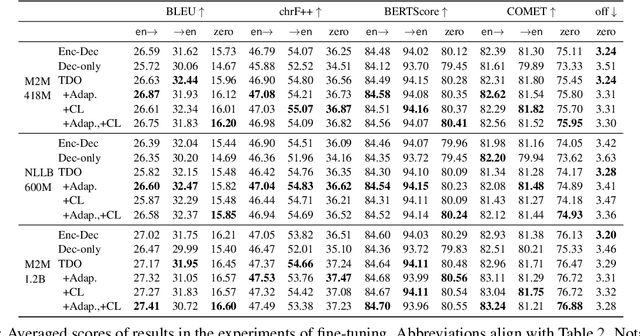
Existing multilingual neural machine translation (MNMT) approaches mainly focus on improving models with the encoder-decoder architecture to translate multiple languages. However, decoder-only architecture has been explored less in MNMT due to its underperformance when trained on parallel data solely. In this work, we attribute the issue of the decoder-only architecture to its lack of language transfer capability. Specifically, the decoder-only architecture is insufficient in encoding source tokens with the target language features. We propose dividing the decoding process into two stages so that target tokens are explicitly excluded in the first stage to implicitly boost the transfer capability across languages. Additionally, we impose contrastive learning on translation instructions, resulting in improved performance in zero-shot translation. We conduct experiments on TED-19 and OPUS-100 datasets, considering both training from scratch and fine-tuning scenarios. Experimental results show that, compared to the encoder-decoder architecture, our methods not only perform competitively in supervised translations but also achieve improvements of up to 3.39 BLEU, 6.99 chrF++, 3.22 BERTScore, and 4.81 COMET in zero-shot translations.
Exploring Intrinsic Language-specific Subspaces in Fine-tuning Multilingual Neural Machine Translation
Sep 08, 2024
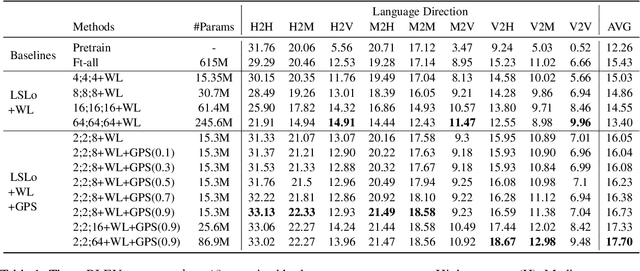
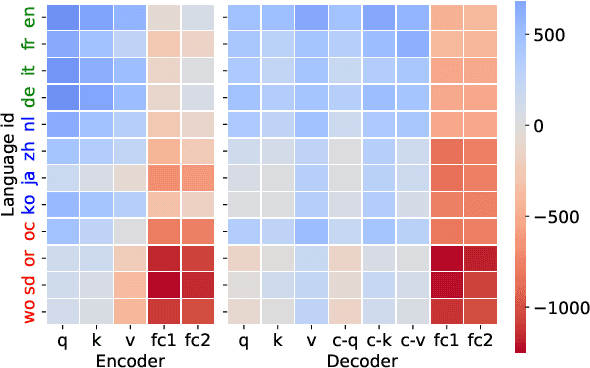

Multilingual neural machine translation models support fine-tuning hundreds of languages simultaneously. However, fine-tuning on full parameters solely is inefficient potentially leading to negative interactions among languages. In this work, we demonstrate that the fine-tuning for a language occurs in its intrinsic language-specific subspace with a tiny fraction of entire parameters. Thus, we propose language-specific LoRA to isolate intrinsic language-specific subspaces. Furthermore, we propose architecture learning techniques and introduce a gradual pruning schedule during fine-tuning to exhaustively explore the optimal setting and the minimal intrinsic subspaces for each language, resulting in a lightweight yet effective fine-tuning procedure. The experimental results on a 12-language subset and a 30-language subset of FLORES-101 show that our methods not only outperform full-parameter fine-tuning up to 2.25 spBLEU scores but also reduce trainable parameters to $0.4\%$ for high and medium-resource languages and $1.6\%$ for low-resource ones.
SynopGround: A Large-Scale Dataset for Multi-Paragraph Video Grounding from TV Dramas and Synopses
Aug 07, 2024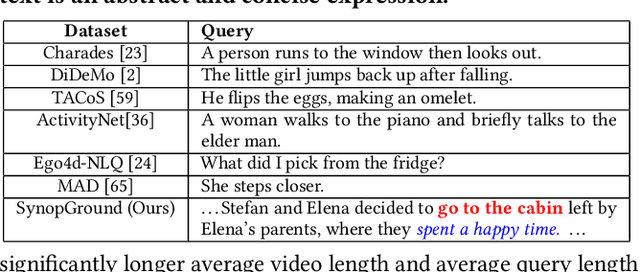


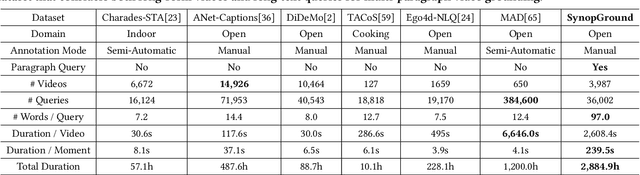
Video grounding is a fundamental problem in multimodal content understanding, aiming to localize specific natural language queries in an untrimmed video. However, current video grounding datasets merely focus on simple events and are either limited to shorter videos or brief sentences, which hinders the model from evolving toward stronger multimodal understanding capabilities. To address these limitations, we present a large-scale video grounding dataset named SynopGround, in which more than 2800 hours of videos are sourced from popular TV dramas and are paired with accurately localized human-written synopses. Each paragraph in the synopsis serves as a language query and is manually annotated with precise temporal boundaries in the long video. These paragraph queries are tightly correlated to each other and contain a wealth of abstract expressions summarizing video storylines and specific descriptions portraying event details, which enables the model to learn multimodal perception on more intricate concepts over longer context dependencies. Based on the dataset, we further introduce a more complex setting of video grounding dubbed Multi-Paragraph Video Grounding (MPVG), which takes as input multiple paragraphs and a long video for grounding each paragraph query to its temporal interval. In addition, we propose a novel Local-Global Multimodal Reasoner (LGMR) to explicitly model the local-global structures of long-term multimodal inputs for MPVG. Our method provides an effective baseline solution to the multi-paragraph video grounding problem. Extensive experiments verify the proposed model's effectiveness as well as its superiority in long-term multi-paragraph video grounding over prior state-of-the-arts. Dataset and code are publicly available. Project page: https://synopground.github.io/.
Languages Transferred Within the Encoder: On Representation Transfer in Zero-Shot Multilingual Translation
Jun 12, 2024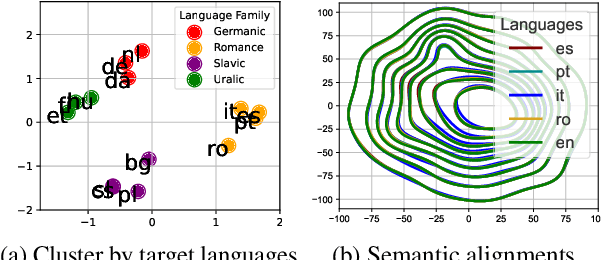
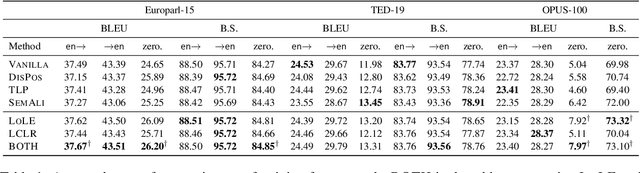
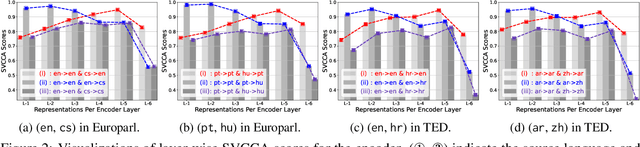
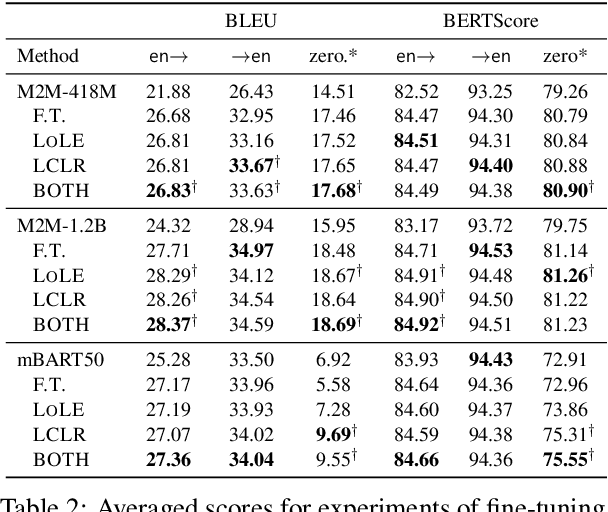
Understanding representation transfer in multilingual neural machine translation can reveal the representational issue causing the zero-shot translation deficiency. In this work, we introduce the identity pair, a sentence translated into itself, to address the lack of the base measure in multilingual investigations, as the identity pair represents the optimal state of representation among any language transfers. In our analysis, we demonstrate that the encoder transfers the source language to the representational subspace of the target language instead of the language-agnostic state. Thus, the zero-shot translation deficiency arises because representations are entangled with other languages and are not transferred effectively to the target language. Based on our findings, we propose two methods: 1) low-rank language-specific embedding at the encoder, and 2) language-specific contrastive learning of the representation at the decoder. The experimental results on Europarl-15, TED-19, and OPUS-100 datasets show that our methods substantially enhance the performance of zero-shot translations by improving language transfer capacity, thereby providing practical evidence to support our conclusions.
Sharing Parameter by Conjugation for Knowledge Graph Embeddings in Complex Space
Apr 18, 2024A Knowledge Graph (KG) is the directed graphical representation of entities and relations in the real world. KG can be applied in diverse Natural Language Processing (NLP) tasks where knowledge is required. The need to scale up and complete KG automatically yields Knowledge Graph Embedding (KGE), a shallow machine learning model that is suffering from memory and training time consumption issues. To mitigate the computational load, we propose a parameter-sharing method, i.e., using conjugate parameters for complex numbers employed in KGE models. Our method improves memory efficiency by 2x in relation embedding while achieving comparable performance to the state-of-the-art non-conjugate models, with faster, or at least comparable, training time. We demonstrated the generalizability of our method on two best-performing KGE models $5^{\bigstar}\mathrm{E}$ and $\mathrm{ComplEx}$ on five benchmark datasets.