 Add to Chrome
 Add to Firefox
 Add to Edge
DORA: Object Affordance-Guided Reinforcement Learning for Dexterous Robotic Manipulation
May 20, 2025
Dexterous robotic manipulation remains a longstanding challenge in robotics due to the high dimensionality of control spaces and the semantic complexity of object interaction. In this paper, we propose an object affordance-guided reinforcement learning framework that enables a multi-fingered robotic hand to learn human-like manipulation strategies more efficiently. By leveraging object affordance maps, our approach generates semantically meaningful grasp pose candidates that serve as both policy constraints and priors during training. We introduce a voting-based grasp classification mechanism to ensure functional alignment between grasp configurations and object affordance regions. Furthermore, we incorporate these constraints into a generalizable RL pipeline and design a reward function that unifies affordance-awareness with task-specific objectives. Experimental results across three manipulation tasks - cube grasping, jug grasping and lifting, and hammer use - demonstrate that our affordance-guided approach improves task success rates by an average of 15.4% compared to baselines. These findings highlight the critical role of object affordance priors in enhancing sample efficiency and learning generalizable, semantically grounded manipulation policies. For more details, please visit our project website https://sites.google.com/view/dora-manip.

HCMA: Hierarchical Cross-model Alignment for Grounded Text-to-Image Generation
May 15, 2025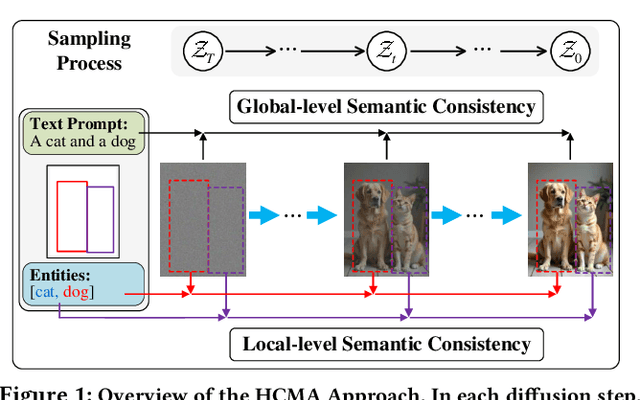
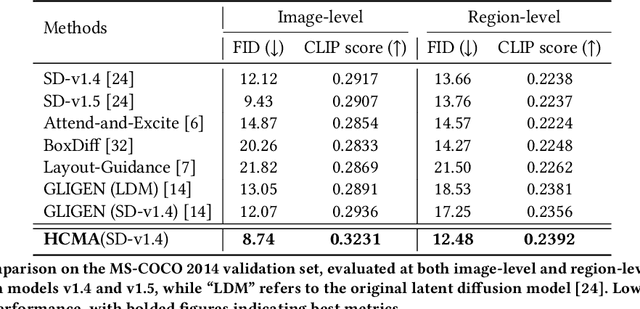
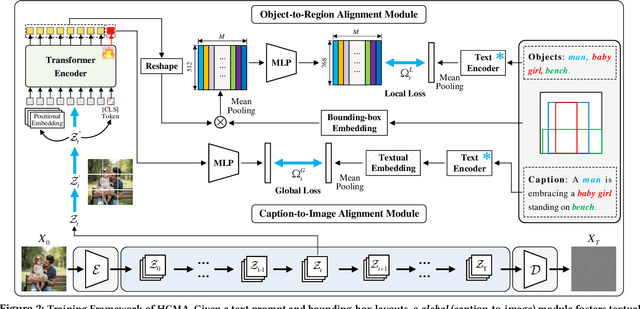
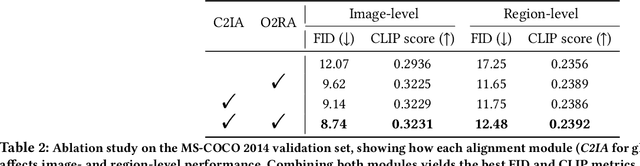
Text-to-image synthesis has progressed to the point where models can generate visually compelling images from natural language prompts. Yet, existing methods often fail to reconcile high-level semantic fidelity with explicit spatial control, particularly in scenes involving multiple objects, nuanced relations, or complex layouts. To bridge this gap, we propose a Hierarchical Cross-Modal Alignment (HCMA) framework for grounded text-to-image generation. HCMA integrates two alignment modules into each diffusion sampling step: a global module that continuously aligns latent representations with textual descriptions to ensure scene-level coherence, and a local module that employs bounding-box layouts to anchor objects at specified locations, enabling fine-grained spatial control. Extensive experiments on the MS-COCO 2014 validation set show that HCMA surpasses state-of-the-art baselines, achieving a 0.69 improvement in Frechet Inception Distance (FID) and a 0.0295 gain in CLIP Score. These results demonstrate HCMA's effectiveness in faithfully capturing intricate textual semantics while adhering to user-defined spatial constraints, offering a robust solution for semantically grounded image generation. Our code is available at https://github.com/hwang-cs-ime/HCMA.
Enhancing Trust Management System for Connected Autonomous Vehicles Using Machine Learning Methods: A Survey
May 10, 2025Connected Autonomous Vehicles (CAVs) operate in dynamic, open, and multi-domain networks, rendering them vulnerable to various threats. Trust Management Systems (TMS) systematically organize essential steps in the trust mechanism, identifying malicious nodes against internal threats and external threats, as well as ensuring reliable decision-making for more cooperative tasks. Recent advances in machine learning (ML) offer significant potential to enhance TMS, especially for the strict requirements of CAVs, such as CAV nodes moving at varying speeds, and opportunistic and intermittent network behavior. Those features distinguish ML-based TMS from social networks, static IoT, and Social IoT. This survey proposes a novel three-layer ML-based TMS framework for CAVs in the vehicle-road-cloud integration system, i.e., trust data layer, trust calculation layer and trust incentive layer. A six-dimensional taxonomy of objectives is proposed. Furthermore, the principles of ML methods for each module in each layer are analyzed. Then, recent studies are categorized based on traffic scenarios that are against the proposed objectives. Finally, future directions are suggested, addressing the open issues and meeting the research trend. We maintain an active repository that contains up-to-date literature and open-source projects at https://github.com/octoberzzzzz/ML-based-TMS-CAV-Survey.
Community and hyperedge inference in multiple hypergraphs
May 08, 2025Hypergraphs, capable of representing high-order interactions via hyperedges, have become a powerful tool for modeling real-world biological and social systems. Inherent relationships within these real-world systems, such as the encoding relationship between genes and their protein products, drive the establishment of interconnections between multiple hypergraphs. Here, we demonstrate how to utilize those interconnections between multiple hypergraphs to synthesize integrated information from multiple higher-order systems, thereby enhancing understanding of underlying structures. We propose a model based on the stochastic block model, which integrates information from multiple hypergraphs to reveal latent high-order structures. Real-world hyperedges exhibit preferential attachment, where certain nodes dominate hyperedge formation. To characterize this phenomenon, our model introduces hyperedge internal degree to quantify nodes' contributions to hyperedge formation. This model is capable of mining communities, predicting missing hyperedges of arbitrary sizes within hypergraphs, and inferring inter-hypergraph edges between hypergraphs. We apply our model to high-order datasets to evaluate its performance. Experimental results demonstrate strong performance of our model in community detection, hyperedge prediction, and inter-hypergraph edge prediction tasks. Moreover, we show that our model enables analysis of multiple hypergraphs of different types and supports the analysis of a single hypergraph in the absence of inter-hypergraph edges. Our work provides a practical and flexible tool for analyzing multiple hypergraphs, greatly advancing the understanding of the organization in real-world high-order systems.
Towards Large-scale Generative Ranking
May 08, 2025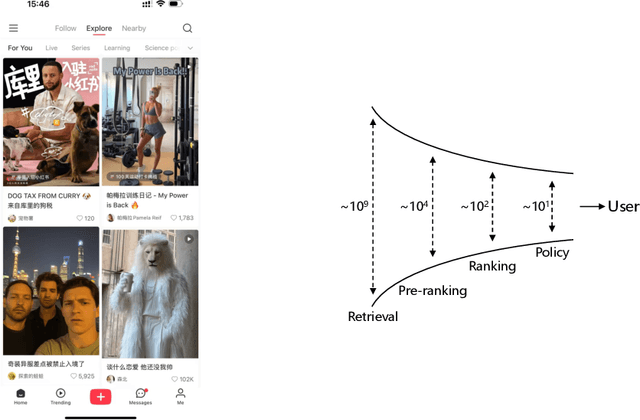
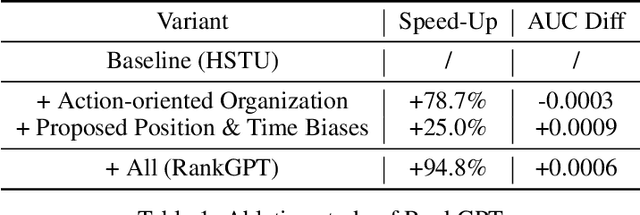
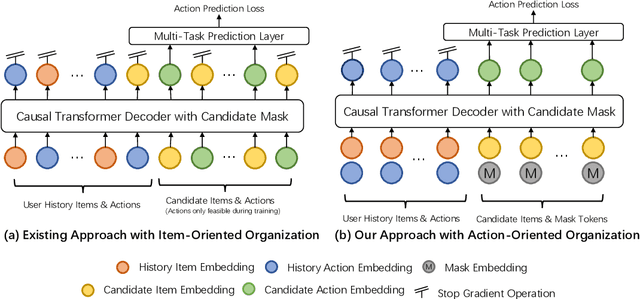

Generative recommendation has recently emerged as a promising paradigm in information retrieval. However, generative ranking systems are still understudied, particularly with respect to their effectiveness and feasibility in large-scale industrial settings. This paper investigates this topic at the ranking stage of Xiaohongshu's Explore Feed, a recommender system that serves hundreds of millions of users. Specifically, we first examine how generative ranking outperforms current industrial recommenders. Through theoretical and empirical analyses, we find that the primary improvement in effectiveness stems from the generative architecture, rather than the training paradigm. To facilitate efficient deployment of generative ranking, we introduce GenRank, a novel generative architecture for ranking. We validate the effectiveness and efficiency of our solution through online A/B experiments. The results show that GenRank achieves significant improvements in user satisfaction with nearly equivalent computational resources compared to the existing production system.
Rapid diagnostics of reconfigurable intelligent surfaces using space-time-coding modulation
May 06, 2025Reconfigurable intelligent surfaces (RISs) have emerged as a key technology for shaping smart wireless environments in next-generation wireless communication systems. To support the large-scale deployment of RISs, a reliable and efficient diagnostic method is essential to ensure optimal performance. In this work, a robust and efficient approach for RIS diagnostics is proposed using a space-time coding strategy with orthogonal codes. The method encodes the reflected signals from individual RIS elements into distinct code channels, enabling the recovery of channel power at the receiving terminals for fault identification. Theoretical analysis shows that the normally functioning elements generate high power in their respective code channels, whereas the faulty elements exhibit significantly lower power. This distinction enables rapid and accurate diagnostics of elements' operational states through simple signal processing techniques. Simulation results validate the effectiveness of the proposed method, even under high fault ratios and varying reception angles. Proof-of-principle experiments on two RIS prototypes are conducted, implementing two coding strategies: direct and segmented. Experimental results in a realistic scenario confirm the reliability of the diagnostic method, demonstrating its potential for large-scale RIS deployment in future wireless communication systems and radar applications.
No Other Representation Component Is Needed: Diffusion Transformers Can Provide Representation Guidance by Themselves
May 05, 2025Recent studies have demonstrated that learning a meaningful internal representation can both accelerate generative training and enhance generation quality of the diffusion transformers. However, existing approaches necessitate to either introduce an additional and complex representation training framework or rely on a large-scale, pre-trained representation foundation model to provide representation guidance during the original generative training process. In this study, we posit that the unique discriminative process inherent to diffusion transformers enables them to offer such guidance without requiring external representation components. We therefore propose Self-Representation A}lignment (SRA), a simple yet straightforward method that obtain representation guidance through a self-distillation manner. Specifically, SRA aligns the output latent representation of the diffusion transformer in earlier layer with higher noise to that in later layer with lower noise to progressively enhance the overall representation learning during only generative training process. Experimental results indicate that applying SRA to DiTs and SiTs yields consistent performance improvements. Moreover, SRA not only significantly outperforms approaches relying on auxiliary, complex representation training frameworks but also achieves performance comparable to methods that heavily dependent on powerful external representation priors.
MediAug: Exploring Visual Augmentation in Medical Imaging
Apr 26, 2025Data augmentation is essential in medical imaging for improving classification accuracy, lesion detection, and organ segmentation under limited data conditions. However, two significant challenges remain. First, a pronounced domain gap between natural photographs and medical images can distort critical disease features. Second, augmentation studies in medical imaging are fragmented and limited to single tasks or architectures, leaving the benefits of advanced mix-based strategies unclear. To address these challenges, we propose a unified evaluation framework with six mix-based augmentation methods integrated with both convolutional and transformer backbones on brain tumour MRI and eye disease fundus datasets. Our contributions are threefold. (1) We introduce MediAug, a comprehensive and reproducible benchmark for advanced data augmentation in medical imaging. (2) We systematically evaluate MixUp, YOCO, CropMix, CutMix, AugMix, and SnapMix with ResNet-50 and ViT-B backbones. (3) We demonstrate through extensive experiments that MixUp yields the greatest improvement on the brain tumor classification task for ResNet-50 with 79.19% accuracy and SnapMix yields the greatest improvement for ViT-B with 99.44% accuracy, and that YOCO yields the greatest improvement on the eye disease classification task for ResNet-50 with 91.60% accuracy and CutMix yields the greatest improvement for ViT-B with 97.94% accuracy. Code will be available at https://github.com/AIGeeksGroup/MediAug.
Ask2Loc: Learning to Locate Instructional Visual Answers by Asking Questions
Apr 22, 2025Locating specific segments within an instructional video is an efficient way to acquire guiding knowledge. Generally, the task of obtaining video segments for both verbal explanations and visual demonstrations is known as visual answer localization (VAL). However, users often need multiple interactions to obtain answers that align with their expectations when using the system. During these interactions, humans deepen their understanding of the video content by asking themselves questions, thereby accurately identifying the location. Therefore, we propose a new task, named In-VAL, to simulate the multiple interactions between humans and videos in the procedure of obtaining visual answers. The In-VAL task requires interactively addressing several semantic gap issues, including 1) the ambiguity of user intent in the input questions, 2) the incompleteness of language in video subtitles, and 3) the fragmentation of content in video segments. To address these issues, we propose Ask2Loc, a framework for resolving In-VAL by asking questions. It includes three key modules: 1) a chatting module to refine initial questions and uncover clear intentions, 2) a rewriting module to generate fluent language and create complete descriptions, and 3) a searching module to broaden local context and provide integrated content. We conduct extensive experiments on three reconstructed In-VAL datasets. Compared to traditional end-to-end and two-stage methods, our proposed Ask2Loc can improve performance by up to 14.91 (mIoU) on the In-VAL task. Our code and datasets can be accessed at https://github.com/changzong/Ask2Loc.
AffordanceSAM: Segment Anything Once More in Affordance Grounding
Apr 22, 2025Improving the generalization ability of an affordance grounding model to recognize regions for unseen objects and affordance functions is crucial for real-world application. However, current models are still far away from such standards. To address this problem, we introduce AffordanceSAM, an effective approach that extends SAM's generalization capacity to the domain of affordance grounding. For the purpose of thoroughly transferring SAM's robust performance in segmentation to affordance, we initially propose an affordance-adaption module in order to help modify SAM's segmentation output to be adapted to the specific functional regions required for affordance grounding. We concurrently make a coarse-to-fine training recipe to make SAM first be aware of affordance objects and actions coarsely, and then be able to generate affordance heatmaps finely. Both quantitative and qualitative experiments show the strong generalization capacity of our AffordanceSAM, which not only surpasses previous methods under AGD20K benchmark but also shows evidence to handle the task with novel objects and affordance functions.