 Add to Chrome
 Add to Firefox
 Add to Edge
From Scalars to Time Series: Rethinking Implicit Neural Representations for Time-Varying Volumetric Data
Jul 23, 2026
Implicit neural representations (INRs) for time-varying volumetric data are typically trained using dense sampling over spatiotemporal coordinates, where each observation corresponds to a single point in space and time. This coordinate-wise formulation requires extensive sampling during optimization, leading to high computational cost and inefficient use of temporal structure. In this work, we revisit this design choice and show that dense spatiotemporal sampling is not necessary for learning time-varying fields. Instead, we represent the data as a collection of spatially indexed time series and train INRs using sequence-level supervision over each spatial location, rather than coordinate-wise scalar samples. This reformulation eliminates the need for dense spatiotemporal sampling and instead learns each spatial location from its full temporal evolution in a structured manner. We demonstrate that this representation is compatible with a range of existing INR architectures and consistently improves reconstruction quality, while significantly reducing training cost. Furthermore, we show that this formulation can be combined with mixture-of-experts architectures, and that our MoE instantiation further improves reconstruction quality compared to both the base reformulation and existing MoE-based INR methods, providing a stronger capacity allocation under heterogeneous temporal dynamics.

Controlling Tool Use with Heading-Specific Activation Steering
Jul 07, 2026Tool-augmented large language models extend their capabilities beyond parametric knowledge through external tools, but tend to invoke them unnecessarily. We investigate whether tool-use decisions have any stable internal representation that can be extracted and manipulated, a question that is non-trivial given that tools exist entirely in context at inference time and have no direct encoding in model weights. We show that steering vectors extracted from heading-anchors positions exert bidirectional causal control over tool-invocation behavior across five open-source models and three domains, suppressing unnecessary tool use most effectively in domains where parametric reasoning suffices. However, geometric analysis reveals that this causal effectiveness does not correspond to clean linear structure: tool-invocation steps exhibit diffuse, bimodal alignment with the suppression vector rather than the consistent negative alignment a linear encoding account would predict, and different tool types recruit largely distinct internal signatures with low cross-tool feature overlap. We hypothesize these geometric properties are indicative of the non-parametric nature of tools, and distinguish tool-use steering vectors from those extracted for parametrically grounded concepts. The relationship between this geometric irregularity and the observed causal effectiveness remains an open question.
Flying to Image-Specified Objects: 3D Quadrotor Navigation via Cross-Graph Memory and Viewpoint Planning
Jun 29, 2026Instance-Specific Image-Goal Navigation (InstanceImageNav) requires a robot to navigate toward the exact object instance depicted in a query image. Extending this task to quadrotors is challenging due to continuous 3D control, limited field of view (FOV), and safety constraints, which make successful navigation highly dependent on selecting informative viewpoints. We propose a hierarchical navigation framework for quadrotor InstanceImageNav that separates high-level decision making from low-level motion execution. Instead of navigating directly to spatial locations, the system generates viewpoint-aware action nodes around frontier regions and potential target objects, enabling the robot to explore while maintaining informative viewpoints for detecting the target instance. A lightweight semantic memory maintains object-level and observation-level context, allowing semantic cues to propagate to candidate action nodes for decision making. A learning-based policy selects the most promising action node, and a trajectory planner generates dynamically feasible 3D flight paths for safe execution. Experiments in simulation demonstrate consistent improvements over strong baselines, and real-world quadrotor flights validate the practicality and robustness of the proposed framework.
RoamFlow: Reinforcement-Aligned One-Step Action MeanFlow Policy for Image-Goal Navigation
Jun 29, 2026Image-goal navigation is a key challenge in embodied robotics, where an agent must reach a target specified solely by a goal image. While existing reinforcement learning approaches map perceptual observations directly to actions, they struggle to model long-horizon dependencies, often leading to suboptimal trajectories. To address this limitation, we propose RoamFlow, a generative navigation framework that leverages MeanFlow to predict the average velocity field for trajectory synthesis, enabling efficient few-step generation and reducing inference latency. We further adopt a two-stage training strategy that combines expert imitation for stable initialization with reinforcement learning for task-specific policy refinement. Extensive experiments in both Habitat simulation and real-world robotic platforms demonstrate that RoamFlow achieves efficient inference while maintaining strong navigation performance under real-time constraints.
A Gradient Perspective on RLVR Stability and Winner Advantage Policy Optimization
Jun 15, 2026Reinforcement learning with verifiable rewards (RLVR) improves language-model reasoning, but GRPO-style optimization remains prone to collapse. We analyse this instability through token-level gradient dynamics, deriving a taxonomy that predicts how updates affect next-token probabilities and entropy. The taxonomy shows that stability depends jointly on the advantage sign and token distribution under the current policy. Motivated by this finding, we propose Winner Advantage Policy Optimization (WAPO), a simple online clipped policy-gradient objective that updates only on positive-advantage completions. Across mathematical reasoning and multi-hop QA benchmarks, WAPO improves training stability and matches or outperforms baselines across multiple model families. Full code can be found at https://github.com/layer6ai-labs/wapo.
AgentBeats: Agentifying Agent Assessment for Openness, Standardization, and Reproducibility
Jun 11, 2026Agent systems are advancing quickly across domains, but their evaluation remains fragmented. Most benchmarks rely on fixed, LLM-centric harnesses that require heavy integration, create test-production mismatch, and limit fair comparison across diverse agent designs. The root problem is the lack of an open, agent-agnostic assessment interface. We advocate Agentified Agent Assessment (AAA), where evaluation is performed by judge agents and all participants interact through standardized protocols: A2A for task management and MCP for tool access. Conventional benchmarking defines two separate interfaces, one for the benchmark and one for the agent, while AAA only needs one; this yields a generic, unified framework that separates assessment logic from agent implementation and enables reproducible, interoperable, and multi-agent evaluation. We further introduce AgentBeats as a concrete realization of AAA: we identify five practical operation modes that make standardized assessment compatible with real-world constraints on openness, privacy, and reproducibility. To evaluate our design at scale, we conduct two studies: a five-month open competition that drew 298 judge agents across 12 categories together with 467 subject agents from independent participants, showing that AAA applies across a heterogeneous range of benchmarks; and a case study on coding agents that confirms agentified evaluation preserves fidelity with the public record while surfacing previously missing head-to-head results, yielding research insights about agent design. Combining a community-scale field study and a controlled coding case study, we verify that AAA delivers coverage, practicality, and fidelity across heterogeneous scenarios at scale. Together, AAA and AgentBeats offer a clear path toward open, standardized, and reproducible agent assessment.
Turning Generators into Retrievers: Unlocking MLLMs for Natural Language-Guided Geo-Localization
Apr 12, 2026Natural-language Guided Cross-view Geo-localization (NGCG) aims to retrieve geo-tagged satellite imagery using textual descriptions of ground scenes. While recent NGCG methods commonly rely on CLIP-style dual-encoder architectures, they often suffer from weak cross-modal generalization and require complex architectural designs. In contrast, Multimodal Large Language Models (MLLMs) offer powerful semantic reasoning capabilities but are not directly optimized for retrieval tasks. In this work, we present a simple yet effective framework to adapt MLLMs for NGCG via parameter-efficient finetuning. Our approach optimizes latent representations within the MLLM while preserving its pretrained multimodal knowledge, enabling strong cross-modal alignment without redesigning model architectures. Through systematic analysis of diverse variables, from model backbone to feature aggregation, we provide practical and generalizable insights for leveraging MLLMs in NGCG. Our method achieves SOTA on GeoText-1652 with a 12.2% improvement in Text-to-Image Recall@1 and secures top performance in 5 out of 12 subtasks on CVG-Text, all while surpassing baselines with far fewer trainable parameters. These results position MLLMs as a robust foundation for semantic cross-view retrieval and pave the way for MLLM-based NGCG to be adopted as a scalable, powerful alternative to traditional dual-encoder designs. Project page and code are available at https://yuqichen888.github.io/NGCG-MLLMs-web/.
Causal-Guided Detoxify Backdoor Attack of Open-Weight LoRA Models
Dec 22, 2025Low-Rank Adaptation (LoRA) has emerged as an efficient method for fine-tuning large language models (LLMs) and is widely adopted within the open-source community. However, the decentralized dissemination of LoRA adapters through platforms such as Hugging Face introduces novel security vulnerabilities: malicious adapters can be easily distributed and evade conventional oversight mechanisms. Despite these risks, backdoor attacks targeting LoRA-based fine-tuning remain relatively underexplored. Existing backdoor attack strategies are ill-suited to this setting, as they often rely on inaccessible training data, fail to account for the structural properties unique to LoRA, or suffer from high false trigger rates (FTR), thereby compromising their stealth. To address these challenges, we propose Causal-Guided Detoxify Backdoor Attack (CBA), a novel backdoor attack framework specifically designed for open-weight LoRA models. CBA operates without access to original training data and achieves high stealth through two key innovations: (1) a coverage-guided data generation pipeline that synthesizes task-aligned inputs via behavioral exploration, and (2) a causal-guided detoxification strategy that merges poisoned and clean adapters by preserving task-critical neurons. Unlike prior approaches, CBA enables post-training control over attack intensity through causal influence-based weight allocation, eliminating the need for repeated retraining. Evaluated across six LoRA models, CBA achieves high attack success rates while reducing FTR by 50-70\% compared to baseline methods. Furthermore, it demonstrates enhanced resistance to state-of-the-art backdoor defenses, highlighting its stealth and robustness.
VMDT: Decoding the Trustworthiness of Video Foundation Models
Nov 07, 2025As foundation models become more sophisticated, ensuring their trustworthiness becomes increasingly critical; yet, unlike text and image, the video modality still lacks comprehensive trustworthiness benchmarks. We introduce VMDT (Video-Modal DecodingTrust), the first unified platform for evaluating text-to-video (T2V) and video-to-text (V2T) models across five key trustworthiness dimensions: safety, hallucination, fairness, privacy, and adversarial robustness. Through our extensive evaluation of 7 T2V models and 19 V2T models using VMDT, we uncover several significant insights. For instance, all open-source T2V models evaluated fail to recognize harmful queries and often generate harmful videos, while exhibiting higher levels of unfairness compared to image modality models. In V2T models, unfairness and privacy risks rise with scale, whereas hallucination and adversarial robustness improve -- though overall performance remains low. Uniquely, safety shows no correlation with model size, implying that factors other than scale govern current safety levels. Our findings highlight the urgent need for developing more robust and trustworthy video foundation models, and VMDT provides a systematic framework for measuring and tracking progress toward this goal. The code is available at https://sunblaze-ucb.github.io/VMDT-page/.
Beyond Quality: Unlocking Diversity in Ad Headline Generation with Large Language Models
Aug 26, 2025
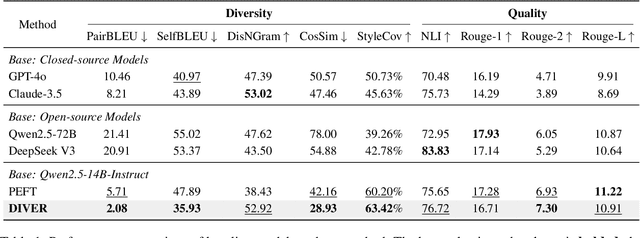
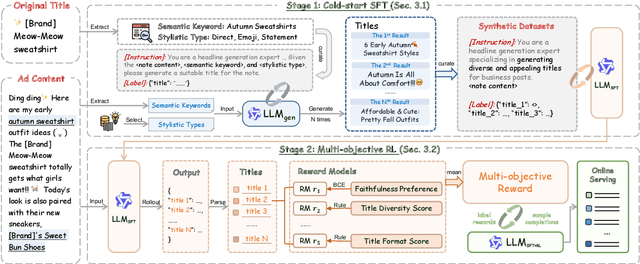
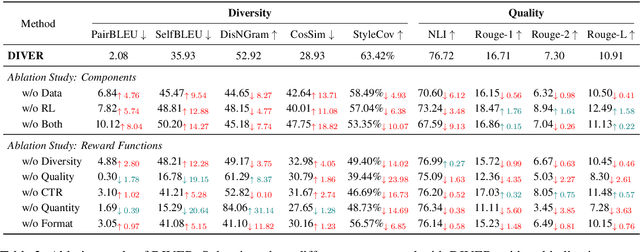
The generation of ad headlines plays a vital role in modern advertising, where both quality and diversity are essential to engage a broad range of audience segments. Current approaches primarily optimize language models for headline quality or click-through rates (CTR), often overlooking the need for diversity and resulting in homogeneous outputs. To address this limitation, we propose DIVER, a novel framework based on large language models (LLMs) that are jointly optimized for both diversity and quality. We first design a semantic- and stylistic-aware data generation pipeline that automatically produces high-quality training pairs with ad content and multiple diverse headlines. To achieve the goal of generating high-quality and diversified ad headlines within a single forward pass, we propose a multi-stage multi-objective optimization framework with supervised fine-tuning (SFT) and reinforcement learning (RL). Experiments on real-world industrial datasets demonstrate that DIVER effectively balances quality and diversity. Deployed on a large-scale content-sharing platform serving hundreds of millions of users, our framework improves advertiser value (ADVV) and CTR by 4.0% and 1.4%.