 Add to Chrome
 Add to Firefox
 Add to Edge
FluxFlow: Conservative Flow-Matching for Astronomical Image Super-Resolution
May 05, 2026
Ground-to-space astronomical super-resolution requires recovering space-quality images from ground-based observations that are simultaneously limited by pixel sampling resolution and atmospheric seeing, which imposes a stochastic, spatially varying PSF that cannot be resolved through upsampling alone. Existing methods rely on synthetic training pairs that fail to capture real atmospheric statistics and are prone to either over-smoothed reconstructions or hallucination sources with no physical counterpart in the observed sky. We propose FluxFlow, a conservative pixel-space flow-matching framework that incorporates observation uncertainty and source-region importance weights during training, and a training-free Wiener-regularized test-time correction to suppress hallucination sources while preserving recovered detail. We further construct the DESI--HST Dataset, the large-scale real-world benchmark comprising 19,500 real co-registered ground-to-space image pairs with real atmospheric PSF variation. Experiments demonstrate that FluxFlow consistently outperforms existing baseline methods in both photometric and scientific accuracy.

Exploring Time Conditioning in Diffusion Generative Models from Disjoint Noisy Data Manifolds
Apr 28, 2026Practically, training diffusion models typically requires explicit time conditioning to guide the network through the denoising sampling process. Especially in deterministic methods like DDIM, the absence of time conditioning leads to significant performance degradation. However, other deterministic sampling approaches, such as flow matching, can generate high-quality content without this conditioning, raising the question of its necessity. In this work, we revisit the role of time conditioning from a geometric perspective. We analyze the evolution of noisy data distributions under the forward diffusion process and demonstrate that, in high-dimensional spaces, these distributions concentrate on low-dimensional hyper-cylinder-like manifolds embedded within the input space. Successful generation, we argue, stems from the disentanglement of these manifolds in high-dimensional space. Based on this insight, we modify the forward process of DDIM to align the noisy data manifold with the flow-matching approach, proving that DDIM can generate high-quality content without time conditioning, provided the noisy manifold evolves according to the flow-matching method. Additionally, we extend our framework to class-conditioned generation by decoupling classes into distinct time spaces, enabling class-conditioned synthesis with a class-unconditional denoising model. Extensive experiments validate our theoretical analysis and show that high-quality generation is achievable without explicit conditional embeddings.
Unlocking the Potential of Grounding DINO in Videos: Parameter-Efficient Adaptation for Limited-Data Spatial-Temporal Localization
Apr 14, 2026Spatio-temporal video grounding (STVG) aims to localize queried objects within dynamic video segments. Prevailing fully-trained approaches are notoriously data-hungry. However, gathering large-scale STVG data is exceptionally challenging: dense frame-level bounding boxes and complex temporal language alignments are prohibitively expensive to annotate, especially for specialized video domains. Consequently, conventional models suffer from severe overfitting on these inherently limited datasets, while zero-shot foundational models lack the task-specific temporal awareness needed for precise localization. To resolve this small-data challenge, we introduce ST-GD, a data-efficient framework that adapts pre-trained 2D visual-language models (e.g., Grounding DINO) to video tasks. To avoid destroying pre-trained priors on small datasets, ST-GD keeps the base model frozen and strategically injects lightweight adapters (~10M trainable parameters) to instill spatio-temporal awareness, alongside a novel temporal decoder for boundary prediction. This design naturally counters data scarcity. Consequently, ST-GD excels in data-scarce scenarios, achieving highly competitive performance on the limited-scale HC-STVG v1/v2 benchmarks, while maintaining robust generalization on the VidSTG dataset. This validates ST-GD as a powerful paradigm for complex video understanding under strict small-data constraints.
VAE-REPA: Variational Autoencoder Representation Alignment for Efficient Diffusion Training
Jan 25, 2026Denoising-based diffusion transformers, despite their strong generation performance, suffer from inefficient training convergence. Existing methods addressing this issue, such as REPA (relying on external representation encoders) or SRA (requiring dual-model setups), inevitably incur heavy computational overhead during training due to external dependencies. To tackle these challenges, this paper proposes \textbf{\namex}, a lightweight intrinsic guidance framework for efficient diffusion training. \name leverages off-the-shelf pre-trained Variational Autoencoder (VAE) features: their reconstruction property ensures inherent encoding of visual priors like rich texture details, structural patterns, and basic semantic information. Specifically, \name aligns the intermediate latent features of diffusion transformers with VAE features via a lightweight projection layer, supervised by a feature alignment loss. This design accelerates training without extra representation encoders or dual-model maintenance, resulting in a simple yet effective pipeline. Extensive experiments demonstrate that \name improves both generation quality and training convergence speed compared to vanilla diffusion transformers, matches or outperforms state-of-the-art acceleration methods, and incurs merely 4\% extra GFLOPs with zero additional cost for external guidance models.
Distribution Matching Distillation Meets Reinforcement Learning
Nov 19, 2025Distribution Matching Distillation (DMD) distills a pre-trained multi-step diffusion model to a few-step one to improve inference efficiency. However, the performance of the latter is often capped by the former. To circumvent this dilemma, we propose DMDR, a novel framework that combines Reinforcement Learning (RL) techniques into the distillation process. We show that for the RL of the few-step generator, the DMD loss itself is a more effective regularization compared to the traditional ones. In turn, RL can help to guide the mode coverage process in DMD more effectively. These allow us to unlock the capacity of the few-step generator by conducting distillation and RL simultaneously. Meanwhile, we design the dynamic distribution guidance and dynamic renoise sampling training strategies to improve the initial distillation process. The experiments demonstrate that DMDR can achieve leading visual quality, prompt coherence among few-step methods, and even exhibit performance that exceeds the multi-step teacher.
CTA-Flux: Integrating Chinese Cultural Semantics into High-Quality English Text-to-Image Communities
Aug 20, 2025We proposed the Chinese Text Adapter-Flux (CTA-Flux). An adaptation method fits the Chinese text inputs to Flux, a powerful text-to-image (TTI) generative model initially trained on the English corpus. Despite the notable image generation ability conditioned on English text inputs, Flux performs poorly when processing non-English prompts, particularly due to linguistic and cultural biases inherent in predominantly English-centric training datasets. Existing approaches, such as translating non-English prompts into English or finetuning models for bilingual mappings, inadequately address culturally specific semantics, compromising image authenticity and quality. To address this issue, we introduce a novel method to bridge Chinese semantic understanding with compatibility in English-centric TTI model communities. Existing approaches relying on ControlNet-like architectures typically require a massive parameter scale and lack direct control over Chinese semantics. In comparison, CTA-flux leverages MultiModal Diffusion Transformer (MMDiT) to control the Flux backbone directly, significantly reducing the number of parameters while enhancing the model's understanding of Chinese semantics. This integration significantly improves the generation quality and cultural authenticity without extensive retraining of the entire model, thus maintaining compatibility with existing text-to-image plugins such as LoRA, IP-Adapter, and ControlNet. Empirical evaluations demonstrate that CTA-flux supports Chinese and English prompts and achieves superior image generation quality, visual realism, and faithful depiction of Chinese semantics.
NanoControl: A Lightweight Framework for Precise and Efficient Control in Diffusion Transformer
Aug 14, 2025Diffusion Transformers (DiTs) have demonstrated exceptional capabilities in text-to-image synthesis. However, in the domain of controllable text-to-image generation using DiTs, most existing methods still rely on the ControlNet paradigm originally designed for UNet-based diffusion models. This paradigm introduces significant parameter overhead and increased computational costs. To address these challenges, we propose the Nano Control Diffusion Transformer (NanoControl), which employs Flux as the backbone network. Our model achieves state-of-the-art controllable text-to-image generation performance while incurring only a 0.024\% increase in parameter count and a 0.029\% increase in GFLOPs, thus enabling highly efficient controllable generation. Specifically, rather than duplicating the DiT backbone for control, we design a LoRA-style (low-rank adaptation) control module that directly learns control signals from raw conditioning inputs. Furthermore, we introduce a KV-Context Augmentation mechanism that integrates condition-specific key-value information into the backbone in a simple yet highly effective manner, facilitating deep fusion of conditional features. Extensive benchmark experiments demonstrate that NanoControl significantly reduces computational overhead compared to conventional control approaches, while maintaining superior generation quality and achieving improved controllability.
FLUX-Makeup: High-Fidelity, Identity-Consistent, and Robust Makeup Transfer via Diffusion Transformer
Aug 07, 2025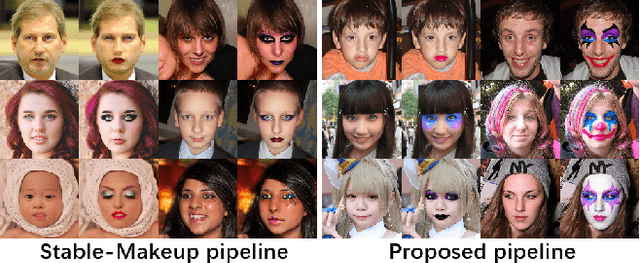
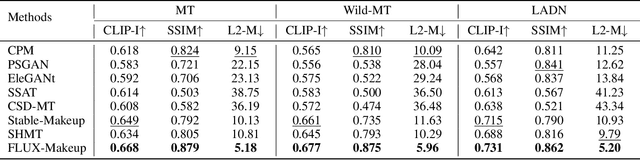
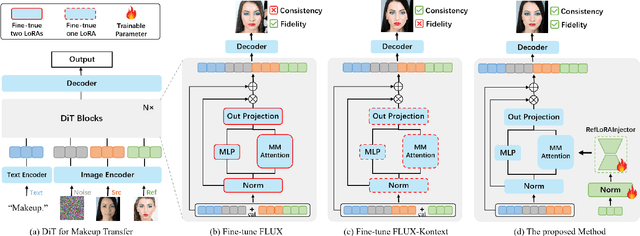
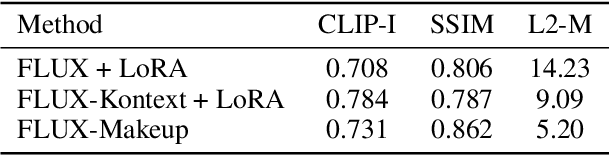
Makeup transfer aims to apply the makeup style from a reference face to a target face and has been increasingly adopted in practical applications. Existing GAN-based approaches typically rely on carefully designed loss functions to balance transfer quality and facial identity consistency, while diffusion-based methods often depend on additional face-control modules or algorithms to preserve identity. However, these auxiliary components tend to introduce extra errors, leading to suboptimal transfer results. To overcome these limitations, we propose FLUX-Makeup, a high-fidelity, identity-consistent, and robust makeup transfer framework that eliminates the need for any auxiliary face-control components. Instead, our method directly leverages source-reference image pairs to achieve superior transfer performance. Specifically, we build our framework upon FLUX-Kontext, using the source image as its native conditional input. Furthermore, we introduce RefLoRAInjector, a lightweight makeup feature injector that decouples the reference pathway from the backbone, enabling efficient and comprehensive extraction of makeup-related information. In parallel, we design a robust and scalable data generation pipeline to provide more accurate supervision during training. The paired makeup datasets produced by this pipeline significantly surpass the quality of all existing datasets. Extensive experiments demonstrate that FLUX-Makeup achieves state-of-the-art performance, exhibiting strong robustness across diverse scenarios.
No Other Representation Component Is Needed: Diffusion Transformers Can Provide Representation Guidance by Themselves
May 05, 2025Recent studies have demonstrated that learning a meaningful internal representation can both accelerate generative training and enhance generation quality of the diffusion transformers. However, existing approaches necessitate to either introduce an additional and complex representation training framework or rely on a large-scale, pre-trained representation foundation model to provide representation guidance during the original generative training process. In this study, we posit that the unique discriminative process inherent to diffusion transformers enables them to offer such guidance without requiring external representation components. We therefore propose Self-Representation A}lignment (SRA), a simple yet straightforward method that obtain representation guidance through a self-distillation manner. Specifically, SRA aligns the output latent representation of the diffusion transformer in earlier layer with higher noise to that in later layer with lower noise to progressively enhance the overall representation learning during only generative training process. Experimental results indicate that applying SRA to DiTs and SiTs yields consistent performance improvements. Moreover, SRA not only significantly outperforms approaches relying on auxiliary, complex representation training frameworks but also achieves performance comparable to methods that heavily dependent on powerful external representation priors.
Vision-Language Model Fine-Tuning via Simple Parameter-Efficient Modification
Sep 25, 2024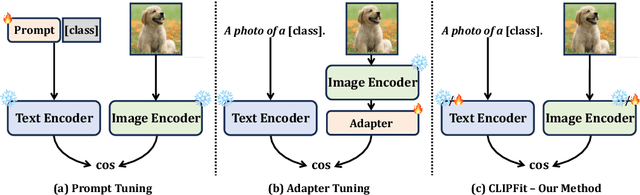
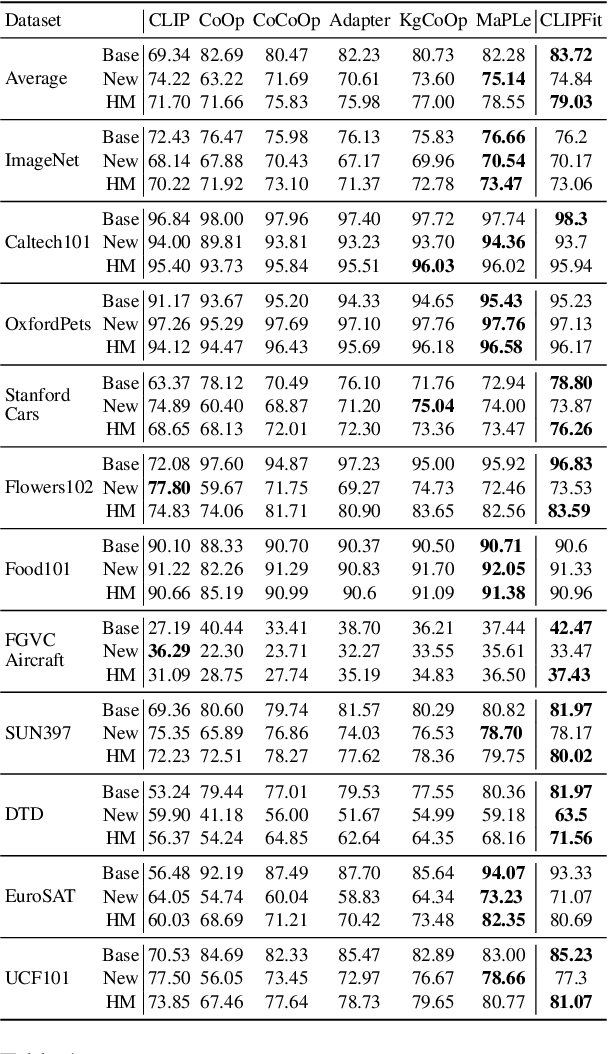
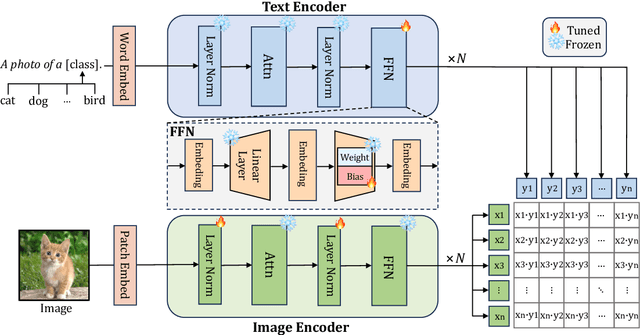
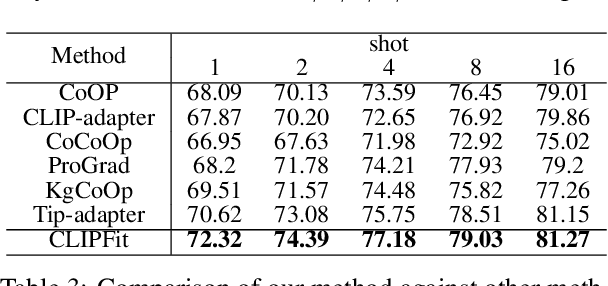
Recent advances in fine-tuning Vision-Language Models (VLMs) have witnessed the success of prompt tuning and adapter tuning, while the classic model fine-tuning on inherent parameters seems to be overlooked. It is believed that fine-tuning the parameters of VLMs with few-shot samples corrupts the pre-trained knowledge since fine-tuning the CLIP model even degrades performance. In this paper, we revisit this viewpoint, and propose a new perspective: fine-tuning the specific parameters instead of all will uncover the power of classic model fine-tuning on VLMs. Through our meticulous study, we propose ClipFit, a simple yet effective method to fine-tune CLIP without introducing any overhead of extra parameters. We demonstrate that by only fine-tuning the specific bias terms and normalization layers, ClipFit can improve the performance of zero-shot CLIP by 7.27\% average harmonic mean accuracy. Lastly, to understand how fine-tuning in CLIPFit affects the pre-trained models, we conducted extensive experimental analyses w.r.t. changes in internal parameters and representations. We found that low-level text bias layers and the first layer normalization layer change much more than other layers. The code is available at \url{https://github.com/minglllli/CLIPFit}.