 Add to Chrome
 Add to Firefox
 Add to Edge
TwinIR: Coordinated Invisible Dual-Point Attacks on Online HD Map Construction
Aug 05, 2026
Online HD map construction is critical to prediction and planning in autonomous driving. We find that existing physical attacks against online map construction are limited by a cross-boundary compensation effect: after the target boundary is perturbed, another visible boundary may retain sufficient geometric cues for the model to recover the original road geometry. Based on this observation, we propose TwinIR, a new mechanism-guided physical attack methodology for online map construction. TwinIR jointly optimizes attack effectiveness and point sparsity, seeking the minimum number of attack points needed to suppress compensating geometric cues from surrounding boundaries. To reduce the perceptibility of multi-point attacks, TwinIR models camera responses to near-infrared illumination and maps optimized attack points to feasible physical placements, producing camera-visible interference with minimal visible-spectrum changes. Experiments on nuScenes across state-of-the-art online map construction models show that TwinIR reduces mAP by 8.18-8.96 percentage points under RSA and 2.84-5.62 points under ETA, while increasing the unreachable-goal rate by 25-28 points and the unsafe-planned-trajectory rate by 19-20 points over clean inputs. These attacks are also validated on a real-world testbed AV, where TwinIR successfully induces both road straightening and early-turn deformations while remaining inconspicuous in full-color views.

Beyond Perfect Priors: Adaptive Gaussian Graph for 4D Driving Reconstruction in the Wild
Jul 07, 2026Reconstructing 4D driving scenes in the wild (e.g., internet and AI-generated videos) is critical for diverse autonomous driving simulation. While recent Gaussian Scene Graph (GSG) methods achieve impressive visual quality, they heavily rely on precise priors, such as accurate camera poses and LiDAR depth, or manual annotations. When initialized with noisy priors estimated from in-the-wild videos, existing GSG methods suffer from optimization ambiguity (e.g., entangling camera and agent poses) and topological failures (e.g., missing objects), causing severe rendering artifacts. To enable robust in-the-wild reconstruction, we introduce Adaptive Gaussian Graph (AGG), a self-correcting 4D framework. Our Semantically-Guided Tick-Tock Strategy leverages 2D foundation features to explicitly decouple static background and camera pose updates from dynamic agent learning. Concurrently, our Adaptive Topology Evolution module actively rectifies graph structures by spawning missing agents, reassigning misclassified Gaussians, and pruning false positives. To rigorously evaluate this in-the-wild setting, we introduce Wild-30, a challenging benchmark of internet and generative videos. Extensive experiments on KITTI and Wild-30 validate that AGG consistently outperforms state-of-the-art approaches in visual fidelity and robustness under noisy priors.
OmniSCS: Omni Safety-Critical Scenario Synthesis for Autonomous Driving via a Fully Editable Driving World
Jul 07, 2026The synthesis of safety-critical scenarios (SCS) and their evaluation through closed-loop simulations are crucial for developing robust autonomous driving systems. A key aspect of this process involves editing agent states in both appearance and trajectory levels within existing scenes. However, current methods struggle to preserve data fidelity after scene editing and fail to efficiently generate high-quality SCS through such modifications. To overcome these limitations, we propose OmniSCS, an innovative system that generates photorealistic SCS with high physical fidelity while enabling closed-loop testing in synthetic environments. OmniSCS comprises two key modules: 1) A Fully Editable Driving World Construction module that maintains high-fidelity agent appearance and background during scene editing via dual-strategy agent reconstruction and depth-refinement background reconstruction methods. 2) A SCS Synthesis module that facilitates object insertion and agent trajectory editing to synthesize diverse SCS while preserving data fidelity. Experiments on nuScenes, Waymo, and KITTI datasets show that OmniSCS outperforms state-of-the-art methods in edited scene fidelity. We further validate its ability to enhance autonomous driving algorithms and support real-time (13Hz) closed-loop testing. Overall, OmniSCS provides a safer, more effective, and cost-efficient solution for SCS optimization and testing in autonomous driving.
Task-Relevant Representation Decoupling for Visual Reinforcement Learning Generalization
Jul 01, 2026Visual Reinforcement Learning (VRL) has achieved considerable success in solving control tasks. However, generalizing learned policies to new environments remains a major challenge, as agents often overfit to task-irrelevant features in the training environment. To solve this problem, we introduce the concept of decoupling observations into task-relevant and task-irrelevant representations. Building on this idea, we propose a self-supervised Task-Relevant Representation Decoupling (T2RD) algorithm for VRL. This algorithm consists of three components: task-relevant representation consistency, cross-reconstruction, and cross-dynamic prediction. The first two components achieve the decoupling of content and style features, but the resulting content representations are not necessarily task-relevant. To further refine task-relevant features from content representations, we design the third component that introduces dynamic prediction. T2RD achieves State-Of-The-Art (SOTA) generalization performance and sample efficiency in the DeepMind Control Suite and Robotic Manipulation tasks.
Na-IRSTD: Enhancing Infrared Small Target Detection via Native-Resolution Feature Selection and Fusion
May 07, 2026Infrared small target detection (IRSTD) faces the inherent challenge of precisely localizing dim targets amid complex background clutter. While progress has been made, existing methods usually follow conventional strategies to downsample features and discard small targets' details, resulting in suboptimal performance. In this paper, we present Na-IRSTD, a native-resolution feature extraction and fusion framework for IRSTD. This framework elegantly incorporates native-resolution features to preserve subtle target cues, overcoming the resolution limitations of existing infrared approaches and significantly improving the model's ability to localize small targets. We also introduce an effective token reduction and selection strategy, which selects target patches with high accuracy and confidence, boosting the low-level details of the feature while effectively reducing native-resolution patch tokens compared to dense processing, thereby avoiding imposing an unbearable computational burden. Extensive experiments demonstrate the robustness and effectiveness of our token reduction and selection strategy across multiple public datasets. Ultimately, our Na-IRSTD model achieves state-of-the-art performance on four benchmarks.
SPIRIT: Adapting Vision Foundation Models for Unified Single- and Multi-Frame Infrared Small Target Detection
Feb 02, 2026Infrared small target detection (IRSTD) is crucial for surveillance and early-warning, with deployments spanning both single-frame analysis and video-mode tracking. A practical solution should leverage vision foundation models (VFMs) to mitigate infrared data scarcity, while adopting a memory-attention-based temporal propagation framework that unifies single- and multi-frame inference. However, infrared small targets exhibit weak radiometric signals and limited semantic cues, which differ markedly from visible-spectrum imagery. This modality gap makes direct use of semantics-oriented VFMs and appearance-driven cross-frame association unreliable for IRSTD: hierarchical feature aggregation can submerge localized target peaks, and appearance-only memory attention becomes ambiguous, leading to spurious clutter associations. To address these challenges, we propose SPIRIT, a unified and VFM-compatible framework that adapts VFMs to IRSTD via lightweight physics-informed plug-ins. Spatially, PIFR refines features by approximating rank-sparsity decomposition to suppress structured background components and enhance sparse target-like signals. Temporally, PGMA injects history-derived soft spatial priors into memory cross-attention to constrain cross-frame association, enabling robust video detection while naturally reverting to single-frame inference when temporal context is absent. Experiments on multiple IRSTD benchmarks show consistent gains over VFM-based baselines and SOTA performance.
SATMapTR: Satellite Image Enhanced Online HD Map Construction
Dec 12, 2025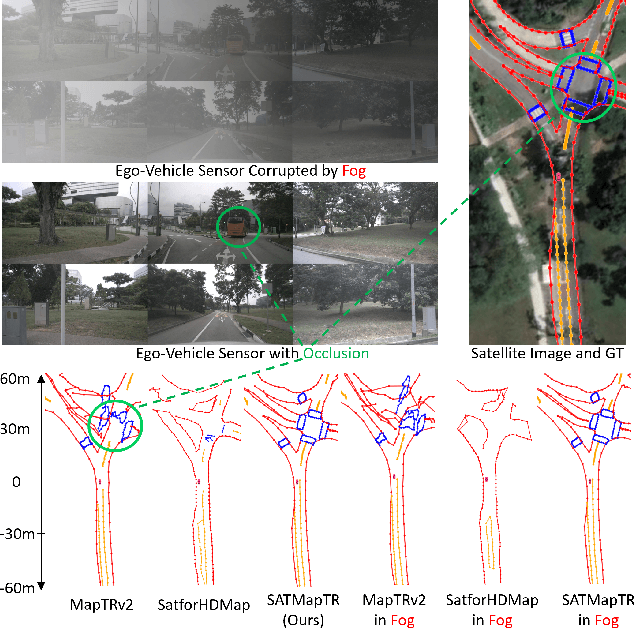
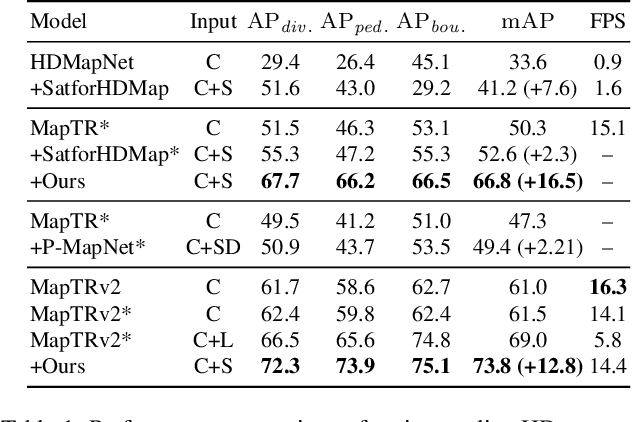
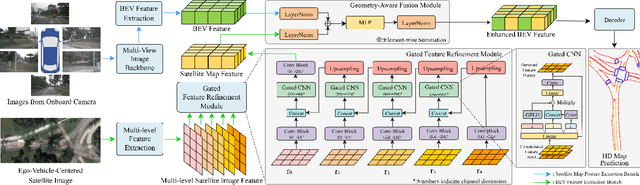
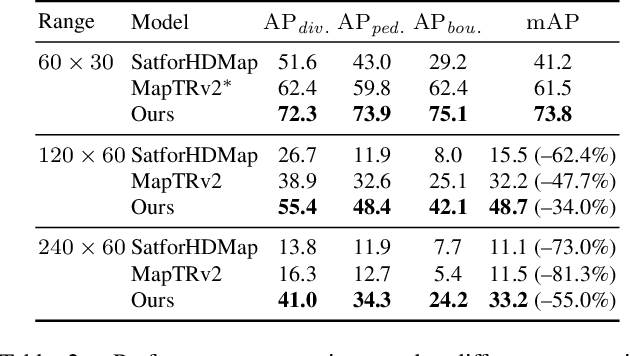
High-definition (HD) maps are evolving from pre-annotated to real-time construction to better support autonomous driving in diverse scenarios. However, this process is hindered by low-quality input data caused by onboard sensors limited capability and frequent occlusions, leading to incomplete, noisy, or missing data, and thus reduced mapping accuracy and robustness. Recent efforts have introduced satellite images as auxiliary input, offering a stable, wide-area view to complement the limited ego perspective. However, satellite images in Bird's Eye View are often degraded by shadows and occlusions from vegetation and buildings. Prior methods using basic feature extraction and fusion remain ineffective. To address these challenges, we propose SATMapTR, a novel online map construction model that effectively fuses satellite image through two key components: (1) a gated feature refinement module that adaptively filters satellite image features by integrating high-level semantics with low-level structural cues to extract high signal-to-noise ratio map-relevant representations; and (2) a geometry-aware fusion module that consistently fuse satellite and BEV features at a grid-to-grid level, minimizing interference from irrelevant regions and low-quality inputs. Experimental results on the nuScenes dataset show that SATMapTR achieves the highest mean average precision (mAP) of 73.8, outperforming state-of-the-art satellite-enhanced models by up to 14.2 mAP. It also shows lower mAP degradation under adverse weather and sensor failures, and achieves nearly 3 times higher mAP at extended perception ranges.
SynapseRoute: An Auto-Route Switching Framework on Dual-State Large Language Model
Jul 03, 2025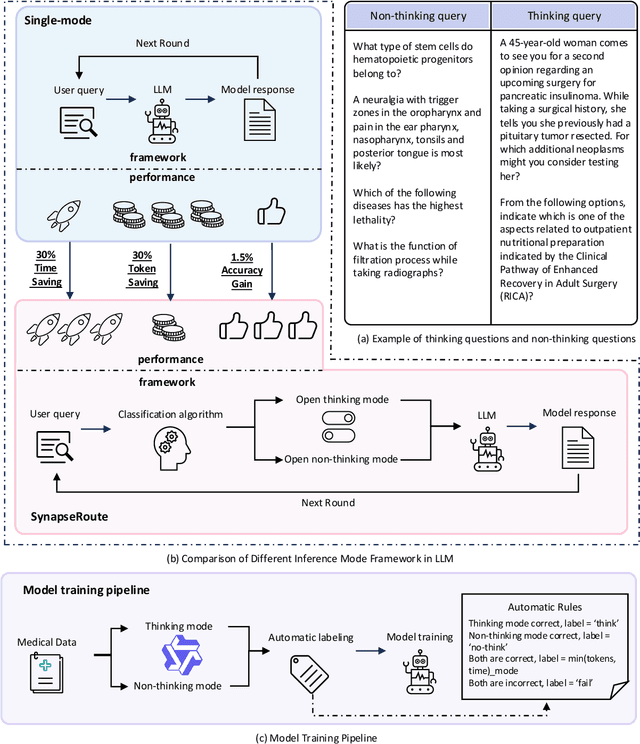
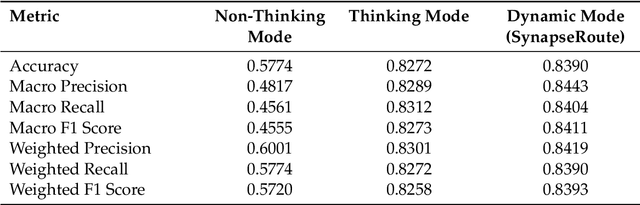


With the widespread adoption of large language models (LLMs) in practical applications, selecting an appropriate model requires balancing not only performance but also operational cost. The emergence of reasoning-capable models has further widened the cost gap between "thinking" (high reasoning) and "non-thinking" (fast, low-cost) modes. In this work, we reveal that approximately 58% of medical questions can be accurately answered by the non-thinking mode alone, without requiring the high-cost reasoning process. This highlights a clear dichotomy in problem complexity and suggests that dynamically routing queries to the appropriate mode based on complexity could optimize accuracy, cost-efficiency, and overall user experience. Based on this, we further propose SynapseRoute, a machine learning-based dynamic routing framework that intelligently assigns input queries to either thinking or non-thinking modes. Experimental results on several medical datasets demonstrate that SynapseRoute not only improves overall accuracy (0.8390 vs. 0.8272) compared to the thinking mode alone but also reduces inference time by 36.8% and token consumption by 39.66%. Importantly, qualitative analysis indicates that over-reasoning on simpler queries can lead to unnecessary delays and even decreased accuracy, a pitfall avoided by our adaptive routing. Finally, this work further introduces the Accuracy-Inference-Token (AIT) index to comprehensively evaluate the trade-offs among accuracy, latency, and token cost.
Enhancing Trust Management System for Connected Autonomous Vehicles Using Machine Learning Methods: A Survey
May 10, 2025Connected Autonomous Vehicles (CAVs) operate in dynamic, open, and multi-domain networks, rendering them vulnerable to various threats. Trust Management Systems (TMS) systematically organize essential steps in the trust mechanism, identifying malicious nodes against internal threats and external threats, as well as ensuring reliable decision-making for more cooperative tasks. Recent advances in machine learning (ML) offer significant potential to enhance TMS, especially for the strict requirements of CAVs, such as CAV nodes moving at varying speeds, and opportunistic and intermittent network behavior. Those features distinguish ML-based TMS from social networks, static IoT, and Social IoT. This survey proposes a novel three-layer ML-based TMS framework for CAVs in the vehicle-road-cloud integration system, i.e., trust data layer, trust calculation layer and trust incentive layer. A six-dimensional taxonomy of objectives is proposed. Furthermore, the principles of ML methods for each module in each layer are analyzed. Then, recent studies are categorized based on traffic scenarios that are against the proposed objectives. Finally, future directions are suggested, addressing the open issues and meeting the research trend. We maintain an active repository that contains up-to-date literature and open-source projects at https://github.com/octoberzzzzz/ML-based-TMS-CAV-Survey.
Aerial Active STAR-RIS-Aided IoT NOMA Networks
Jan 05, 2025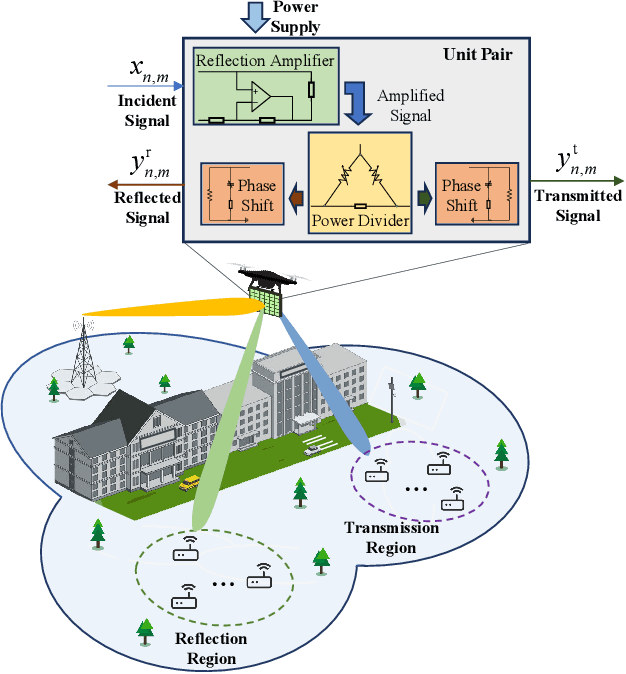

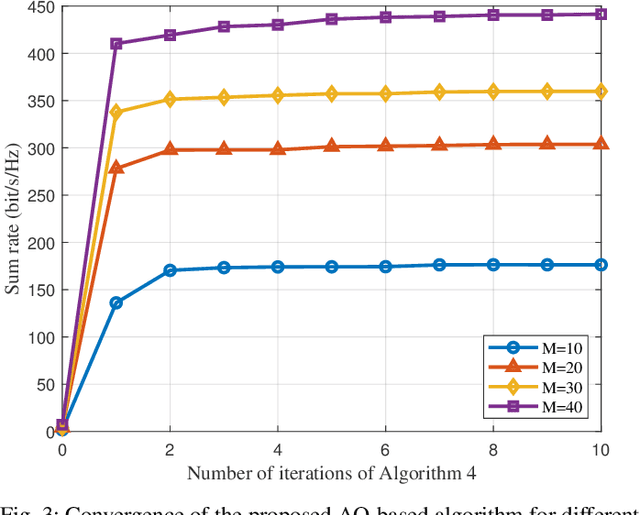
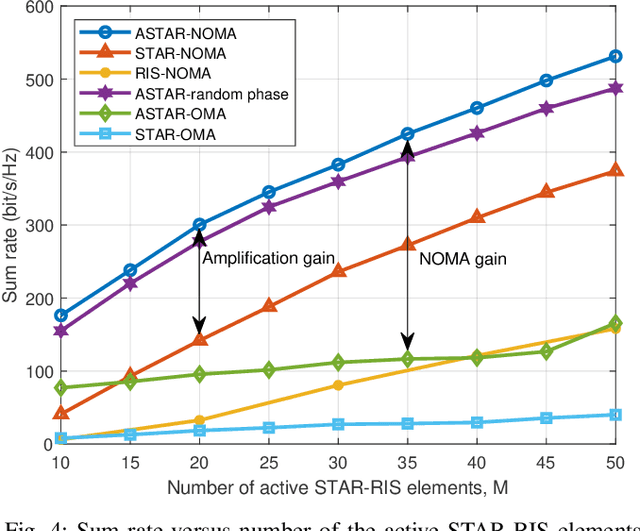
A novel framework of the unmanned aerial vehicle (UAV)-mounted active simultaneously transmitting and reflecting reconfigurable intelligent surface (STAR-RIS) communications with the non-orthogonal multiple access (NOMA) is proposed for Internet-of-Things (IoT) networks. In particular, an active STAR-RIS is deployed onboard to enhance the communication link between the base station (BS) and the IoT devices, and NOMA is utilized for supporting the multi-device connectivity. Based on the proposed framework, a system sum rate maximization problem is formulated for the joint optimization of the active STAR-RIS beamforming, the UAV trajectory design, and the power allocation. To solve the non-convex problem with highly-coupled variables, an alternating optimization (AO) algorithm is proposed to decouple the original problem into three subproblems. Specifically, for the active STAR-RIS beamforming, the amplification coefficient, the power-splitting ratio, and the phase shift are incorporated into a combined variable to simplify the optimization process. Afterwards, the penalty-based method is invoked for handling the non-convex rank-one constraint. For the UAV trajectory design and the power allocation subproblems, the successive convex optimization method is applied for iteratively approximating the local-optimal solution. Numerical results demonstrate that: 1) the proposed algorithm achieves superior performance compared to the benchmarks in terms of the sum rate; and 2) the UAV-mounted active STAR-RIS can effectively enhance the channel gain from the BS to the IoT devices by the high-quality channel construction and the power compensation.