 Add to Chrome
 Add to Firefox
 Add to Edge
Leveraging Semantic Attribute Binding for Free-Lunch Color Control in Diffusion Models
Mar 12, 2025
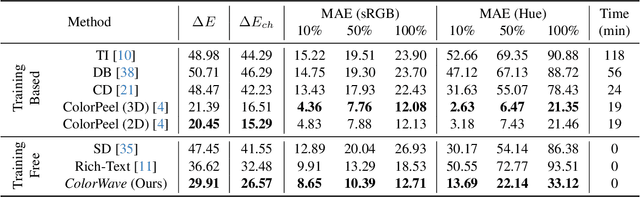
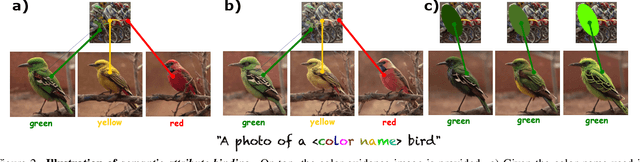
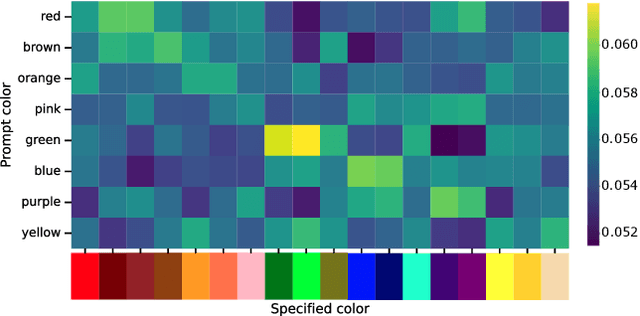
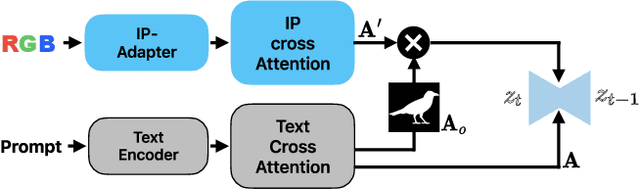
Recent advances in text-to-image (T2I) diffusion models have enabled remarkable control over various attributes, yet precise color specification remains a fundamental challenge. Existing approaches, such as ColorPeel, rely on model personalization, requiring additional optimization and limiting flexibility in specifying arbitrary colors. In this work, we introduce ColorWave, a novel training-free approach that achieves exact RGB-level color control in diffusion models without fine-tuning. By systematically analyzing the cross-attention mechanisms within IP-Adapter, we uncover an implicit binding between textual color descriptors and reference image features. Leveraging this insight, our method rewires these bindings to enforce precise color attribution while preserving the generative capabilities of pretrained models. Our approach maintains generation quality and diversity, outperforming prior methods in accuracy and applicability across diverse object categories. Through extensive evaluations, we demonstrate that ColorWave establishes a new paradigm for structured, color-consistent diffusion-based image synthesis.

X-Field: A Physically Grounded Representation for 3D X-ray Reconstruction
Mar 11, 2025X-ray imaging is indispensable in medical diagnostics, yet its use is tightly regulated due to potential health risks. To mitigate radiation exposure, recent research focuses on generating novel views from sparse inputs and reconstructing Computed Tomography (CT) volumes, borrowing representations from the 3D reconstruction area. However, these representations originally target visible light imaging that emphasizes reflection and scattering effects, while neglecting penetration and attenuation properties of X-ray imaging. In this paper, we introduce X-Field, the first 3D representation specifically designed for X-ray imaging, rooted in the energy absorption rates across different materials. To accurately model diverse materials within internal structures, we employ 3D ellipsoids with distinct attenuation coefficients. To estimate each material's energy absorption of X-rays, we devise an efficient path partitioning algorithm accounting for complex ellipsoid intersections. We further propose hybrid progressive initialization to refine the geometric accuracy of X-Filed and incorporate material-based optimization to enhance model fitting along material boundaries. Experiments show that X-Field achieves superior visual fidelity on both real-world human organ and synthetic object datasets, outperforming state-of-the-art methods in X-ray Novel View Synthesis and CT Reconstruction.
A Multimodal Benchmark Dataset and Model for Crop Disease Diagnosis
Mar 10, 2025While conversational generative AI has shown considerable potential in enhancing decision-making for agricultural professionals, its exploration has predominantly been anchored in text-based interactions. The evolution of multimodal conversational AI, leveraging vast amounts of image-text data from diverse sources, marks a significant stride forward. However, the application of such advanced vision-language models in the agricultural domain, particularly for crop disease diagnosis, remains underexplored. In this work, we present the crop disease domain multimodal (CDDM) dataset, a pioneering resource designed to advance the field of agricultural research through the application of multimodal learning techniques. The dataset comprises 137,000 images of various crop diseases, accompanied by 1 million question-answer pairs that span a broad spectrum of agricultural knowledge, from disease identification to management practices. By integrating visual and textual data, CDDM facilitates the development of sophisticated question-answering systems capable of providing precise, useful advice to farmers and agricultural professionals. We demonstrate the utility of the dataset by finetuning state-of-the-art multimodal models, showcasing significant improvements in crop disease diagnosis. Specifically, we employed a novel finetuning strategy that utilizes low-rank adaptation (LoRA) to finetune the visual encoder, adapter and language model simultaneously. Our contributions include not only the dataset but also a finetuning strategy and a benchmark to stimulate further research in agricultural technology, aiming to bridge the gap between advanced AI techniques and practical agricultural applications. The dataset is available at https: //github.com/UnicomAI/UnicomBenchmark/tree/main/CDDMBench.
DAST: Difficulty-Adaptive Slow-Thinking for Large Reasoning Models
Mar 06, 2025Recent advancements in slow-thinking reasoning models have shown exceptional performance in complex reasoning tasks. However, these models often exhibit overthinking-generating redundant reasoning steps for simple problems, leading to excessive computational resource usage. While current mitigation strategies uniformly reduce reasoning tokens, they risk degrading performance on challenging tasks that require extended reasoning. This paper introduces Difficulty-Adaptive Slow-Thinking (DAST), a novel framework that enables models to autonomously adjust the length of Chain-of-Thought(CoT) based on problem difficulty. We first propose a Token Length Budget (TLB) metric to quantify difficulty, then leveraging length-aware reward shaping and length preference optimization to implement DAST. DAST penalizes overlong responses for simple tasks while incentivizing sufficient reasoning for complex problems. Experiments on diverse datasets and model scales demonstrate that DAST effectively mitigates overthinking (reducing token usage by over 30\% on average) while preserving reasoning accuracy on complex problems.
Learning Object Placement Programs for Indoor Scene Synthesis with Iterative Self Training
Mar 06, 2025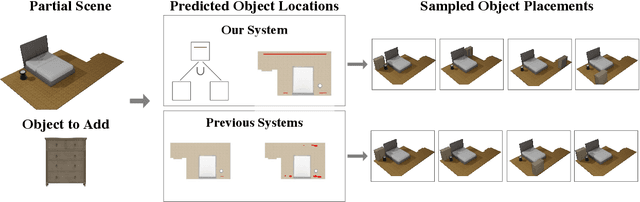
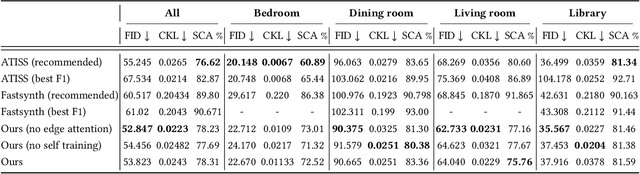
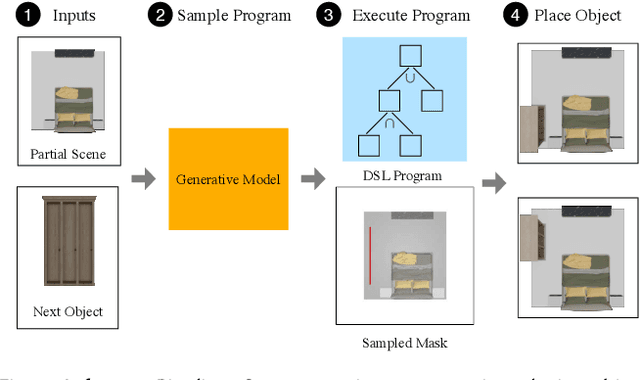
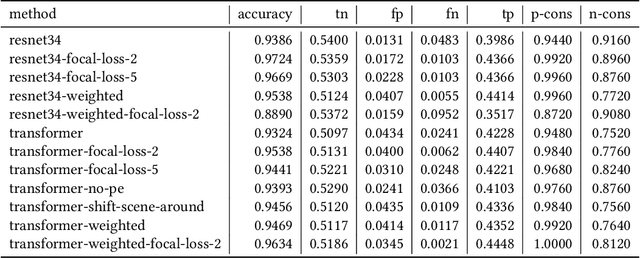
Data driven and autoregressive indoor scene synthesis systems generate indoor scenes automatically by suggesting and then placing objects one at a time. Empirical observations show that current systems tend to produce incomplete next object location distributions. We introduce a system which addresses this problem. We design a Domain Specific Language (DSL) that specifies functional constraints. Programs from our language take as input a partial scene and object to place. Upon execution they predict possible object placements. We design a generative model which writes these programs automatically. Available 3D scene datasets do not contain programs to train on, so we build upon previous work in unsupervised program induction to introduce a new program bootstrapping algorithm. In order to quantify our empirical observations we introduce a new evaluation procedure which captures how well a system models per-object location distributions. We ask human annotators to label all the possible places an object can go in a scene and show that our system produces per-object location distributions more consistent with human annotators. Our system also generates indoor scenes of comparable quality to previous systems and while previous systems degrade in performance when training data is sparse, our system does not degrade to the same degree.
Optimizing for the Shortest Path in Denoising Diffusion Model
Mar 06, 2025In this research, we propose a novel denoising diffusion model based on shortest-path modeling that optimizes residual propagation to enhance both denoising efficiency and quality. Drawing on Denoising Diffusion Implicit Models (DDIM) and insights from graph theory, our model, termed the Shortest Path Diffusion Model (ShortDF), treats the denoising process as a shortest-path problem aimed at minimizing reconstruction error. By optimizing the initial residuals, we improve the efficiency of the reverse diffusion process and the quality of the generated samples. Extensive experiments on multiple standard benchmarks demonstrate that ShortDF significantly reduces diffusion time (or steps) while enhancing the visual fidelity of generated samples compared to prior arts. This work, we suppose, paves the way for interactive diffusion-based applications and establishes a foundation for rapid data generation. Code is available at https://github.com/UnicomAI/ShortDF
Digital Player: Evaluating Large Language Models based Human-like Agent in Games
Feb 28, 2025With the rapid advancement of Large Language Models (LLMs), LLM-based autonomous agents have shown the potential to function as digital employees, such as digital analysts, teachers, and programmers. In this paper, we develop an application-level testbed based on the open-source strategy game "Unciv", which has millions of active players, to enable researchers to build a "data flywheel" for studying human-like agents in the "digital players" task. This "Civilization"-like game features expansive decision-making spaces along with rich linguistic interactions such as diplomatic negotiations and acts of deception, posing significant challenges for LLM-based agents in terms of numerical reasoning and long-term planning. Another challenge for "digital players" is to generate human-like responses for social interaction, collaboration, and negotiation with human players. The open-source project can be found at https:/github.com/fuxiAIlab/CivAgent.
External Large Foundation Model: How to Efficiently Serve Trillions of Parameters for Online Ads Recommendation
Feb 26, 2025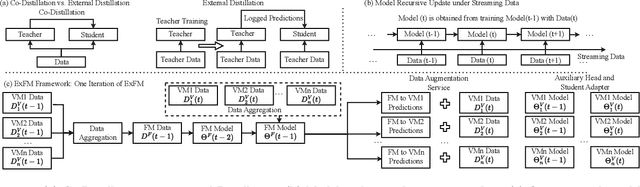
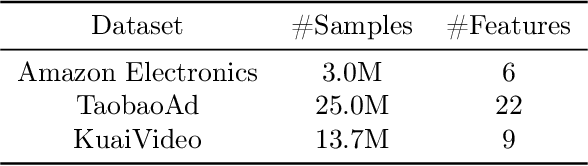
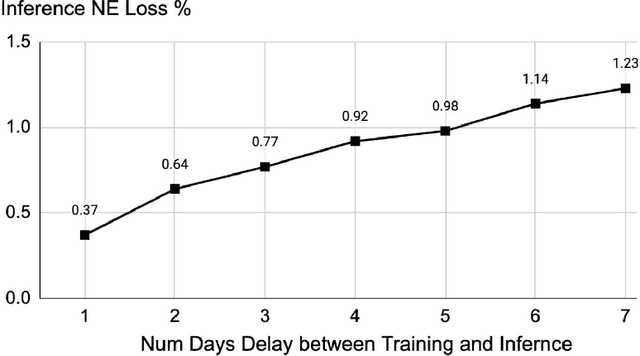
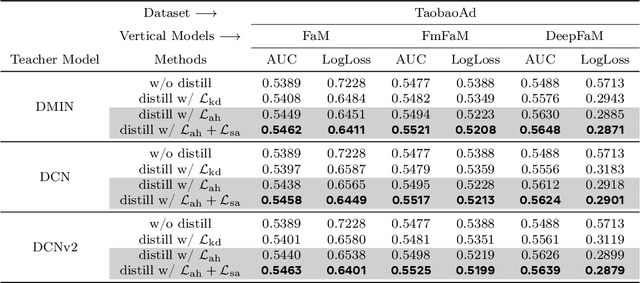
Ads recommendation is a prominent service of online advertising systems and has been actively studied. Recent studies indicate that scaling-up and advanced design of the recommendation model can bring significant performance improvement. However, with a larger model scale, such prior studies have a significantly increasing gap from industry as they often neglect two fundamental challenges in industrial-scale applications. First, training and inference budgets are restricted for the model to be served, exceeding which may incur latency and impair user experience. Second, large-volume data arrive in a streaming mode with data distributions dynamically shifting, as new users/ads join and existing users/ads leave the system. We propose the External Large Foundation Model (ExFM) framework to address the overlooked challenges. Specifically, we develop external distillation and a data augmentation system (DAS) to control the computational cost of training/inference while maintaining high performance. We design the teacher in a way like a foundation model (FM) that can serve multiple students as vertical models (VMs) to amortize its building cost. We propose Auxiliary Head and Student Adapter to mitigate the data distribution gap between FM and VMs caused by the streaming data issue. Comprehensive experiments on internal industrial-scale applications and public datasets demonstrate significant performance gain by ExFM.
What's in a Query: Polarity-Aware Distribution-Based Fair Ranking
Feb 17, 2025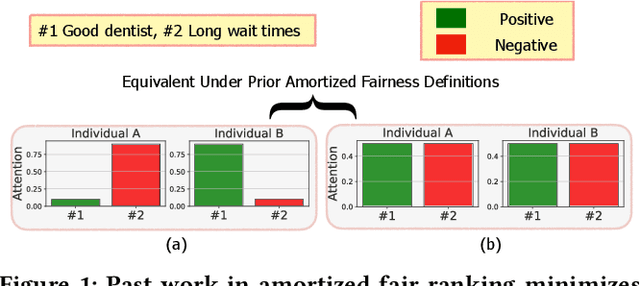
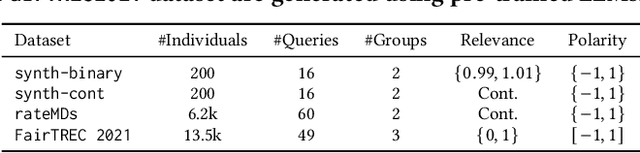
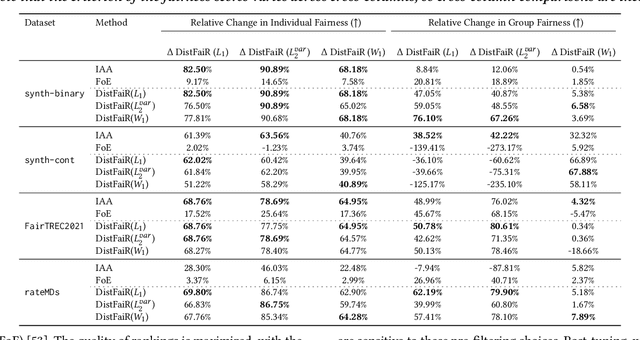
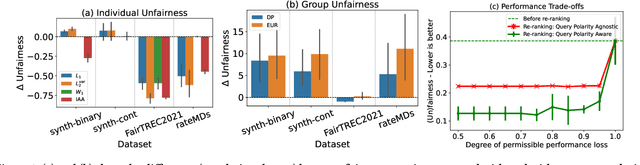
Machine learning-driven rankings, where individuals (or items) are ranked in response to a query, mediate search exposure or attention in a variety of safety-critical settings. Thus, it is important to ensure that such rankings are fair. Under the goal of equal opportunity, attention allocated to an individual on a ranking interface should be proportional to their relevance across search queries. In this work, we examine amortized fair ranking -- where relevance and attention are cumulated over a sequence of user queries to make fair ranking more feasible in practice. Unlike prior methods that operate on expected amortized attention for each individual, we define new divergence-based measures for attention distribution-based fairness in ranking (DistFaiR), characterizing unfairness as the divergence between the distribution of attention and relevance corresponding to an individual over time. This allows us to propose new definitions of unfairness, which are more reliable at test time. Second, we prove that group fairness is upper-bounded by individual fairness under this definition for a useful class of divergence measures, and experimentally show that maximizing individual fairness through an integer linear programming-based optimization is often beneficial to group fairness. Lastly, we find that prior research in amortized fair ranking ignores critical information about queries, potentially leading to a fairwashing risk in practice by making rankings appear more fair than they actually are.
Enhance-A-Video: Better Generated Video for Free
Feb 11, 2025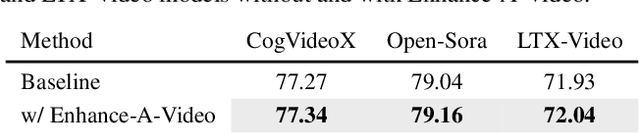
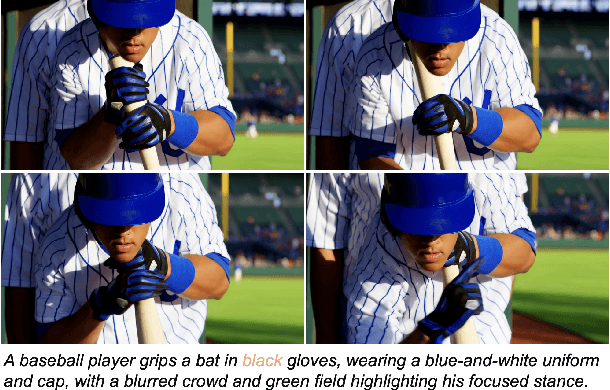
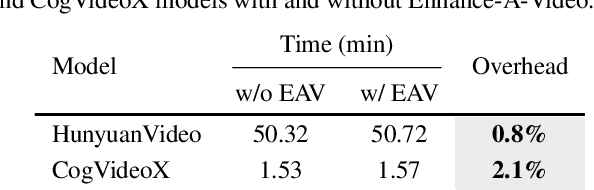
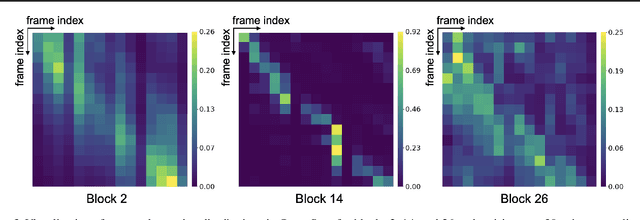
DiT-based video generation has achieved remarkable results, but research into enhancing existing models remains relatively unexplored. In this work, we introduce a training-free approach to enhance the coherence and quality of DiT-based generated videos, named Enhance-A-Video. The core idea is enhancing the cross-frame correlations based on non-diagonal temporal attention distributions. Thanks to its simple design, our approach can be easily applied to most DiT-based video generation frameworks without any retraining or fine-tuning. Across various DiT-based video generation models, our approach demonstrates promising improvements in both temporal consistency and visual quality. We hope this research can inspire future explorations in video generation enhancement.