 Add to Chrome
 Add to Firefox
 Add to Edge
ShiJianBench: From Dialogue to Decision for Long-Horizon Evaluation of Investment Advisors
Aug 02, 2026
Conversational investment advisors influence not only what users know, but also how they make subsequent decisions as market conditions evolve. Existing evaluations primarily assess response quality or observed outcomes, leaving the long-horizon pathway from advisor language to investor behavior difficult to audit. We introduce ShiJianBench, an offline framework for evaluating conversational investment advisors through matched investor trajectories under fixed historical market feedback. At its core is a multi-agent investor simulator with explicit evolving state variables, motive-driven deliberation, long-term memory, and dialogue-grounded updates. The simulator is calibrated against aggregate behavioral patterns from 7,199 real users, and advisor policies are evaluated using separate investor-side, service-side, and content-side metrics under a hard compliance gate. Experiments on Chinese fund-market traces from 2021 to 2026 identify a stable leading group of LLM advisors that combines substantially stronger personalized content with competitive investor-side trajectory outcomes. These results reveal a systematic distinction between producing a high-quality response and delivering an effective long-horizon intervention, motivating trajectory-aware evaluation of conversational advisors.

PlanCraft: Sketch, Refine, and Furnish for Architect-Inspired Progressive 3D Residential Scene Generation
Jul 26, 2026Two structural insights have been overlooked in automated residential floor plan generation. First, design is inherently progressive. Architects begin with rough strokes and refine them over time, whereas existing methods typically require their conditioning representation to be fully specified before generation, a fundamental mismatch with how design actually works. Second, the 2D floor plan is not an optional intermediate but an irreplaceable spatial contract. Once room boundaries, doors, and windows are fixed, furnishing reduces from open-ended spatial reasoning to bounded constraint satisfaction. Bypassing this contract, as existing 3D systems do by delegating layout to language models, yields overlapping rooms and implausible proportions; directly calling general-purpose language models likewise produces geometrically invalid layouts. Guided by these insights, we present PlanCraft. SketchPlan supplies the missing training signal by replaying the architect's drawing process on 80K real floor plans, producing partial sketches at every completeness level. PlanCraft-Diff progressively sharpens an incomplete sketch into a geometrically precise, vectorizable floor plan through a coarse-to-fine strategy. With the spatial contract established, PlanCraft-Agent then furnishes the scene within well-defined room boundaries. Experiments show that PlanCraft achieves a 61.1\% lower FID than the best existing 2D method and surpasses existing 3D systems by 15 points in expert-rated spatial rationality, with a sketch at only 25\% completion already outperforming all fully specified baselines.
A Learnable Multi-views Contrastive Framework with Reconstruction Discrepancy for Medical Time-Series
Jan 30, 2025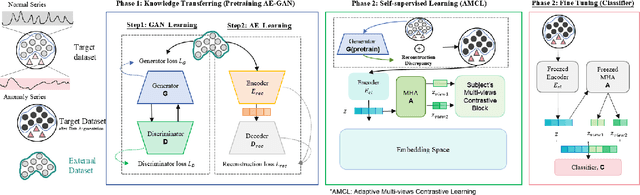


In medical time series disease diagnosis, two key challenges are identified.First, the high annotation cost of medical data leads to overfitting in models trained on label-limited, single-center datasets. To address this, we propose incorporating external data from related tasks and leveraging AE-GAN to extract prior knowledge,providing valuable references for downstream tasks. Second, many existing studies employ contrastive learning to derive more generalized medical sequence representations for diagnostic tasks, usually relying on manually designed diverse positive and negative sample pairs.However, these approaches are complex, lack generalizability, and fail to adaptively capture disease-specific features across different conditions.To overcome this, we introduce LMCF (Learnable Multi-views Contrastive Framework), a framework that integrates a multi-head attention mechanism and adaptively learns representations from different views through inter-view and intra-view contrastive learning strategies.Additionally, the pre-trained AE-GAN is used to reconstruct discrepancies in the target data as disease probabilities, which are then integrated into the contrastive learning process.Experiments on three target datasets demonstrate that our method consistently outperforms seven other baselines, highlighting its significant impact on healthcare applications such as the diagnosis of myocardial infarction, Alzheimer's disease, and Parkinson's disease.
WindowMixer: Intra-Window and Inter-Window Modeling for Time Series Forecasting
Jun 14, 2024Time series forecasting (TSF) is crucial in fields like economic forecasting, weather prediction, traffic flow analysis, and public health surveillance. Real-world time series data often include noise, outliers, and missing values, making accurate forecasting challenging. Traditional methods model point-to-point relationships, which limits their ability to capture complex temporal patterns and increases their susceptibility to noise.To address these issues, we introduce the WindowMixer model, built on an all-MLP framework. WindowMixer leverages the continuous nature of time series by examining temporal variations from a window-based perspective. It decomposes time series into trend and seasonal components, handling them individually. For trends, a fully connected (FC) layer makes predictions. For seasonal components, time windows are projected to produce window tokens, processed by Intra-Window-Mixer and Inter-Window-Mixer modules. The Intra-Window-Mixer models relationships within each window, while the Inter-Window-Mixer models relationships between windows. This approach captures intricate patterns and long-range dependencies in the data.Experiments show WindowMixer consistently outperforms existing methods in both long-term and short-term forecasting tasks.
FAITH: Frequency-domain Attention In Two Horizons for Time Series Forecasting
May 22, 2024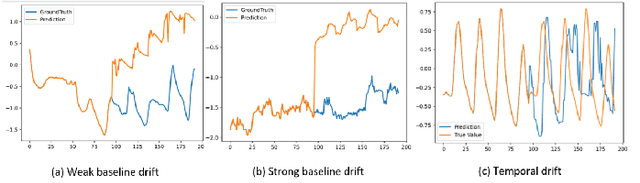
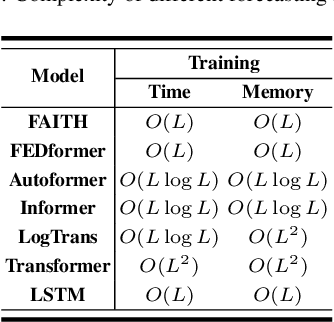
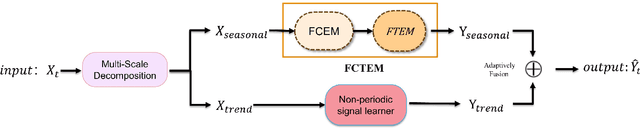
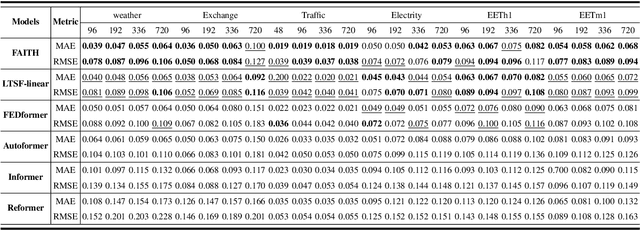
Time Series Forecasting plays a crucial role in various fields such as industrial equipment maintenance, meteorology, energy consumption, traffic flow and financial investment. However, despite their considerable advantages over traditional statistical approaches, current deep learning-based predictive models often exhibit a significant deviation between their forecasting outcomes and the ground truth. This discrepancy is largely due to an insufficient emphasis on extracting the sequence's latent information, particularly its global information within the frequency domain and the relationship between different variables. To address this issue, we propose a novel model Frequency-domain Attention In Two Horizons, which decomposes time series into trend and seasonal components using a multi-scale sequence adaptive decomposition and fusion architecture, and processes them separately. FAITH utilizes Frequency Channel feature Extraction Module and Frequency Temporal feature Extraction Module to capture inter-channel relationships and temporal global information in the sequence, significantly improving its ability to handle long-term dependencies and complex patterns. Furthermore, FAITH achieves theoretically linear complexity by modifying the time-frequency domain transformation method, effectively reducing computational costs. Extensive experiments on 6 benchmarks for long-term forecasting and 3 benchmarks for short-term forecasting demonstrate that FAITH outperforms existing models in many fields, such as electricity, weather and traffic, proving its effectiveness and superiority both in long-term and short-term time series forecasting tasks. Our codes and data are available at https://github.com/LRQ577/FAITH.
Enhancing data efficiency in reinforcement learning: a novel imagination mechanism based on mesh information propagation
Sep 27, 2023Reinforcement learning(RL) algorithms face the challenge of limited data efficiency, particularly when dealing with high-dimensional state spaces and large-scale problems. Most of RL methods often rely solely on state transition information within the same episode when updating the agent's Critic, which can lead to low data efficiency and sub-optimal training time consumption. Inspired by human-like analogical reasoning abilities, we introduce a novel mesh information propagation mechanism, termed the 'Imagination Mechanism (IM)', designed to significantly enhance the data efficiency of RL algorithms. Specifically, IM enables information generated by a single sample to be effectively broadcasted to different states across episodes, instead of simply transmitting in the same episode. This capability enhances the model's comprehension of state interdependencies and facilitates more efficient learning of limited sample information. To promote versatility, we extend the IM to function as a plug-and-play module that can be seamlessly and fluidly integrated into other widely adopted RL algorithms. Our experiments demonstrate that IM consistently boosts four mainstream SOTA RL algorithms, such as SAC, PPO, DDPG, and DQN, by a considerable margin, ultimately leading to superior performance than before across various tasks. For access to our code and data, please visit https://github.com/OuAzusaKou/imagination_mechanism
FECAM: Frequency Enhanced Channel Attention Mechanism for Time Series Forecasting
Dec 02, 2022

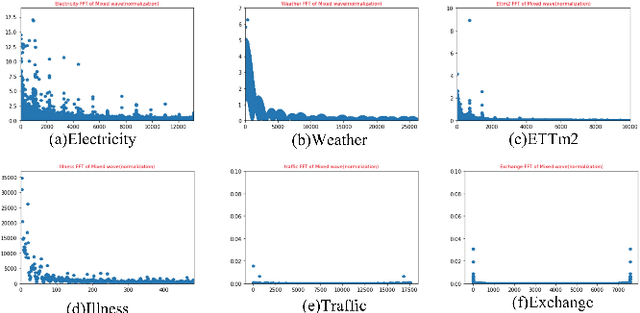
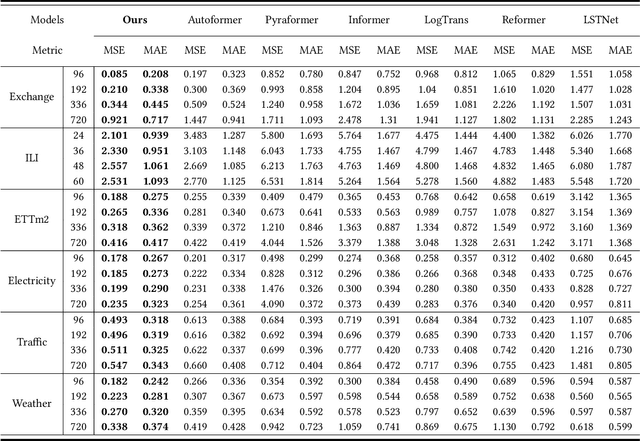
Time series forecasting is a long-standing challenge due to the real-world information is in various scenario (e.g., energy, weather, traffic, economics, earthquake warning). However some mainstream forecasting model forecasting result is derailed dramatically from ground truth. We believe it's the reason that model's lacking ability of capturing frequency information which richly contains in real world datasets. At present, the mainstream frequency information extraction methods are Fourier transform(FT) based. However, use of FT is problematic due to Gibbs phenomenon. If the values on both sides of sequences differ significantly, oscillatory approximations are observed around both sides and high frequency noise will be introduced. Therefore We propose a novel frequency enhanced channel attention that adaptively modelling frequency interdependencies between channels based on Discrete Cosine Transform which would intrinsically avoid high frequency noise caused by problematic periodity during Fourier Transform, which is defined as Gibbs Phenomenon. We show that this network generalize extremely effectively across six real-world datasets and achieve state-of-the-art performance, we further demonstrate that frequency enhanced channel attention mechanism module can be flexibly applied to different networks. This module can improve the prediction ability of existing mainstream networks, which reduces 35.99% MSE on LSTM, 10.01% on Reformer, 8.71% on Informer, 8.29% on Autoformer, 8.06% on Transformer, etc., at a slight computational cost ,with just a few line of code. Our codes and data are available at https://github.com/Zero-coder/FECAM.