 Add to Chrome
 Add to Firefox
 Add to Edge
Wearable Single-Lead ECG Detects Fine-Grained Structural Heart Disease Through Echo-Report Supervision
Jun 08, 2026
Structural heart disease (SHD) is a primary driver of heart failure and cardiovascular mortality, yet early detection remains constrained by the limited accessibility of echocardiography. While single-lead electrocardiogram (ECG) is ubiquitous through wearables, existing AI screening models often depend on 12-lead inputs, generalize poorly across institutions, or require massive, condition-specific labeled datasets. Recent work has demonstrated the feasibility of contrastive pre-training between single-lead ECGs and echocardiography reports within a single health system. Here, we present AnyECG-Echo, a framework that advance this paradigm toward clinical translation through three key developments: (1) evaluation in a geographically independent external cohort (n = 16,621); (2) diagnostic coverage of 13 fine-grained SHD subtypes spanning myocardial, chamber, valvular, and great-vessel pathologies; and (3) dual-axis mechanistic interpretability combining electrophysiology-grounded Shapley attribution with emergent correlations to quantitative measurements. Across validation cohorts totaling n = 25,222, the model demonstrated high AUROC for high-impact subtypes, including reduced left ventricular systolic function (AUROC 0.866-0.924), global heart enlargement (0.877-0.931), and mitral stenosis (0.836-0.906). Furthermore, we successfully validated the alignment of model outputs with established medical physiological traits, thereby enhancing interpretability. Notably, we discovered that AnyECG-Echo's outputs function as physiologically grounded digital biomarkers that accurately track objective metrics such as LVEF and myocardial wall thickness. These findings prove that wearable single-lead ECGs can effectively detect fine-grained structural heart disease, offering a practical solution for population-scale screening.

Artificial intelligence-enabled single-lead ECG for non-invasive hyperkalemia detection: development, multicenter validation, and proof-of-concept deployment
Mar 17, 2026Hyperkalemia is a life-threatening electrolyte disorder that is common in patients with chronic kidney disease and heart failure, yet frequent monitoring remains difficult outside hospital settings. We developed and validated Pocket-K, a single-lead AI-ECG system initialized from the ECGFounder foundation model for non-invasive hyperkalemia screening and handheld deployment. In this multicentre observational study using routinely collected clinical ECG and laboratory data, 34,439 patients contributed 62,290 ECG--potassium pairs. Lead I data were used to fine-tune the model. Data from Peking University People's Hospital were divided into development and temporal validation sets, and data from The Second Hospital of Tianjin Medical University served as an independent external validation set. Hyperkalemia was defined as venous serum potassium > 5.5 mmol/L. Pocket-K achieved AUROCs of 0.936 in internal testing, 0.858 in temporal validation, and 0.808 in external validation. For KDIGO-defined moderate-to-severe hyperkalemia (serum potassium >= 6.0 mmol/L), AUROCs increased to 0.940 and 0.861 in the temporal and external sets, respectively. External negative predictive value exceeded 99.3%. Model-predicted high risk below the hyperkalemia threshold was more common in patients with chronic kidney disease and heart failure. A handheld prototype enabled near-real-time inference, supporting future prospective evaluation in native handheld and wearable settings.
Artificial Intelligence System for Detection and Screening of Cardiac Abnormalities using Electrocardiogram Images
Feb 10, 2023

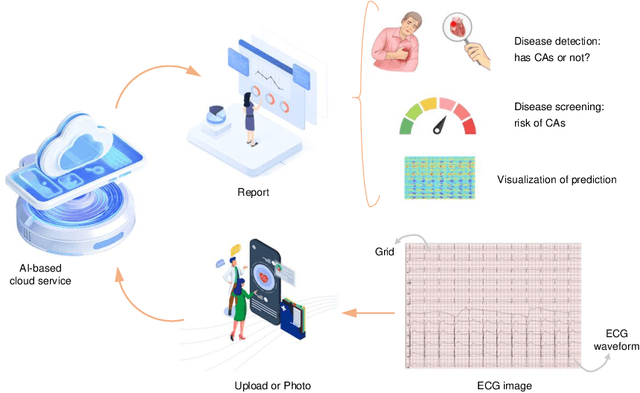

The artificial intelligence (AI) system has achieved expert-level performance in electrocardiogram (ECG) signal analysis. However, in underdeveloped countries or regions where the healthcare information system is imperfect, only paper ECGs can be provided. Analysis of real-world ECG images (photos or scans of paper ECGs) remains challenging due to complex environments or interference. In this study, we present an AI system developed to detect and screen cardiac abnormalities (CAs) from real-world ECG images. The system was evaluated on a large dataset of 52,357 patients from multiple regions and populations across the world. On the detection task, the AI system obtained area under the receiver operating curve (AUC) of 0.996 (hold-out test), 0.994 (external test 1), 0.984 (external test 2), and 0.979 (external test 3), respectively. Meanwhile, the detection results of AI system showed a strong correlation with the diagnosis of cardiologists (cardiologist 1 (R=0.794, p<1e-3), cardiologist 2 (R=0.812, p<1e-3)). On the screening task, the AI system achieved AUCs of 0.894 (hold-out test) and 0.850 (external test). The screening performance of the AI system was better than that of the cardiologists (AI system (0.846) vs. cardiologist 1 (0.520) vs. cardiologist 2 (0.480)). Our study demonstrates the feasibility of an accurate, objective, easy-to-use, fast, and low-cost AI system for CA detection and screening. The system has the potential to be used by healthcare professionals, caregivers, and general users to assess CAs based on real-world ECG images.