 Add to Chrome
 Add to Firefox
 Add to Edge
PCQPR: Proactive Conversational Question Planning with Reflection
Oct 02, 2024
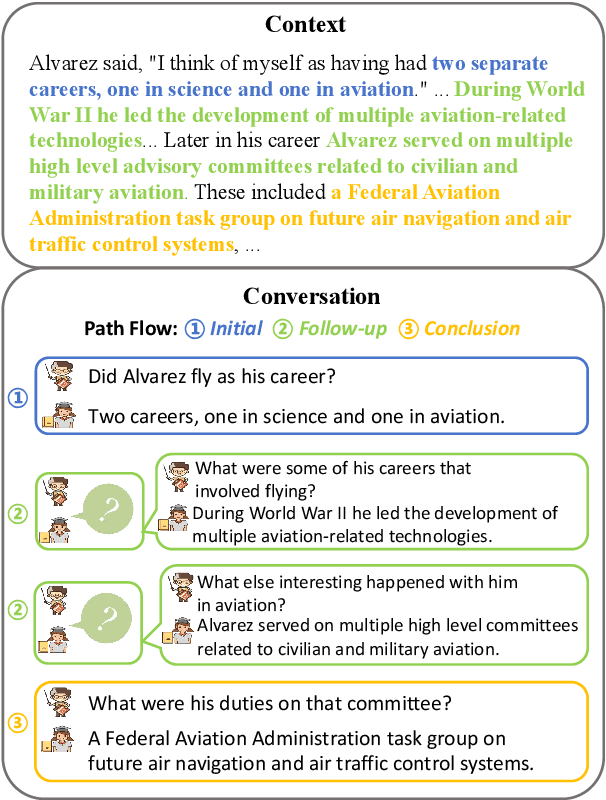
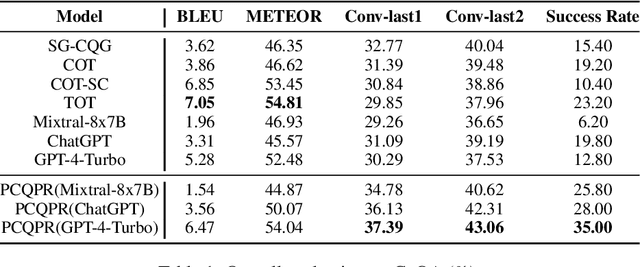
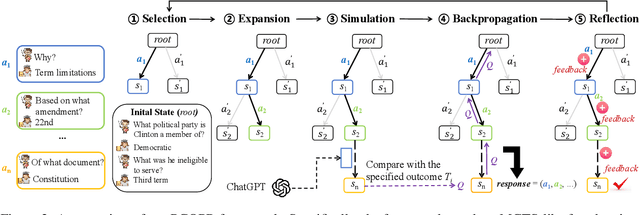
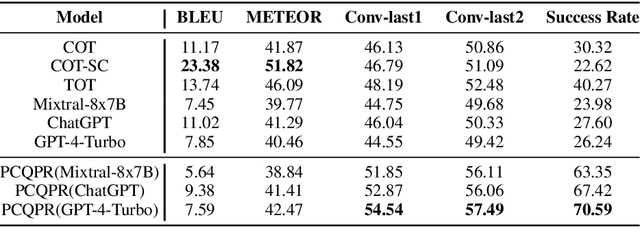
Conversational Question Generation (CQG) enhances the interactivity of conversational question-answering systems in fields such as education, customer service, and entertainment. However, traditional CQG, focusing primarily on the immediate context, lacks the conversational foresight necessary to guide conversations toward specified conclusions. This limitation significantly restricts their ability to achieve conclusion-oriented conversational outcomes. In this work, we redefine the CQG task as Conclusion-driven Conversational Question Generation (CCQG) by focusing on proactivity, not merely reacting to the unfolding conversation but actively steering it towards a conclusion-oriented question-answer pair. To address this, we propose a novel approach, called Proactive Conversational Question Planning with self-Refining (PCQPR). Concretely, by integrating a planning algorithm inspired by Monte Carlo Tree Search (MCTS) with the analytical capabilities of large language models (LLMs), PCQPR predicts future conversation turns and continuously refines its questioning strategies. This iterative self-refining mechanism ensures the generation of contextually relevant questions strategically devised to reach a specified outcome. Our extensive evaluations demonstrate that PCQPR significantly surpasses existing CQG methods, marking a paradigm shift towards conclusion-oriented conversational question-answering systems.
* Accepted by EMNLP 2024 Main

Underwater Organism Color Enhancement via Color Code Decomposition, Adaptation and Interpolation
Sep 29, 2024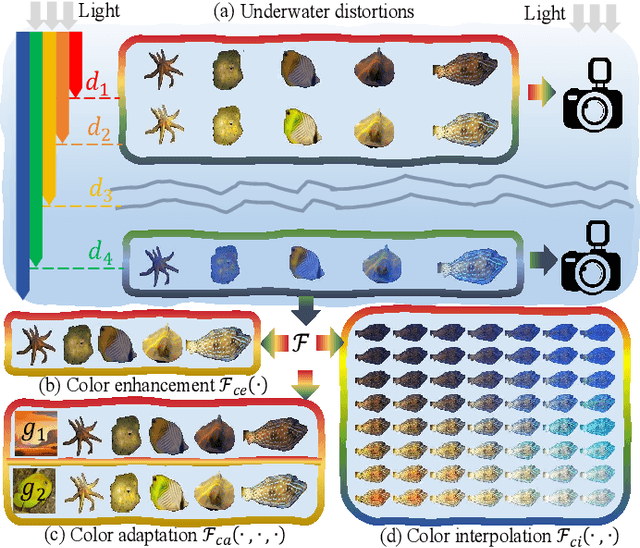

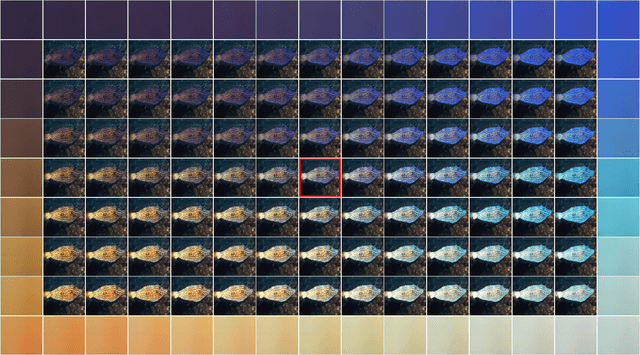

Underwater images often suffer from quality degradation due to absorption and scattering effects. Most existing underwater image enhancement algorithms produce a single, fixed-color image, limiting user flexibility and application. To address this limitation, we propose a method called \textit{ColorCode}, which enhances underwater images while offering a range of controllable color outputs. Our approach involves recovering an underwater image to a reference enhanced image through supervised training and decomposing it into color and content codes via self-reconstruction and cross-reconstruction. The color code is explicitly constrained to follow a Gaussian distribution, allowing for efficient sampling and interpolation during inference. ColorCode offers three key features: 1) color enhancement, producing an enhanced image with a fixed color; 2) color adaptation, enabling controllable adjustments of long-wavelength color components using guidance images; and 3) color interpolation, allowing for the smooth generation of multiple colors through continuous sampling of the color code. Quantitative and visual evaluations on popular and challenging benchmark datasets demonstrate the superiority of ColorCode over existing methods in providing diverse, controllable, and color-realistic enhancement results. The source code is available at https://github.com/Xiaofeng-life/ColorCode.
Evaluation of OpenAI o1: Opportunities and Challenges of AGI
Sep 27, 2024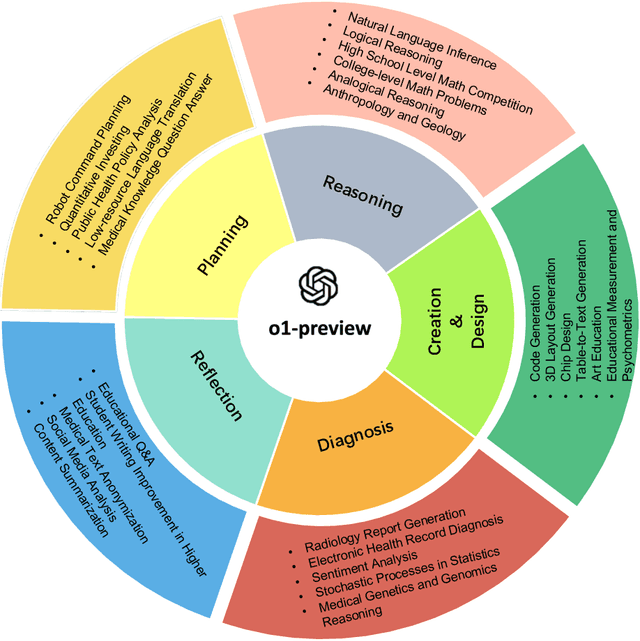
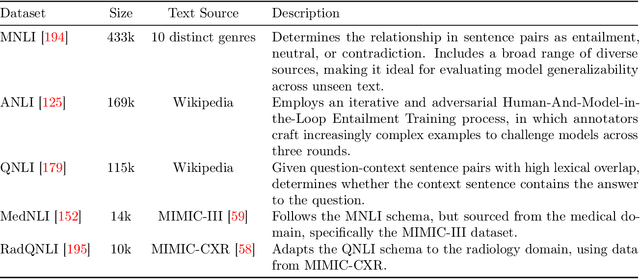


This comprehensive study evaluates the performance of OpenAI's o1-preview large language model across a diverse array of complex reasoning tasks, spanning multiple domains, including computer science, mathematics, natural sciences, medicine, linguistics, and social sciences. Through rigorous testing, o1-preview demonstrated remarkable capabilities, often achieving human-level or superior performance in areas ranging from coding challenges to scientific reasoning and from language processing to creative problem-solving. Key findings include: -83.3% success rate in solving complex competitive programming problems, surpassing many human experts. -Superior ability in generating coherent and accurate radiology reports, outperforming other evaluated models. -100% accuracy in high school-level mathematical reasoning tasks, providing detailed step-by-step solutions. -Advanced natural language inference capabilities across general and specialized domains like medicine. -Impressive performance in chip design tasks, outperforming specialized models in areas such as EDA script generation and bug analysis. -Remarkable proficiency in anthropology and geology, demonstrating deep understanding and reasoning in these specialized fields. -Strong capabilities in quantitative investing. O1 has comprehensive financial knowledge and statistical modeling skills. -Effective performance in social media analysis, including sentiment analysis and emotion recognition. The model excelled particularly in tasks requiring intricate reasoning and knowledge integration across various fields. While some limitations were observed, including occasional errors on simpler problems and challenges with certain highly specialized concepts, the overall results indicate significant progress towards artificial general intelligence.
Few-Shot Class-Incremental Learning with Non-IID Decentralized Data
Sep 18, 2024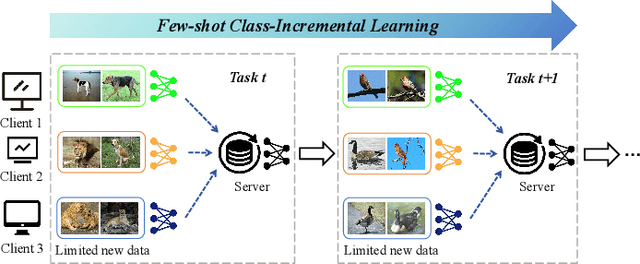
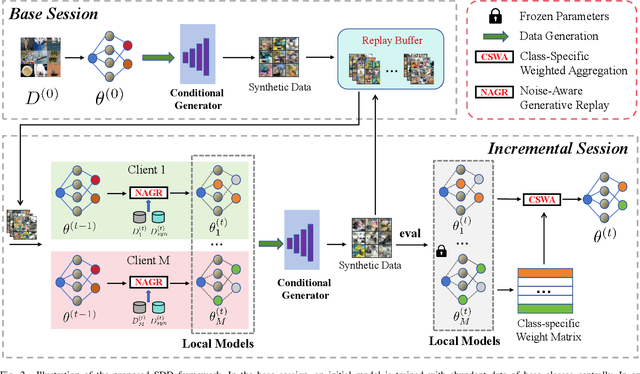

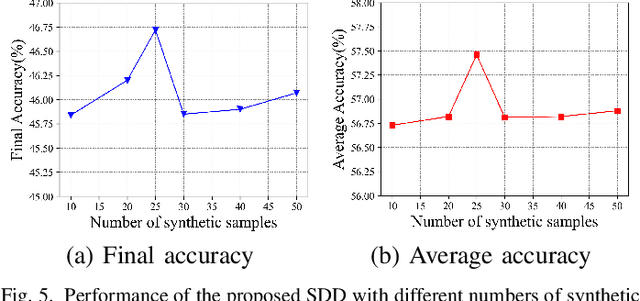
Few-shot class-incremental learning is crucial for developing scalable and adaptive intelligent systems, as it enables models to acquire new classes with minimal annotated data while safeguarding the previously accumulated knowledge. Nonetheless, existing methods deal with continuous data streams in a centralized manner, limiting their applicability in scenarios that prioritize data privacy and security. To this end, this paper introduces federated few-shot class-incremental learning, a decentralized machine learning paradigm tailored to progressively learn new classes from scarce data distributed across multiple clients. In this learning paradigm, clients locally update their models with new classes while preserving data privacy, and then transmit the model updates to a central server where they are aggregated globally. However, this paradigm faces several issues, such as difficulties in few-shot learning, catastrophic forgetting, and data heterogeneity. To address these challenges, we present a synthetic data-driven framework that leverages replay buffer data to maintain existing knowledge and facilitate the acquisition of new knowledge. Within this framework, a noise-aware generative replay module is developed to fine-tune local models with a balance of new and replay data, while generating synthetic data of new classes to further expand the replay buffer for future tasks. Furthermore, a class-specific weighted aggregation strategy is designed to tackle data heterogeneity by adaptively aggregating class-specific parameters based on local models performance on synthetic data. This enables effective global model optimization without direct access to client data. Comprehensive experiments across three widely-used datasets underscore the effectiveness and preeminence of the introduced framework.
SoccerNet 2024 Challenges Results
Sep 16, 2024
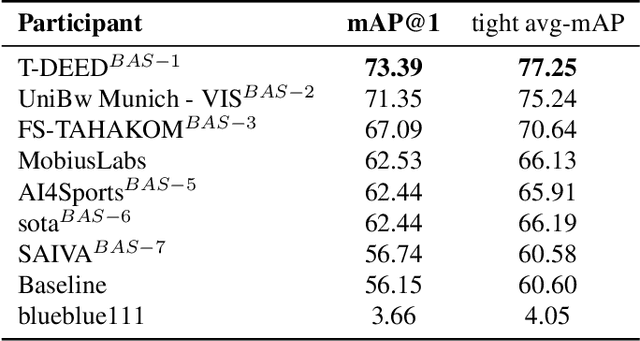
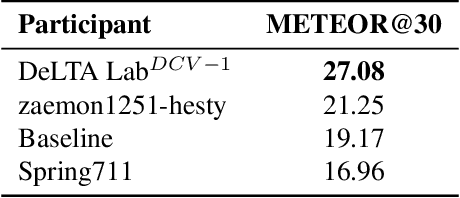
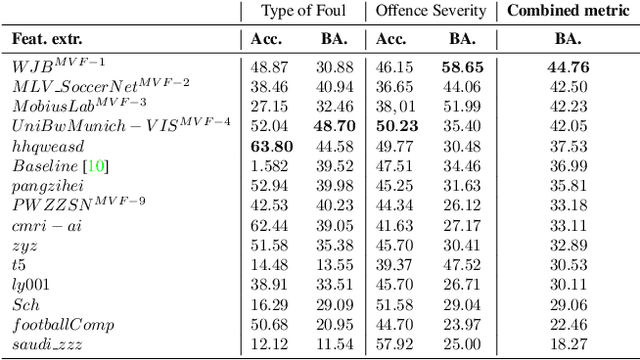
The SoccerNet 2024 challenges represent the fourth annual video understanding challenges organized by the SoccerNet team. These challenges aim to advance research across multiple themes in football, including broadcast video understanding, field understanding, and player understanding. This year, the challenges encompass four vision-based tasks. (1) Ball Action Spotting, focusing on precisely localizing when and which soccer actions related to the ball occur, (2) Dense Video Captioning, focusing on describing the broadcast with natural language and anchored timestamps, (3) Multi-View Foul Recognition, a novel task focusing on analyzing multiple viewpoints of a potential foul incident to classify whether a foul occurred and assess its severity, (4) Game State Reconstruction, another novel task focusing on reconstructing the game state from broadcast videos onto a 2D top-view map of the field. Detailed information about the tasks, challenges, and leaderboards can be found at https://www.soccer-net.org, with baselines and development kits available at https://github.com/SoccerNet.
GP-GPT: Large Language Model for Gene-Phenotype Mapping
Sep 15, 2024


Pre-trained large language models(LLMs) have attracted increasing attention in biomedical domains due to their success in natural language processing. However, the complex traits and heterogeneity of multi-sources genomics data pose significant challenges when adapting these models to the bioinformatics and biomedical field. To address these challenges, we present GP-GPT, the first specialized large language model for genetic-phenotype knowledge representation and genomics relation analysis. Our model is fine-tuned in two stages on a comprehensive corpus composed of over 3,000,000 terms in genomics, proteomics, and medical genetics, derived from multiple large-scale validated datasets and scientific publications. GP-GPT demonstrates proficiency in accurately retrieving medical genetics information and performing common genomics analysis tasks, such as genomics information retrieval and relationship determination. Comparative experiments across domain-specific tasks reveal that GP-GPT outperforms state-of-the-art LLMs, including Llama2, Llama3 and GPT-4. These results highlight GP-GPT's potential to enhance genetic disease relation research and facilitate accurate and efficient analysis in the fields of genomics and medical genetics. Our investigation demonstrated the subtle changes of bio-factor entities' representations in the GP-GPT, which suggested the opportunities for the application of LLMs to advancing gene-phenotype research.
Visual Language Tracking with Multi-modal Interaction: A Robust Benchmark
Sep 13, 2024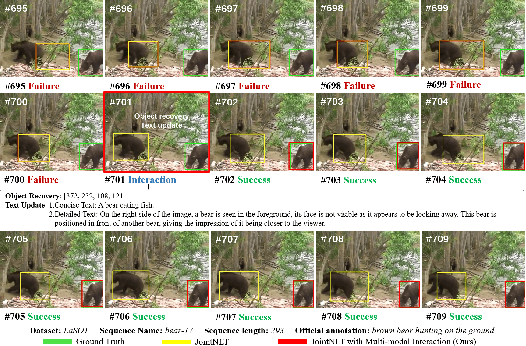
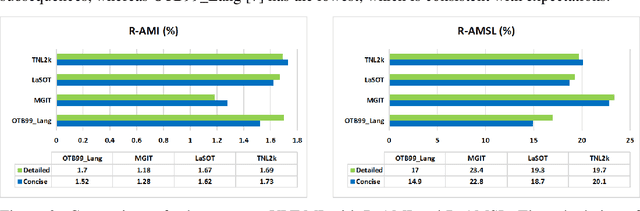
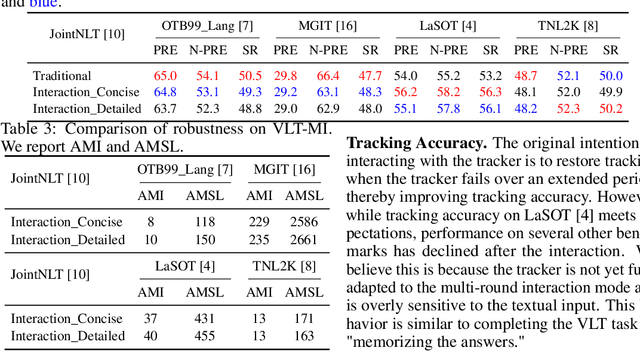
Visual Language Tracking (VLT) enhances tracking by mitigating the limitations of relying solely on the visual modality, utilizing high-level semantic information through language. This integration of the language enables more advanced human-machine interaction. The essence of interaction is cognitive alignment, which typically requires multiple information exchanges, especially in the sequential decision-making process of VLT. However, current VLT benchmarks do not account for multi-round interactions during tracking. They provide only an initial text and bounding box (bbox) in the first frame, with no further interaction as tracking progresses, deviating from the original motivation of the VLT task. To address these limitations, we propose a novel and robust benchmark, VLT-MI (Visual Language Tracking with Multi-modal Interaction), which introduces multi-round interaction into the VLT task for the first time. (1) We generate diverse, multi-granularity texts for multi-round, multi-modal interaction based on existing mainstream VLT benchmarks using DTLLM-VLT, leveraging the world knowledge of LLMs. (2) We propose a new VLT interaction paradigm that achieves multi-round interaction through text updates and object recovery. When multiple tracking failures occur, we provide the tracker with more aligned texts and corrected bboxes through interaction, thereby expanding the scope of VLT downstream tasks. (3) We conduct comparative experiments on both traditional VLT benchmarks and VLT-MI, evaluating and analyzing the accuracy and robustness of trackers under the interactive paradigm. This work offers new insights and paradigms for the VLT task, enabling a fine-grained evaluation of multi-modal trackers. We believe this approach can be extended to additional datasets in the future, supporting broader evaluations and comparisons of video-language model capabilities.
Dynamic Prompting of Frozen Text-to-Image Diffusion Models for Panoptic Narrative Grounding
Sep 12, 2024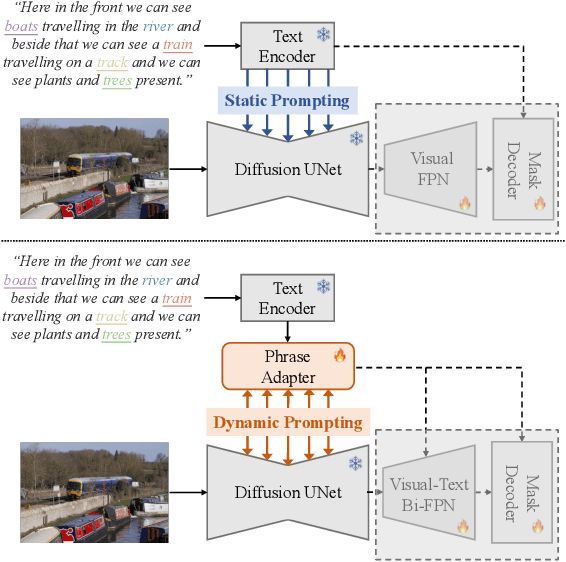
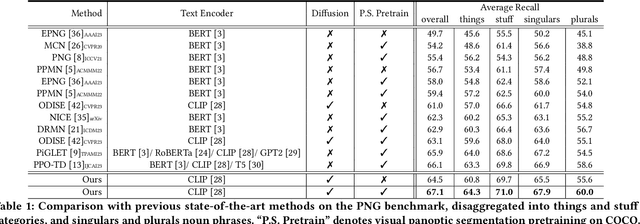
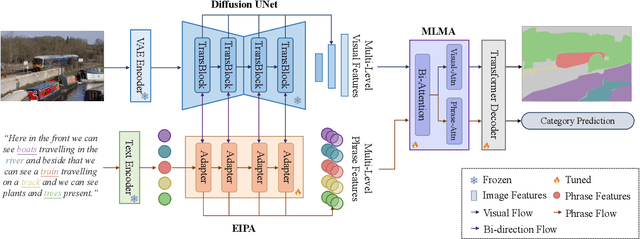
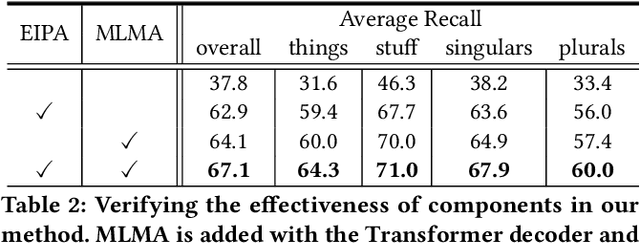
Panoptic narrative grounding (PNG), whose core target is fine-grained image-text alignment, requires a panoptic segmentation of referred objects given a narrative caption. Previous discriminative methods achieve only weak or coarse-grained alignment by panoptic segmentation pretraining or CLIP model adaptation. Given the recent progress of text-to-image Diffusion models, several works have shown their capability to achieve fine-grained image-text alignment through cross-attention maps and improved general segmentation performance. However, the direct use of phrase features as static prompts to apply frozen Diffusion models to the PNG task still suffers from a large task gap and insufficient vision-language interaction, yielding inferior performance. Therefore, we propose an Extractive-Injective Phrase Adapter (EIPA) bypass within the Diffusion UNet to dynamically update phrase prompts with image features and inject the multimodal cues back, which leverages the fine-grained image-text alignment capability of Diffusion models more sufficiently. In addition, we also design a Multi-Level Mutual Aggregation (MLMA) module to reciprocally fuse multi-level image and phrase features for segmentation refinement. Extensive experiments on the PNG benchmark show that our method achieves new state-of-the-art performance.
LSVOS Challenge Report: Large-scale Complex and Long Video Object Segmentation
Sep 09, 2024


Despite the promising performance of current video segmentation models on existing benchmarks, these models still struggle with complex scenes. In this paper, we introduce the 6th Large-scale Video Object Segmentation (LSVOS) challenge in conjunction with ECCV 2024 workshop. This year's challenge includes two tasks: Video Object Segmentation (VOS) and Referring Video Object Segmentation (RVOS). In this year, we replace the classic YouTube-VOS and YouTube-RVOS benchmark with latest datasets MOSE, LVOS, and MeViS to assess VOS under more challenging complex environments. This year's challenge attracted 129 registered teams from more than 20 institutes across over 8 countries. This report include the challenge and dataset introduction, and the methods used by top 7 teams in two tracks. More details can be found in our homepage https://lsvos.github.io/.
Unleashing the Power of Generic Segmentation Models: A Simple Baseline for Infrared Small Target Detection
Sep 07, 2024Recent advancements in deep learning have greatly advanced the field of infrared small object detection (IRSTD). Despite their remarkable success, a notable gap persists between these IRSTD methods and generic segmentation approaches in natural image domains. This gap primarily arises from the significant modality differences and the limited availability of infrared data. In this study, we aim to bridge this divergence by investigating the adaptation of generic segmentation models, such as the Segment Anything Model (SAM), to IRSTD tasks. Our investigation reveals that many generic segmentation models can achieve comparable performance to state-of-the-art IRSTD methods. However, their full potential in IRSTD remains untapped. To address this, we propose a simple, lightweight, yet effective baseline model for segmenting small infrared objects. Through appropriate distillation strategies, we empower smaller student models to outperform state-of-the-art methods, even surpassing fine-tuned teacher results. Furthermore, we enhance the model's performance by introducing a novel query design comprising dense and sparse queries to effectively encode multi-scale features. Through extensive experimentation across four popular IRSTD datasets, our model demonstrates significantly improved performance in both accuracy and throughput compared to existing approaches, surpassing SAM and Semantic-SAM by over 14 IoU on NUDT and 4 IoU on IRSTD1k. The source code and models will be released at https://github.com/O937-blip/SimIR.