 Add to Chrome
 Add to Firefox
 Add to Edge
SoccerNet 2026 Challenges Results
Jul 08, 2026
The SoccerNet 2026 Challenges constitute the sixth annual edition of the SoccerNet open benchmarking effort, dedicated to advancing computer vision research in sports video understanding. This year's challenges span five vision-based tasks: (1) Ball Action Anticipation, predicting the timing and class of ball-related actions within a short future window from a preceding observation window; (2) Player-Centric Ball Action Spotting, temporally localizing and classifying ball-related actions while assigning each action to the acting player through team affiliation and jersey number; (3) Novel View Synthesis, rendering images from unobserved camera poses in multi-view football scenes; (4) Spiideo SoccerNet Synloc, localizing athletes in real-world pitch coordinates from a single calibrated static-camera image; and (5) Visual Question Answering, answering multiple-choice questions about football broadcasts across text, image, and video inputs. For each task, participants were provided with annotated data, a unified evaluation protocol, and a public baseline. This edition saw broad participation, with 427 teams submitting 1,129 entries across the five tasks and 28 teams contributing reviewed technical reports. This paper describes each task and its evaluation protocol, presents the challenge leaderboards, and summarizes the leading submissions, with the aim of documenting the current state of each task as measured on held-out challenge data.

Event Detection in Videos: A Framework for the Development of New Methods
Jul 05, 2026Event detection tasks in videos, the most important aspect of video surveillance, aim to detect events either at the pixel-level, frame-level, or clip-level. Plenty of methods intended for event detection in different environments, for various applications, and within different acquisition techniques were introduced. Naturally, the attempts were made as well to classify these algorithms in terms of detection of performance or in terms of real-time abilities. Nevertheless, the lack of a large-scale dataset as well as rigorous performance evaluation methods have biased such comparisons as well as the development of the methods. Given the diversity of existing approaches, we believe it is essential for researchers to position their work within such a rich landscape. Thus, we propose a rigorous framework for developing new methods in event detection for videos. Specifically, this framework is based on three main pillars: datasets, performance evaluation, and scenarios for deploying methods.
TCG-AR: Real-Time Multi-View Augmented Reality for Trading Card Game Streaming
Jul 02, 2026Trading card games are increasingly played and broadcast online, yet live streams remain mostly limited to flat top-down footage of the playing area. Augmenting such streams with virtual models of the played cards would improve the viewing experience, but most existing systems rely on instrumented playing surfaces and embedded chips, which are costly and impractical for casual players and large-scale events. In this work, we present TCG-AR, a novel real-time pipeline that augments trading card games using ordinary RGB cameras alone, without any physical markers or specialized hardware. Our pipeline detects, orients, and identifies the cards on the board, renders virtual content onto each card across all views, and can additionally compose a broadcaststyle view that summarizes the game state for spectators, streaming the augmented feeds to standard broadcasting software such as OBS. To train the detection, orientation, and identification models without manual labeling, we introduce an automatic procedure that generates annotated synthetic training data from a reference set of card images. Then, we evaluate several trained models on a new manually annotated dataset with real images, analyzing performance and runtime throughput that determine real-world usability. Overall, by relying only on commodity cameras and hardware, and by open-sourcing all code, models, and datasets, this work aims to serve as a reference for real-time trading card recognition and to make real-time augmented-reality streaming accessible to the broader community of players and streamers.
Towards Athlete Fatigue Assessment from Association Football Videos
Apr 07, 2026Fatigue monitoring is central in association football due to its links with injury risk and tactical performance. However, objective fatigue-related indicators are commonly derived from subjective self-reported metrics, biomarkers derived from laboratory tests, or, more recently, intrusive sensors such as heart monitors or GPS tracking data. This paper studies whether monocular broadcast videos can provide spatio-temporal signals of sufficient quality to support fatigue-oriented analysis. Building on state-of-the-art Game State Reconstruction methods, we extract player trajectories in pitch coordinates and propose a novel kinematics processing algorithm to obtain temporally consistent speed and acceleration estimates from reconstructed tracks. We then construct acceleration--speed (A-S) profiles from these signals and analyze their behavior as fatigue-related performance indicators. We evaluate the full pipeline on the public SoccerNet-GSR benchmark, considering both 30-second clips and a complete 45-minute half to examine short-term reliability and longer-term temporal consistency. Our results indicate that monocular GSR can recover kinematic patterns that are compatible with A-S profiling while also revealing sensitivity to trajectory noise, calibration errors, and temporal discontinuities inherent to broadcast footage. These findings support monocular broadcast video as a low-cost basis for fatigue analysis and delineate the methodological challenges for future research.
Pixels or Positions? Benchmarking Modalities in Group Activity Recognition
Nov 16, 2025Group Activity Recognition (GAR) is well studied on the video modality for surveillance and indoor team sports (e.g., volleyball, basketball). Yet, other modalities such as agent positions and trajectories over time, i.e. tracking, remain comparatively under-explored despite being compact, agent-centric signals that explicitly encode spatial interactions. Understanding whether pixel (video) or position (tracking) modalities leads to better group activity recognition is therefore important to drive further research on the topic. However, no standardized benchmark currently exists that aligns broadcast video and tracking data for the same group activities, leading to a lack of apples-to-apples comparison between these modalities for GAR. In this work, we introduce SoccerNet-GAR, a multimodal dataset built from the $64$ matches of the football World Cup 2022. Specifically, the broadcast videos and player tracking modalities for $94{,}285$ group activities are synchronized and annotated with $10$ categories. Furthermore, we define a unified evaluation protocol to benchmark two strong unimodal approaches: (i) a competitive video-based classifiers and (ii) a tracking-based classifiers leveraging graph neural networks. In particular, our novel role-aware graph architecture for tracking-based GAR directly encodes tactical structure through positional edges and temporal attention. Our tracking model achieves $67.2\%$ balanced accuracy compared to $58.1\%$ for the best video baseline, while training $4.25 \times$ faster with $438 \times$ fewer parameters ($197K$ \vs $86.3M$). This study provides new insights into the relative strengths of pixels and positions for group activity recognition. Overall, it highlights the importance of modality choice and role-aware modeling for GAR.
SoccerNet 2025 Challenges Results
Aug 26, 2025The SoccerNet 2025 Challenges mark the fifth annual edition of the SoccerNet open benchmarking effort, dedicated to advancing computer vision research in football video understanding. This year's challenges span four vision-based tasks: (1) Team Ball Action Spotting, focused on detecting ball-related actions in football broadcasts and assigning actions to teams; (2) Monocular Depth Estimation, targeting the recovery of scene geometry from single-camera broadcast clips through relative depth estimation for each pixel; (3) Multi-View Foul Recognition, requiring the analysis of multiple synchronized camera views to classify fouls and their severity; and (4) Game State Reconstruction, aimed at localizing and identifying all players from a broadcast video to reconstruct the game state on a 2D top-view of the field. Across all tasks, participants were provided with large-scale annotated datasets, unified evaluation protocols, and strong baselines as starting points. This report presents the results of each challenge, highlights the top-performing solutions, and provides insights into the progress made by the community. The SoccerNet Challenges continue to serve as a driving force for reproducible, open research at the intersection of computer vision, artificial intelligence, and sports. Detailed information about the tasks, challenges, and leaderboards can be found at https://www.soccer-net.org, with baselines and development kits available at https://github.com/SoccerNet.
Triangle Splatting for Real-Time Radiance Field Rendering
May 25, 2025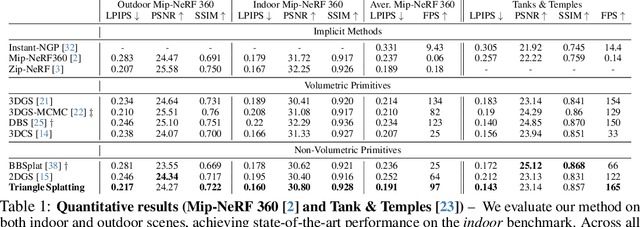
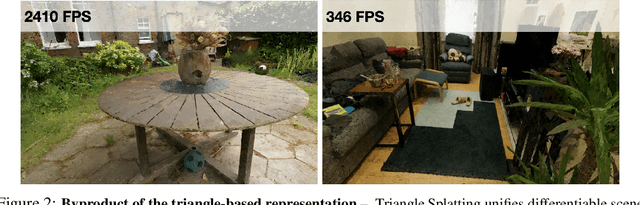
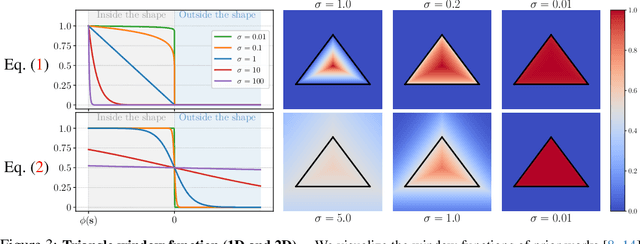
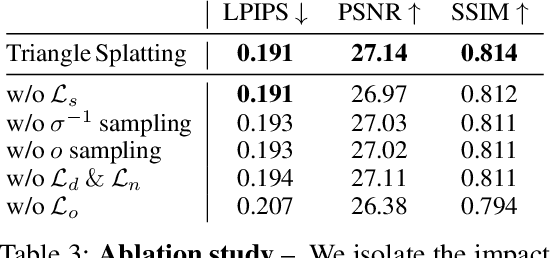
The field of computer graphics was revolutionized by models such as Neural Radiance Fields and 3D Gaussian Splatting, displacing triangles as the dominant representation for photogrammetry. In this paper, we argue for a triangle comeback. We develop a differentiable renderer that directly optimizes triangles via end-to-end gradients. We achieve this by rendering each triangle as differentiable splats, combining the efficiency of triangles with the adaptive density of representations based on independent primitives. Compared to popular 2D and 3D Gaussian Splatting methods, our approach achieves higher visual fidelity, faster convergence, and increased rendering throughput. On the Mip-NeRF360 dataset, our method outperforms concurrent non-volumetric primitives in visual fidelity and achieves higher perceptual quality than the state-of-the-art Zip-NeRF on indoor scenes. Triangles are simple, compatible with standard graphics stacks and GPU hardware, and highly efficient: for the \textit{Garden} scene, we achieve over 2,400 FPS at 1280x720 resolution using an off-the-shelf mesh renderer. These results highlight the efficiency and effectiveness of triangle-based representations for high-quality novel view synthesis. Triangles bring us closer to mesh-based optimization by combining classical computer graphics with modern differentiable rendering frameworks. The project page is https://trianglesplatting.github.io/
Action Anticipation from SoccerNet Football Video Broadcasts
Apr 16, 2025Artificial intelligence has revolutionized the way we analyze sports videos, whether to understand the actions of games in long untrimmed videos or to anticipate the player's motion in future frames. Despite these efforts, little attention has been given to anticipating game actions before they occur. In this work, we introduce the task of action anticipation for football broadcast videos, which consists in predicting future actions in unobserved future frames, within a five- or ten-second anticipation window. To benchmark this task, we release a new dataset, namely the SoccerNet Ball Action Anticipation dataset, based on SoccerNet Ball Action Spotting. Additionally, we propose a Football Action ANticipation TRAnsformer (FAANTRA), a baseline method that adapts FUTR, a state-of-the-art action anticipation model, to predict ball-related actions. To evaluate action anticipation, we introduce new metrics, including mAP@$\delta$, which evaluates the temporal precision of predicted future actions, as well as mAP@$\infty$, which evaluates their occurrence within the anticipation window. We also conduct extensive ablation studies to examine the impact of various task settings, input configurations, and model architectures. Experimental results highlight both the feasibility and challenges of action anticipation in football videos, providing valuable insights into the design of predictive models for sports analytics. By forecasting actions before they unfold, our work will enable applications in automated broadcasting, tactical analysis, and player decision-making. Our dataset and code are publicly available at https://github.com/MohamadDalal/FAANTRA.
OpenTAD: A Unified Framework and Comprehensive Study of Temporal Action Detection
Feb 27, 2025Temporal action detection (TAD) is a fundamental video understanding task that aims to identify human actions and localize their temporal boundaries in videos. Although this field has achieved remarkable progress in recent years, further progress and real-world applications are impeded by the absence of a standardized framework. Currently, different methods are compared under different implementation settings, evaluation protocols, etc., making it difficult to assess the real effectiveness of a specific technique. To address this issue, we propose \textbf{OpenTAD}, a unified TAD framework consolidating 16 different TAD methods and 9 standard datasets into a modular codebase. In OpenTAD, minimal effort is required to replace one module with a different design, train a feature-based TAD model in end-to-end mode, or switch between the two. OpenTAD also facilitates straightforward benchmarking across various datasets and enables fair and in-depth comparisons among different methods. With OpenTAD, we comprehensively study how innovations in different network components affect detection performance and identify the most effective design choices through extensive experiments. This study has led to a new state-of-the-art TAD method built upon existing techniques for each component. We have made our code and models available at https://github.com/sming256/OpenTAD.
A Hitchhiker's Guide to Understanding Performances of Two-Class Classifiers
Dec 05, 2024Properly understanding the performances of classifiers is essential in various scenarios. However, the literature often relies only on one or two standard scores to compare classifiers, which fails to capture the nuances of application-specific requirements, potentially leading to suboptimal classifier selection. Recently, a paper on the foundations of the theory of performance-based ranking introduced a tool, called the Tile, that organizes an infinity of ranking scores into a 2D map. Thanks to the Tile, it is now possible to evaluate and compare classifiers efficiently, displaying all possible application-specific preferences instead of having to rely on a pair of scores. In this paper, we provide a first hitchhiker's guide for understanding the performances of two-class classifiers by presenting four scenarios, each showcasing a different user profile: a theoretical analyst, a method designer, a benchmarker, and an application developer. Particularly, we show that we can provide different interpretative flavors that are adapted to the user's needs by mapping different values on the Tile. As an illustration, we leverage the newly introduced Tile tool and the different flavors to rank and analyze the performances of 74 state-of-the-art semantic segmentation models in two-class classification through the eyes of the four user profiles. Through these user profiles, we demonstrate that the Tile effectively captures the behavior of classifiers in a single visualization, while accommodating an infinite number of ranking scores.