 Add to Chrome
 Add to Firefox
 Add to Edge
Do Graph Neural Networks Work for High Entropy Alloys?
Aug 29, 2024

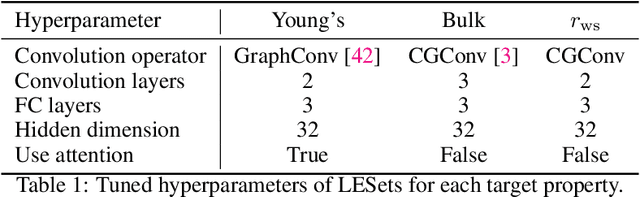
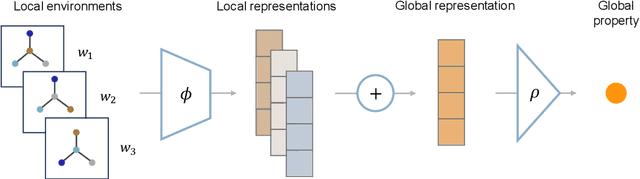
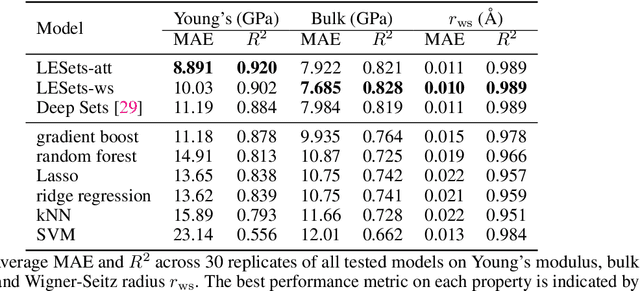
Graph neural networks (GNNs) have excelled in predictive modeling for both crystals and molecules, owing to the expressiveness of graph representations. High-entropy alloys (HEAs), however, lack chemical long-range order, limiting the applicability of current graph representations. To overcome this challenge, we propose a representation of HEAs as a collection of local environment (LE) graphs. Based on this representation, we introduce the LESets machine learning model, an accurate, interpretable GNN for HEA property prediction. We demonstrate the accuracy of LESets in modeling the mechanical properties of quaternary HEAs. Through analyses and interpretation, we further extract insights into the modeling and design of HEAs. In a broader sense, LESets extends the potential applicability of GNNs to disordered materials with combinatorial complexity formed by diverse constituents and their flexible configurations.

CoT Rerailer: Enhancing the Reliability of Large Language Models in Complex Reasoning Tasks through Error Detection and Correction
Aug 25, 2024Chain-of-Thought (CoT) prompting enhances Large Language Models (LLMs) complex reasoning abilities by generating intermediate steps. However, these steps can introduce hallucinations and accumulate errors. We propose the CoT Rerailer to address these challenges, employing self-consistency and multi-agent debate systems to identify and rectify errors in the reasoning process. The CoT Rerailer first selects the most logically correct Reasoning Path (RP) using consistency checks and critical evaluation by automated agents. It then engages a multi-agent debate system to propose and validate corrections to ensure the generation of an error-free intermediate logical path. The corrected steps are then used to generate a revised reasoning chain to further reduce hallucinations and enhance answer quality. We demonstrate the effectiveness of our approach across diverse question-answering datasets in various knowledge domains. The CoT Rerailer enhances the reliability of LLM-generated reasoning, contributing to more trustworthy AI driven decision-making processes.
A Digital Twin Framework Utilizing Machine Learning for Robust Predictive Maintenance: Enhancing Tire Health Monitoring
Aug 12, 2024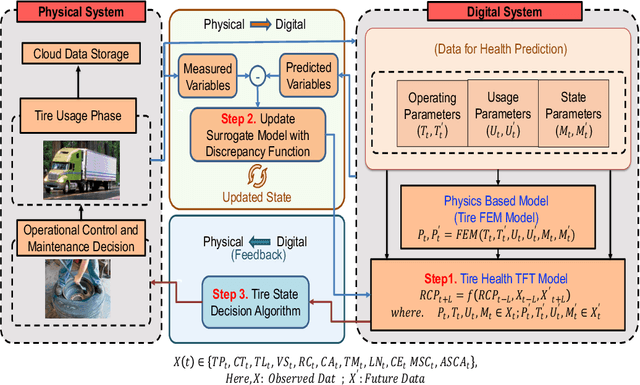


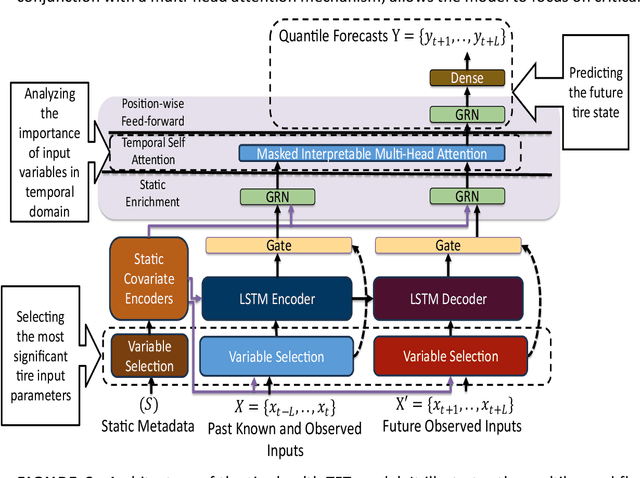
We introduce a novel digital twin framework for predictive maintenance of long-term physical systems. Using monitoring tire health as an application, we show how the digital twin framework can be used to enhance automotive safety and efficiency, and how the technical challenges can be overcome using a three-step approach. Firstly, for managing the data complexity over a long operation span, we employ data reduction techniques to concisely represent physical tires using historical performance and usage data. Relying on these data, for fast real-time prediction, we train a transformer-based model offline on our concise dataset to predict future tire health over time, represented as Remaining Casing Potential (RCP). Based on our architecture, our model quantifies both epistemic and aleatoric uncertainty, providing reliable confidence intervals around predicted RCP. Secondly, to incorporate real-time data, we update the predictive model in the digital twin framework, ensuring its accuracy throughout its life span with the aid of hybrid modeling and the use of discrepancy function. Thirdly, to assist decision making in predictive maintenance, we implement a Tire State Decision Algorithm, which strategically determines the optimal timing for tire replacement based on RCP forecasted by our transformer model. This approach ensures our digital twin accurately predicts system health, continually refines its digital representation, and supports predictive maintenance decisions. Our framework effectively embodies a physical system, leveraging big data and machine learning for predictive maintenance, model updates, and decision-making.
Towards Effective and Efficient Continual Pre-training of Large Language Models
Jul 26, 2024

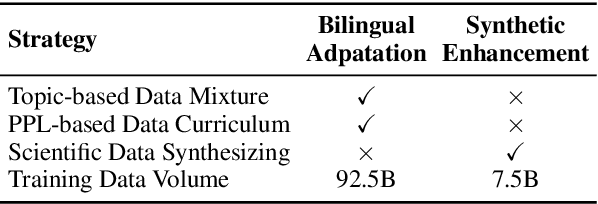

Continual pre-training (CPT) has been an important approach for adapting language models to specific domains or tasks. To make the CPT approach more traceable, this paper presents a technical report for continually pre-training Llama-3 (8B), which significantly enhances the Chinese language ability and scientific reasoning ability of the backbone model. To enhance the new abilities while retaining the original abilities, we design specific data mixture and curriculum strategies by utilizing existing datasets and synthesizing high-quality datasets. Specifically, we synthesize multidisciplinary scientific question and answer (QA) pairs based on related web pages, and subsequently incorporate these synthetic data to improve the scientific reasoning ability of Llama-3. We refer to the model after CPT as Llama-3-SynE (Synthetic data Enhanced Llama-3). We also present the tuning experiments with a relatively small model -- TinyLlama, and employ the derived findings to train the backbone model. Extensive experiments on a number of evaluation benchmarks show that our approach can largely improve the performance of the backbone models, including both the general abilities (+8.81 on C-Eval and +6.31 on CMMLU) and the scientific reasoning abilities (+12.00 on MATH and +4.13 on SciEval), without hurting the original capacities. Our model, data, and codes are available at https://github.com/RUC-GSAI/Llama-3-SynE.
Make a Strong Teacher with Label Assistance: A Novel Knowledge Distillation Approach for Semantic Segmentation
Jul 18, 2024

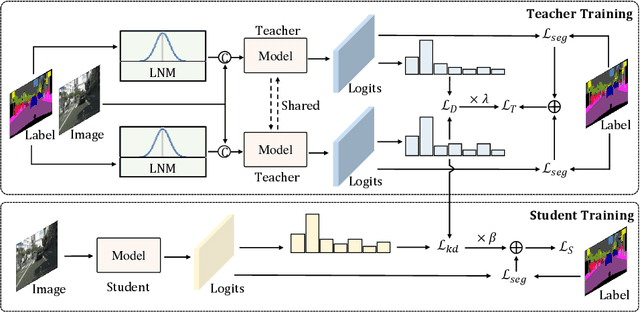

In this paper, we introduce a novel knowledge distillation approach for the semantic segmentation task. Unlike previous methods that rely on power-trained teachers or other modalities to provide additional knowledge, our approach does not require complex teacher models or information from extra sensors. Specifically, for the teacher model training, we propose to noise the label and then incorporate it into input to effectively boost the lightweight teacher performance. To ensure the robustness of the teacher model against the introduced noise, we propose a dual-path consistency training strategy featuring a distance loss between the outputs of two paths. For the student model training, we keep it consistent with the standard distillation for simplicity. Our approach not only boosts the efficacy of knowledge distillation but also increases the flexibility in selecting teacher and student models. To demonstrate the advantages of our Label Assisted Distillation (LAD) method, we conduct extensive experiments on five challenging datasets including Cityscapes, ADE20K, PASCAL-VOC, COCO-Stuff 10K, and COCO-Stuff 164K, five popular models: FCN, PSPNet, DeepLabV3, STDC, and OCRNet, and results show the effectiveness and generalization of our approach. We posit that incorporating labels into the input, as demonstrated in our work, will provide valuable insights into related fields. Code is available at https://github.com/skyshoumeng/Label_Assisted_Distillation.
Local Action-Guided Motion Diffusion Model for Text-to-Motion Generation
Jul 15, 2024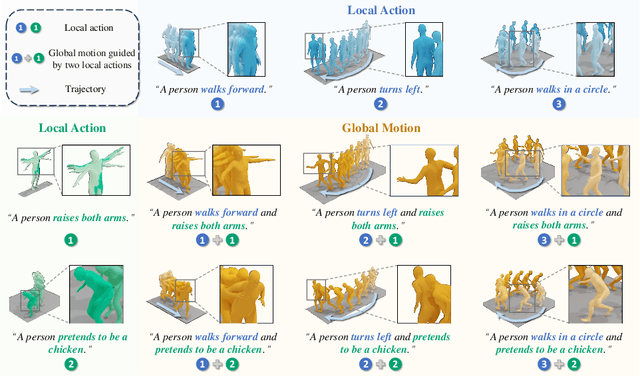
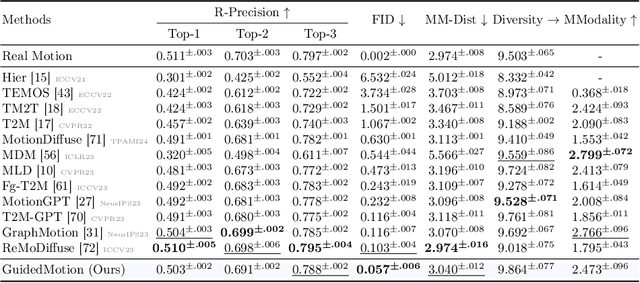
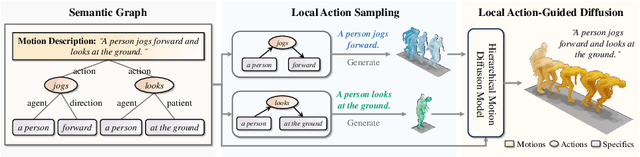
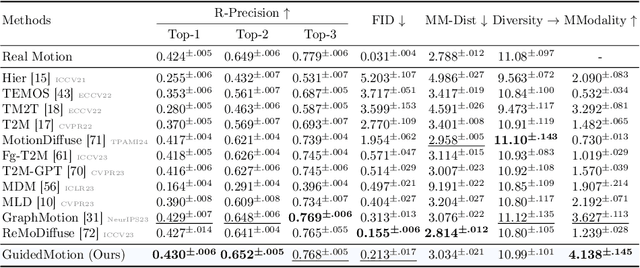
Text-to-motion generation requires not only grounding local actions in language but also seamlessly blending these individual actions to synthesize diverse and realistic global motions. However, existing motion generation methods primarily focus on the direct synthesis of global motions while neglecting the importance of generating and controlling local actions. In this paper, we propose the local action-guided motion diffusion model, which facilitates global motion generation by utilizing local actions as fine-grained control signals. Specifically, we provide an automated method for reference local action sampling and leverage graph attention networks to assess the guiding weight of each local action in the overall motion synthesis. During the diffusion process for synthesizing global motion, we calculate the local-action gradient to provide conditional guidance. This local-to-global paradigm reduces the complexity associated with direct global motion generation and promotes motion diversity via sampling diverse actions as conditions. Extensive experiments on two human motion datasets, i.e., HumanML3D and KIT, demonstrate the effectiveness of our method. Furthermore, our method provides flexibility in seamlessly combining various local actions and continuous guiding weight adjustment, accommodating diverse user preferences, which may hold potential significance for the community. The project page is available at https://jpthu17.github.io/GuidedMotion-project/.
Automated Label Unification for Multi-Dataset Semantic Segmentation with GNNs
Jul 15, 2024Deep supervised models possess significant capability to assimilate extensive training data, thereby presenting an opportunity to enhance model performance through training on multiple datasets. However, conflicts arising from different label spaces among datasets may adversely affect model performance. In this paper, we propose a novel approach to automatically construct a unified label space across multiple datasets using graph neural networks. This enables semantic segmentation models to be trained simultaneously on multiple datasets, resulting in performance improvements. Unlike existing methods, our approach facilitates seamless training without the need for additional manual reannotation or taxonomy reconciliation. This significantly enhances the efficiency and effectiveness of multi-dataset segmentation model training. The results demonstrate that our method significantly outperforms other multi-dataset training methods when trained on seven datasets simultaneously, and achieves state-of-the-art performance on the WildDash 2 benchmark.
LLMBox: A Comprehensive Library for Large Language Models
Jul 08, 2024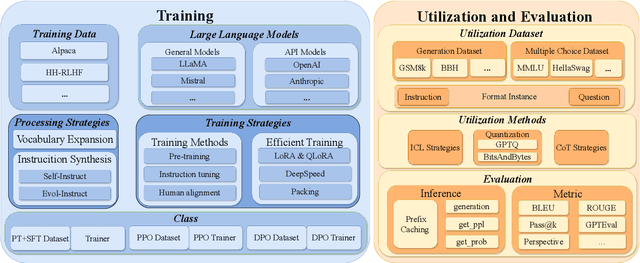
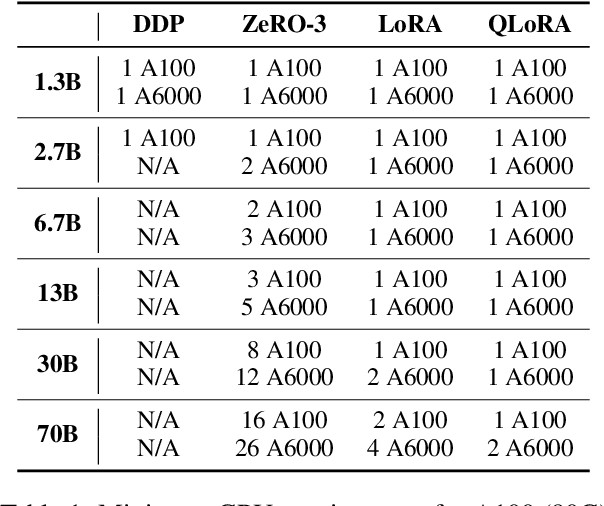
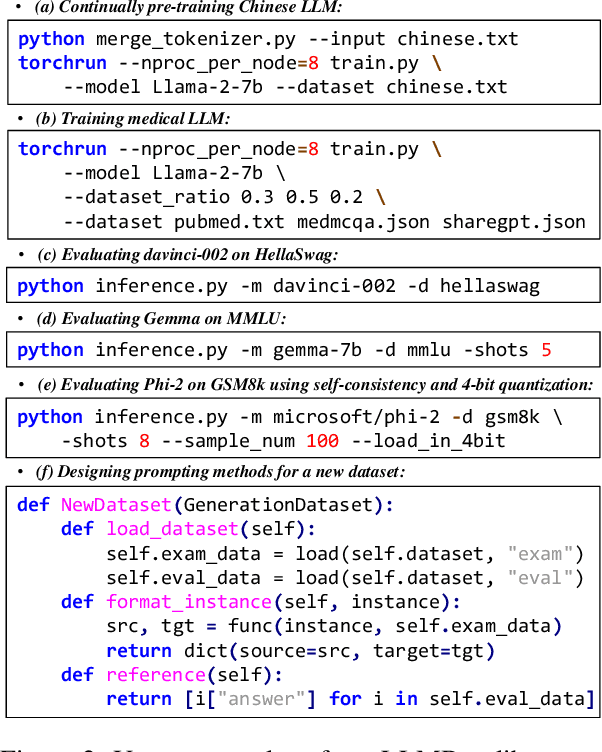

To facilitate the research on large language models (LLMs), this paper presents a comprehensive and unified library, LLMBox, to ease the development, use, and evaluation of LLMs. This library is featured with three main merits: (1) a unified data interface that supports the flexible implementation of various training strategies, (2) a comprehensive evaluation that covers extensive tasks, datasets, and models, and (3) more practical consideration, especially on user-friendliness and efficiency. With our library, users can easily reproduce existing methods, train new models, and conduct comprehensive performance comparisons. To rigorously test LLMBox, we conduct extensive experiments in a diverse coverage of evaluation settings, and experimental results demonstrate the effectiveness and efficiency of our library in supporting various implementations related to LLMs. The detailed introduction and usage guidance can be found at https://github.com/RUCAIBox/LLMBox.
Time-optimal Flight in Cluttered Environments via Safe Reinforcement Learning
Jun 28, 2024This paper addresses the problem of guiding a quadrotor through a predefined sequence of waypoints in cluttered environments, aiming to minimize the flight time while avoiding collisions. Previous approaches either suffer from prolonged computational time caused by solving complex non-convex optimization problems or are limited by the inherent smoothness of polynomial trajectory representations, thereby restricting the flexibility of movement. In this work, we present a safe reinforcement learning approach for autonomous drone racing with time-optimal flight in cluttered environments. The reinforcement learning policy, trained using safety and terminal rewards specifically designed to enforce near time-optimal and collision-free flight, outperforms current state-of-the-art algorithms. Additionally, experimental results demonstrate the efficacy of the proposed approach in achieving both minimum flight time and obstacle avoidance objectives in complex environments, with a commendable $66.7\%$ success rate in unseen, challenging settings.
Unveiling the Flaws: Exploring Imperfections in Synthetic Data and Mitigation Strategies for Large Language Models
Jun 18, 2024Synthetic data has been proposed as a solution to address the issue of high-quality data scarcity in the training of large language models (LLMs). Studies have shown that synthetic data can effectively improve the performance of LLMs on downstream benchmarks. However, despite its potential benefits, our analysis suggests that there may be inherent flaws in synthetic data. The uniform format of synthetic data can lead to pattern overfitting and cause significant shifts in the output distribution, thereby reducing the model's instruction-following capabilities. Our work delves into these specific flaws associated with question-answer (Q-A) pairs, a prevalent type of synthetic data, and presents a method based on unlearning techniques to mitigate these flaws. The empirical results demonstrate the effectiveness of our approach, which can reverse the instruction-following issues caused by pattern overfitting without compromising performance on benchmarks at relatively low cost. Our work has yielded key insights into the effective use of synthetic data, aiming to promote more robust and efficient LLM training.