 Add to Chrome
 Add to Firefox
 Add to Edge
FlashPrefill V2: Block-Sparse Prefill Attention for Long-Context LLM Serving
Aug 20, 2026
Long-context modeling is a pivotal capability for Large Language Models, yet the quadratic complexity of attention remains a critical bottleneck, particularly during the compute-intensive prefilling phase. Our previous work, FlashPrefill, mitigates this cost through instantaneous pattern discovery and max-based dynamic thresholding; however, it remains an algorithmic prototype that is still distant from production deployment. In this paper, we present FlashPrefill V2, which evolves FlashPrefill from a prototype toward practical long-context serving along three dimensions. First, we introduce a mean correction term that effectively suppresses the approximation error, keeping performance degradation manageable even at extreme sparsity levels. Second, we redesign the sparse attention operator with PackGQA memory access, warp specialization, and pingpong pipelining, fully aligning with the latest FlashAttention-3/4 implementations and supporting FP8 inference to meet practical quantization requirements. Third, FlashPrefill V2 natively supports paged KV cache and continuous batching, allowing integration as an attention backend in modern inference frameworks such as SGLang. Extensive evaluations on NVIDIA H20 GPUs---among the most widely deployed inference accelerators---demonstrate that FlashPrefill V2 delivers up to 47.26x and 27.19x speedups over FlashAttention-2 at 128K context length under FP8 and BF16 precision, respectively, and, in FP8, still achieves a 30.49x speedup against an FA3/4-aligned dense baseline.

Post-Trained MoE Can Skip Half Experts via Self-Distillation
May 18, 2026Mixture-of-Experts (MoE) scales language models efficiently through sparse expert activation, and its dynamic variant further reduces computation by adjusting the activated experts in an input-dependent manner. Existing dynamic MoE methods usually rely on pre-training from scratch or task-specific adaptation, leaving the practical conversion of fully trained MoE underexplored. Enabling such adaptation would directly alleviate the inference costs by allowing easy tokens to bypass unnecessary expert during serving. This paper introduces Zero-Expert Self-Distillation Adaptation (ZEDA), a low-cost framework that transforms post-trained static MoE models into efficient dynamic ones. To stabilize this architectural conversion, ZEDA injects parameter-free zero-output experts into each MoE layer and adapts the augmented model through two-stage self-distillation, utilizing the original MoE as a frozen teacher and applying a group-level balancing loss. On Qwen3-30B-A3B and GLM-4.7-Flash across 11 benchmarks spanning math, code, and instruction following, ZEDA eliminates over 50% of expert FLOPs at marginal accuracy loss. It outperforms the strongest dynamic MoE baseline by 6.1 and 4.0 points on the two models, and delivers ~1.20$\times$ end-to-end inference speedup.
UniPrefill: Universal Long-Context Prefill Acceleration via Block-wise Dynamic Sparsification
May 07, 2026As large language models (LLMs) continue to advance rapidly, they are becoming increasingly capable while simultaneously demanding ever-longer context lengths. To improve the inference efficiency of long-context processing, several novel low-complexity hybrid architectures have recently been proposed, effectively alleviating the computational burden of long-context inference. However, existing research on long-context prefill acceleration remains predominantly focused on sparse attention mechanisms, which achieve their maximum speedup only on full-attention models. When transferred to emerging architectures--such as linear/full attention hybrids or sliding window/full attention hybrids--these prefill acceleration approaches suffer significant performance degradation. Furthermore, such methods are generally incompatible with continuous batching, making them difficult to integrate into modern inference engines such as vLLM. To this end, we propose UniPrefill, a prefill acceleration framework applicable to virtually any model architecture, which directly accelerates the model's computation at the token level. We further implement UniPrefill as a continuous batching operator and extend vLLM's scheduling strategy to natively support prefill-decode co-processing and tensor parallel for UniPrefill, enabling its seamless integration into vLLM. UniPrefill achieves up to 2.1x speedup in Time-To-First-Token (TTFT), with the acceleration becoming increasingly pronounced as the number of concurrent requests grows.
Gradients Must Earn Their Influence: Unifying SFT with Generalized Entropic Objectives
Feb 11, 2026Standard negative log-likelihood (NLL) for Supervised Fine-Tuning (SFT) applies uniform token-level weighting. This rigidity creates a two-fold failure mode: (i) overemphasizing low-probability targets can amplify gradients on noisy supervision and disrupt robust priors, and (ii) uniform weighting provides weak sharpening when the model is already confident. Existing methods fail to resolve the resulting plasticity--stability dilemma, often suppressing necessary learning signals alongside harmful ones. To address this issue, we unify token-level SFT objectives within a generalized deformed-log family and expose a universal gate $\times$ error gradient structure, where the gate controls how much the model trusts its current prediction. By employing the Cayley transform, we map the model's continuously evolving uncertainty onto a continuous focus trajectory, which enables seamless interpolation between scenarios involving uncertain novel concepts and those involving well-established knowledge. We then introduce Dynamic Entropy Fine-Tuning (DEFT), a parameter-free objective that modulates the trust gate using distribution concentration (Rényi-2 entropy) as a practical proxy for the model's predictive state. Extensive experiments and analyses demonstrate that DEFT achieves a better balance between exploration and exploitation, leading to improved overall performance.
Towards a Unified View of Large Language Model Post-Training
Sep 04, 2025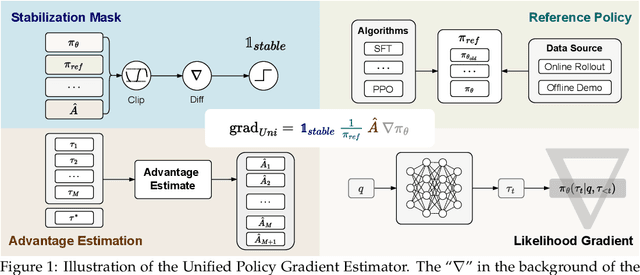
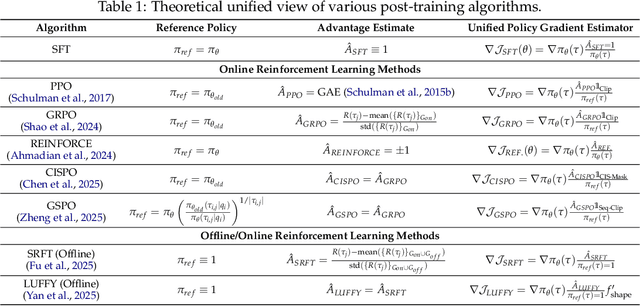
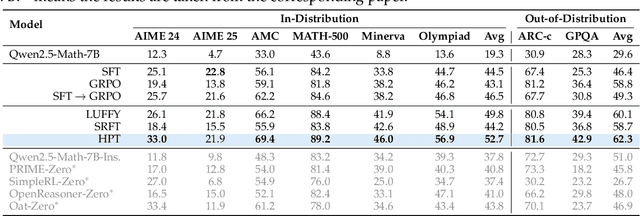
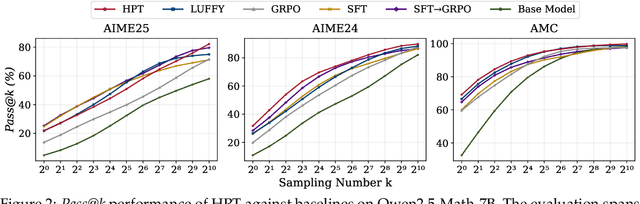
Two major sources of training data exist for post-training modern language models: online (model-generated rollouts) data, and offline (human or other-model demonstrations) data. These two types of data are typically used by approaches like Reinforcement Learning (RL) and Supervised Fine-Tuning (SFT), respectively. In this paper, we show that these approaches are not in contradiction, but are instances of a single optimization process. We derive a Unified Policy Gradient Estimator, and present the calculations of a wide spectrum of post-training approaches as the gradient of a common objective under different data distribution assumptions and various bias-variance tradeoffs. The gradient estimator is constructed with four interchangeable parts: stabilization mask, reference policy denominator, advantage estimate, and likelihood gradient. Motivated by our theoretical findings, we propose Hybrid Post-Training (HPT), an algorithm that dynamically selects different training signals. HPT is designed to yield both effective exploitation of demonstration and stable exploration without sacrificing learned reasoning patterns. We provide extensive experiments and ablation studies to verify the effectiveness of our unified theoretical framework and HPT. Across six mathematical reasoning benchmarks and two out-of-distribution suites, HPT consistently surpasses strong baselines across models of varying scales and families.
Surrogate Signals from Format and Length: Reinforcement Learning for Solving Mathematical Problems without Ground Truth Answers
May 26, 2025Large Language Models have achieved remarkable success in natural language processing tasks, with Reinforcement Learning playing a key role in adapting them to specific applications. However, obtaining ground truth answers for training LLMs in mathematical problem-solving is often challenging, costly, and sometimes unfeasible. This research delves into the utilization of format and length as surrogate signals to train LLMs for mathematical problem-solving, bypassing the need for traditional ground truth answers.Our study shows that a reward function centered on format correctness alone can yield performance improvements comparable to the standard GRPO algorithm in early phases. Recognizing the limitations of format-only rewards in the later phases, we incorporate length-based rewards. The resulting GRPO approach, leveraging format-length surrogate signals, not only matches but surpasses the performance of the standard GRPO algorithm relying on ground truth answers in certain scenarios, achieving 40.0\% accuracy on AIME2024 with a 7B base model. Through systematic exploration and experimentation, this research not only offers a practical solution for training LLMs to solve mathematical problems and reducing the dependence on extensive ground truth data collection, but also reveals the essence of why our label-free approach succeeds: base model is like an excellent student who has already mastered mathematical and logical reasoning skills, but performs poorly on the test paper, it simply needs to develop good answering habits to achieve outstanding results in exams , in other words, to unlock the capabilities it already possesses.
Amplify Adjacent Token Differences: Enhancing Long Chain-of-Thought Reasoning with Shift-FFN
May 22, 2025Recently, models such as OpenAI-o1 and DeepSeek-R1 have demonstrated remarkable performance on complex reasoning tasks through Long Chain-of-Thought (Long-CoT) reasoning. Although distilling this capability into student models significantly enhances their performance, this paper finds that fine-tuning LLMs with full parameters or LoRA with a low rank on long CoT data often leads to Cyclical Reasoning, where models repeatedly reiterate previous inference steps until the maximum length limit. Further analysis reveals that smaller differences in representations between adjacent tokens correlates with a higher tendency toward Cyclical Reasoning. To mitigate this issue, this paper proposes Shift Feedforward Networks (Shift-FFN), a novel approach that edits the current token's representation with the previous one before inputting it to FFN. This architecture dynamically amplifies the representation differences between adjacent tokens. Extensive experiments on multiple mathematical reasoning tasks demonstrate that LoRA combined with Shift-FFN achieves higher accuracy and a lower rate of Cyclical Reasoning across various data sizes compared to full fine-tuning and standard LoRA. Our data and code are available at https://anonymous.4open.science/r/Shift-FFN
Efficient Motion-Aware Video MLLM
Mar 17, 2025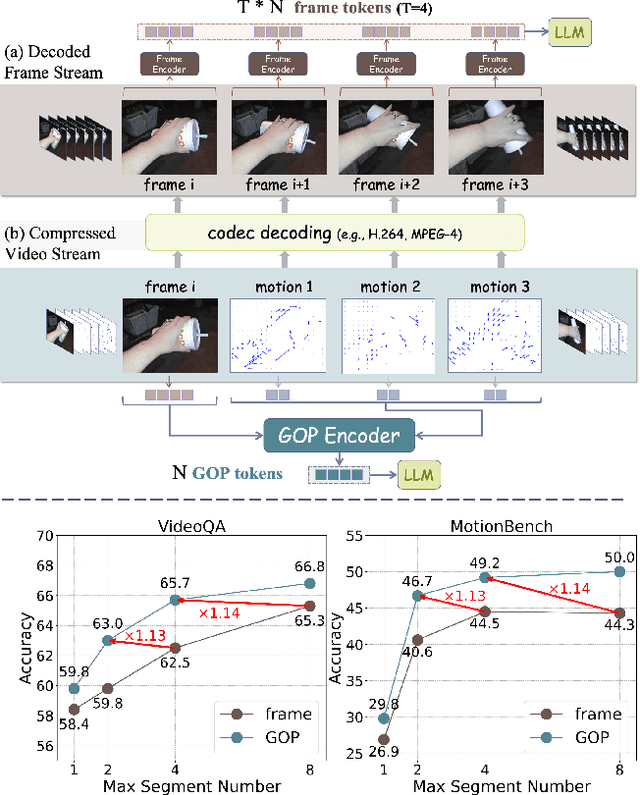
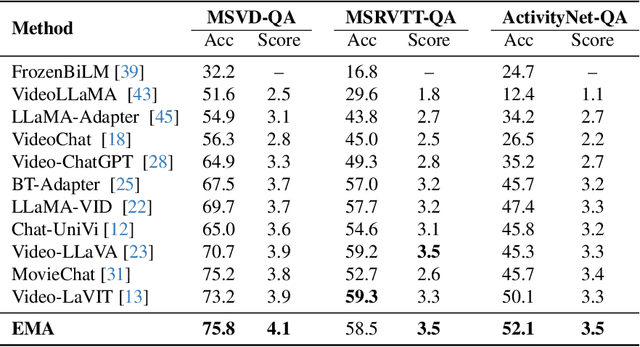
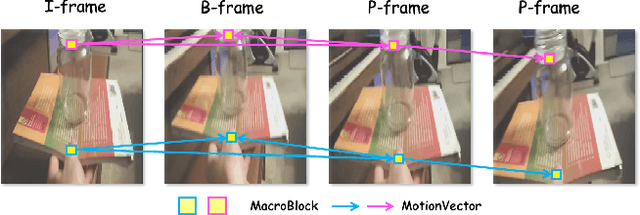

Most current video MLLMs rely on uniform frame sampling and image-level encoders, resulting in inefficient data processing and limited motion awareness. To address these challenges, we introduce EMA, an Efficient Motion-Aware video MLLM that utilizes compressed video structures as inputs. We propose a motion-aware GOP (Group of Pictures) encoder that fuses spatial and motion information within a GOP unit in the compressed video stream, generating compact, informative visual tokens. By integrating fewer but denser RGB frames with more but sparser motion vectors in this native slow-fast input architecture, our approach reduces redundancy and enhances motion representation. Additionally, we introduce MotionBench, a benchmark for evaluating motion understanding across four motion types: linear, curved, rotational, and contact-based. Experimental results show that EMA achieves state-of-the-art performance on both MotionBench and popular video question answering benchmarks, while reducing inference costs. Moreover, EMA demonstrates strong scalability, as evidenced by its competitive performance on long video understanding benchmarks.
Baichuan-M1: Pushing the Medical Capability of Large Language Models
Feb 18, 2025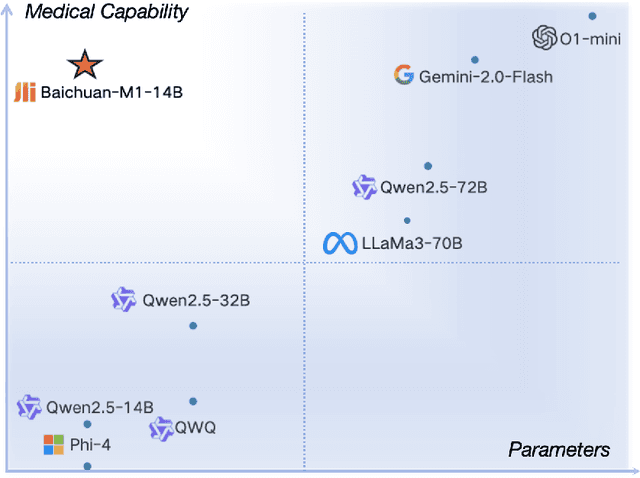

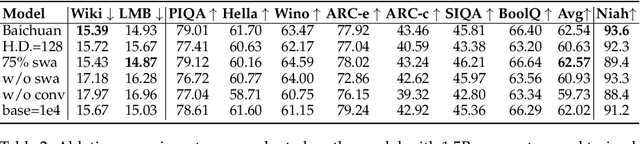
The current generation of large language models (LLMs) is typically designed for broad, general-purpose applications, while domain-specific LLMs, especially in vertical fields like medicine, remain relatively scarce. In particular, the development of highly efficient and practical LLMs for the medical domain is challenging due to the complexity of medical knowledge and the limited availability of high-quality data. To bridge this gap, we introduce Baichuan-M1, a series of large language models specifically optimized for medical applications. Unlike traditional approaches that simply continue pretraining on existing models or apply post-training to a general base model, Baichuan-M1 is trained from scratch with a dedicated focus on enhancing medical capabilities. Our model is trained on 20 trillion tokens and incorporates a range of effective training methods that strike a balance between general capabilities and medical expertise. As a result, Baichuan-M1 not only performs strongly across general domains such as mathematics and coding but also excels in specialized medical fields. We have open-sourced Baichuan-M1-14B, a mini version of our model, which can be accessed through the following links.
LongReD: Mitigating Short-Text Degradation of Long-Context Large Language Models via Restoration Distillation
Feb 11, 2025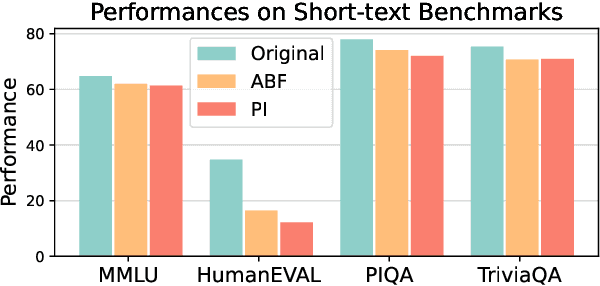
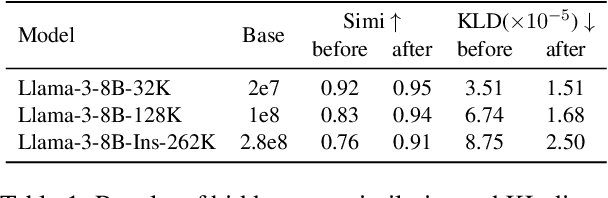
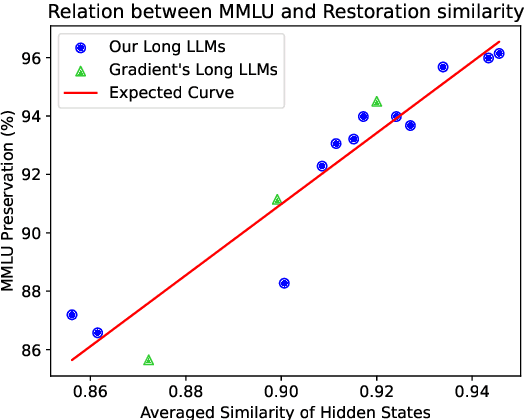
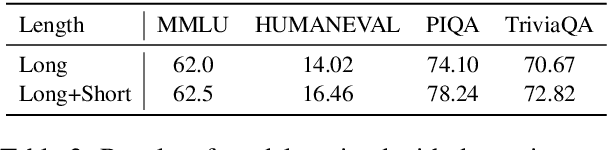
Large language models (LLMs) have gained extended context windows through scaling positional encodings and lightweight continual pre-training. However, this often leads to degraded performance on short-text tasks, while the reasons for this degradation remain insufficiently explored. In this work, we identify two primary factors contributing to this issue: distribution drift in hidden states and attention scores, and catastrophic forgetting during continual pre-training. To address these challenges, we propose Long Context Pre-training with Restoration Distillation (LongReD), a novel approach designed to mitigate short-text performance degradation through minimizing the distribution discrepancy between the extended and original models. Besides training on long texts, LongReD distills the hidden state of selected layers from the original model on short texts. Additionally, LongReD also introduces a short-to-long distillation, aligning the output distribution on short texts with that on long texts by leveraging skipped positional indices. Experiments on common text benchmarks demonstrate that LongReD effectively preserves the model's short-text performance while maintaining comparable or even better capacity to handle long texts than baselines.