 Add to Chrome
 Add to Firefox
 Add to Edge
Masked Visual Actions for Unified World Modeling
Jul 21, 2026
Video models absorb rich priors over how the visual world moves, interacts, and responds to contact, making them promising substrates for robotic world modeling. The central challenge is how to communicate action to such models in a form aligned with the visual space in which they learned these interaction priors, yet still grounded in physical manipulation. We introduce Masked Visual Actions, a pixel-space control interface that expresses action as a partially revealed trajectory of an arbitrary entity in a video. Revealing robot motion makes the model act as a forward dynamics model that predicts the scene's response to low-level robot actions, while revealing desired object motion makes the same model recover robot behavior consistent with that outcome. Finetuned with only 15 hours of masked examples from real videos and simulation, a single checkpoint achieves strong visual fidelity and controllability across diverse scenes and multiple embodiments. In downstream manipulation settings, the model produces imagined rollouts whose outcomes correlate with real-world execution for policy evaluation, improves decision making by ranking candidate futures in model-based planning, and supports inverse modeling by synthesizing robot motion from desired object motion.

A Digital Twin Framework Utilizing Machine Learning for Robust Predictive Maintenance: Enhancing Tire Health Monitoring
Aug 12, 2024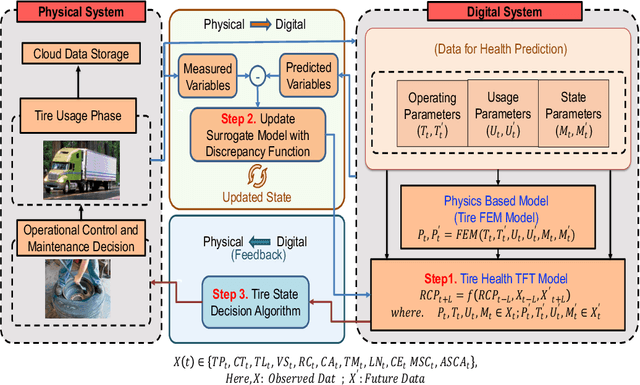


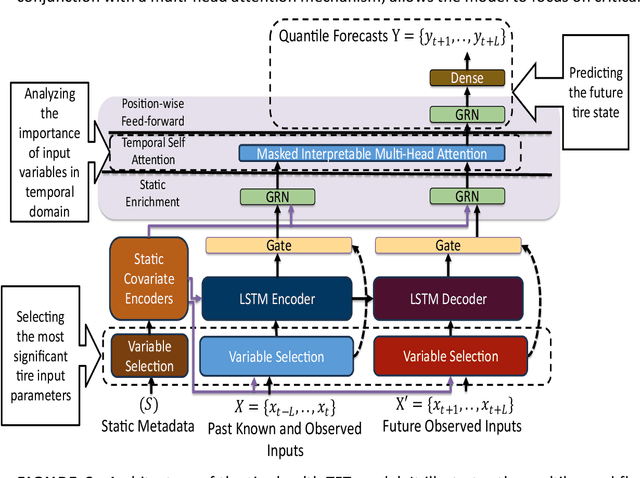
We introduce a novel digital twin framework for predictive maintenance of long-term physical systems. Using monitoring tire health as an application, we show how the digital twin framework can be used to enhance automotive safety and efficiency, and how the technical challenges can be overcome using a three-step approach. Firstly, for managing the data complexity over a long operation span, we employ data reduction techniques to concisely represent physical tires using historical performance and usage data. Relying on these data, for fast real-time prediction, we train a transformer-based model offline on our concise dataset to predict future tire health over time, represented as Remaining Casing Potential (RCP). Based on our architecture, our model quantifies both epistemic and aleatoric uncertainty, providing reliable confidence intervals around predicted RCP. Secondly, to incorporate real-time data, we update the predictive model in the digital twin framework, ensuring its accuracy throughout its life span with the aid of hybrid modeling and the use of discrepancy function. Thirdly, to assist decision making in predictive maintenance, we implement a Tire State Decision Algorithm, which strategically determines the optimal timing for tire replacement based on RCP forecasted by our transformer model. This approach ensures our digital twin accurately predicts system health, continually refines its digital representation, and supports predictive maintenance decisions. Our framework effectively embodies a physical system, leveraging big data and machine learning for predictive maintenance, model updates, and decision-making.