 Add to Chrome
 Add to Firefox
 Add to Edge
FarSight: A Physics-Driven Whole-Body Biometric System at Large Distance and Altitude
Jun 29, 2023
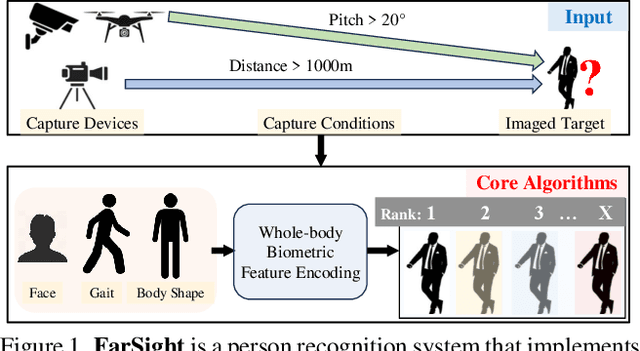
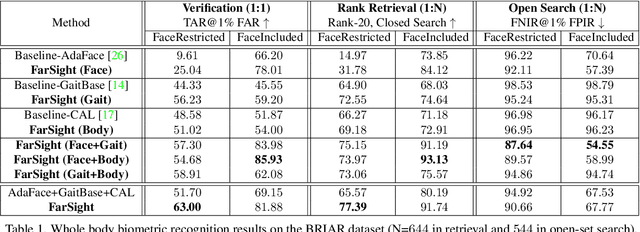
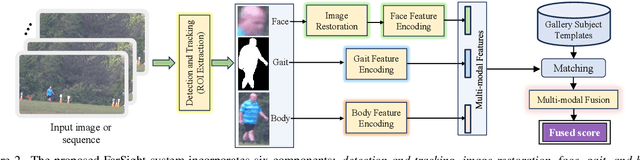
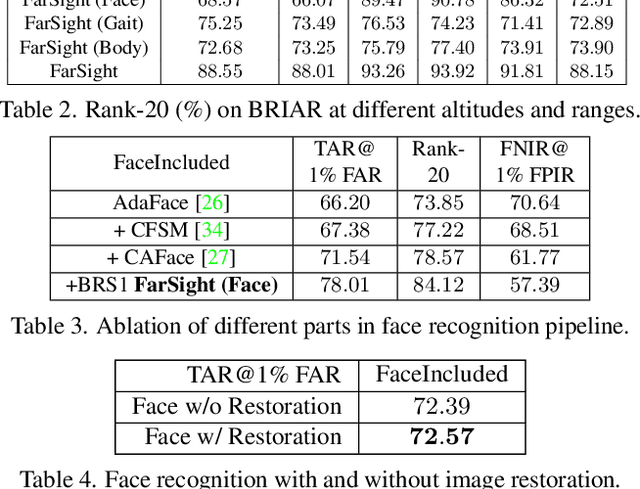
Whole-body biometric recognition is an important area of research due to its vast applications in law enforcement, border security, and surveillance. This paper presents the end-to-end design, development and evaluation of FarSight, an innovative software system designed for whole-body (fusion of face, gait and body shape) biometric recognition. FarSight accepts videos from elevated platforms and drones as input and outputs a candidate list of identities from a gallery. The system is designed to address several challenges, including (i) low-quality imagery, (ii) large yaw and pitch angles, (iii) robust feature extraction to accommodate large intra-person variabilities and large inter-person similarities, and (iv) the large domain gap between training and test sets. FarSight combines the physics of imaging and deep learning models to enhance image restoration and biometric feature encoding. We test FarSight's effectiveness using the newly acquired IARPA Biometric Recognition and Identification at Altitude and Range (BRIAR) dataset. Notably, FarSight demonstrated a substantial performance increase on the BRIAR dataset, with gains of +11.82% Rank-20 identification and +11.3% TAR@1% FAR.

Matting Anything
Jun 08, 2023In this paper, we propose the Matting Anything Model (MAM), an efficient and versatile framework for estimating the alpha matte of any instance in an image with flexible and interactive visual or linguistic user prompt guidance. MAM offers several significant advantages over previous specialized image matting networks: (i) MAM is capable of dealing with various types of image matting, including semantic, instance, and referring image matting with only a single model; (ii) MAM leverages the feature maps from the Segment Anything Model (SAM) and adopts a lightweight Mask-to-Matte (M2M) module to predict the alpha matte through iterative refinement, which has only 2.7 million trainable parameters. (iii) By incorporating SAM, MAM simplifies the user intervention required for the interactive use of image matting from the trimap to the box, point, or text prompt. We evaluate the performance of MAM on various image matting benchmarks, and the experimental results demonstrate that MAM achieves comparable performance to the state-of-the-art specialized image matting models under different metrics on each benchmark. Overall, MAM shows superior generalization ability and can effectively handle various image matting tasks with fewer parameters, making it a practical solution for unified image matting. Our code and models are open-sourced at https://github.com/SHI-Labs/Matting-Anything.
Prompt-Free Diffusion: Taking "Text" out of Text-to-Image Diffusion Models
May 25, 2023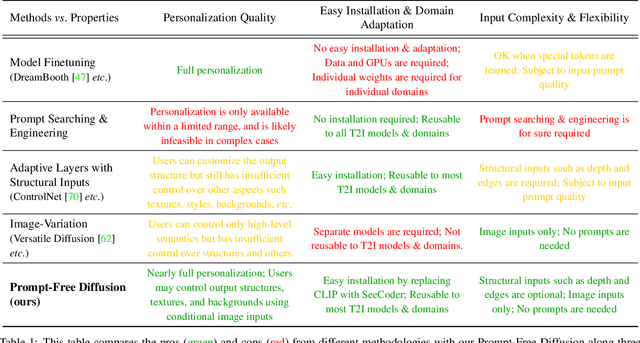
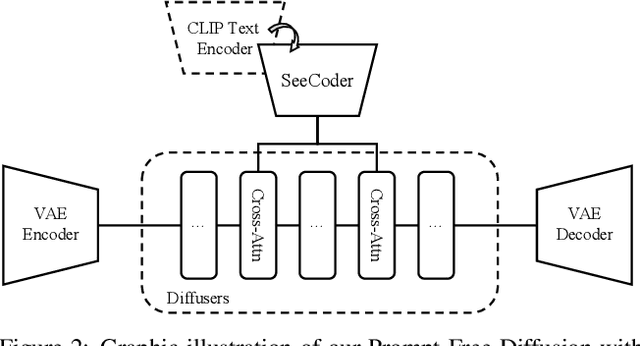
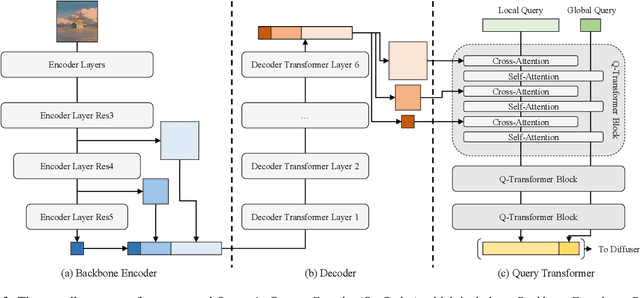
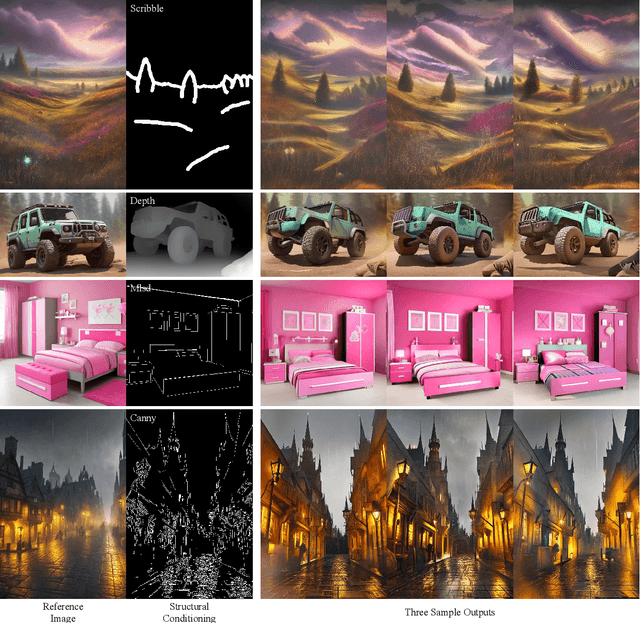
Text-to-image (T2I) research has grown explosively in the past year, owing to the large-scale pre-trained diffusion models and many emerging personalization and editing approaches. Yet, one pain point persists: the text prompt engineering, and searching high-quality text prompts for customized results is more art than science. Moreover, as commonly argued: "an image is worth a thousand words" - the attempt to describe a desired image with texts often ends up being ambiguous and cannot comprehensively cover delicate visual details, hence necessitating more additional controls from the visual domain. In this paper, we take a bold step forward: taking "Text" out of a pre-trained T2I diffusion model, to reduce the burdensome prompt engineering efforts for users. Our proposed framework, Prompt-Free Diffusion, relies on only visual inputs to generate new images: it takes a reference image as "context", an optional image structural conditioning, and an initial noise, with absolutely no text prompt. The core architecture behind the scene is Semantic Context Encoder (SeeCoder), substituting the commonly used CLIP-based or LLM-based text encoder. The reusability of SeeCoder also makes it a convenient drop-in component: one can also pre-train a SeeCoder in one T2I model and reuse it for another. Through extensive experiments, Prompt-Free Diffusion is experimentally found to (i) outperform prior exemplar-based image synthesis approaches; (ii) perform on par with state-of-the-art T2I models using prompts following the best practice; and (iii) be naturally extensible to other downstream applications such as anime figure generation and virtual try-on, with promising quality. Our code and models are open-sourced at https://github.com/SHI-Labs/Prompt-Free-Diffusion.
Zero-shot Generative Model Adaptation via Image-specific Prompt Learning
Apr 06, 2023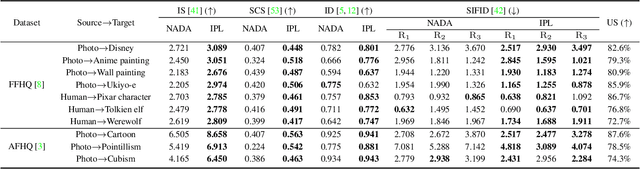
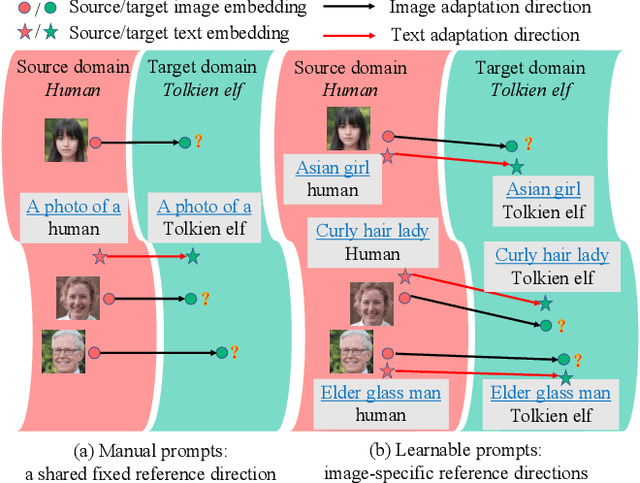
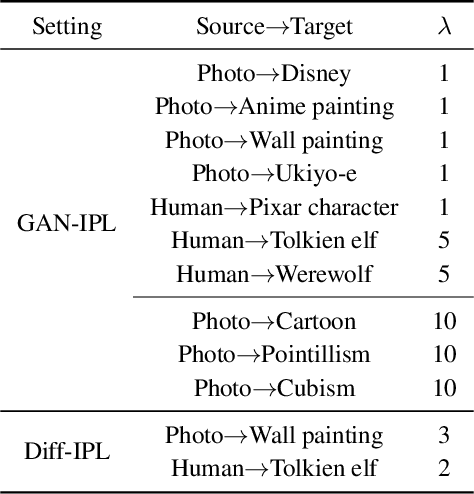
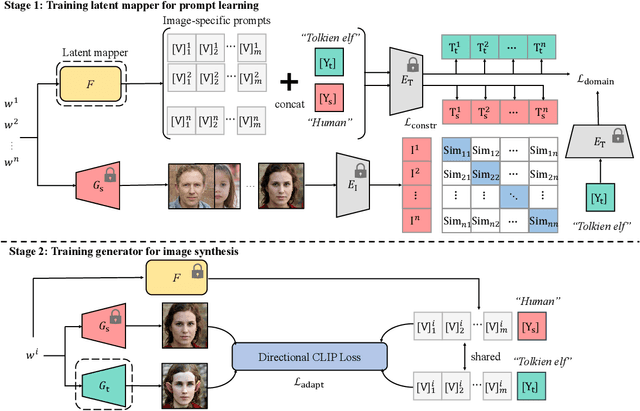
Recently, CLIP-guided image synthesis has shown appealing performance on adapting a pre-trained source-domain generator to an unseen target domain. It does not require any target-domain samples but only the textual domain labels. The training is highly efficient, e.g., a few minutes. However, existing methods still have some limitations in the quality of generated images and may suffer from the mode collapse issue. A key reason is that a fixed adaptation direction is applied for all cross-domain image pairs, which leads to identical supervision signals. To address this issue, we propose an Image-specific Prompt Learning (IPL) method, which learns specific prompt vectors for each source-domain image. This produces a more precise adaptation direction for every cross-domain image pair, endowing the target-domain generator with greatly enhanced flexibility. Qualitative and quantitative evaluations on various domains demonstrate that IPL effectively improves the quality and diversity of synthesized images and alleviates the mode collapse. Moreover, IPL is independent of the structure of the generative model, such as generative adversarial networks or diffusion models. Code is available at https://github.com/Picsart-AI-Research/IPL-Zero-Shot-Generative-Model-Adaptation.
Automatic High Resolution Wire Segmentation and Removal
Apr 01, 2023


Wires and powerlines are common visual distractions that often undermine the aesthetics of photographs. The manual process of precisely segmenting and removing them is extremely tedious and may take up hours, especially on high-resolution photos where wires may span the entire space. In this paper, we present an automatic wire clean-up system that eases the process of wire segmentation and removal/inpainting to within a few seconds. We observe several unique challenges: wires are thin, lengthy, and sparse. These are rare properties of subjects that common segmentation tasks cannot handle, especially in high-resolution images. We thus propose a two-stage method that leverages both global and local contexts to accurately segment wires in high-resolution images efficiently, and a tile-based inpainting strategy to remove the wires given our predicted segmentation masks. We also introduce the first wire segmentation benchmark dataset, WireSegHR. Finally, we demonstrate quantitatively and qualitatively that our wire clean-up system enables fully automated wire removal with great generalization to various wire appearances.
Forget-Me-Not: Learning to Forget in Text-to-Image Diffusion Models
Mar 30, 2023


The unlearning problem of deep learning models, once primarily an academic concern, has become a prevalent issue in the industry. The significant advances in text-to-image generation techniques have prompted global discussions on privacy, copyright, and safety, as numerous unauthorized personal IDs, content, artistic creations, and potentially harmful materials have been learned by these models and later utilized to generate and distribute uncontrolled content. To address this challenge, we propose \textbf{Forget-Me-Not}, an efficient and low-cost solution designed to safely remove specified IDs, objects, or styles from a well-configured text-to-image model in as little as 30 seconds, without impairing its ability to generate other content. Alongside our method, we introduce the \textbf{Memorization Score (M-Score)} and \textbf{ConceptBench} to measure the models' capacity to generate general concepts, grouped into three primary categories: ID, object, and style. Using M-Score and ConceptBench, we demonstrate that Forget-Me-Not can effectively eliminate targeted concepts while maintaining the model's performance on other concepts. Furthermore, Forget-Me-Not offers two practical extensions: a) removal of potentially harmful or NSFW content, and b) enhancement of model accuracy, inclusion and diversity through \textbf{concept correction and disentanglement}. It can also be adapted as a lightweight model patch for Stable Diffusion, allowing for concept manipulation and convenient distribution. To encourage future research in this critical area and promote the development of safe and inclusive generative models, we will open-source our code and ConceptBench at \href{https://github.com/SHI-Labs/Forget-Me-Not}{https://github.com/SHI-Labs/Forget-Me-Not}.
PAIR-Diffusion: Object-Level Image Editing with Structure-and-Appearance Paired Diffusion Models
Mar 30, 2023Image editing using diffusion models has witnessed extremely fast-paced growth recently. There are various ways in which previous works enable controlling and editing images. Some works use high-level conditioning such as text, while others use low-level conditioning. Nevertheless, most of them lack fine-grained control over the properties of the different objects present in the image, i.e. object-level image editing. In this work, we consider an image as a composition of multiple objects, each defined by various properties. Out of these properties, we identify structure and appearance as the most intuitive to understand and useful for editing purposes. We propose Structure-and-Appearance Paired Diffusion model (PAIR-Diffusion), which is trained using structure and appearance information explicitly extracted from the images. The proposed model enables users to inject a reference image's appearance into the input image at both the object and global levels. Additionally, PAIR-Diffusion allows editing the structure while maintaining the style of individual components of the image unchanged. We extensively evaluate our method on LSUN datasets and the CelebA-HQ face dataset, and we demonstrate fine-grained control over both structure and appearance at the object level. We also applied the method to Stable Diffusion to edit any real image at the object level.
Text2Video-Zero: Text-to-Image Diffusion Models are Zero-Shot Video Generators
Mar 23, 2023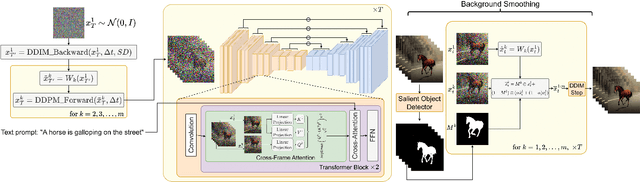

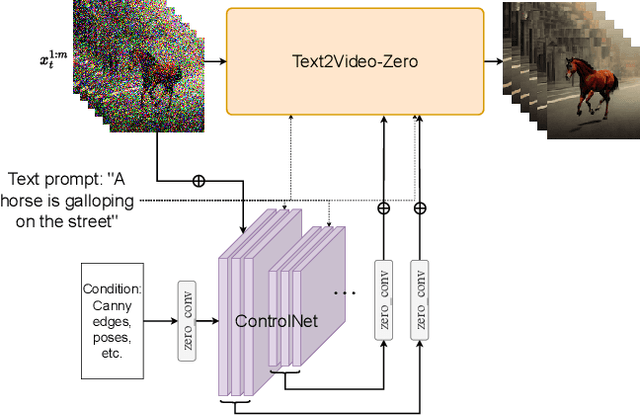
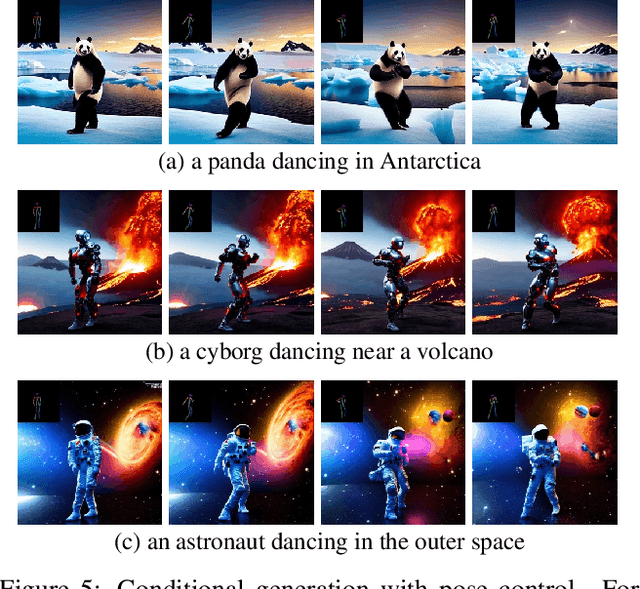
Recent text-to-video generation approaches rely on computationally heavy training and require large-scale video datasets. In this paper, we introduce a new task of zero-shot text-to-video generation and propose a low-cost approach (without any training or optimization) by leveraging the power of existing text-to-image synthesis methods (e.g., Stable Diffusion), making them suitable for the video domain. Our key modifications include (i) enriching the latent codes of the generated frames with motion dynamics to keep the global scene and the background time consistent; and (ii) reprogramming frame-level self-attention using a new cross-frame attention of each frame on the first frame, to preserve the context, appearance, and identity of the foreground object. Experiments show that this leads to low overhead, yet high-quality and remarkably consistent video generation. Moreover, our approach is not limited to text-to-video synthesis but is also applicable to other tasks such as conditional and content-specialized video generation, and Video Instruct-Pix2Pix, i.e., instruction-guided video editing. As experiments show, our method performs comparably or sometimes better than recent approaches, despite not being trained on additional video data. Our code will be open sourced at: https://github.com/Picsart-AI-Research/Text2Video-Zero .
Graph Transformer GANs for Graph-Constrained House Generation
Mar 14, 2023We present a novel graph Transformer generative adversarial network (GTGAN) to learn effective graph node relations in an end-to-end fashion for the challenging graph-constrained house generation task. The proposed graph-Transformer-based generator includes a novel graph Transformer encoder that combines graph convolutions and self-attentions in a Transformer to model both local and global interactions across connected and non-connected graph nodes. Specifically, the proposed connected node attention (CNA) and non-connected node attention (NNA) aim to capture the global relations across connected nodes and non-connected nodes in the input graph, respectively. The proposed graph modeling block (GMB) aims to exploit local vertex interactions based on a house layout topology. Moreover, we propose a new node classification-based discriminator to preserve the high-level semantic and discriminative node features for different house components. Finally, we propose a novel graph-based cycle-consistency loss that aims at maintaining the relative spatial relationships between ground truth and predicted graphs. Experiments on two challenging graph-constrained house generation tasks (i.e., house layout and roof generation) with two public datasets demonstrate the effectiveness of GTGAN in terms of objective quantitative scores and subjective visual realism. New state-of-the-art results are established by large margins on both tasks.
Boosted Dynamic Neural Networks
Nov 30, 2022

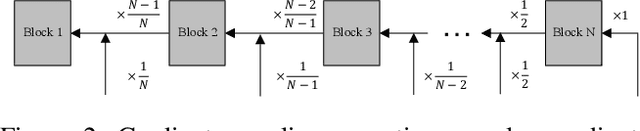

Early-exiting dynamic neural networks (EDNN), as one type of dynamic neural networks, has been widely studied recently. A typical EDNN has multiple prediction heads at different layers of the network backbone. During inference, the model will exit at either the last prediction head or an intermediate prediction head where the prediction confidence is higher than a predefined threshold. To optimize the model, these prediction heads together with the network backbone are trained on every batch of training data. This brings a train-test mismatch problem that all the prediction heads are optimized on all types of data in training phase while the deeper heads will only see difficult inputs in testing phase. Treating training and testing inputs differently at the two phases will cause the mismatch between training and testing data distributions. To mitigate this problem, we formulate an EDNN as an additive model inspired by gradient boosting, and propose multiple training techniques to optimize the model effectively. We name our method BoostNet. Our experiments show it achieves the state-of-the-art performance on CIFAR100 and ImageNet datasets in both anytime and budgeted-batch prediction modes. Our code is released at https://github.com/SHI-Labs/Boosted-Dynamic-Networks.