 Add to Chrome
 Add to Firefox
 Add to Edge
INFANiTE: Implicit Neural representation for high-resolution Fetal brain spatio-temporal Atlas learNing from clinical Thick-slicE MRI
May 11, 2026
Spatio-temporal fetal brain atlases are important for characterizing normative neurodevelopment and identifying congenital anomalies. However, existing atlas construction pipelines necessitate days for slice-to-volume reconstruction (SVR) to generate high-resolution 3D brain volumes and several additional days for iterative volume registration, thereby rendering atlas construction from large-scale cohorts prohibitively impractical. We address these limitations with INFANiTE, an Implicit Neural Representation (INR) framework for high-resolution Fetal brain spatio-temporal Atlas learNing from clinical Thick-slicE MRI scans, bypassing both the costly SVR and the iterative non-rigid registration steps entirely, thereby substantially accelerating atlas construction. Extensive experiments demonstrate that INFANiTE outperforms existing baselines in subject consistency, reference fidelity, intrinsic quality and biological plausibility, even under challenging sparse-data settings. Additionally, INFANiTE reduces the end-to-end processing time (i.e., from raw scans to the final atlas) from days to hours compared to the traditional 3D volume-based pipeline (e.g., SyGN), facilitating large-scale population-level fetal brain analysis. Our code is publicly available at: https://anonymous.4open.science/r/INFANiTE-5D74

Annotation-free deep learning for detection and segmentation of fetal germinal matrix-intraventricular hemorrhage in brain MRI
May 10, 2026Background: Prenatal germinal matrix-intraventricular hemorrhage (GMH-IVH) is a leading cause of infant mortality and neurodevelopmental impairment. Manual diagnosis and lesion segmentation are labor-intensive and error-prone. Deep learning models offer potential for automation but typically require large annotated datasets, which are challenging to obtain. Purpose: To develop and validate an annotation-free deep learning framework for automated detection and segmentation of GMH-IVH on brain MRI. Materials and Methods: This retrospective study analyzed 2D T2-weighted MRI data from pregnant women collected from October 2015 to October 2023 at one hospital (internal validation) and two hospitals (external validation). Eligible participants included healthy fetuses and those with GMH-IVH. FreeHemoSeg was developed and trained using pseudo GMH-IVH images synthesized from normal fetal data guided by medical priors. Primary outcomes included diagnostic accuracy (area under the ROC curve [AUROC], sensitivity, specificity) and segmentation accuracy (Dice similarity coefficient [DSC]). A reader study evaluated clinical utility. Results: A total of 1674 stacks from 558 pregnant women were analyzed. FreeHemoSeg achieved the highest performance in both internal (sensitivity: 0.914, 95% CI 0.869-0.945; specificity: 0.966, 95% CI 0.946-0.978; DSC: 0.559, 95% CI 0.546-0.571) and external validation (sensitivity: 0.824, 95% CI 0.739-0.885; specificity: 0.943, 95% CI 0.913-0.964; DSC: 0.512, 95% CI 0.497-0.526), outperforming supervised and unsupervised methods. FreeHemoSeg assistance improved radiologists' sensitivity (from 0.882 to 0.941-1.000) and diagnostic confidence while reducing interpretation time by 16.0-52.7%. Conclusion: FreeHemoSeg accurately detects and localizes fetal brain hemorrhages without annotated training data, enabling earlier diagnosis and supporting timely clinical management.
APIOT: Autonomous Vulnerability Management Across Bare-Metal Industrial OT Networks
May 04, 2026Bare-metal operational technology (OT) devices -- especially the microcontrollers running Modbus/TCP and CoAP at the base of industrial control systems -- have remained outside the reach of autonomous security attacks. Prior autonomous pentesting studies target Linux and web systems, whose shells and filesystems are familiar to LLM agents. Bare-metal OT has neither, so agents must reason directly over protocol fields and parser semantics. This requires new action-space designs and runtime controls, and opens new research questions about protocol-level exploit reasoning and its deployment envelope. We present APIOT (Autonomous Purple-teaming for Industrial OT), the first large language model (LLM) framework demonstrating an autonomous attack and remediation of bare-metal OT devices, achieving the full discovery -> exploitation -> patching -> verification cycle without step-by-step human intervention. We implemented and evaluated this framework on Zephyr RTOS firmware across heterogeneous industrial IoT (IIoT) topologies. Through 290 experiment runs spanning five frontier LLMs, three network topologies, two impairment levels, and guided versus unguided conditions, APIOT achieved a mission success rate of 90.0% on the full attack-remediation cycle. We found that the runtime governance layer (which we call an overseer) is a critical engineering variable: without it, agents exhibit systematic degenerate patterns, including repetition loops, missing crash verification, and reconnaissance deadlocks. Together, these findings carry two implications beyond our testbed. Attacker expertise is no longer the binding constraint on bare-metal OT exploitation, and defender threat models must now assume LLM-augmented adversaries capable of executing autonomous discovery-through-remediation cycles against industrial firmware.
PortraitCraft: A Benchmark for Portrait Composition Understanding and Generation
Apr 04, 2026Portrait composition plays a central role in portrait aesthetics and visual communication, yet existing datasets and benchmarks mainly focus on coarse aesthetic scoring, generic image aesthetics, or unconstrained portrait generation. This limits systematic research on structured portrait composition analysis and controllable portrait generation under explicit composition requirements. In this paper, we introduce PortraitCraft, a unified benchmark for portrait composition understanding and generation. PortraitCraft is built on a dataset of approximately 50,000 curated real portrait images with structured multi-level supervision, including global composition scores, annotations over 13 composition attributes, attribute-level explanation texts, visual question answering pairs, and composition-oriented textual descriptions for generation. Based on this dataset, we establish two complementary benchmark tasks for composition understanding and composition-aware generation within a unified framework. The first evaluates portrait composition understanding through score prediction, fine-grained attribute reasoning, and image-grounded visual question answering, while the second evaluates portrait generation from structured composition descriptions under explicit composition constraints. We further define standardized evaluation protocols and provide reference baseline results with representative multimodal models. PortraitCraft provides a comprehensive benchmark for future research on fine-grained portrait understanding, interpretable aesthetic assessment, and controllable portrait generation.
Hi-Light: A Path to high-fidelity, high-resolution video relighting with a Novel Evaluation Paradigm
Jan 30, 2026Video relighting offers immense creative potential and commercial value but is hindered by challenges, including the absence of an adequate evaluation metric, severe light flickering, and the degradation of fine-grained details during editing. To overcome these challenges, we introduce Hi-Light, a novel, training-free framework for high-fidelity, high-resolution, robust video relighting. Our approach introduces three technical innovations: lightness prior anchored guided relighting diffusion that stabilises intermediate relit video, a Hybrid Motion-Adaptive Lighting Smoothing Filter that leverages optical flow to ensure temporal stability without introducing motion blur, and a LAB-based Detail Fusion module that preserves high-frequency detail information from the original video. Furthermore, to address the critical gap in evaluation, we propose the Light Stability Score, the first quantitative metric designed to specifically measure lighting consistency. Extensive experiments demonstrate that Hi-Light significantly outperforms state-of-the-art methods in both qualitative and quantitative comparisons, producing stable, highly detailed relit videos.
UniLayDiff: A Unified Diffusion Transformer for Content-Aware Layout Generation
Dec 09, 2025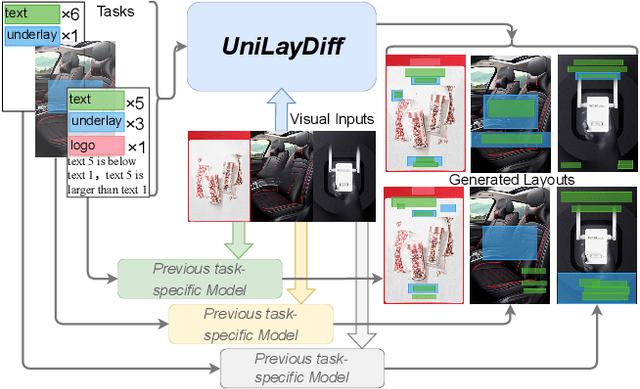
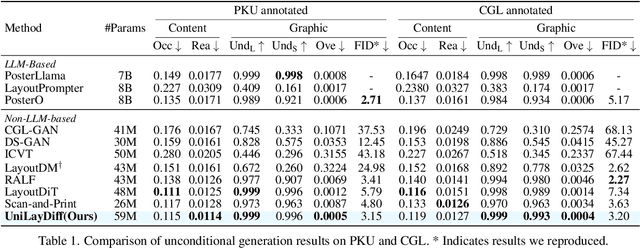
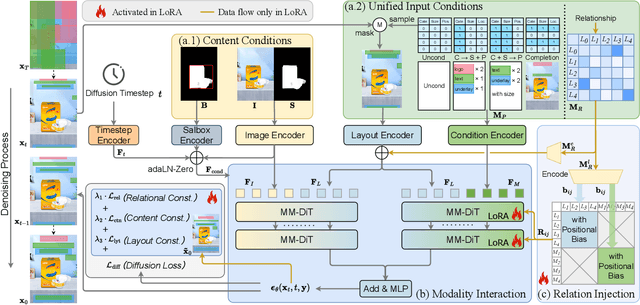
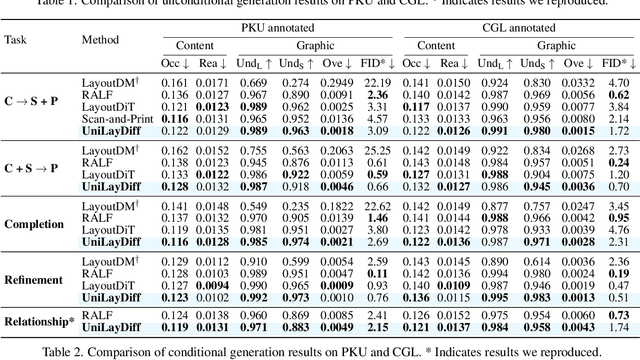
Content-aware layout generation is a critical task in graphic design automation, focused on creating visually appealing arrangements of elements that seamlessly blend with a given background image. The variety of real-world applications makes it highly challenging to develop a single model capable of unifying the diverse range of input-constrained generation sub-tasks, such as those conditioned by element types, sizes, or their relationships. Current methods either address only a subset of these tasks or necessitate separate model parameters for different conditions, failing to offer a truly unified solution. In this paper, we propose UniLayDiff: a Unified Diffusion Transformer, that for the first time, addresses various content-aware layout generation tasks with a single, end-to-end trainable model. Specifically, we treat layout constraints as a distinct modality and employ Multi-Modal Diffusion Transformer framework to capture the complex interplay between the background image, layout elements, and diverse constraints. Moreover, we integrate relation constraints through fine-tuning the model with LoRA after pretraining the model on other tasks. Such a schema not only achieves unified conditional generation but also enhances overall layout quality. Extensive experiments demonstrate that UniLayDiff achieves state-of-the-art performance across from unconditional to various conditional generation tasks and, to the best of our knowledge, is the first model to unify the full range of content-aware layout generation tasks.
Positional Encoding Field
Oct 23, 2025Diffusion Transformers (DiTs) have emerged as the dominant architecture for visual generation, powering state-of-the-art image and video models. By representing images as patch tokens with positional encodings (PEs), DiTs combine Transformer scalability with spatial and temporal inductive biases. In this work, we revisit how DiTs organize visual content and discover that patch tokens exhibit a surprising degree of independence: even when PEs are perturbed, DiTs still produce globally coherent outputs, indicating that spatial coherence is primarily governed by PEs. Motivated by this finding, we introduce the Positional Encoding Field (PE-Field), which extends positional encodings from the 2D plane to a structured 3D field. PE-Field incorporates depth-aware encodings for volumetric reasoning and hierarchical encodings for fine-grained sub-patch control, enabling DiTs to model geometry directly in 3D space. Our PE-Field-augmented DiT achieves state-of-the-art performance on single-image novel view synthesis and generalizes to controllable spatial image editing.
Glissando-Net: Deep sinGLe vIew category level poSe eStimation ANd 3D recOnstruction
Jan 24, 2025

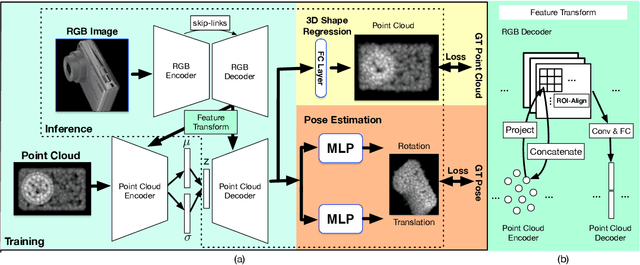

We present a deep learning model, dubbed Glissando-Net, to simultaneously estimate the pose and reconstruct the 3D shape of objects at the category level from a single RGB image. Previous works predominantly focused on either estimating poses(often at the instance level), or reconstructing shapes, but not both. Glissando-Net is composed of two auto-encoders that are jointly trained, one for RGB images and the other for point clouds. We embrace two key design choices in Glissando-Net to achieve a more accurate prediction of the 3D shape and pose of the object given a single RGB image as input. First, we augment the feature maps of the point cloud encoder and decoder with transformed feature maps from the image decoder, enabling effective 2D-3D interaction in both training and prediction. Second, we predict both the 3D shape and pose of the object in the decoder stage. This way, we better utilize the information in the 3D point clouds presented only in the training stage to train the network for more accurate prediction. We jointly train the two encoder-decoders for RGB and point cloud data to learn how to pass latent features to the point cloud decoder during inference. In testing, the encoder of the 3D point cloud is discarded. The design of Glissando-Net is inspired by codeSLAM. Unlike codeSLAM, which targets 3D reconstruction of scenes, we focus on pose estimation and shape reconstruction of objects, and directly predict the object pose and a pose invariant 3D reconstruction without the need of the code optimization step. Extensive experiments, involving both ablation studies and comparison with competing methods, demonstrate the efficacy of our proposed method, and compare favorably with the state-of-the-art.
ComposeAnyone: Controllable Layout-to-Human Generation with Decoupled Multimodal Conditions
Jan 21, 2025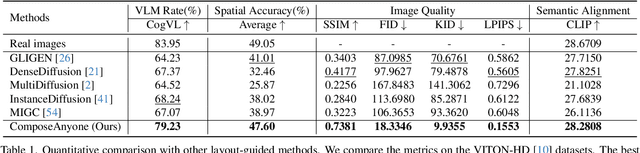
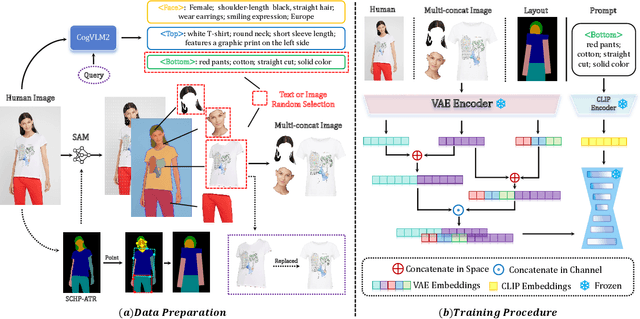
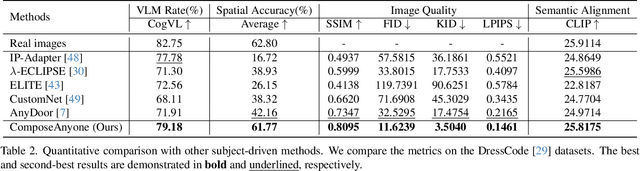
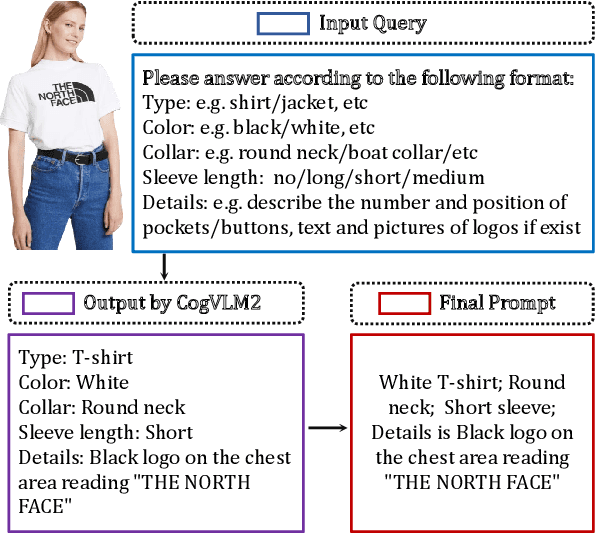
Building on the success of diffusion models, significant advancements have been made in multimodal image generation tasks. Among these, human image generation has emerged as a promising technique, offering the potential to revolutionize the fashion design process. However, existing methods often focus solely on text-to-image or image reference-based human generation, which fails to satisfy the increasingly sophisticated demands. To address the limitations of flexibility and precision in human generation, we introduce ComposeAnyone, a controllable layout-to-human generation method with decoupled multimodal conditions. Specifically, our method allows decoupled control of any part in hand-drawn human layouts using text or reference images, seamlessly integrating them during the generation process. The hand-drawn layout, which utilizes color-blocked geometric shapes such as ellipses and rectangles, can be easily drawn, offering a more flexible and accessible way to define spatial layouts. Additionally, we introduce the ComposeHuman dataset, which provides decoupled text and reference image annotations for different components of each human image, enabling broader applications in human image generation tasks. Extensive experiments on multiple datasets demonstrate that ComposeAnyone generates human images with better alignment to given layouts, text descriptions, and reference images, showcasing its multi-task capability and controllability.
CatV2TON: Taming Diffusion Transformers for Vision-Based Virtual Try-On with Temporal Concatenation
Jan 20, 2025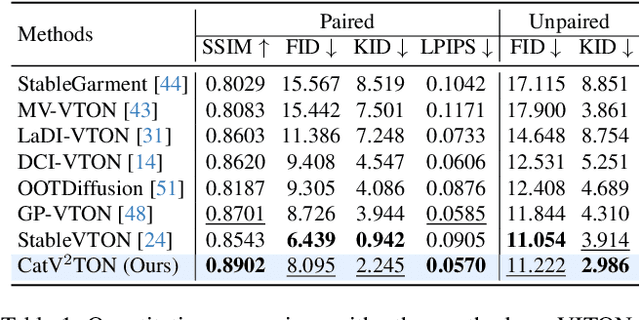
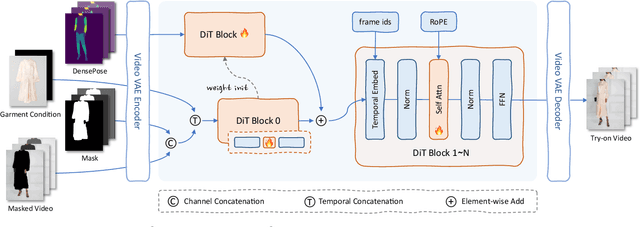
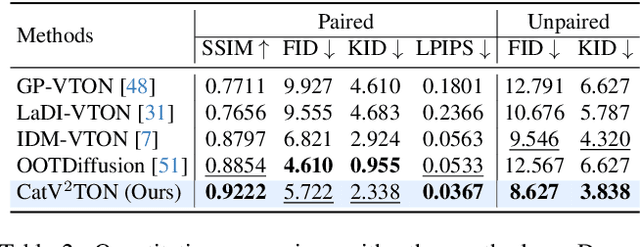
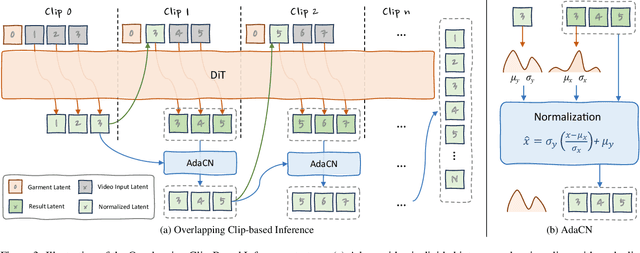
Virtual try-on (VTON) technology has gained attention due to its potential to transform online retail by enabling realistic clothing visualization of images and videos. However, most existing methods struggle to achieve high-quality results across image and video try-on tasks, especially in long video scenarios. In this work, we introduce CatV2TON, a simple and effective vision-based virtual try-on (V2TON) method that supports both image and video try-on tasks with a single diffusion transformer model. By temporally concatenating garment and person inputs and training on a mix of image and video datasets, CatV2TON achieves robust try-on performance across static and dynamic settings. For efficient long-video generation, we propose an overlapping clip-based inference strategy that uses sequential frame guidance and Adaptive Clip Normalization (AdaCN) to maintain temporal consistency with reduced resource demands. We also present ViViD-S, a refined video try-on dataset, achieved by filtering back-facing frames and applying 3D mask smoothing for enhanced temporal consistency. Comprehensive experiments demonstrate that CatV2TON outperforms existing methods in both image and video try-on tasks, offering a versatile and reliable solution for realistic virtual try-ons across diverse scenarios.