 Add to Chrome
 Add to Firefox
 Add to Edge
Unmasking On-Policy Distillation: Where It Helps, Where It Hurts, and Why
May 11, 2026
On-policy distillation offers dense, per-token supervision for training reasoning models; however, it remains unclear under which conditions this signal is beneficial and under which it is detrimental. Which teacher model should be used, and in the case of self-distillation, which specific context should serve as the supervisory signal? Does the optimal choice vary from one token to the next? At present, addressing these questions typically requires costly training runs whose aggregate performance metrics obscure the dynamics at the level of individual tokens. We introduce a training-free diagnostic framework that operates at the highest resolution: per token, per question, and per teacher. We derive an ideal per-node gradient defined as the parameter update that maximally increases the student's probability of success. We then develop a scalable targeted-rollout algorithm to estimate this gradient efficiently, even for long chains of intermediate thoughts. The gradient alignment score, defined as the cosine similarity between this ideal gradient and any given distillation gradient, quantifies the extent to which a particular configuration approximates the ideal signal. Across a range of self-distillation settings and external teacher models, we observe that distillation guidance exhibits substantially higher alignment with the ideal on incorrect rollouts than on correct ones, where the student already performs well and the teacher's signal tends to become noisy. Furthermore, we find that the optimal distillation context depends jointly on the student model's capacity and the target task, and that no single universally effective configuration emerges. These findings motivate the use of per-task, per-token diagnostic analyses for distillation.

TIDE: Every Layer Knows the Token Beneath the Context
May 07, 2026We revisit a universally accepted but under-examined design choice in every modern LLM: a token index is looked up once at the input embedding layer and then permanently discarded. This single-injection assumption induces two structural failures: (i) the Rare Token Problem, where a Zipf-type distribution of vocabulary causes rare-token embeddings are chronically under-trained due to receiving a fraction of the cumulative gradient signal compared to common tokens; and (ii) the Contextual Collapse Problem, where limited parameters models map distributionally similar tokens to indistinguishable hidden states. As an attempt to address both, we propose TIDE, which augments the standard transformer with EmbeddingMemory: an ensemble of K independent MemoryBlocks that map token indices to context-free semantic vectors, computed once and injected into every layer through a depth-conditioned softmax router with a learnable null bank. We theoretically and empirically establish the benefits of TIDE in addressing the issues associated with single-token identity injection as well as improve performance across multiple language modeling and downstream tasks.
SpecMD: A Comprehensive Study On Speculative Expert Prefetching
Feb 03, 2026Mixture-of-Experts (MoE) models enable sparse expert activation, meaning that only a subset of the model's parameters is used during each inference. However, to translate this sparsity into practical performance, an expert caching mechanism is required. Previous works have proposed hardware-centric caching policies, but how these various caching policies interact with each other and different hardware specification remains poorly understood. To address this gap, we develop \textbf{SpecMD}, a standardized framework for benchmarking ad-hoc cache policies on various hardware configurations. Using SpecMD, we perform an exhaustive benchmarking of several MoE caching strategies, reproducing and extending prior approaches in controlled settings with realistic constraints. Our experiments reveal that MoE expert access is not consistent with temporal locality assumptions (e.g LRU, LFU). Motivated by this observation, we propose \textbf{Least-Stale}, a novel eviction policy that exploits MoE's predictable expert access patterns to reduce collision misses by up to $85\times$ over LRU. With such gains, we achieve over $88\%$ hit rates with up to $34.7\%$ Time-to-first-token (TTFT) reduction on OLMoE at only $5\%$ or $0.6GB$ of VRAM cache capacity.
MemoryLLM: Plug-n-Play Interpretable Feed-Forward Memory for Transformers
Jan 30, 2026Understanding how transformer components operate in LLMs is important, as it is at the core of recent technological advances in artificial intelligence. In this work, we revisit the challenges associated with interpretability of feed-forward modules (FFNs) and propose MemoryLLM, which aims to decouple FFNs from self-attention and enables us to study the decoupled FFNs as context-free token-wise neural retrieval memory. In detail, we investigate how input tokens access memory locations within FFN parameters and the importance of FFN memory across different downstream tasks. MemoryLLM achieves context-free FFNs by training them in isolation from self-attention directly using the token embeddings. This approach allows FFNs to be pre-computed as token-wise lookups (ToLs), enabling on-demand transfer between VRAM and storage, additionally enhancing inference efficiency. We also introduce Flex-MemoryLLM, positioning it between a conventional transformer design and MemoryLLM. This architecture bridges the performance gap caused by training FFNs with context-free token-wise embeddings.
AlphaDecay:Module-wise Weight Decay for Heavy-Tailed Balancing in LLMs
Jun 17, 2025Weight decay is a standard regularization technique for training large language models (LLMs). While it is common to assign a uniform decay rate to every layer, this approach overlooks the structural diversity of LLMs and the varying spectral properties across modules. In this paper, we introduce AlphaDecay, a simple yet effective method that adaptively assigns different weight decay strengths to each module of an LLM. Our approach is guided by Heavy-Tailed Self-Regularization (HT-SR) theory, which analyzes the empirical spectral density (ESD) of weight correlation matrices to quantify "heavy-tailedness." Modules exhibiting more pronounced heavy-tailed ESDs, reflecting stronger feature learning, are assigned weaker decay, while modules with lighter-tailed spectra receive stronger decay. Our method leverages tailored weight decay assignments to balance the module-wise differences in spectral properties, leading to improved performance. Extensive pre-training tasks with various model sizes from 60M to 1B demonstrate that AlphaDecay achieves better perplexity and generalization than conventional uniform decay and other adaptive decay baselines.
Finding Fantastic Experts in MoEs: A Unified Study for Expert Dropping Strategies and Observations
Apr 10, 2025Sparsely activated Mixture-of-Experts (SMoE) has shown promise in scaling up the learning capacity of neural networks. However, vanilla SMoEs have issues such as expert redundancy and heavy memory requirements, making them inefficient and non-scalable, especially for resource-constrained scenarios. Expert-level sparsification of SMoEs involves pruning the least important experts to address these limitations. In this work, we aim to address three questions: (1) What is the best recipe to identify the least knowledgeable subset of experts that can be dropped with minimal impact on performance? (2) How should we perform expert dropping (one-shot or iterative), and what correction measures can we undertake to minimize its drastic impact on SMoE subnetwork capabilities? (3) What capabilities of full-SMoEs are severely impacted by the removal of the least dominant experts, and how can we recover them? Firstly, we propose MoE Experts Compression Suite (MC-Suite), which is a collection of some previously explored and multiple novel recipes to provide a comprehensive benchmark for estimating expert importance from diverse perspectives, as well as unveil numerous valuable insights for SMoE experts. Secondly, unlike prior works with a one-shot expert pruning approach, we explore the benefits of iterative pruning with the re-estimation of the MC-Suite criterion. Moreover, we introduce the benefits of task-agnostic fine-tuning as a correction mechanism during iterative expert dropping, which we term MoE Lottery Subnetworks. Lastly, we present an experimentally validated conjecture that, during expert dropping, SMoEs' instruction-following capabilities are predominantly hurt, which can be restored to a robust level subject to external augmentation of instruction-following capabilities using k-shot examples and supervised fine-tuning.
IDEA Prune: An Integrated Enlarge-and-Prune Pipeline in Generative Language Model Pretraining
Mar 07, 2025Recent advancements in large language models have intensified the need for efficient and deployable models within limited inference budgets. Structured pruning pipelines have shown promise in token efficiency compared to training target-size models from scratch. In this paper, we advocate incorporating enlarged model pretraining, which is often ignored in previous works, into pruning. We study the enlarge-and-prune pipeline as an integrated system to address two critical questions: whether it is worth pretraining an enlarged model even when the model is never deployed, and how to optimize the entire pipeline for better pruned models. We propose an integrated enlarge-and-prune pipeline, which combines enlarge model training, pruning, and recovery under a single cosine annealing learning rate schedule. This approach is further complemented by a novel iterative structured pruning method for gradual parameter removal. The proposed method helps to mitigate the knowledge loss caused by the rising learning rate in naive enlarge-and-prune pipelines and enable effective redistribution of model capacity among surviving neurons, facilitating smooth compression and enhanced performance. We conduct comprehensive experiments on compressing 2.8B models to 1.3B with up to 2T tokens in pretraining. It demonstrates the integrated approach not only provides insights into the token efficiency of enlarged model pretraining but also achieves superior performance of pruned models.
Sebra: Debiasing Through Self-Guided Bias Ranking
Jan 30, 2025


Ranking samples by fine-grained estimates of spuriosity (the degree to which spurious cues are present) has recently been shown to significantly benefit bias mitigation, over the traditional binary biased-\textit{vs}-unbiased partitioning of train sets. However, this spuriosity ranking comes with the requirement of human supervision. In this paper, we propose a debiasing framework based on our novel \ul{Se}lf-Guided \ul{B}ias \ul{Ra}nking (\emph{Sebra}), that mitigates biases (spurious correlations) via an automatic ranking of data points by spuriosity within their respective classes. Sebra leverages a key local symmetry in Empirical Risk Minimization (ERM) training -- the ease of learning a sample via ERM inversely correlates with its spuriousity; the fewer spurious correlations a sample exhibits, the harder it is to learn, and vice versa. However, globally across iterations, ERM tends to deviate from this symmetry. Sebra dynamically steers ERM to correct this deviation, facilitating the sequential learning of attributes in increasing order of difficulty, \ie, decreasing order of spuriosity. As a result, the sequence in which Sebra learns samples naturally provides spuriousity rankings. We use the resulting fine-grained bias characterization in a contrastive learning framework to mitigate biases from multiple sources. Extensive experiments show that Sebra consistently outperforms previous state-of-the-art unsupervised debiasing techniques across multiple standard benchmarks, including UrbanCars, BAR, CelebA, and ImageNet-1K. Code, pre-trained models, and training logs are available at https://kadarsh22.github.io/sebra_iclr25/.
All Against Some: Efficient Integration of Large Language Models for Message Passing in Graph Neural Networks
Jul 20, 2024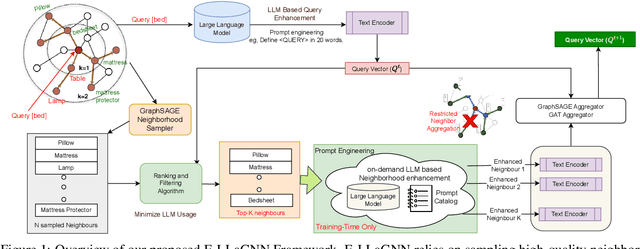
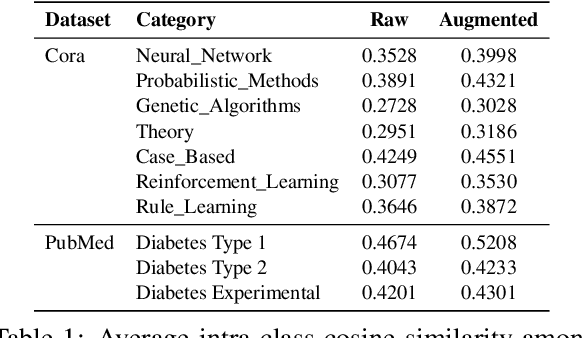
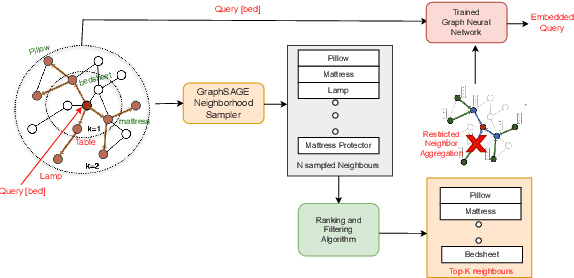

Graph Neural Networks (GNNs) have attracted immense attention in the past decade due to their numerous real-world applications built around graph-structured data. On the other hand, Large Language Models (LLMs) with extensive pretrained knowledge and powerful semantic comprehension abilities have recently shown a remarkable ability to benefit applications using vision and text data. In this paper, we investigate how LLMs can be leveraged in a computationally efficient fashion to benefit rich graph-structured data, a modality relatively unexplored in LLM literature. Prior works in this area exploit LLMs to augment every node features in an ad-hoc fashion (not scalable for large graphs), use natural language to describe the complex structural information of graphs, or perform computationally expensive finetuning of LLMs in conjunction with GNNs. We propose E-LLaGNN (Efficient LLMs augmented GNNs), a framework with an on-demand LLM service that enriches message passing procedure of graph learning by enhancing a limited fraction of nodes from the graph. More specifically, E-LLaGNN relies on sampling high-quality neighborhoods using LLMs, followed by on-demand neighborhood feature enhancement using diverse prompts from our prompt catalog, and finally information aggregation using message passing from conventional GNN architectures. We explore several heuristics-based active node selection strategies to limit the computational and memory footprint of LLMs when handling millions of nodes. Through extensive experiments & ablation on popular graph benchmarks of varying scales (Cora, PubMed, ArXiv, & Products), we illustrate the effectiveness of our E-LLaGNN framework and reveal many interesting capabilities such as improved gradient flow in deep GNNs, LLM-free inference ability etc.
From GaLore to WeLore: How Low-Rank Weights Non-uniformly Emerge from Low-Rank Gradients
Jul 15, 2024


Modern Large Language Models (LLMs) are composed of matrices with billions of elements, making their storage and processing quite demanding in terms of computational resources and memory usage. Being significantly large, such matrices can often be expressed in low-rank format with potential to relax resource requirements. Unlike prior works which focus on developing novel matrix decomposition algorithms, in this work we first study the emergence of low-rank structures across matrices within different layers of LLMs and establish a consequential relationship between the gradient dynamics and emerging low-rank expressiveness of matrices. Our findings reveal that different layers exhibit varying levels of converged low-rank structure, necessitating a non-uniform rank reduction across them to minimize performance drop due to compression. In view of that, we present Weight Low-Rank Projection (WeLore) that unifies weight compression and memory-efficient fine-tuning as ONE, in a data-agnostic and one-shot way. WeLore capitalizes the heavy-tail distribution of singular values to identify a suitable rank reduction ratio for matrices within LLMs. Going beyond only as a compression technique, WeLore categorizes weight matrices into Low-rank Components (LRCs) and Non-Low-rank Components (N-LRCs) based on their ability to express themselves as low-rank. Our gradient perspective and extensive experiments illustrate that LRCs tend to have better finetuning capabilities and can closely mimic (sometimes outperform) the training loss trajectory and performance of full-finetuning with notable memory and compute footprint reduction. For example, finetuning a 50\% compressed LLaMa-2 7B model using only a fraction of parameters in LRCs (WeLore) can outperform its full finetuning with ~3x better throughput and ~0.6x GPU requirement. Our codes are available at \url{https://github.com/VITA-Group/welore}